Selasa, 05 Juli 2011
Our Great Pantheist Epic
Senin, 29 November 2010
Remember, Remember the 29th of November
American history contains many anniversaries – some good, some bad, some remembered with
parades, some remembered with shame, and some often forgotten. Today, November 29th, marks the 146th year anniversary of the Sand Creek Massacre, a tragic event in 1864 Kiowa County, Colorado in which some 700 men of the Third Colorado Cavalry under John Chivington surrounded and attacked a village of Cheyenne and Arapaho Indians. After the gun powder blasts settled, at least 150 Native Americans lay dead.
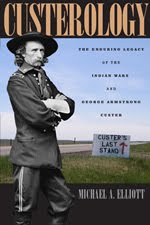
Of all the locations in the United States National Park Service, the Sand Creek Massacre National Historic Site is the only one to include the word “massacre” in the title (though the 2005 historic marker called it the “Sand Creek Battle Ground,” picture taken from National Park Service website). Yesterday this piece of American history was brought to my attention by the compelling and engaging book Custerology: The Enduring Legacy of the Indian
Wars and George Armstrong Custer (2007) by Emory English professor Michael Elliott. Elliott’s book is an artful blend of ethnographic fieldwork and history of the life of Custer and his spectral-like legacy that looms over the thousands of Americans who are fascinated by his life, military career, and – perhaps most of all – his death. Locating the power of memory and public history of Custer enthusiasts in the land he walked, rode, and lived upon, the memoirs he and his wife left behind, and the immense appeal of the unknowns surrounding his famous death, Elliott deftly explores “Custerology” – or the “historical interpretation and commemoration” of all things Custer – as a site of the inherent and “collective ambivalence” of the relationship between the United States and “the indigenous peoples who have lived within its borders.” To accomplish his task, Elliott interviewed members of the Little Bighorn Associates (a group of American history/Custer aficionados), spent time with Steve Alexander (a living historian of Custer’s life), talked with local Native Americans, and dug deep into the primary sources and existing historiography surrounding Custer. The result is an enjoyable read on a sometimes disheartening, but always fascinating topic.
Established in April of 2007, the Sand Creek Massacre National Historic Site calls attention to what contemporary National Parks Director Mary Bomar called one of “the tragedies that affect our national consciousness.” About 500 hundred were present at the site’s dedication, including Cheyenne and Arapaho leaders who turned out on April 28th for the ceremony. Typically when I think of America’s National Parks system and religion, my mind conjures images of John Muir sitting near Yosemite’s Cathedral Rocks writing defenses of his beloved landscape or tales from the Park-to-Park Highway’s first “pilgrims” in the 1920s West in search of spiritual rejuvenation (perhaps this due to my love of Ken Burns documentaries). The Indian Wars’ so-called “clash of cultures” elucidates contentious moments of American religious history, and its memorialized sites bring into focus religious intolerance, violence, and resistance. Though not the most lovely way to begin the week, this somber note certainly complicates popular public history narratives of the grand first Thanksgiving between friendly pilgrims and Indians near Plymouth Rock.
Rabu, 27 Januari 2010
The Scripture of Nature, Part 2
Last fall, Paul offered an insightful post (and others chimed in with equally thoughtful comments) on the ways that religion intersected with the first episode of Ken Burns' latest documentary on national parks.
For those who missed it the first time around (like me), or for those without an extra $100 to purchase the series (like me), the series begins (re)airing tonight.
Did anyone incorporate the first episode into religion or history classes last fall? This spring? I have not done so yet, but did use a short clip about the relationship between John Muir and Theodore Roosevelt.
Minggu, 27 September 2009
The Scripture of Nature
In his reflections on the film, at the Oxford University Press blog, Worster analyzes the religious vision and language both behind the establishment of the national park system, and of the emphases of Burns's film. Incidentally, the Washington Post reviewer, who (like me) is a "great indoorsman," has some funny quips about the occasional sanctimony that makes the film drag a bit -- still, it's well worth watching, and makes me grateful again for Muir and his descendants. The alternative -- the religion of the marketplace and endless development -- would have produced a catastrophe in comparison to the vision of Muir and his twentieth-century acolytes, including Gary Snyder. There is a darker underside even in this vision, hinted at a bit in the film, in terms of the connection between the displacement of Natives and the establishment of the parks; but this was part of a broader history of the 19th century. Worster concludes:
I am convinced that democratic societies are especially open to the religion of nature, for it takes faith out of the hands of priests and gives it back to the people. As long as Americans hunger for religion and as long as they pursue democracy, the national parks will likely be treasured as places where the people can go to worship as they see fit.
Watching the film also reminded me of an email conversation I had some years ago with the former editor of the Colorado Springs Gazette, Sean Paige, who now heads Local Liberty Action. For years he railed against a small local tax we have locally (TOPS, the Trails and Open Space Tax) which funds the purchase of local parcels of open space; he once responded to a short letter to the editor I sent in with a several screen email rant-and-rave to the effect of "if you want a park, go buy one yourself, PROFESSOR Harvey." For years I used his rant in class writing exercises, asking students to take his execrable rough draft and rephrase his arguments in comprehensible terms.
In doing so, Paige served as the equivalent of those who railed against the role of "big government" in setting aside the national parks, blocking "development," and the like. It's remarkable to me that the scripture of nature is powerful enough to trump the otherwise libertarian instincts of my local populace, and those in the era of the establishment and growth of the parks system. That's some powerful religion.
Senin, 04 Agustus 2008
Religion at Colonial Williamsburg
It has been over thirty years since I last visited Colonial Williamsburg. (I have vivid memories of sitting on the edge of a hotel bed with my father watching Richard Nixon resign the presidency on Aug. 9, 1974). So when I was invited to do a book talk on Virginia's Northern Neck, I thought I would turn the trip into a little family excursion to this so-called "National Treasure."
I have been writing a bit about Williamsburg over at my blog, but I thought I would comment here on the role religion plays at America's premier living history museum. Here are a few random thoughts:
First, I noticed that the re-enactors (particularly George Washington) made a lot of references to "God" and "Providence" in their speeches. (I did not hear "Jesus" or "Jesus Christ" mentioned). This, I think, is an accurate reflection of how Washington would have spoken, but I wonder how much pressure the "powers that be" at CW have received from the large number of conservative evangelicals and "Christian America" types who may have petitioned for more religious language. While I can't verify this, I have heard that the administration at Williamsburg have tried to address this issue.
Second, the stock of colonial and revolutionary history at the Williamsburg Book Sellers (located in the CW Visitors Center) is quite impressive. They had a nice section on early American religion, which included both scholarly and popular treatments of the era. The closest thing they had to "Christian America" literature was Peter Lillback's George Washington's Sacred Fire, an extended argument for Washington's Christianity.
Third, the Jamestown National Park treats the role of religion in the colony, but they are careful to explain that it was not the driving force behind the settlement. There is a foundation of an Anglican Church dating back to 1639 located next to the newly discovered Jamestown fort. As the story goes, in 1994 archaeologist William Kelso started digging for the fort in the place he did because he believed that if the church had been previously found, then the fort could not have been far away. He, of course, was right.
Fourth, the National Park Service has a monument to Rev. Robert Hunt, the first Anglican who dedicated the settlement to the glory of God. There is also a huge cross behind the fort, a symbol of the original Anglican presence in Jamestown. Both of these religious displays played an important role in last year's 400th anniversary celebrations sponsored by Pat Robertson and a Christian America organization called Providence Forum. (I have blogged about these before).
Fifth, the African-American and Baptist experience in Virginia is vividly portrayed in a program that focuses on Gowan Pamphlet, a Black preacher, and James Ireland, a white Baptist preacher who was supposedly the most persecuted Baptist in the colony. This presentation was excellent and the characters were very clear about Virginia Baptist's early commitment to the separation of church and state.
Sixth, I stopped in at the historic Wren Building on the campus of William and Mary College. Those who follow religious news may remember the 2006 debate over whether or not a cross should be displayed in the Wren Building Chapel. (W&M religion professor David Holmes debated conservative think tanker Dinesh D'Souza on this issue. You can see the debate here.) What struck me about my visit to the Wren Chapel was the fact that this cross is actually quite small (about two feet in height). From what I understand, a compromise was reached in this case. The cross remains in the chapel, but it is now on display on the side of the room in a glass case rather than on the altar where it was originally located.
Overall, I was quite impressed with the way religion was integrated into everyday life at Colonial Williamsburg and the surrounding historical parks. It seems that one would be hard pressed to criticize the Foundation for failing to take notice of this essential aspect of early American life.