Tampilkan postingan dengan label native american religion. Tampilkan semua postingan

Minggu, 08 Mei 2011

After the Historical Revolutions: Or, When the Tree Falls in the Historical Paradigm Forest, Does Anyone Listen?

Paul Harvey

A review of (and an announcement of) some challenging new works in earlier American History, and the history of the American West, got me to thinking about the changing of the historical paradigm guard -- or whether those guards get changed at all by scholarly revolutions. These are questions which affect the course of American religious history, but bear with me for a short detour before discussing that further.

These thoughts first came from reading Charles Mann’s review of Daniel K. Richhter’s new book Before the Revolution: America’s Ancient Past (Harvard Press) in Saturday’s Wall Street Journal (yes, Virginia, I do read the Wall Street Journal! But I'm not sure if the link will let in non-subscribers; if it doesn't and you want to read, I'm happy to send it to you).

I know nothing about this book other than this review, but I am a big fan of Richter’s earlier work Facing East from Indian Country: A Native History of Early America, a favorite of mine to use in class for its wonderful illustrations of how changing one’s angle of vision creates an entirely different historical sense of a period. Richter also engages in some deft analyses of early American documents of religious history from the European-Native encounter, including John Eliot’s bizarre but fascinating Indian Dialogues, of course the Jesuit Relations, Indian conversion narratives, and various ceremonial encounters at treaty negotiations.

In his review of Richter’s new book, Mann writes:

“Every few decades, historians develop a new way of looking at the past. I am not talking about ‘revisionism’ but unifying conceptual schemes, the sort of mental framework that Frderick Jackson Turner created in his argument for the importance of the frontier to our history or that Bernard Bailyn established in his studies of the American Revolution’s ideological orgins. Historians debated Turner for a long time and continue to debate Mr. Bailyn. I wouldn’t be surprised if they were arguing with Mr. Richter a decade from today.”

When I become King of the World I will permanently ban the word "revisionism" and its variant "historical revisionism" (as I have already banned the words "bias" and "politically correct" in my classrooms, since they have become barriers to thought and discussion), since they have been rendered meaningless for precisely the reason Mann explains there.

But the revolution in understanding is not just in the early America of Richter. My longtime friend Anne Hyde, Professor of History at my sister institution Colorado College, is about to publish her magnum opus for the West of the first half of the nineteenth century, Empires, Nations, Families: A History of the North American West, 1800-1860, part of University of Nebraska’s outstanding series History of the American West series. If this this means anything to you, as it will to some of you, the immediate predecessor to Anne’s book is Colin Calloway’s monumental work One Vast Winter Count: The Native American West Before Lewis and Clark.

(As a brief aside, when Anne and I were in graduate school, she always made it to the library at 8:00 a.m. sharp, while I was lucky to drag myself, half hungover and ears still ringing from some too-loud jazz concert the night before, by 10:00 or 11:00 at best, which explains a lot about the great scholarly discipline it took for Anne to finish this huge work, while I was busy watching the Mavs beat the Lakers).

Anne’s work may suggests a paradigm for understanding the history of the West in that era, in a way such as Richter and Colin Calloway have done for earlier American history. Her work also features chapters fully integrating the Mormon West into the larger picture, and too much else of interest besides to even begin to summarize here.

All of this is exciting as an historian. But all of it also makes me wonder how, whether, and when any of this affects public consciousness of earlier American history. Lately we’ve been talking about Barton et al., and of course the bookshelves at your Barnes & Noble are full of everything Founding Father related. I understand that, but considering the impact of the works above – great on historians, perhaps little on anyone else – makes me wonder about similar questions for religious history.

The older paradigm of American religious history will be familiar to many blog readers here, and most are familiar with its more recent challengers, summarized in works such as Tweed’s edited volume Retelling U.S. Religious History. I once saw Elizabeth Fox-Genovese, God rest her soul, blast away at that book at a Young Scholars in American Religion conference, with most of the authors in that book in attendance; it quickly became clear she was itching for a fight with a group that had no interest in fighting with her on the alleged evils of “postmodernist” history, since that debate was long since old and tired at that point; at the end of it, Diana Butler Bass got up and urged her to give up swinging at phantoms since none of us were in the ring with her. Sitting in the back row with Diana, I gave her a big high-five for trying to extricate us all from such an unproductive conversation.

Much of the newer paradigm seems to come from removing religious history from the specific story of the American nation-state, and using categories that engage religious experience at its own level rather than as some proxy for political parties or current day culture wars. We've blogged here extensively about some recent classics that move American religious history/studies well down this path -- by Leigh Schmidt, Robert Orsi, Kathryn Lofton, and numerous others.

Again, however, for religious history as for the studies of earlier American history mentioned above, one wonders whether and how this affects any sort of public consciousness or discussion, and whether it’s the job of religious historians to evangelize for these perspectives that challenge or disrupt how we perceive the American religious past (and present). Or maybe scholars should just do their work, let popularizers who are good at popularizing disseminate this stuff to the general public (like happens in science all the time -- neuroscientists do their thing, and then someone like Oliver Sacks explains a little bit of it to us), and trust that over a generation or two it will find its way into the more general understandings. That's a comforting and easy role to take, but it leaves not much excuse for complaining about why some pseudo-historians advise presidential candidates while the rest of us get to advise freshmen how to raise their grade from a D to a C.

As usual, I have no answers, only questions. You're welcome.

[Sutton -- sorry about your Lakers. Not].

Rabu, 27 April 2011

Rituals of Violence, War, and Death Among the Wendat/Huron and the Dakotas: Two New Studies

Paul Harvey

War, violence, and rituals of death have been central to American history, nowhere more so than among Native Americans. Here, just wanted to alert you to a couple of new works that advance new understandings of religious rituals surrounding war, violence, and death.

First, last week Historiann called my attention to a new book which I have yet to see but looks hugely promising, especially as a classroom-usable text. I'll quote from her here:

Erik Seeman’s The Huron-Wendat Feast of the Dead: Indian-European Encounters in Early North America (Johns Hopkins University Press, 2011). From the book jacket:

“Two thousand Wendat (Huron) Indians stood on the edge of an enormous burial pit… they held in their arms the bones of roughly seven hundred deceased friends and family members. The Wendats had lovingly scraped and cleaned the bones of the corpses that had decomposed on the scaffolds. They awaited only the signal from the master of the ritual to place the bones in the pit. This was the great Feast of the Dead.”

Witnesses to these Wendat burial rituals were European colonists, French Jesuit missionaries in particular. Rather than being horrified by these unfamiliar native practices, Europeans recognized the parallels between them and their own understanding of death and human remains. Both groups believed that deceased souls traveled to the afterlife; both believed that elaborate mortuary rituals ensured the safe transit of the soul to the supernatural realm; and both believed in the power of human bones.

Appreciating each other’s funerary practices allowed the Wendats and French colonists to find common ground where there seemingly would be none. Erik R. Seeman analyzes these encounters, using the Feast of the Dead as a metaphor for broader Indian-European relations in North America. His compelling narrative gives undergraduate students of early America and the Atlantic World a revealing glimpse into this fascinating — and surprising — meeting of cultures.

Anyone who has poked around at all in The Jesuit Relations will recognize descriptions of the feasts of the dead in these documents to be some of the most immediately compelling and gripping (if, as always with the Jesuits, problematic) primary sources for 17th-century Native American religious practices. Weighing in a a svelte 176 pages, this book looks like an effort to use these kinds of sources in a way that opens them up and makes discussion of cross-cultural religious encounters in early America accessible for classroom discussion.

And here's a powerful new article of interest to many of you, by our friend and colleague Jennifer Graber, whose first book The Furnace of Affliction has received attention at our blog before.

The article, based on some outstanding research in the American Board of Commissioners for Foreign Missions papers at the Minnesota Historical Society, is "Mighty Upheaval on the Minnesota Frontier: Violence, War, and Death in Dakota and Missionary Christianity," Church History 80 (March 2011): 76-108.

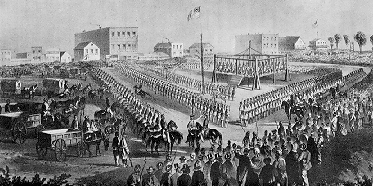
The piece begins by asking "If . . . war is the norm rather than the aberration in American national life, how are we to understand the transformations experienced in 1862 by missionaries and Dakotas as part of a larger American story . . . [and how do we] understand how violence worked to reshape the participants' religious lives?" Graber considers the effects both on missionaries from the ABCFM and the Dakotas of the Dakota War in Minnesota in the late summer of 1862, a horrific outbreak of violence which resulted in the deaths of several hundred settlers and later the mass public execution of over 300 Indians, particularly focused on non-Christian Indians and "medicine men" who were thought to be the ringleaders of the revolt. Graber makes effective use of concepts of Christianity and violence drawn from Emma Anderson's Betrayal of Faith, Jill Lepore's The Name of War, and Harry Stout's "Religion, War, and the Meaning of America" (from Religion and American Culture, Summer 2009, 275-89).

In one section, Graber considers the religious responses of Dakotas to this signal event in their history, including the "conversion" of many of those awaiting execution. She provides a complex portrayal difficult to summarize here but well worth the read. Alongside this, Graber considers also the effect that the trauma of war had on the missionaries, and concludes that "these men underwent their own transformation. Their encounter with violence and devastation, punishment and incarceration caused them to mitigate and complicate the revivalist Calvinism they brought to the frontier. Their vision of missions made up of churches and schools became something else altogether, one of reservations and prisons that God used to make Indian converts."

Despite its short length, this sobering piece had me reflecting in ways which inspired some previous blogging about Emma Anderson's Betrayal of Faith. Highly recommended reading, especially after our last continuous decade of religion, violence, war, and death.

Jumat, 08 April 2011

Whose Story is American Religious History?

By Heath Carter

I'm here in Grand Rapids, Michigan, where I'm attending the American Society of Church History's spring meeting, organized around the theme of "Christianity and Migrations." There are any number of interesting panels and I hope to post another update before all is said and done, but for now a brief report on Rachel Wheeler's stimulating plenary address this morning entitled, "Whose Story is American Religious History? The Parallel Lives of Daniel Boone and Joshua, the Mohican." Wheeler is an associate professor of religious studies at IUPUI whose work has come up often on this blog [those interested in reading up on her first book, To Live Upon Hope, might check out fellow blogger Lin Fisher's conversation with her back in 2009].

Her talk today engaged big questions about how we should narrate the story of European-Indian encounter in the Americas, which has ramifications of course for how we tell the story of American religious history. She argued that the life of Joshua, an Indian convert to Moravianism, highlights the difficulties with both triumphalist and revisionist accounts of conflict on the frontier. The problems with triumphalism, a view summed up in Horatio Greenough's mid-nineteenth century sculpture, The Rescue, need not be elaborated here. There is a reason why the statue, an image of which Wheeler incorporated into her talk, was removed from the steps of the U.S. capitol building in the late-1950s.
But Wheeler persuasively showed that Joshua's story also complicates the revisionist narrative, which lacks the categories to see his conversion as anything other than collusion with the oppressor; and lacks, moreover, the flexibility to allow for Moravian missionaries who - unlike some of their Protestant counterparts in the late-18th century - were not virulently anti-Indian but were in fact open to some of the ways that Indian converts made Christianity their own.

In elaborating the fascinating comparison between Boone and Joshua, Wheeler followed themes of migration, war, and conversion. All of these will be central to her next book, a biography of Joshua which will put him belatedly on more religious historians' radar (I confess that before Wheeler's talk I had not heard of him). If her second book makes the same kind of splash as her first, it may be that we'll all soon be required to take what she called the "Joshua test" - do our accounts of American religious history shed light upon the experience of this Mohican-Moravian martyr, or will we continue to relegate those like him to the margins? For the profession's sake, let's root for passing grades for all.

Kamis, 17 Februari 2011

Native Americans, Christianity, and the Reshaping of the American Religious Landscape

Paul Harvey

Here's a review from Choice of a new anthology/essay collection of tremendous value to those interested in the relationship of Native Americans and Christianity. Below the review I'm pasting in a table of contents, as well; as you will see, a number of the top scholars in this field -- Joanna Brooks, Hilary Wyss, Emma Anderson, Rachel Wheeler, Michael McNally, Steven Hackel, and others -- are represented here. So, first the brief review, and then more detail below that; the link below in the title takes you to the book's website at UNC Press. For those not as familiar with this topic, this is a great way to introduce yourself, in bite-sized portions, to some of the best recent scholarship.

Native Americans, Christianity, and the reshaping of the American religious landscape, ed. by Joel W. Martin and Mark A. Nicholas. North Carolina, 2010. 325p index afp; ISBN 9780807834060, $75.00; ISBN 9780807871454 pbk, $27.95. Reviewed in 2011mar CHOICE.

Martin and Nicholas's valuable essay collection addressing Native American interactions with European/European-American Christianity during the Colonial period and into the 19th century incorporates multiple disciplines, including history, religious studies, Native American studies, anthropology, and literary studies. Collectively, the authors illustrate Native agency in interactions with non-Native Christians. Rather than presenting Native experiences from a Eurocentric perspective, the authors show how Natives embraced Christian symbols and ideas, using them in ways that benefitted themselves and their fellow Natives and showing that, for those who chose to embrace Christian faiths, it was possible to be both Native and Christian. The essays also show that even when interaction with non-Natives brought Native communities hardship, Native peoples shaped Christianity in such a way as to benefit themselves and their communities. Each essay is well researched, eloquently written, and significant to the understanding of Native experiences in and with Christianity. An important contribution to a variety of disciplines, most importantly US Christianity, Native peoples, and US history. Summing Up: Highly recommended. Upper-division undergraduates and above


Table of Contents:

Hard feelings : Samson Occom contemplates his Christian mentors / Joanna Brooks -- Eager partners in reform : Indians and Frederick Baylies in Southern New England, 1780-1840 / Daniel Mandell -- Crisscrossing Projects of Sovereignty and conversion : Cherokee Christians and New England missionaries during the 1820s / Joel W. Martin -- Native American popular religion in New England's Old Colony, 1670-1770 / Douglas L. Winiarski -- Blood, fire, and "baptism" : three perspectives on the death of Jean de Brébeuf, seventeenth-century Jesuit "martyr" / Emma Anderson -- The Catholic rosary, gendered practice, and female power in French-Indian spiritual encounters / Tracy Neal Leavelle -- The souls of Highlanders, the salvation of Indians : Scottish mission and eighteenth-century British empire / Laura M. Stevens -- Print culture and the power of native literacy in California and New England Missions / Steven W. Hackel and Hilary E. Wyss -- Hendrick Aupaumut : Christian-Mahican prophet / Rachel Wheeler -- To become a chosen people : the missionary work and missionary spirit of the Brotherton and Stockbridge Indians, 1775-1835 / David J. Silverman -- Conclusion : turns and common grounds / Mark A. Nicholas -- Coda : naming the legacy of native Christian missionary encounters / Michael D. McNally

Minggu, 16 Januari 2011

Woman in the Wilderness: Letters of Harriet Wood Wheeler

Paul Harvey

Here's a very nice primary source book for your collection or for your university library, that adds much to the literature on nineteenth-century missionaries, especially female missionaries, and white-Native interactions: Nancy Bunge, ed., Woman in the Wilderness: Letters of Harriet Wood Wheeler, Missionary Wife, 1832-1892.

In this volume, Bunge has collected the most significant letters and writings of a missionary and her family, who worked among the Ojibwe from the 1840s through the 1860s, including during the period of the removal of the Ojibwe from their lands in northern Wisconsin; the collection also includes a newspaper article from Julia Wheeler in 1862 which condemns government policy for leading to the 1862 Sioux uprising in Minnesota, which culminated in the hangings of 38 Sioux in December 1862. In this volume, Wheeler begins with fairly conventional Protestant attitudes from her home area near Lowell, Massachusetts, but during her years as a "missionary wife" becomes an advocate for her subjects.

The editor, Michigan State University professor Nancy Bunge, discusses the process of collecting the material for this compilation here. The result of her work is a letter collection that allows the reader to watch the evolution of the subject over a quarter century or more, and to understand in a more intimate way the lives and interactions of white and natives on the midwestern frontier.

Senin, 03 Januari 2011

Review: Anetso, the Cherokee Ball Game

Art Remillard

Michael Zogry first learned of the Cherokee precursor to lacrosse, called “anetso,” in a class with Raymond Fogelson of the University of Chicago. The dearth of scholarship on the game surprised Zogry, who saw it as a fascinating blend of athletics and religious ritual. He read carefully the two major treatments of anetso—Fogelson’s 1962 dissertation and James Mooney’s 1890 article “Cherokee Ball Play”—and realized that there was more to the story. So when Zogry began his doctoral work, he aspired to offer a new perspective. This culminated in his innovative, compelling, and thoroughly researched, Anetso, the Cherokee Ball Game: At the Center of Ceremony and Identity.

Zogry spent four years studying anetso before seeing it in person in 1997. He arrived at the fairgrounds in Cherokee, North Carolina armed with a video camera and an intellectual suitcase stuffed with names like Bourdieu, Bell, Grimes, Geertz, Lévi-Strauss, Smith, Turner, and others. Theories raced through Zogry’s head, when suddenly reality struck—literally. As the game progressed, Zogry watched the tiny white ball float toward him and the players following closely behind. Unable to evade the rush, Zogry was knocked to the ground. This collision, the author recalls, “has continued to assert itself as a strong memory. I now think of it as a metaphor for describing my process of grappling with the relevant issues, and frankly, the limitations of my scholarly perspective to apprehend even this bit of culture in anything but a fleeting way” (15).

Specifically, Zogry came to realize that he needed a new vocabulary to discuss this game, which is more than “just a game.” In The Savage Mind, Lévi-Strauss said that a game has a set of rules and ends when one side prevails. In contrast, a ritual, which bears resemblance to a game, aims to produce, in Lévi-Strauss’s words, “a particular type of equilibrium between two sides.” While perhaps a useful point of departure, and certainly still influential, Zogry insists that anetso does not fit neatly within this conceptual framework. It is a game, to be sure. But Zogry demonstrates that anetso connects to the most significant dimensions of Cherokee religious identity. As a result, the game "resists and problematizes" the classifications of Lévi-Strauss and the likeminded (1).

Zogry starts by looking at anetso’s relation to Cherokee cultural narratives. Among the stories he retells is one of a pre-human contest between the birds and animals, where, interestingly enough, two small animals approach the bird team and request to join their side. The team captain, an eagle, accepts the defectors and fits them with wings, making one a bat and the other a flying squirrel. When the game begins, the retrofitted rodents lead the birds to victory. According to Zogry, the Cherokee still recount this narrative, particularly to the youth, to warn against boastfulness and to emphasize the importance of “inclusiveness” and “adaptability” (48). This sense of tribal solidarity was essential during the “Era of Great Change” (1799-1838). Then, missionaries criticized the game for its perceived “heathenish” underpinnings, and calls for removal became louder and louder. Meanwhile, Zogry shows how the Cherokee defiantly played anetso, using it as “a vehicle for expression of Cherokee identity” (105).

In addition to detailing the broad narrative and social meanings of anetso, Zogry also examines rituals directly associated with the game. Preparation begins weeks in advance with public and private rituals. Ball teams hire conjurers, who enlist assistance from “other-than-human persons.” Players avoid sexual contact, while abiding by a strict dietary code that prohibits consumption of young birds, small animals, or frogs. Zogry finds that most of these traditions have carried into contemporary performances of anetso. And while most players are active Christians, few see any conflict between their Cherokee and Christian practices. This is a perspective that has developed with time, just as anetso has changed over the ages. But Zogry insists that the game is still vital, despite claims from informants that it's not. “The ethic of participation,” he retorts, “the way the players carry themselves and acquit themselves on the field, the honor of performing to the best of their ability in a contest that their ancestors once played on the same land, these remain meaningful reasons to participate for Cherokee adults and teenagers” (145).

In the book's closing pages, Zogry considers the broader implications of his findings. For example, he takes aim at Allen Guttmann, who in From Ritual to Record, argues that in the modern sporting world “the attachment to the realm of the transcendent has been severed.” Guttmann maintains that a priest or minister at a football game does not serve the same function as a shaman at an Indian ball game. Without the minister, the football game will go on. Without the shaman, there is no ball game. Zogry is unconvinced. “Football, like anetso, provides a cultural locus for a range of activities, some that can be termed ‘ritual’ and some ‘religious.’ Preliminary and postgame activities, propitiatory activities, community involvement, even gambling serve to weave the experience of this game into the social lives of players and spectators” (221). To be clear, Zogry does not advocate collapsing religion and sports. Rather, he seems comfortable with ambiguity and open to “rethinking the categories in a manner that hopefully is more accurate” (235).

Specialists in Cherokee religion, ritual studies, and religion and sports will appreciate this book. Zorgy uses an impressive array of sources, from his own fieldwork, to newspapers, manuscripts, personal journals, and travel accounts. The book is thoroughly interdisciplinary, drawing insights from historians, anthropologists, and theorists of religion, ritual, sports, and culture. Additionally, Zogry hints at possibilities for more study. He mentions that women presently play anetso, a new development in the game’s history and “a fruitful area of future research” (184). I hope that Zogry explores this "fruitful" terrain, perhaps making it part of a broader treatment of Native American women and sports. I wonder how female performances of anetso would compare with the Navajo and Apache “Sunrise Ceremony.” In this rite-of-passage ceremony, young women arise early in the morning and run out toward the rising sun and back, thereby recreating the myth of the “White Painted Woman,” a deity who reversed the aging process by moving toward the sun and melding with her younger self. The ritualized running also emphasizes strength and health, in contrast to tribal plagues such as alcoholism and type-2 diabetes. Zogry has done the intellectual work to examine this and other religious/athletic performances, and I'm eager to see where he takes us next.

Selasa, 28 Desember 2010

After Pluralism


Paul Harvey

For those (looking in the mirror here) inclined to refer to "pluralism" a little too easily as an unqualified good, standing apart from history, here's an important new work calling for attention to the concept, and to what come after what was supposed to be the end of history: Courtney Bender and Pamela Klassen, ed., After Pluralism: Reimagining Religious Engagement. It's an edited collection of essays from across nations and disciplines, and features some top-flight folks in American religious studies; Table of Contents is here, excerpt of the book is here. Winnifred Sullivan is featured in the work, discussing de facto "naturalized" religious establishments and the law; Tracy Leavelle and Michael McNally weigh in with contributions on the complexities and perils of pluralism and Native American "religious freedom." A brief excerpt from the intro suggests some of the challenges the book takes on:

The details of European and North American cases reveal greater complexity and complication, if not contradictions, in the formations of pluralism. In the United States, for example, a secular state that is presumed to neither encourage nor discourage religious identity unites some variants of religious plurality as admissible under law while excluding other religious groups as insufficiently tolerant. At the same time, the idioms of tolerance, multicultural or religious celebrations, simultaneously depoliticize and depublicize particular religious interests. In the face of these normative paths to “religious” recognition, scholars must acknowledge and inquire further into the processes by which gaining religious recognition in the United States requires that groups take a seat at a multireligious table. The stories told in this volume call attention to a growing recognition that the varying cultures of religious pluralism in which we live are always directed toward and galvanized by multiple fields of knowledge and power.

Selasa, 19 Oktober 2010

Seneca Possessed

Paul Harvey

From Choice, a quick hit review of a new book that should be of interest to many:

Dennis, Matthew. Seneca possessed: Indians, witchcraft, and power in the early American republic. Pennsylvania, 2010. 313p bibl index afp; ISBN 9780812242263, $45.00. Reviewed in 2010nov CHOICE.
This fascinating study examines how the Senecas struggled to maintain their community, autonomy, and land between 1780 and 1825. Dennis begins by describing the dangerous chaos that shook western New York in the wake of the Revolutionary War. He then analyzes the message and effects of the Seneca prophet Handsome Lake, including connections to the Second Great Awakening, and provides a nuanced view of how witch hunting before, during, and after served as "a unified defense of Seneca integrity and sovereignty." Next, the author examines the connections that the tribe developed with Quaker missionaries, who proved useful partly by providing needed technology and education and partly by acting as a "firebreak" against other, less compliant missionaries, but mostly by supporting the Senecas in their fight against efforts by the Ogden Land Company and the State of New York to take their land and autonomy. The book seems disjointed because of the separate Handsome Lake and Quaker-focused sections, but that is outweighed by its analysis of Seneca social and cultural change and continuity, and its examination of the connections between the tribe and the surrounding US culture. Summing Up:Recommended. All levels/libraries. -- D. R. Mandell, Truman State University

Senin, 23 Agustus 2010

Frankly, my dear, I don’t give a Franciscan

Linford D. Fisher

It used to be a bad word. “Franciscan.” Well, for colonial historians, at least. I mean, really, with a full-out colonial missions program to American Indians that was inescapably ethnocentric at best (even if well intended) or disturbingly malevolent at worst, Franciscans have usually been at the religious center of the so-called Black Legend with their forced labor and corporeal punishment of Natives in Florida, New Mexico, and California. This is particularly true vis-à-vis the typical scholarly praise concerning the relatively tolerant, culturally sensitive missionizing undertaken by the Jesuits in the colonial period. The classic, “recent” touchstone on the depredations of the Franciscans in the New Mexico context is, of course, Ramon Gutierrez’s When Jesus Came, the Corn Mothers Went Away (1991). Despite the various criticisms that have subsequently emerged, this text is seemingly here to stay. It is a gripping narrative, to be sure. Who couldn’t help but cringe at his lengthy recounting of the eighty years of Franciscan evangelization prior to the Pueblo Revolt in 1680 that included overt sexual exploitation and humiliation?

When David J. Weber—the leading scholar in borderland studies—sadly passed away earlier this week, I pulled out his classic, The Spanish Frontier in North America (1992) to remind myself of what Weber contributed to all of this. Surprisingly, his account is comparatively even-keeled, even though he did label Franciscan missions as “but one of the oppressive frontier institutions of the Spanish state” (121).

But is this view changing? Of course. It has to. This is the historical profession, after all, and many tenure cases are hanging on the successful revisioning of the minutiae of every field. A book I just finished while on a research vacation (an oxy-moron if there ever was one) with the family reminds me that the historical view of Franciscans is slowly changing: Joseph M. Hall, Jr., Zamumo’s Gifts: Indian-European Exchange in the Colonial Southeast (2009). To be sure, the book is really about the importance of Native conceptions of exchange in trumping and shaping European notions of commercial trade well into the eighteenth century. Nonetheless, the Franciscans take center stage in at least one chapter, since their missions among the Apalachees in the 1600s open up avenues for Spanish exchange and trade with inland Natives. Hall seems to almost minimize the effect of the Franciscans, essentially arguing that the missionaries had little control over the Timicuan and Guales as a whole: “The simple fact remained that Indians in and beyond the missions remained in control of the region. Although missionaries introduced a host of new coercive forms into Guale and Timicuan life during the early seventeenth century, including restrictions on their movements, a greater regimentation of diet, and more frequent corporal punishment, such impositions weighed relatively lightly on most of their charges” (61). This was in part due to the enormous numerical differential that often gets overlooked: in 1630 there were 27 missionaries for 50,000 Timicuans and Guales. For myself, I wonder if his assessment does not take into account the practical, on the ground imperial weight and presence the missionaries and their regional military and trade counterparts represented. In the end, however, Hall still agrees with archaeologist Jerald Milanich that “missions were colonization” (53).

Nonetheless, Hall is not alone. Franciscan pacification/colonization is looking far different in various geographical regions. Steven W. Hackel in Children of Coyote, Missionaries of Saint Francis (2005) was surprised to find that Indians in southern California had far more autonomy in Franciscan mission towns than he expected—even producing surplus crops for their own economic benefit. Another study that will be soon forthcoming by my colleague at Brown, Amy Remensnyder, on the various uses of the Madonna in late medieval and early modern conquests in the Old World and New, also highlights the Franciscans in the New World context. And, somewhat similarly, she is more interested in what Franciscans and the Spanish do and how they operate than she is in taking them to task, once again, for the many injustices that historians have rightly pointed out.

Then again, perhaps the Jesuits’ fortunes are changing, too, but for the worse. Emma Anderson’s The Betrayal of Faith (featured here on this blog) turns historiographical wisdom concerning the Jesuits on its head. In her retelling, the Jesuits (and Paul LeJeune in particular) come across as just as intolerant and demanding as their Franciscan/Recollet counterparts.

These developments, of course, are part of a much larger re-casting of missionaries among Native Americans in the wake of earlier and important ethnohistorians like Francis Jennings and James Axtell. David Silverman, Rachel Wheeler, and Richard Cogley are just a few examples of the ways in which historians have increasingly asked different, native-centered questions to provide a more nuanced emphasis on Natives’ creative agency instead of cataloguing the sins of the European evangelists. A terrific-looking book that is due out in a month will likely add to this ongoing conversation: Joel Martin and Mark A. Nicholas, eds., Native Americans, Christianity, and the Reshaping of the American Religious Landscape (UNC, Sept. 2010).

All of this simply serves as a reminder that history is, first and foremost, an interpretive enterprise, and that how we view things, people, movements, and events can—and must—change over time. In the meantime, thanks for a terrific corpus of scholarship, David J. Weber. RIP.


Sabtu, 21 Agustus 2010

The Past is Never Dead . . . Religious Leaders in Virginia on Local Tribes

Randall Stephens

I was just thinking about a new idea for the blog. Maybe a series of posts? "The Past is Never Dead . . ." It could entail news items or books that deal with contemporaries who are wrestling with history. To paraphrase Carl Becker "everyman/woman his/her own religious historian." Many Americans come to grips with the nation's religious identity be resorting to the past. (Isn't this Glenn Beck's big campaign?) Perhaps history has a greater resonance right now. Some questions: How do believers and non-believers use history to describe what America is or has been? Who owns American religious history? Why is it so important for citizens to put religious history, or just American history in general, to use for the present?

Robert Dilday, "Baptist executives urge federal recognition of Virginia tribes," Associated Baptist Press, 19 August 2010.

RICHMOND, Va. (ABP) -- The top executives of two Virginia Baptist groups have joined other religious leaders in calling for federal recognition of six Native American tribes in the state.

In an open letter released Aug. 17, about 30 Christian, Jewish and Muslim leaders asked Virginia’s Republican governor and two Democratic senators to support congressional legislation giving to Virginia’s tribes the same status held by more than 560 other Native American tribes across the United States.

Among the signers were John Upton, executive director of the predominantly white Baptist General Association of Virginia, who also was recently elected president of the Baptist World Alliance, and Cessar Scott, executive minister of the historically black Baptist General Convention of Virginia. . . .

History erased by racist official

Walter Plecker, registrar of Virginia’s Bureau of Vital Statistics from 1912-1946, replaced “Indian” with “black” on every birth and death certificate in his office. Plecker, a white supremacist, said Native Americans had become a “mongrel” mixture. >>>

Selasa, 10 Agustus 2010

Owned by the White People

Paul Harvey

Don't miss our contributor Christopher Jones's piece over at Juvenile Instructor: " 'Owned by the White People': America and Native Americans in Church History Sunday School Lessons, 1934." Going through some boxes of old material while packing and moving, Chris reflects on Mormon providentialist interpretations, as communicated in Sunday School lessons, on the founding of America, and on relations with Native peoples. Some of it is kind of standard-issue stuff for that period: heroic and virtuous Pilgrims, God preparing the way for the coming of our Christian civilization, and so on. I say "for that period" -- I should say, for that period, but of course for a lot of folks still standard stuff (see Barton, David and Marshall, Peter). Some of it is more LDS specific, explaining what events prepared the way for Joseph Smith. All fascinating stuff.

I have been interested in Native theological responses to all of this history, and how they have dealt with the issues inherent in this kind of Providentalism. One really helpful source, by way of introduction, is James Treat, ed., Native and Christian: Indigenous Voices on Religious Identity in the United States and Canada, where a variety of Native authors grapple with the contested identities of Indian and Christian, and the meanings of biblical myths as applied to their communities. An overview and response to the collection may be found here. In the book, the authors debate the question of what use can be made of sacred texts once those texts have been made into stories that explain, and usually justify, conquest and dispossession. Can those stories be reclaimed?

Well, I was going to blog more about this, but I don't want this to be the "spoiler" for some fairly extensive discussion of these issues (including nineteenth-century Protestant and Mormon providential explanations of the history of America) that Ed Blum and I are working on for our book Jesus in Red, White, and Black, which we're in the home stretches of now. For now, I was curious as to whether anyone had investigated mainstream Protestant (or Catholic) lessons/sermons from that era. I was wondering when these kind of Providentialist interpretations received more critical scrutiny in religious literature, whether that was something that came out of the 1960s and after, or perhaps emerged earlier with the innovations of the Indian New Deal and the rethinking of the "missionary enterprise" that was going on in the 1930s. Has there been a close study of that? Probably, but I can't think of it offhand.

Selasa, 20 Juli 2010

Constructing Lives at Mission San Francisco

Paul Harvey

Apparently this is religion in early/colonial America week here at the blog! Recently I had occasion to re-survey some of the literature about the California missions, especially one of my favorite recent works of scholarship, Steven Hackel's Children of Coyote, Missionaries of Saint Francis: Indian-Spanish Relations in Colonial California, 1769-1850, for my money the most thorough scholarly study of the subject, full of painstakingly constructed data sets from mission records -- the book is reviewed at length, and quite thoughtfully, here.

Religious studies scholar Quincy Newell's new book on native life and religious practice at a California mission is now out, and it came to my attention via the Choice review reprinted below. Her work brings ethnographic and religious studies methods to bear on the subject, and zeroes in on one mission in particular. Another longer and more extensive review may be found here; the money quote there, for our purposes here: "She postulates that many Native people chose baptism and mission life over continued residence in their traditional villages in order to enhance their spiritual power within their society and maintain the prestige of ever-weakening kinship networks. This interesting and thoughtful analysis lends new a perspective to the literature."

Below is the review from Choice. Be sure also to check out Quincy Newell's contributions at the blog Religion in the American West.

Newell, Quincy D. Constructing lives at Mission San Francisco: Native Californians and Hispanic colonists, 1776-1821. New Mexico, 2009. 267p bibl index afp; ISBN9780826347060, $39.95. Reviewed in 2010aug CHOICE.
Despite the passage of 175 years since the last Spanish California mission was secularized in 1834, these Hispanicized Indian communities continue to provoke contentious scholarly debate regarding the nature and intent of the Franciscan missionary enterprise more generally. With cultural critique all the rage, it is no wonder that indigenous voices have been lost in the fray. By contrast with earlier such treatments, religious studies professor Newell (Univ. of Wyoming) delivers a culturally nuanced, meticulously researched, and thought-provoking narrative treatment for contextualizing voices silenced in earlier works regarding Native lifeways in the California missions. Newell's narrative delivers brilliant insights and exceptionally fine-grained readings of both Costanoan Indian and Hispanic colonial perceptions, beliefs, and cultural norms. Deploying a narrative approach borne of historical fictions and the reconstituted life histories of such memorable Costanoan converts as Pismote, a disaffected though perceptive young female left to ponder the contradictions of both the Spanish empire and the Catholic faith, readers ultimately learn to "see" the surreal world of the Costanoan people and the Hispanic Catholic colonists with whom they held court. Summing Up: Highly recommended. Al levels/libraries. -- R. G. Mendoza, California State University, Monterey Bay

Kamis, 15 April 2010

King Philip’s Board Game: Trivializing or Educating?

Linford D. Fisher

I really have no excuse for blogging about an upcoming board game titled “King Philip’s War,” since it has nothing to do with religion in America. Or does it? A board game that allows players to take sides and reenact one of the most horrific clashes between Natives and English colonists in the colonial period must certainly have something to do with religion.

John Poniske, a middle school social studies teacher from Maryland, claims he designed the game to educate the wider public about the war itself, since he was surprised to read about it in a military magazine (his surprise surprised me, to be frank; which textbook published in the last twenty years does not mention King Philip’s War?).

The company behind the game, MultiManPublishing, is known for its militaristic-historical games. One can purchase board games that reenact the major battles of the Civil War, for example, or a board game that might be my personal favorite, called “Warriors of God,” which allows players to participate in the wars between England and France between 1135-1453.

Am I being too cynical here? Maybe a generation of young people will be educated by this board game. But I would hope that, in the future, people might turn to less-trivializing and more nuanced and culturally sensitive ways to learn about King Philip’s War. For middle-schoolers, Dan Mandell has an age-appropriate text on the war and has recently completed a forthcoming book on the same topic for a more general adult audience. Really hardy non-specialists might even consider tackling classics like Jill Lepore’s The Name of War. Or, as a last resort, interested media- and entertainment-starved folks could even learn a lot from watching Episode One of PBS’s “We Shall Remain.” But a board game? My only consolation is that it has not (yet?) been turned into a game for the Wii.

Minggu, 07 Maret 2010

Surprising or Otherwise Interesting Primary Sources, Part III a: Lacrosse, the Jesuit Relations, and a Man of "Sense"

Art Remillard

Just south of Syracuse, New York, members of the Onondaga Nation regularly gather in a ritualized celebration of community, tradition, and family. It’s a rather sweaty affair—but then again, games of lacrosse generally are. “Families here have been playing lacrosse together for a long time. It is part of our lives,” says Chief Irving Powless. Unlike the game you might be familiar with, the Onondaga version of lacrosse is quite unique. Their field has neither boundaries nor standard lengths. The number of participants vary from game to game. Clans make up the teams, so a game might have 5 against 30, depending on who shows up. And people of all ages play, from 10 to 80 (as far as I can tell, Powless is in his late 70s and still plays). None of this has made the game any less intense. Rumor has it that when Jim Brown came to the reservation to play, a 145-pound Powless knocked him to the ground. It’s no wonder why the Cherokee nicknamed lacrosse “the little brother of war.”

But the vigorous play is not for show. Instead, it fuses with effort and joy, and expresses a living connection with the past and present. As Powless explains, “When we play a game here on Mother Earth, a game is taking place up there in the Land of the Creator at the same time. . . . So then after we pass away and we are through we have a means by which we can get our stick up into the Creator's world so that we'll play again.”

This brings me to Paul’s post on the Jesuit Relations. The Relations holds our first written description of lacrosse, which certainly did not emphasize the community-binding function of the game. Instead, we see a prime example of the spiritual competition at work between French missionaries and medicine men--or more broadly, between European Catholicism and Native American traditions.
In 1636, living among the Huron in Ontario, Jesuit missionary Jean de Brébeuf commented on the game that he would call “lacrosse”—named such because the sticks reminded him of the “crosier” carried by bishops in religious processions. The connection between Catholicism and Indian culture ended there. Brébeuf had no love for the “sorcerer” who prescribed lacrosse as cure for individual and communal illness.

In the classroom, I use Brébeuf’s description of lacrosse to illustrate James Axtell's point that French missionaries labored to become “a man of ‘sense.’” That is, Black Robes went to great lengths learning, documenting, and absorbing Indian culture, language, customs, and religion. The end goal (bad pun?) was to build status within the tribe, and challenge the "shamanic rival for spiritual leadership.”

Below is Brébeuf’s description of Indian lacrosse. He also talks about a game of chance called "dish." You can find this writing in both Allen Greer’s aforementioned The Jesuit Relations: Natives and Missionaries in Seventeenth-Century North America and online.

-----------------
Of three kinds of games especially in use among these Peoples,—namely, the games of lacrosse, dish, and straw,—the first two are, they say, most healing. Is not this worthy of compassion? There is a poor sick man, fevered of body and almost dying, and a miserable Sorcerer will order for him, as a cooling remedy, a game of lacrosse. Or the sick man himself, sometimes, will have dreamed that he must die unless the whole country shall play lacrosse for his health; and, no matter how little may be his credit, you will see then in a beautiful field, Village contending against Village, as to who will play lacrosse the better, and betting against one another Beaver robes and Porcelain collars, so as to excite greater interest.

Sometimes, also, one of these jugglers will say that the whole Country is sick, and he asks a game of lacrosse to heal it; no more needs to be said, it is published immediately everywhere; and all the Captains of each Village give orders that all the young men do their duty in this respect, otherwise some great misfortune would befall the whole Country.

The game of dish is also in great renown in affairs of medicine, especially if the sick man has dreamed of it. This game is purely one of chance: they play it with six plum-stones, white on one side and black on the other, in a dish that they strike very roughly against the ground, so that the plum-stones leap up and fall, sometimes on one side and sometimes on the other. The game consists in throwing all white or all black; they usually play Village against Village. All the people gather in a Cabin, and they dispose themselves on poles, arranged as high as the roof, along both sides. The sick man is brought in in a blanket, and that man of the Village who is to shake the dish (for there is only one on each side set apart for the purpose), he, I say, walks behind, his head and face wrapped in his garment. They bet heavily on both sides. When the man of the opposite party takes the dish they cry at the top of their voice achinc, achinc, achinc, " three, three, three," or perhaps ioio, ioio, ioio, wishing him to throw only three white or three black. You might have seen this winter a great crowd returning from here to their Villages, having lost their moccasins at a time when there was nearly three feet of snow,—apparently as cheerful, nevertheless, as if they had won. The most remarkable thing I notice in regard to this matter is the disposition they bring to it. There are some who fast several days before playing: the evening before, they all meet together in a Cabin, and make a feast to find out what will be the result of the game. The one chosen to hold the dish takes the stones, and puts them promiscuously into a dish, and covers it, so as to prevent any one from putting his hand into it. That done, they sing; the song over, the dish is uncovered, and the plum-stones are found all white or all black. On this point, I asked a Savage if those against whom they were to play did not do the same on their side, and if they might not find the plum-stones in the same condition. He said they did; "And yet, " said I to him," all can not win;" to that he knew not what to answer. He informed me besides of two remarkable things: in the first place, that they choose, to handle the dish, some one who had dreamed that he would win, or who had a charm; moreover, those who have a charm do not conceal it, and carry it everywhere with them: we have, they tell me, one of these in our Village, who rubs the plum-stones with a certain ointment and hardly ever fails to win. Secondly, that in making the attempt some of the plum-stones disappear, and are found some time after in the dish with the others.
Among all these fooleries, I dare not speak of the infamies and uncleanness which the Devil makes to slip into them, causing them to see in a dream that they can only be healed by wallowing in all sorts of filth. May he who has saved us by the blood of the Lamb grant to remedy this as soon as possible, accepting for this purpose, if need be, our souls and lives, that we most willingly offer to him for the salvation of these Peoples, and the remission of our own sins.

Sabtu, 06 Maret 2010

Surprising or Otherwise Interesting Primary Sources, Part III: The Jesus Lottery in the Jesuit Relations


Surprising or Otherwise Interesting Primary Sources, Part III: The Jesus Lottery in the Jesuit Relations

Paul Harvey

Earlier this week, Randall got us going on a series that I hope others will contribute to here: Surprising or Otherwise Interesting Primary Sources. Randall picked out a narrative in Abroad in America: Visitors to the New Nation, 1776-1914 by Nakahama Manjirō, a Japanese seafarer lost at sea who washed up on a deserted island, was picked up by an American ship, and ended up in Massachusetts in 1841.

Actually (and unbeknownst to him), Lin got us started a few posts down with his reflections on The View from Patgatgoch (Or Why the Moravians Are Still Sexy), his post about the 1300 pp. compilation of primary sources from the German Moravian mission among the Patgatgoch in eighteenth-century Connecticut.

So I’ll call my first contribution to this series Part III: the Jesus Lottery in the Jesuit Relations. No one would ever call the Jesuit Relations a “surprising” primary source; they’ve been grist for the scholarly mill for a century or more since the publication of Reuben Gold Thwaites’ 1899 edition of The Jesuit Relations and Allied Documents. More recently, Allen Greer’s The Jesuit Relations: Natives and Missionaries in Seventeenth-Century North America has provided a nice, short “greatest hits” compilations of selected excerpts from the Relations that have made these documents much more accessible for classroom use.

But while they are a standard source, I always remain surprised how little they seem to get used in courses on early American history generally, and American religious history more specifically. Since they have been scanned and are all easily available online, the possibilities for use are greater than ever. Just recently, I was using The Jesuit Relations Index to look for specific items through keyword searching, and got involved in hours of fascinating reading (the online index also made possible in one weekend or so a search that otherwise would have taken an awful lot more time reading through the hard copy).

In my search I found this story, which had previously escaped my attention, in vol. 55 of the Relations, covering 1671-1672. The story is told with the usual hagiographical excess, but reading about the porcelain beads offered up to the infant Jesus (or, in another story, the tobacco sprinkled over a manger scene figurine) provides plenty of fodder for classroom discussions of the interaction of religious traditions.

ARTICLE III. OF THE DEVOTION OF THE HURON

CHRISTIANS TO THE HOLY INFANT JESUS.

THE Reverend Mother Marie de l’Incarnation, of whom we shall speak later, presented at the beginning of Advent to Louys Taondechoren, chief Dogique of the little Huron Church, a very beautiful waxen relief Image of the holy Infant Jesus in his cradle. This good Savage manifested more gratitude for the gift than if he had been presented with all the treasures in the world. The entire Village shared his joy, and regarded this holy Image, although given to an individual, as a common possession and a present sent from Heaven. Their Pastor — who seeks only new opportunities for inflaming that zeal of theirs for everything connected with God’s Service — formed the plan, with Louys’s consent, to afford consolation to all with this treasure; and to take such action that each of the cabins might enjoy it in turn. Being well instructed, they beheld in this Image him whom it represented; and well knew that the honors which they rendered it would not stop at the figure before their eyes, but would pass on even to the sacred person of the Savior of the world, who graciously condescended to become a Child for love of us.

They conceived the idea of making the honors bestowed upon this holy Image an atonement for the ill reception that the Jews gave the Infant Jesus when he came into the world. [Page 277] The Father, seeing them filled with such pious feelings, assured them that this act of devotion would secure them a thousand blessings from Heaven. He gave them a whole week to prepare to receive the Image in their cabins; that week was spent in a. renewal of fervor that was highly acceptable to Heaven and Earth. A Missionary is happy when he finds means to reach the heart; and anything that can serve to advance his Church in the spirit of the faith, and in the practice of the solid virtues, seems to him of importance. He wrote on separate slips the names of the Heads of all the cabins; and when the day for this act of devotion came, after singing the Veni creator, the first slip that came to hand was the one inscribed with the name of a good widow, who had displayed especial zeal in the preparation that she had made for rendering herself worthy of being the first hostess of the little Jesus. She had thought only of what might please him, — often rising before dawn to go and [26] offer him her prayers in the Chapel; and to recite her Rosary there for the purpose of inclining his holy Mother’s heart in her favor. At this news she thought that she would die with joy. Speedily all was made ready, her cabin thoroughly cleaned, and a very neat little Altar prepared, with its dais and adorned with all the beautiful things that she could find for the reception of such a guest. For she was well convinced that this choice was a stroke of Heaven, and the sign of a special Providence of Our Lord toward her and all her family. The holy Image having been borne to her cabin in a sort of Procession, and placed on the Altar, the Father had the company offer a prayer in greeting to their guest, and present to him all that they [Page 279] possessed, — their goods, their persons, and their lives; while at the close, they all began to sing Christmas carols in their language in honor of the Holy Infant Jesus, continuing this Practice at their little evening Benedictions, On each of the following days.

The ceremony was followed by a feast which this good woman gave to the chief people of the Village; but before Placing the food before them, she thus addressed the whole company: “The little Jesus is entertaining you; and you must know that, although everything is his, independently of me, nevertheless I of my own free will make him a special gift of all that belongs to me, — my corn and other grain, and my little furnishings; and I pray him also to take possession of my person and of my children, to make such use of them as he shall choose, during this life and throughout all eternity. It was to make this solemn declaration in your presence that I prepared this little feast in his name.” That act of devotion was approved by all the company, and the Father, who was present, caused them after the benediction, to offer a prayer to the holy Infant Jesus, supplicating his acceptance of this good widow’s offering. She wished further that two of her children should also share in this offering. To this end, she sent for her little son Joseph, thirteen years old, our pupil in the sixth class, and godson of Monseigneur our Bishop, who is having him reared in his palace. Upon his arrival, she first made him pay divine honors to Our Lord in his Image; and then asked him, at the same time showing him Some Porcelain collars, — [28] wherein the entire wealth of the family consists, — whether he were not Well pleased to give the little Jesus half of his share. “Yes, indeed,” [Page 283] said he. Putting the same question to a daughter of hers, she received a like reply. Thereupon she said: “You gratify me, my children so the little Jesus will be pleased to accept half of our most precious possessions, and will sanction our using the rest in making our little necessary purchases.”

On the following day, she begged the Father to come to her cabin where, in her children’s presence, she besought him to accept a fine collar of 4,000 porcelain beads for the infant Jesus. This was given in order to strengthen the friendship which the latter had deigned to show them by choosing their cabin for his first abode in the village; and to implore him to regard them always as persons who, while wholly his from the necessity of their being, and the constant succor of his grace, had, by a voluntary resolve of their own free Will, pledged themselves to serve him the rest of their lives more faithfully than ever. They also besought him not to forsake them; and, although he made his abode in other cabins, to extend to them always a special Providence. The Father accepted the collar at the time, in order not to deprive her of the merit of her generosity and gratitude; but, because of her poverty, he made her take it back again two weeks later, assuring her that our Lord would be as well pleased thereby as if it were used in adorning his Altar.

While this image of the holy infant Jesus was passing from cabin to cabin each week, in the manner related, until the Festival of the Purification, each person, with a holy jealousy, took pleasure in preparing for it an altar more magnificent than the last, inventing new devices to guard it from the smoke.

Jumat, 19 Februari 2010

The View from Pachgatgoch (or, Why Moravians are Still Sexy)

Linford D. Fisher

Moravians are about as exotic as early American history can ever hope to be. And, seemingly, I cannot stop writing about them. Officially, they are not part of my research agenda, but books about them mysteriously appear on my shelves, squeeze their way onto my course reading lists, and land in my mailbox for possible review. This past January, once again, I found myself immersed in the world of early American Moravians as I picked my way through the 1300 hundred pages that comprise one of the most recent publications related to Moravians in early America: an enormous two-volume translation of the German diaries of the Moravian mission in Pachgatgoch, Connecticut, translated and edited by husband and wife team William A. Starna and Corinna Dally-Starna, titled, Gideon’s People: Being a Chronicle of an American Indian Community in Colonial Connecticut and the Moravian Missionaries Who Served There (2009). The diaries span from 1747 through 1763, even though the mission officially started in 1743 and was maintained on and off until 1770. My official evaluation of the volumes will be forthcoming in the New England Quarterly later this year, but the diaries themselves prompted more reflection that I could possibly fit into a book review, so I thought I’d share some of the overflow here.

First and foremost, reading through these diaries reminded me of the surprising religious and ethnic diversity of western Connecticut. Pachgatgoch was in many ways at the crossroads of empire and a place of multiple, overlapping religious regions and ethnicities. Runaway Africans and Indians along with Indian preachers from other parts of the colony drift in and out of Pachgatgoch. EuroAmericans (mostly English and Dutch), likewise, surface in the diaries as inquisitive visitors: Presbyterians, Anglicans, New Lights, Old Lights, Baptists, Separates, Quakers, seekers, and even the occasional Jew or two come to figure out the Moravians and—at times, even try to join them. Peering into the Pachgatgoch records is almost like peeking behind the curtain at a show or performance, or into the basement or attic of a host's house: you find some unexpected things that belie the official presentation. Whatever we might take to be the “center” of religious history in the colonies, these records serve as a warning against privileging too much the urban coastal centers.

Secondly, I was deeply impressed with the intensely intertwinedness of Indian and non-Native lives. Labor is of course the most familiar point of overlap (discussed below), but Indians also routinely cleared out of Pachgatgoch to party all night with their Anglo neighbors. The most frequently recurring (and railed against) example of this is the annual day of post-harvest thanksgiving in the colony. It was an “old custom” of the Indians, according to the Moravians, to go and celebrate late into the night with their “good friends” the white people. Joachim Sensemann let the Pachgatgoch know in no uncertain terms that he “would be pleased if they stayed nicely at home”—to no effect, of course. Not only were Indians out in colonial homes working (and boozing it up), in towns selling brooms, baskets, bowls, and spoons, but colonists were also constantly visiting the small Indian town. In addition to almost daily, more mundane visits by colonial neighbors, on at least two occasions the Anglo congregants of local English minister Cyrus Marsh came to the Moravians’ Sunday services at Pachgatgoch when Marsh was sick or out of town. By the late 1750s, non-Indian attendance at Moravian Indian services was so frequent that it prompted exasperation on the part of Moravian missionaries, who worked hard to shield the Pachgatgoch from outside influences. So ubiquitous were the colonists even on most weekdays that Moravian missionary Johann Mack reported with surprise in 1761 that he had not seen a “white” person for almost four days.

Thirdly, in reading these records, I was reminded of the politicized nature of Indian evangelism at the edges of empire. Not only were the Moravian missionaries arrested and placed on trial in Milford, Connecticut, in 1743 under deep suspicion of being Catholic spies trying to woo local Indians into a military alliance against New England Protestants, but they were subsequently banned from Connecticut for a full six years. Even after they returned, rumors circulated for the next decade that they were supplying the French with powder and shot. (I grappled with some of these issues in an NEQ essay from Sept. 2009.) Over time local colonists grew to accept the Moravians more and more, and even the minister of nearby Kent, Connecticut, cannot seem to forgive himself for not defending the Moravians when they were placed on trial (his excuse was that he had been temporarily swayed against the Moravians by Gilbert Tennent’s 1743 anti-Moravian tract, Some Account of the Principles of the Moravians).

Fourthly, I’ll admit to receiving new insight into the way that drunkenness actually functioned in Native communities. Everyone knows that the drunken Indian quickly became a colonial Indian stereotype; less often discussed are the ways in which drunken men (usually) not only offended EuroAmerican religious sensibilities but also brought tangible fear and physical danger to Indian families and communities. According to the Moravians, at least, drunken Indian men routinely got abusive enough that women and children fled into the woods overnight or to the Moravians’ houses to escape the violent outrages of their husbands, brothers, and sons. In short, drunkenness was a very real social threat for Indians themselves in this period; it was not just something missionaries denounced in fits of cultural arrogance. I knew this, of course, but somehow these records made this more tangible.

Fifthly, the centrality of free and unfree labor for Indians and Africans alike in this period cannot be overstated. My suspicions that debt and labor profoundly shaped much of Indian-African-colonist relations were confirmed by the stories in these volumes. Just one example of this was a colonist who was owed money by a Moravian Indian, marched into Pachgatgoch and, when he couldn’t find the Indian who owed him money, instead randomly kidnapped two Indian children and sold them for profit as servants/slaves.

Sixthly, and lastly, these records confirm, once again, the difficulty of any single group in bringing about the desired religious and cultural transformation in Indian communities. The last few years of the diaries drip with a familiar declension narrative in which the drinking, sexual promiscuity, and religious indifference of Natives spins out of control. The harder the Moravians try to reform specific cultural habits (not clothing Native children, for example), the less the Pachgatgoch respond. The curious thing is, of course, that many Pachgatgoch do continue as Moravian Indian Christians well past the official closing of the mission. Some move to Pennsylvania and some remain in New York and/or Connecticut, but the perceived failure of the Moravians does not always translate into a total abandonment of Christianity by the Pachgatgoch.

In short, the Moravians are still sexy for a reason. These volumes are well worth the hefty price you pay either by purchasing them or lugging them home from the library (plus, you’ll look cool and cutting-edge carrying anything with “Moravian” in the title). The issues raised are numerous and enlightening, and for that we owe Starna and Dally-Starna a big thanks.