Tampilkan postingan dengan label religion in antebellum america. Tampilkan semua postingan

Kamis, 23 Juni 2011

Catholic Looks at American Culture in the Antebellum Era and the Mid-Twentieth Century: Two New Books


Paul Harvey

Just a brief note on two new books that will be of interest to some readers here, both important pieces of scholarship on the Catholic relationship with American politics and culture.

First, a review from Choice, just below, on Catholics and slavery:

Wallace, W. Jason
. Catholics, slaveholders, and the dilemma of American evangelicalism, 1835-1860. Notre Dame, 2010. 200p index afp ISBN 026804421x pbk, $30.00; ISBN9780268044213 pbk, $30.00. Reviewed in 2011jul CHOICE.
Over the past 40 years, scholars have produced a cornucopia of quality scholarship detailing the importance of religion in the antebellum era and how particular religious ideas shaped competing visions of the American Republic, creating the context for and animating the Civil War. Wallace's fine volume elucidates the challenge Catholicism brought to that discourse. Its traditional theology challenged the individualism in the hermeneutics of northern and southern Protestants. Increasing German and Irish Catholic immigration threatened the English domination of the US. In five crisp chapters, Wallace (history, Samford Univ.) outlines how Catholicism debated the hegemonic discourse of Protestant-based acquisitive capitalism, articulated a traditional accommodation to slavery as a product of human sin, and asserted its own historic and ongoing contribution to the discussion of social morality and the proper sources of the Christian life. In their attempts to explain, Catholic leaders offered a powerful critique of nationalism and religion rooted solely in the authority of individual believers under the Constitution and Scripture, an intellectual impeachment given credence by the outbreak of Civil War. Catholicism offered an alternative vision rooted in tradition, realism, and theology. Summing Up:Recommended. All levels/libraries. -- E. R. Crowther, Adams State College

Next up, a book just received which appears to be a landmark study: Anthony Burke Smith, The Look of Catholics: Portrayals in Popular Culture from the Great Depression to the Cold War, hot off the press from the University Press of Kansas. I've only had the chance to skim through parts, but it looks fascinating, and later this summer Emily will give us a more substantive discussion of the book up here.

A brief bit from the book's webpage:

For much of American history, Catholics’ perceived allegiance to an international church centered in Rome excluded them from full membership in society. Now Anthony Burke Smith shows how the intersection of the mass media and the visually rich culture of Catholicism changed that Protestant perception and, in the process, changed American culture.

Smith examines depictions of and by Catholics in American popular culture during the critical period between the Great Depression and the height of the Cold War. He surveys the popular films, television, and photojournalism of the era that reimagined Catholicism as an important, even attractive, element of American life to reveal the deeply political and social meanings of the Catholic presence in popular culture.

Smith shows that Hollywood played a big part in this midcentury Catholicization of the American imagination. Leo McCarey’s Oscar-winning film Going My Way, starring the soothing (and Catholic) Bing Crosby, turned the Catholic parish into a vehicle for American dreams, while Pat O’Brien and Spencer Tracy portrayed heroic priests who championed the underclass in some of the era’s biggest hits. And even while a filmmaker like John Ford rarely focused on clerics and the Church, Smith reveals how his films gave a distinctly ethnic Catholic accent to his cinematic depictions of American community.

Smith also looks at the efforts of Henry Luce’s influential Life magazine to harness Catholicism to a postwar vision of middle-class prosperity and cultural consensus. And he considers the unexpected success of Bishop Fulton J. Sheen’s prime-time television show Life is Worth Living in the 1950s, which offered a Catholic message that spoke to the anxieties of Cold War audiences.

Revealing images of orthodox belief whose sharpest edges had been softened to suggest tolerance and goodwill, Smith shows how such representations overturned stereotypes of Catholics as un-American. Spanning a time when hot and cold wars challenged Americans’ traditional assumptions about national identity and purpose, his book conveys the visual style, moral confidence, and international character of Catholicism that gave it the cultural authority to represent America.

In short, the book appears to be a cultural history accompaniment to Kevin Schultz's Tri-Faith America, reviewed at the blog here previously by Chris Beneke. The book features extensive discussions of Catholic representations in the movies, going far beyond the usual "Legion of Decency" emphasis that most books about Catholics and the movies cover. There are also chapters on Catholics in Life magazine, on Fulton Sheen and Catholics in television, and on "John Ford's Irish American Century."

Minggu, 08 Mei 2011

After the Historical Revolutions: Or, When the Tree Falls in the Historical Paradigm Forest, Does Anyone Listen?

Paul Harvey

A review of (and an announcement of) some challenging new works in earlier American History, and the history of the American West, got me to thinking about the changing of the historical paradigm guard -- or whether those guards get changed at all by scholarly revolutions. These are questions which affect the course of American religious history, but bear with me for a short detour before discussing that further.

These thoughts first came from reading Charles Mann’s review of Daniel K. Richhter’s new book Before the Revolution: America’s Ancient Past (Harvard Press) in Saturday’s Wall Street Journal (yes, Virginia, I do read the Wall Street Journal! But I'm not sure if the link will let in non-subscribers; if it doesn't and you want to read, I'm happy to send it to you).

I know nothing about this book other than this review, but I am a big fan of Richter’s earlier work Facing East from Indian Country: A Native History of Early America, a favorite of mine to use in class for its wonderful illustrations of how changing one’s angle of vision creates an entirely different historical sense of a period. Richter also engages in some deft analyses of early American documents of religious history from the European-Native encounter, including John Eliot’s bizarre but fascinating Indian Dialogues, of course the Jesuit Relations, Indian conversion narratives, and various ceremonial encounters at treaty negotiations.

In his review of Richter’s new book, Mann writes:

“Every few decades, historians develop a new way of looking at the past. I am not talking about ‘revisionism’ but unifying conceptual schemes, the sort of mental framework that Frderick Jackson Turner created in his argument for the importance of the frontier to our history or that Bernard Bailyn established in his studies of the American Revolution’s ideological orgins. Historians debated Turner for a long time and continue to debate Mr. Bailyn. I wouldn’t be surprised if they were arguing with Mr. Richter a decade from today.”

When I become King of the World I will permanently ban the word "revisionism" and its variant "historical revisionism" (as I have already banned the words "bias" and "politically correct" in my classrooms, since they have become barriers to thought and discussion), since they have been rendered meaningless for precisely the reason Mann explains there.

But the revolution in understanding is not just in the early America of Richter. My longtime friend Anne Hyde, Professor of History at my sister institution Colorado College, is about to publish her magnum opus for the West of the first half of the nineteenth century, Empires, Nations, Families: A History of the North American West, 1800-1860, part of University of Nebraska’s outstanding series History of the American West series. If this this means anything to you, as it will to some of you, the immediate predecessor to Anne’s book is Colin Calloway’s monumental work One Vast Winter Count: The Native American West Before Lewis and Clark.

(As a brief aside, when Anne and I were in graduate school, she always made it to the library at 8:00 a.m. sharp, while I was lucky to drag myself, half hungover and ears still ringing from some too-loud jazz concert the night before, by 10:00 or 11:00 at best, which explains a lot about the great scholarly discipline it took for Anne to finish this huge work, while I was busy watching the Mavs beat the Lakers).

Anne’s work may suggests a paradigm for understanding the history of the West in that era, in a way such as Richter and Colin Calloway have done for earlier American history. Her work also features chapters fully integrating the Mormon West into the larger picture, and too much else of interest besides to even begin to summarize here.

All of this is exciting as an historian. But all of it also makes me wonder how, whether, and when any of this affects public consciousness of earlier American history. Lately we’ve been talking about Barton et al., and of course the bookshelves at your Barnes & Noble are full of everything Founding Father related. I understand that, but considering the impact of the works above – great on historians, perhaps little on anyone else – makes me wonder about similar questions for religious history.

The older paradigm of American religious history will be familiar to many blog readers here, and most are familiar with its more recent challengers, summarized in works such as Tweed’s edited volume Retelling U.S. Religious History. I once saw Elizabeth Fox-Genovese, God rest her soul, blast away at that book at a Young Scholars in American Religion conference, with most of the authors in that book in attendance; it quickly became clear she was itching for a fight with a group that had no interest in fighting with her on the alleged evils of “postmodernist” history, since that debate was long since old and tired at that point; at the end of it, Diana Butler Bass got up and urged her to give up swinging at phantoms since none of us were in the ring with her. Sitting in the back row with Diana, I gave her a big high-five for trying to extricate us all from such an unproductive conversation.

Much of the newer paradigm seems to come from removing religious history from the specific story of the American nation-state, and using categories that engage religious experience at its own level rather than as some proxy for political parties or current day culture wars. We've blogged here extensively about some recent classics that move American religious history/studies well down this path -- by Leigh Schmidt, Robert Orsi, Kathryn Lofton, and numerous others.

Again, however, for religious history as for the studies of earlier American history mentioned above, one wonders whether and how this affects any sort of public consciousness or discussion, and whether it’s the job of religious historians to evangelize for these perspectives that challenge or disrupt how we perceive the American religious past (and present). Or maybe scholars should just do their work, let popularizers who are good at popularizing disseminate this stuff to the general public (like happens in science all the time -- neuroscientists do their thing, and then someone like Oliver Sacks explains a little bit of it to us), and trust that over a generation or two it will find its way into the more general understandings. That's a comforting and easy role to take, but it leaves not much excuse for complaining about why some pseudo-historians advise presidential candidates while the rest of us get to advise freshmen how to raise their grade from a D to a C.

As usual, I have no answers, only questions. You're welcome.

[Sutton -- sorry about your Lakers. Not].

Rabu, 27 April 2011

Rituals of Violence, War, and Death Among the Wendat/Huron and the Dakotas: Two New Studies

Paul Harvey

War, violence, and rituals of death have been central to American history, nowhere more so than among Native Americans. Here, just wanted to alert you to a couple of new works that advance new understandings of religious rituals surrounding war, violence, and death.

First, last week Historiann called my attention to a new book which I have yet to see but looks hugely promising, especially as a classroom-usable text. I'll quote from her here:

Erik Seeman’s The Huron-Wendat Feast of the Dead: Indian-European Encounters in Early North America (Johns Hopkins University Press, 2011). From the book jacket:

“Two thousand Wendat (Huron) Indians stood on the edge of an enormous burial pit… they held in their arms the bones of roughly seven hundred deceased friends and family members. The Wendats had lovingly scraped and cleaned the bones of the corpses that had decomposed on the scaffolds. They awaited only the signal from the master of the ritual to place the bones in the pit. This was the great Feast of the Dead.”

Witnesses to these Wendat burial rituals were European colonists, French Jesuit missionaries in particular. Rather than being horrified by these unfamiliar native practices, Europeans recognized the parallels between them and their own understanding of death and human remains. Both groups believed that deceased souls traveled to the afterlife; both believed that elaborate mortuary rituals ensured the safe transit of the soul to the supernatural realm; and both believed in the power of human bones.

Appreciating each other’s funerary practices allowed the Wendats and French colonists to find common ground where there seemingly would be none. Erik R. Seeman analyzes these encounters, using the Feast of the Dead as a metaphor for broader Indian-European relations in North America. His compelling narrative gives undergraduate students of early America and the Atlantic World a revealing glimpse into this fascinating — and surprising — meeting of cultures.

Anyone who has poked around at all in The Jesuit Relations will recognize descriptions of the feasts of the dead in these documents to be some of the most immediately compelling and gripping (if, as always with the Jesuits, problematic) primary sources for 17th-century Native American religious practices. Weighing in a a svelte 176 pages, this book looks like an effort to use these kinds of sources in a way that opens them up and makes discussion of cross-cultural religious encounters in early America accessible for classroom discussion.

And here's a powerful new article of interest to many of you, by our friend and colleague Jennifer Graber, whose first book The Furnace of Affliction has received attention at our blog before.

The article, based on some outstanding research in the American Board of Commissioners for Foreign Missions papers at the Minnesota Historical Society, is "Mighty Upheaval on the Minnesota Frontier: Violence, War, and Death in Dakota and Missionary Christianity," Church History 80 (March 2011): 76-108.

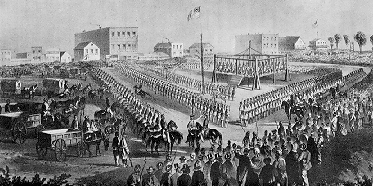
The piece begins by asking "If . . . war is the norm rather than the aberration in American national life, how are we to understand the transformations experienced in 1862 by missionaries and Dakotas as part of a larger American story . . . [and how do we] understand how violence worked to reshape the participants' religious lives?" Graber considers the effects both on missionaries from the ABCFM and the Dakotas of the Dakota War in Minnesota in the late summer of 1862, a horrific outbreak of violence which resulted in the deaths of several hundred settlers and later the mass public execution of over 300 Indians, particularly focused on non-Christian Indians and "medicine men" who were thought to be the ringleaders of the revolt. Graber makes effective use of concepts of Christianity and violence drawn from Emma Anderson's Betrayal of Faith, Jill Lepore's The Name of War, and Harry Stout's "Religion, War, and the Meaning of America" (from Religion and American Culture, Summer 2009, 275-89).

In one section, Graber considers the religious responses of Dakotas to this signal event in their history, including the "conversion" of many of those awaiting execution. She provides a complex portrayal difficult to summarize here but well worth the read. Alongside this, Graber considers also the effect that the trauma of war had on the missionaries, and concludes that "these men underwent their own transformation. Their encounter with violence and devastation, punishment and incarceration caused them to mitigate and complicate the revivalist Calvinism they brought to the frontier. Their vision of missions made up of churches and schools became something else altogether, one of reservations and prisons that God used to make Indian converts."

Despite its short length, this sobering piece had me reflecting in ways which inspired some previous blogging about Emma Anderson's Betrayal of Faith. Highly recommended reading, especially after our last continuous decade of religion, violence, war, and death.

Selasa, 22 Maret 2011

The "Newness" of the 1830s and 40s

Randall Stephens

Today we'll be discussing Paul E. Johnson and Sean Wilentz's The Kingdom of Matthias (Oxford University Press, 1994) in my Forging of an American Nation (1783-1865) class. As most readers of RiAH know, the authors tell the story of a strange religious group and its even stranger prophet, Matthias. The tale of Matthias's Kingdom--rife with "free-lovism," violence, and mystifying, anti-Finneyite beliefs--became front-page news in the 1830s. Early reports from those in my class who have already dug in are positive. One said it seemed a little like a 19th-century E True Hollywood Story.

I picked up a collection of essays, State of Mind: A Boston Reader (1948), at Commonwealth Books here in town last week. It includes wonderful material from the 17th to the mid 20th century. One selection--"The Newness" by Robert Carter, an essay that appears in the November 1889 issue of the Century Magazine--would be a good primary source item to read alongside The Kingdom of Matthias. Carter's sarcastic romp through the reform decades does not deal directly with the hirsute prophet Matthias, but an oddball cast of other wide-eyed dietary, dress, social, and anti-slavery reformers make an appearance in "The Newness." The essay can be read as a local color, skeptical, post-Civil War remembrance of the failures and naivete of reformism.

I include a few passages here:

By the "Newness" I mean a very singular intellectual and spiritual movement which broke out like an epidemic in New England some forty years ago, and ran its course for about ten years, when it subsided and disappeared almost as suddenly as it arose. I call it the
"Newness," because that was the most distinctive term applied to it, and the one by which it was most frequently designated by those engaged in it, though in fact it had no authentic or universally accepted appellation. By outsiders it was generally called Transcendentalism, and its disciples Transcendentalists, and to some extent and at certain periods those terms were used by the disciples themselves. . . .

I have noticed the influence which Unitarianism, Abolitionism, and the study of German literature had in producing the "Newness," and I have mentioned 1835 as about the date of its manifestation. The republication in this country of Carlyle's Sartor Resartus in 1836, and the appearance in the same year of Emerson's Nature, followed rapidly by his other works in the same vein, may be said to have brought the movement to a head, and it soon culminated in the issue of the magazine called "The Dial," in July, 1840, and, shortly after, in the establishment of the Community or Association of Brook Farm, near Boston. . . .

Brook Farm, however, was not the only community which was founded by the disciples of the " Newness." There was one established in 1843 on a farm called Fruitlands, in the town of Harvard, about forty miles from Boston. This was of a much more ultra and grotesque character than Brook Farm. Here were gathered the men and women who based their hopes of reforming the world, and of making all things new, on dress and on diet. They revived the Pythagorean, the Essenian, and the monkish notions of asceticism, with some variations and improvements peculiarly American. The head of the institution was Bronson Alcott, a very remarkable man, whose singularities of character, conduct, and opinion would alone afford sufficient topics fora long lecture. His friend Emerson defined him to be a philosopher devoted to the science of education, and declared that he had singular gifts for awakening contemplation and aspiration in simple and in cultivated persons. He was self educated, but had acquired a rare mastery of English in speech, though his force and subtlety of expression seemed to fail him when he wrote. His writings, though quaint and thoughtful, are clumsy compared with his conversation, which has been pronounced by the best judges to have been unrivaled in grace and clearness.

Mr. Alcott was one of the foremost leaders of the "Newness." He swung round the circle of schemes very rapidly, and after going through a great variety of phases he maintained, at the time of the foundation of Fruitlands, that the evils of life were not so much social
or political as personal, and that a personal reform only could eradicate them; that self-denial was the road to eternal life, and that property was an evil, and animal food of all kinds an abomination. No animal substance, neither flesh, fish, butter, cheese, eggs, nor milk, was allowed to be used at Fruitlands. They were all denounced as pollution, and as tending to corrupt the body and through that the soul. Tea and coffee, molasses and rice, were also proscribed,— the last two as foreign luxuries,— and only water was used as a beverage.

Mr. Alcott would not allow the land to be manured, which he regarded as a base and corrupting and unjust mode of forcing nature. He made also a distinction between vegetables which aspired or grew into the air, as wheat, apples, and other fruits, and the base products which grew downwards into the earth, such as potatoes, beets, radishes, and the like. These latter he would not allow to be used. The bread of the community he himself made of unbolted flour, and sought to render it palatable by forming the loaves into the shape of animals and other pleasant images. He was very strict, indeed rather despotic, in his rule of the community, and some of the members have told me that they were nearly starved to death there; nay, absolutely would have perished with hunger if they had not furtively gone among the surrounding farmers and begged for food. . . .

Brook Farm exploded in 1847 and Margaret Fuller went to Europe, I think it had very little distinctive existence in New England. The aspiring youth of New England seem now to be contented with making their way in the world very much as other people make it, without seeking for any fundamental change in the established order of society.

Kamis, 17 Februari 2011

Native Americans, Christianity, and the Reshaping of the American Religious Landscape

Paul Harvey

Here's a review from Choice of a new anthology/essay collection of tremendous value to those interested in the relationship of Native Americans and Christianity. Below the review I'm pasting in a table of contents, as well; as you will see, a number of the top scholars in this field -- Joanna Brooks, Hilary Wyss, Emma Anderson, Rachel Wheeler, Michael McNally, Steven Hackel, and others -- are represented here. So, first the brief review, and then more detail below that; the link below in the title takes you to the book's website at UNC Press. For those not as familiar with this topic, this is a great way to introduce yourself, in bite-sized portions, to some of the best recent scholarship.

Native Americans, Christianity, and the reshaping of the American religious landscape, ed. by Joel W. Martin and Mark A. Nicholas. North Carolina, 2010. 325p index afp; ISBN 9780807834060, $75.00; ISBN 9780807871454 pbk, $27.95. Reviewed in 2011mar CHOICE.

Martin and Nicholas's valuable essay collection addressing Native American interactions with European/European-American Christianity during the Colonial period and into the 19th century incorporates multiple disciplines, including history, religious studies, Native American studies, anthropology, and literary studies. Collectively, the authors illustrate Native agency in interactions with non-Native Christians. Rather than presenting Native experiences from a Eurocentric perspective, the authors show how Natives embraced Christian symbols and ideas, using them in ways that benefitted themselves and their fellow Natives and showing that, for those who chose to embrace Christian faiths, it was possible to be both Native and Christian. The essays also show that even when interaction with non-Natives brought Native communities hardship, Native peoples shaped Christianity in such a way as to benefit themselves and their communities. Each essay is well researched, eloquently written, and significant to the understanding of Native experiences in and with Christianity. An important contribution to a variety of disciplines, most importantly US Christianity, Native peoples, and US history. Summing Up: Highly recommended. Upper-division undergraduates and above


Table of Contents:

Hard feelings : Samson Occom contemplates his Christian mentors / Joanna Brooks -- Eager partners in reform : Indians and Frederick Baylies in Southern New England, 1780-1840 / Daniel Mandell -- Crisscrossing Projects of Sovereignty and conversion : Cherokee Christians and New England missionaries during the 1820s / Joel W. Martin -- Native American popular religion in New England's Old Colony, 1670-1770 / Douglas L. Winiarski -- Blood, fire, and "baptism" : three perspectives on the death of Jean de Brébeuf, seventeenth-century Jesuit "martyr" / Emma Anderson -- The Catholic rosary, gendered practice, and female power in French-Indian spiritual encounters / Tracy Neal Leavelle -- The souls of Highlanders, the salvation of Indians : Scottish mission and eighteenth-century British empire / Laura M. Stevens -- Print culture and the power of native literacy in California and New England Missions / Steven W. Hackel and Hilary E. Wyss -- Hendrick Aupaumut : Christian-Mahican prophet / Rachel Wheeler -- To become a chosen people : the missionary work and missionary spirit of the Brotherton and Stockbridge Indians, 1775-1835 / David J. Silverman -- Conclusion : turns and common grounds / Mark A. Nicholas -- Coda : naming the legacy of native Christian missionary encounters / Michael D. McNally

Rabu, 02 Februari 2011

Civil War and Emancipation Blogs: First African Baptist and Benjamin Morgan Palmer


Paul Harvey

A note on a new blog of interest to many of you: Civil War Emancipation, established by Donald Shaffer, author of After the Glory: The Struggles of Black Civil War Veterans and other publications. He writes the following of the blog:

The purpose of this blog is: 1) to commemorate important milestones in emancipation in the Civil War as their 150th anniversary arrives in the Sesquicentennial; 2) to discuss noteworthy publications on this subject; 3) to comment on current events related to the Civil War and Emancipation; 4) plus write on whatever else comes to mind that is appropriate. I intend to blog regularly on emancipation throughout the Civil War Sesquicentennial.

A recent post at the new blog discusses and points to the full text to Benjamin Morgan Palmer's famous Thanksgiving Day sermon in Nov. of 1860 in New Orleans, a key text in summarizing the "providential trust" given to southerners to "conserve and to perpetuate the institution of domestic slavery."

The new blog also accompanies the ongoing series going on at the New York Times, Disunion, which is following, in day-by-day format, the sesquicentennial of the secession winter. One entry from Jan. 24th, by Lois Leveen, features an outstanding discussion of the unusual place of the First African Baptist Church of Richmond, the largest black congregation in antebellum America.. The church took shape in the early 1840s and was pastored by a white man appointed to oversee the congregation, Robert Ryland, who (among other things) encouraged slave literacy. The church often rented out its sizable auditorium for citywide political events and entertainments (including minstrel shows). On Jan. 23, 1861, the church opened its doors for white workingmen of Richmond (including a sizable proportion of foreign-born men) to discuss "the alarming state of our beloved country." The meeting adjourned without resolving the sentiments of white locals, who were largely Unionist but starting a slow and agonizing move towards secession.

Normally I teach a course each spring in Civil War/Reconstruction. By happenstance I'm not doing so now, but wish I was so I could take advantage of these exciting new resources, which allow an "in the moment" feeling for the dramatic events of the period. For religious historians, the resources are rich, as well, as evidenced by the extensive discussion linked above to the role of First African Baptist in Richmond.

Congratulations to Prof. Shaffer for his new blog; I look forward to following it.

Senin, 31 Januari 2011

Michael Vick and the Politics of Prison Redemption

Paul Harvey

I always like it when someone comes up with a title guaranteed to drive a little blog traffic. The present title comes from Jennifer Graber, Professor of Religious Studies at Wooster College and author of the just-published The Furnace of Affliction: Prisons and Religion in Antebellum America. In her piece today for History News Network, she uses the Michael Vick saga, and the deep ambivalence about punishment and redemption, as a contemporary case study to investigate the roots of this ambivalence. A little excerpt here:

In round after round, the reformers claimed that a Christian nation necessarily supported criminal punishments designed first and foremost for reformation. Officials retorted that public safety demanded a realistic approach to corrections, one that used bodily punishments and shame to put unrepentant inmates in their proper place. This endless debate gave us the prisons we have today, institutions caught between simultaneous impulses to punish and redeem.

More on the book here, and below:

Focusing on the intersection of Christianity and politics in the American penitentiary system, Jennifer Graber explores evangelical Protestants' efforts to make religion central to emerging practices and philosophies of prison discipline from the 1790s through the 1850s.>Initially, state and prison officials welcomed Protestant reformers' and ministers' recommendations, particularly their ideas about inmate suffering and redemption. Over time, however, officials proved less receptive to the reformers' activities, and inmates also opposed them. Ensuing debates between reformers, officials, and inmates revealed deep disagreements over religion's place in prisons and in the wider public sphere as the separation of church and state took hold and the nation's religious environment became more diverse and competitive. Examining the innovative New York prison system, Graber shows how Protestant reformers failed to realize their dreams of large-scale inmate conversion or of prisons that reflected their values. To keep a foothold in prisons, reformers were forced to relinquish their Protestant terminology and practices and instead to adopt secular ideas about American morals, virtues, and citizenship. Graber argues that, by revising their original understanding of prisoner suffering and redemption, reformers learned to see inmates' afflictions not as a necessary prelude to a sinner's experience of grace but as the required punishment for breaking the new nation's laws.

Rabu, 26 Januari 2011

Myth of American Religious Freedom: Part II

Paul Harvey

Today we continue our interview with David Sehat, author of The Myth of American Religious Freedom.

PH: A good portion of your book is taken up with dissenters -- the abolitionists, Elizabeth Cady Stanton, Mormons, freethinkers, and progressive intellectuals in the twentieth century. Time after time, they get beaten down by the moral establishment, yet in the end they more or less triumphed in crafting a new definition of religious freedom. Can you give us briefly one example of how you use dissenters in your book, and how they confronted and, over time, whittled away at the foundations of the moral establishment?


DS: Of all the people I talk about, my favorite is Elizabeth Cady Stanton. As most of your readers know, Stanton was a radical women’s rights activist who argued that the subservient place of women in law grew out of a Christian patriarchy. To make way for the emancipation of women, Stanton was relentless in her criticism of the connection of Christianity to law. According to her opponents, women’s liberation would entail societal degradation, because treating a woman as an individual before the law would undermine the institution of the family, the mechanism for inculcating morals in society. As a result, Christian proponents of the moral establishment placed the obligations of society over the desires of individual women such as Stanton. By contrast, Stanton placed the individual above society. She argued that laws too often required that the individual—especially the female individual—to be “sacrificed to the highest good of society,” which was the fundamental error of the moral establishment. She claimed instead that a society could not suppress the individual and still uphold the highest social good. Only when individuals possessed full freedom would the possibilities of a society be realized.


Stanton laid out the basic question in the debate, which was: which is most basic, the society or the individual? This claim about the importance of the individual and of individual rights in a liberal, democratic society circulated among the many dissenters to the moral establishment in the nineteenth century. But the notion did not finally triumph until the twentieth century, through progressive intellectuals, such as Herbert Croly and Walter Lippmann, and liberal legal theorists, such as Louis Brandeis, who used the Court to enforce individual rights.


PH: You hit liberal justices pretty hard for misusing history, particularly in claiming a strict separationist position on the First Amendment that basically never really existed. In other words, since the "wall of separation" is basically a historical myth, it is a bad idea to use that myth in reasoning in legal cases. How do you think those on the center/left of the spectrum should view your history of the moral establishment in making arguments favorable to their position? Is this akin to Brown v. Board –acknowledge crimes against freedom committed in the past, including by the Court, and just say we need a completely different model than that?


DS: Yes, that’s exactly right. Using bad history does not help public debate and it does not make stable law. Liberals should acknowledge that the past did not feature a harmonious arrangement of freedom that sprang from the minds of Jefferson and Madison. By reframing their arguments away from that bad history, I actually think liberals would strengthen their own position because the most powerful argument for liberal jurisprudence is historical. It goes something like this: Once upon a time, the individual was subject to religious oppression that used the apparatus of the state. But then the Supreme Court realized that the Bill of Rights, which defines the rights of American citizens, should apply to the states because the states were infringing upon the rights of the individual guaranteed by the Fourteenth Amendment. As the Supreme Court began applying the Bill of Rights to the states, it made a host of questionable historical arguments. But it did so for a still legitimate purpose that is now under attack by religious partisans in the present. The Court sought to free the individual from oppression in order to make the United States into a liberal democracy. We can uphold those rulings while not repeating the same bad history, because acknowledging past Protestant power helps to show why the liberal jurisprudence is necessary.


PH:
The latter portion of the book deals with some more contemporary controversies and decisions, and you suggest very strongly that the Roberts Court, when it has the chance, will "continue to aid political conservatives and religious activists in rehabilitating the moral establishment." This is a different argument than I have seen from some other legal scholars, who have suggested that recently the Supreme Court has moved more towards a position of shying away from big religion decisions, because First Amendment law as to what is or is not a "religion" has just become a huge mess of contradictory decisions (as in the one a few years ago allowing for the use of a religious symbol in a public place in one state, but disallowing it in another state). In what ways do you foresee a possibly more activist court under Roberts, and why would it be interested in rehabilitating a moral establishment that has led to so much dissent and conflict over two centuries, as you trace in your book?


DS: It depends upon what you mean by “big religion decisions.” I agree that the Court seems chastened by the daunting (if not impossible) theoretical task of defining religion in a way that is fair and stable and does not violate the establishment clause. But I don’t think that this strongly conservative Court is going to calmly accept past liberal jurisprudence. Part of my argument is precisely that a case doesn’t have to be about “religion” per se to uphold religious power.


Consider two cases. The Court currently has a case before it that involves an Arizona law which funnels money to private religious schools through a complicated tax credit system. I find this an instructive case. In the nineteenth century, Protestants controlled the schools but they lost that control in the mid-twentieth century as the Supreme Court forbade prayer and Bible-reading in schools. When the Supreme Court dismantled religious control over schools, religious conservatives began to advocate the use of public money in private schools. The Arizona law is in that tradition of seeking an end-run around mid-twentieth-century legal decisions. The state claims that the money given to private, often sectarian schools is not public money because an individual donates the money to a school and is then reimbursed by the state through a tax credit (not a tax deduction) on a matching basis up to a certain amount. As a result, Arizona claims, it cannot be considered a violation of the establishment clause. This sounds like money laundering to me, and I would like to think that the Court would strike it down. But the last thirty years has seen the Court ever more comfortable in providing public money to private schools, even private sectarian schools. If the Court upholds the Arizona law, it would be in keeping with the general jurisprudential trend of rehabilitating Christian schools through the use of public money.


The second case that bears watching is the California gay marriage case, which is going to wind up in the U.S. Supreme Court. The Court has been amenable in the recent past to the notion that the law cannot be used to advance private moral norms. In Lawrence v. Texas in 2002, Justice Kennedy used that argument to strike down all anti-sodomy laws in the United States. Moreover, in 1967 when the Court struck down miscegenation laws, it ruled, “The freedom to marry has long been recognized as one of the most vital personal rights essential to the orderly pursuit of happiness by free men.” Putting these two opinions together might suggest that the Court will uphold gay marriage, but it is not at all clear. As usual, the decision seems likely to boil down to Kennedy’s position. He wrote the opinion striking down sodomy law but did not give any indication of his stance on gay marriage. If I had to read the tea leaves (always a dangerous practice), I’m not optimistic that the Court will rule in favor of gay rights because I don’t think it likely that Kennedy will use the same kind of argument that he made in Lawrence. I hope I’m wrong, but should the Court strike down gay marriage, the ruling would, once again, serve as an extension of religious power.


PH: Getting to the bottom line: in 3 or 4 sentences, can you tell us what is the single most important takeaway point you want people to get from your book?


DS: I think it is time that we stopped celebrating ourselves. And by “we” I mean both liberals and conservatives. This nationalist self-celebration has generated a debate on religion in public life whose most notable feature is a pervading sense of falsity. By looking squarely at the religious coercions of the past and the multiple limits of religious freedom, I’m hoping that we can have a new conversation—both a more honest conversation and a more productive one—on a better historical foundation.


Thanks for the stimulating questions, Paul, and thanks again for reading the book.

Selasa, 25 Januari 2011

The Myth of American Religious Freedom: Interview with David Sehat

Paul Harvey

In the tradition of this blog of posting author interviews from recently published important works in our field (when we're not thinking about zombies, or finding paeans to Sarah Palin on YouTube), I'm pleased today and tomorrow to post a two-part interview with David Sehat, author of the new book The Myth of American Religious Freedom, just out with Oxford.

We've blogged about the book in pre-release before, and I made some false promises to put up a post about Sehat's book together with Sally Gordon's The Spirit of the Law. Sadly, that post will have to wait until the tsunami of the semester calms down a bit, but I believe putting those two books together provides a most stimulating narrative (complementary on some points, contrasting on others) of the intellectual (Sehat) and social (Gordon) history of the concept of religious freedom. In the meantime, here is part one of our interview with David Sehat. You may follow more of his thoughts from his book over at U.S. Intellectual History, where he is a contributor and has recently posted great stuff based on the book, and also check out his recent entry at the Huffington Post, which contains an extensive summary of some of the major themes of the book.
__________________________________________________________

Interview with David Sehat, Part I

Paul Harvey (PH): David, the central phrase in your book is "moral establishment," and you argue that for much of American history we have had a "moral establishment that connected religion and the state." Can you briefly define what you mean by this term for our readers, and why you have chosen to make it central to your book?

David Sehat (DS): Paul, thanks for reading the book and for interviewing me.


When I began researching this book, I was reading the letters and writings of a nineteenth-century agnostic named Robert Ingersoll. My intention was to write a book about American freethought or American agnosticism as a way of showing the informal power of Protestant Christianity. But as I read Ingersoll’s papers, I came across a case (he was a lawyer) that puzzled me. In 1886, he unsuccessfully defended a man named Charles B. Reynolds, who was being tried on two counts of blasphemy. I was stumped: How could a man be convicted of blasphemy nearly one hundred years after the passage of the First Amendment? As I went deeper into the case, my confusion grew. I discovered that blasphemy law existed for much of the nineteenth century, even if its enforcement was erratic. According to its proponents, criticizing Christianity or any elements of Christianity undermined the public foundation for morals. I also discovered that blasphemy was similar to many other kinds of law in that Protestant Christian ideas received the formal protection of law, which was a surprise to me. In other words, the judgments in this case, and many others, only made sense if Christianity was something like an official religion that relied upon the protection of the law.


To make sense of what was going on, I borrowed the idea of a “moral establishment” from the legal scholar John Witte Jr. Taking Witte’s concept further than he might have intended (and probably not in a way that he would agree with), I claim that the moral establishment involves the use of law to perpetuate Christian morals in society. The more I researched, the more I saw that this moral establishment was one of the chief mechanisms throughout American history by which Protestant Christian partisans maintained religious power over society in often illiberal ways.


PH
: You spend a good amount of time criticizing positions on the left and on the right of our current politics, in terms of how they employ religious history to make their favored points about religion/state issues (and moral issues generally). What do you think each side gets basically wrong about history, and if you were anointed Historical King, what would you tell your subjects about how to use history properly in framing arguments about present-day concerns?


DS
: I see both the Left and the Right as misguided in their understanding of the past. Both regard American religious history as a history of freedom that is threatened by the policies of the other side. But I don’t see U.S. history as a history of religious freedom. Instead, I see U.S. history as predominantly one in which Protestant Christians used law and politics to maintain religious power. That is evident in the case of blasphemy laws, but also in a host of other laws and practices that survived for much of U.S. history. It was only in the mid-twentieth century that the Supreme Court began dismantling this connection between religion and the state in order to mitigate religious power and to protect the individual. The Court’s actions caused religious conservatives to mobilize for the restoration of their past power, thus beginning the culture wars of the last fifty years.


So my problem with much of the political debate over the role of religion in public life, especially when that debate invokes history, is that the various parties are simply enacting the culture wars rather than using history to frame their arguments in a meaningful way. As a result, the history is bad on all sides. Liberals are too tendentious when they claim a separation of church and state in the past. To them, I say that Christianity was so thoroughly entwined with law and government that Protestant Christianity had significant power through its connection with the state. And I have to say that when conservatives claim that the United States was a Christian nation in the past, in a certain sense they are right. But I also have a problem with religious conservatives, because the past was not the Christian utopia that some of them claim. Christians relied upon law to protect their religion. And what law involves, above all else, is the coercive capacities of the state. So if we say that the United States was a Christian nation in the past, we must also say that it was a coercively Christian nation.


At bottom, I think all discussions about religion in public life have to acknowledge this past of religious coercion so that, while addressing present day concerns, we can be sure that we do not go back to that coercive past.


PH
: I have often used the phrase "de facto establishment," or "de facto Protestant establishment," in classes, to suggest something of the informal Protestant establishment of the 19th century (the phrase you use in the book is "informal religious establishment," which you then go on to critique as wrong). In effect, your book suggests that my phrasing is wrong, because it fails to capture the legally coercive nature of the moral establishment. So, can you tell me how, in classroom setting, I should explain to students how and why we had effectively a legal establishment even after the First Amendment said we couldn't have one?


DS
: Perhaps we can introduce more concepts than just “legal establishment.” First, we have to explain to students that the religion clauses of the First Amendment did not apply to the states until 1940. The Bill of Rights, for much of American history, applied only to the federal government: at the time when the First Amendment was ratified, six states still paid churches out of the public treasury and continued to be free to do so under the Frist Amendment. To put it most clearly: students need to understand that the First Amendment is really beside the point when we are talking about religious establishments and religious power prior to 1940.


Second, we can explain to students what exactly we mean by an “establishment.” As I mentioned earlier, I rely on John Witte Jr., who argues that there are three components of the American religious establishment: institutional, ceremonial, and moral. Institutional establishment is when states pay churches with public funds. Ceremonial establishment is when states incorporate an homage to God as part of their public ritual ceremonies (like swearing on a Bible or saying “So Help Me God” in the oath of office). And moral establishment is when states draw upon the moral ideas of Christianity (or Protestant Christianity) to craft their laws. When states finally decided to stop paying churches—in other words, when they did away with institutional establishment—there were still two other components of the American religious establishment in place.


I think the moral establishment is the most important because it enabled Protestant Christians to use the idea of morality to establish a special place for their religion in law. As a result, Catholics, Jews, Mormons, and freethinkers, along with a host of others who purportedly failed to demonstrate proper moral norms, faced an active and state-sponsored discrimination that grew out of Protestant legal control.


PH
: The American Missionary Association (AMA) was one of the primary institutional expressions in the nineteenth century of what you call the "moral establishment." Yet its vision for southern blacks after the Civil War, "education for citizenship," eventually gave way to what you call the "white Southern vision of the moral establishment . . . in which maintaining moral order, in this case with a decidedly racial cast, overcame the black argument for individual and equal rights." Do you see this as a case where the center of the moral establishment could not hold? Or I'll put the question another way, paraphrasing Randolph Bourne's famous question to John Dewey about the support of progressive liberals for World War I: if the moral establishment was so dominant, and so (as you frequently suggest) coercive, then how was it so weak as to not be able to prevent the coming of the Civil War, or do anything about the horrific carnage of the Civil War (except to give it religious meaning)?


DS
: This is a great question, thanks for asking it. I don’t want to claim that the moral establishment was all-powerful or even powerful enough to stop the Civil War. I want to make the opposite case: the issue of slavery split the moral establishment, with southern proponents claiming that slavery was an institution for the perpetuation of Christian society and northern proponents seeing slavery as a state-sponsored concession to evil and, therefore, not within the moral establishment. This split allowed for a host of dissenters, mainly radical abolitionists such as William Lloyd Garrison and women’s rights proponents such as Elizabeth Cady Stanton, to challenge the moral establishment by rejecting the idea that religious sensibilities should have a central place in public policy debates.


My narrative here tries to answer the same question that many other writers have sought to answer: why did this moment of liberalism and individual rights during Reconstruction prove so evanescent? I suggest that this liberal moment came into being through the division of the moral establishment over the issue of slavery, a division that gave proponents of individual rights the upper hand. The AMA, the dominant organization of the northern moral establishment after the Civil War, did in certain respects favor individual rights but, ultimately, its low view of black racial capacity meshed with that of the southern moral establishment. The moral establishment came back together after the Civil War around their desire for denominational harmony and their suspicion of black rights—in other words, around a shared distrust of individual rights. This allowed establishment proponents to again maintain their collective (and, in this case, racist) moral norms and undermined the Reconstruction moment of liberal individualism.


[2nd half of interview will be posted tomorrow; stay tuned!]

Sabtu, 08 Januari 2011

The Worst Kind of Slavery: Presbyterian Slave Hiring in the Antebellum South


Paul Harvey

While we're on the theme of religion/slavery/Civil War, the subject of a few posts here lately, just one more recommend for ya'll, which I just read today: Jennifer Oast, " 'The Worst Kind of Slavery': Slave-Owning Presbyterian Churches in Prince Edward County, Virginia," Journal of Southern History LXXVI (November 2010): 867-900. It's not online; you'll need to get it by joining the Southern Historical Association, which is the best deal in town for scholarly societies at just $40, and the annual meetings are fun. The November 2010 issue of the Journal of Southern History is terrific all the way through, featuring articles on mortgaging slave property, on the slave-owning churches as we're discussing here, on fighting contests and masculinity on the plantations, and on the working-class roots of civil rights in Birmingham. All the pieces feature the rigorous research and editing for which the journal is known.

Oast's piece discusses some Presbyterian churches in Prince Edward County which were bequeathed some slaves in the 1760s. By natural increase, the churches tended to an ever-growing extended family of those slaves. The churches hired them out, mostly locally, through the year; Christmas day apparently was the annual hiring season. Because these slaves were "owned by a congregation rather than an individual, they lacked the basic protections that a master's self-interest usually brought." As southerners developed ideas of Christian paternalism to justify slavery, "the slaves of Briery Presbyterian Church had no such paternal identifiable master." The hiring out of the churches' slaves also widened the circle of the beneficiaries of slavery, allowing ordinary whites to enter into the institution at a low cost through the provision of temporary hires. Of course, slave hiring (and mortgaging slaves as collateral to help fund economic expansion) was common, but, as Oast points out, "what made institutional slave hiring different is that all the slaves had to be hired out every year," no matter their age or health; and the records of some of these temporary owners evidenced remarkable brutality. Children of these slaves experienced shockingly high mortality rates, even by the already depressing standards for slaves in that era, and ultimately lacked any patron with a long-term interest in their welfare.

This is a wonderfully researched, compelling, and very sobering piece; hope some of you will check it out, and join the SHA while you're at it.

Kamis, 16 Desember 2010

Myth of American Religious Freedom: Now Published

Paul Harvey

We've blogged here before about David Sehat's The Myth of American Religious Freedom, which I had the privilege of reading in pre-release. The book is now out, with Oxford, and it's a real intellectual treat which is sure to spark discussion and debate. Previously I promised to blog about it along with Sarah Gordon's Spirit of the Laws, and I still intend to do that, when I can steal the time to engage the works at the level they require. Anyway, here is more about the book, cross-posted from U.S. Intellectual History:

The Myth of American Religious Freedom


Dear Readers: I'm delighted to announce the early release of my book, The Myth of American Religious Freedom. Here is the jacket copy from OUP:

In battles over religion and politics in America, both liberals and conservatives often appeal to history. Liberals claim that the Founders separated church and state. But for much of American history, David Sehat writes, Protestant Christianity was intimately intertwined with the state. Yet the past was not the Christian utopia that conservatives imagined either. Instead, a Protestant moral establishment prevailed, using government power to punish free thinkers and religious dissidents.

In The Myth of American Religious Freedom, Sehat provides an eye-opening history of religion in public life, overturning our most cherished myths. Originally, the First Amendment applied only to the federal government, which had limited authority. The Protestant moral establishment ruled on the state level. Using moral laws to uphold religious power, religious partisans enforced a moral and religious orthodoxy against Catholics, Jews, Mormons, agnostics, and others. Not until 1940 did the U.S. Supreme Court extend the First Amendment to the states. As the Supreme Court began to dismantle the connections between religion and government, Sehat argues, religious conservatives mobilized to maintain their power and began the culture wars of the last fifty years. To trace the rise and fall of this Protestant establishment, Sehat focuses on a series of dissenters--abolitionist William Lloyd Garrison, suffragist Elizabeth Cady Stanton, socialist Eugene V. Debs, and many others.

Shattering myths held by both the left and the right, David Sehat forces us to rethink some of our most deeply held beliefs. By showing the bad history used on both sides, he denies partisans a safe refuge with the Founders.

Kamis, 25 November 2010

American as Pumpkin Pie

Paul Harvey

A big shout out to all of you who stop by here, lurk, send me emails, comment (snarkily or otherwise), introduce yourself at conferences to talk about the blog, and send me your suggested topics and contributions. Thanks, one and all.

And while we're on Thanksgiving, here is Heather Cox Richardson's brief exploration of the origins of the holiday during the Civil War; and the American Historical Association blog provides a plethora of fun links about the history of the holiday to follow and read/listen to. One of the links there takes you to American as Pumpkin Pie: A History of Thanksgiving, from the radio program Backstory; one of the interviewees there, Anne Blue Wills of Davidson College, talks about material from her article "Pilgrims and Progress: How Magazines Made Thanksgiving," which discusses the origins of the national holiday before the Civil War in Sarah Hale's efforts through the pages of Godey's Lady's Book and Magazine.

Jumat, 05 November 2010

God's Almost Chosen Peoples

Paul Harvey

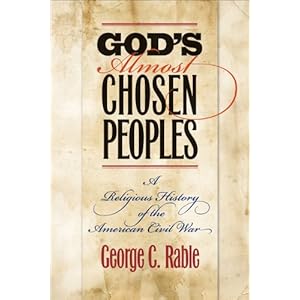
Some of you blog readers are probably hanging at the Southern Historical Association meeting today and through the weekend in Charlotte; sorry I'm not there with you, afraid that the AAR maxed out my personal travel/alcohol budget. In the meantime, though, hope you'll drop by the University of North Carolina Press booth and check out George Rable's very promising looking new book, God's Almost Chosen Peoples: A Religious History of the American Civil War. Skip Stout and others have given the lengthy work a hearty endorsement on the book jacket, and I hope to get to it over Christmas break when 600 pp. books seem a little less daunting. Information on the book below, from the UNC Press website.

God's Almost Chosen Peoples

A Religious History of the American Civil War

By George C. Rable


Throughout the Civil War, soldiers and civilians on both sides of the conflict saw the hand of God in the terrible events of the day, but the standard narratives of the period pay scant attention to religion. Now, in God's Almost Chosen Peoples, Lincoln Prize-winning historian George C. Rable offers a groundbreaking account of how Americans of all political and religious persuasions used faith to interpret the course of the war.

Examining a wide range of published and unpublished documents--including sermons, official statements from various churches, denominational papers and periodicals, and letters, diaries, and newspaper articles--Rable illuminates the broad role of religion during the Civil War, giving attention to often-neglected groups such as Mormons, Catholics, blacks, and people from the Trans-Mississippi region. The book underscores religion's presence in the everyday lives of Americans north and south struggling to understand the meaning of the conflict, from the tragedy of individual death to victory and defeat in battle and even the ultimate outcome of the war. Rable shows that themes of providence, sin, and judgment pervaded both public and private writings about the conflict. Perhaps most important, this volume--the only comprehensive religious history of the war--highlights the resilience of religious faith in the face of political and military storms the likes of which Americans had never before endured.