Tampilkan postingan dengan label civil religion. Tampilkan semua postingan

Jumat, 17 Juni 2011

The Future of American Religious History Monographs

by Edward J. Blum

If you take a quick glance at Paul Harvey’s vita, you’ll see that he plans to dominate the publishing world of the next 12-24 months (from my sociological skills, I count that he has 4 books that will probably be published in that window).

But there are other books that look pretty exciting too – both of which I’ve checked out in dissertation form. As mentioned a few times on this blog, Kelly Baker’s Gospel According to the Klan: The KKK's Appeal to Protestant America, 1915-1930 should be available in September. David Morgan – by far one of my favorite historians, writes of it: “An original and sobering work. In the present age, when we may no longer pretend that the lines between violent fanaticism and religious fervor are clearly discernible, this book makes a timely and urgent intervention. Hatred may have more to do with religion than we care to acknowledge.”

Her title alone reminds me of a little section in Matt Sutton’s book on Sister Aimee where on a church survey form, one congregant wrote down for occupation: “Chief Klansman.” Way to go, Kelly, and what a striking cover!

Then Art Remillard’s Southern Civil Religions: Imagining the Good Society in the Post-Reconstruction Era should be out by December. Not only a blogger, Art is an editor at the terrific online Journal of Southern Religion. Doyen of southern religious history Charles Reagan Wilson claims of Art’s book, “anyone wanting to understand how a variety of people in the South have understood its spiritual and moral meanings will like this book.” I think he’s right, and my guess is that reviewers will read it in comparison with Paul Gaston’s New South Creed and John David Smith’s terrific Old Creed for the New South. Art’s book may also be read as a kind of prequel to Andrew Manis’s Southern Civil Religions in Conflict: Civil Rights and the Culture Wars (2002).

Speaking of J. D. Smith … he’s blurbed another forthcoming book that looks fascinating: W. Scott Poole’s Monsters in America: Our Historical Obsession with the Hideous and the Haunting (out in October). Smith writes, "Poole brings to life American horror stories by framing them within folk belief, religion, and popular culture, broadly unraveling the idea of the monster. Thanks to Poole's insights we see the ubiquity of the monster lurking in and around us." Scott is one of my favorite historians of religion and culture – whether we’re talking South Carolina during Reconstruction or Satan in comic books. This is sure to be another path-breaking book.

And look out early Americanists. Amanda Porterfield’s study of religion and politics in the early Republic – Doubt – should be published soon too, and I think given her work and David Sehat’s Myth of American Religious Freedom we’re going to have to rethink Nathan Hatch’s democratization thesis pretty seriously.

Congratulations to Kelly, Art, Scott, and Amanda.

Kamis, 28 April 2011

Joe Price's Anthem Tour

Art Remillard

"When baseball functions as a civil religion," observes Joe Price in Rounding the Bases, "its true believers--the passionate fans and players who shape their worldviews and daily routines around their devotion to the game--experience a kind of sacramental rejuvenation in the game itself." Joe makes it no secret that he is a "true believer." The book concludes with a thoughtful recollection of his own baseball "conversion" narrative. And this summer, as research for his next book, Joe will sing the national anthem at over 100 minor league baseball parks across the nation.

If you're interested in following along, check out his website , Facebook page, and blog. Joe's wife is also coming along for the ride (they're traveling in an RV), blogging on her side of the story.

Here's one of Joe's dispatches from Florida...


At St. Lucie, a twin pillared sculpture made from remnant steel at Ground Zero graces the entry to the ballpark and pays tribute to the victims of the Twin Towers’ attack. Created by Patrick Cochrane, the piece was donated by retired New York City firefighters who live in the St. Lucie area.

As I entered the ballpark to sing for Florida's Mets, the relic reminded me of the consummate performance of the national anthem by Daniel Rodriguez, then a New York City policeman, at Yankee Stadium shortly after the 9/11 tragedies.

While the crowd’s response to my anthem rendition in St. Lucie was enthusiastic, the most expressive gestures and comments came from Mets players and a vendor.
As I walked the gauntlet past the Mets dugout right after I had sung, manager Pedro Lopez gave me thumbs up and said “Good job,” followed by third-baseman Richard Lucas reaching over the dugout railing to shake hands with me. A short time later, the vendor who was roasting pretzels over a charcoal fire near the backstop breezeway expressed great appreciation for the anthem itself. He offered that his wife, Laura Mercado, had auditioned a couple of days earlier to sing for the Mets and hopes to sing soon for one of the games.

A similar connection took place the following day in Jupiter while I was eating a delectable lunch at Le Metro in the Abacoa Town Center. Tiara, the waitress, recommended the broth-based mushroom soup and, as an entrĂ©e, grilled scallops, presented over tabouli, sliced tomatoes, and a fan of avocado slices dressed with an herbed balsamic vinegarette. I still savor that meal. When she asked what business had brought me to town, I indicated that I’d be singing for the Hammerheads a few hours later. “Wow!” she exclaimed and then recounted how some years ago when she had been living in Newport Beach, California, her daughter Nicole Gero had sung the national anthem for the Freedom Bowl game.

It’s quite simple: Anthem performances bring people together.

Kamis, 10 Februari 2011

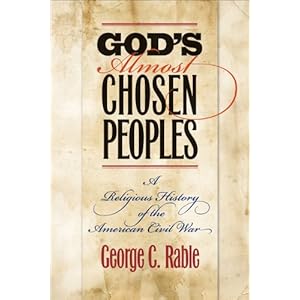
More on Rable, God's Almost Chosen Peoples

The outstanding Civil War Book Review, which has been a bellwether of scholarship on the topic for more than a decade, just posted their new issue for Winter 2011. Readers of this blog will be especially interested to read (or listen to) an interview conducted by editor Nathan Buman with George Rable about his new book, God's Almost Chosen Peoples: A Religious History of the American Civil War.

Following Paul and Ed, who have already given the book some attention here on the blog—and in good RiAH self-promotional style—I'll also draw reader's attention to my own review of Rable's book, just published in Civil War Book Review.

Here is an excerpt:


One of Rable’s major themes concerns the overwhelming significance of civil-religious providential understandings of the course of conflict. For his subjects the hand God was seemingly everywhere, guiding and shaping events in accordance with his will. All too frequently, that providential outlook was conflated—in ways consistent with patterns throughout American religious history to that time—with southern and northern nationalist aspirations. Perhaps this idea was stated most clearly in language approved by one northern Methodist conference in 1862: “Patriotism is a Christian virtue” (153).

Because of deep commitments to providentialism in the Civil War era, “religious faith could be both wind and weathervane,” where success or failure in battles showed adherents the ways in which they had met or fallen short of divine expectations, thus incurring God’s favor or wrath (7). Throughout the war, Union and Confederate officials, as well as local leaders and ministers, called routinely for days of fasting and thanksgiving in an attempt to make sure the public properly aligned itself with God’s will. Furthermore, despite innumerable difficulties, Rable contends that belief in providence maintained a remarkable resiliency. Not only did the religious “line between ‘loyalty’ and ‘disloyalty’” grow “ever-sharper” as the war dragged on, but after Appomattox, believers in the Union continued to understand their cause sanctioned by God (354). In the same way, defeated Confederates did not give up the belief in the righteousness of the cause lost.

Given the impressive amount of research displayed, the single most curious thing about God’s Almost Chosen Peoples is its self-professed lack of an overarching argument—in Rable’s words, it “is not a thesis-driven work” (6). Instead, he opts for a “broad narrative” that shows the centrality of religious belief for nineteenth-century Americans who needed to make sense out of the warring world they found themselves in (6). Rable’s choice will no doubt leave some readers grasping to impose coherence on an unwieldy and intimidating subject. However, because religious values were by no means uniform or monolithic in the Civil War era, and because Rable intends to cover the sweep of religious engagement with the myriad dilemmas that the sectional conflict raised, his broad narrative approach leads to a remarkable inclusivity with regard to topics and subjects.

Jumat, 05 November 2010

God's Almost Chosen Peoples

Paul Harvey

Some of you blog readers are probably hanging at the Southern Historical Association meeting today and through the weekend in Charlotte; sorry I'm not there with you, afraid that the AAR maxed out my personal travel/alcohol budget. In the meantime, though, hope you'll drop by the University of North Carolina Press booth and check out George Rable's very promising looking new book, God's Almost Chosen Peoples: A Religious History of the American Civil War. Skip Stout and others have given the lengthy work a hearty endorsement on the book jacket, and I hope to get to it over Christmas break when 600 pp. books seem a little less daunting. Information on the book below, from the UNC Press website.

God's Almost Chosen Peoples

A Religious History of the American Civil War

By George C. Rable


Throughout the Civil War, soldiers and civilians on both sides of the conflict saw the hand of God in the terrible events of the day, but the standard narratives of the period pay scant attention to religion. Now, in God's Almost Chosen Peoples, Lincoln Prize-winning historian George C. Rable offers a groundbreaking account of how Americans of all political and religious persuasions used faith to interpret the course of the war.

Examining a wide range of published and unpublished documents--including sermons, official statements from various churches, denominational papers and periodicals, and letters, diaries, and newspaper articles--Rable illuminates the broad role of religion during the Civil War, giving attention to often-neglected groups such as Mormons, Catholics, blacks, and people from the Trans-Mississippi region. The book underscores religion's presence in the everyday lives of Americans north and south struggling to understand the meaning of the conflict, from the tragedy of individual death to victory and defeat in battle and even the ultimate outcome of the war. Rable shows that themes of providence, sin, and judgment pervaded both public and private writings about the conflict. Perhaps most important, this volume--the only comprehensive religious history of the war--highlights the resilience of religious faith in the face of political and military storms the likes of which Americans had never before endured.

Jumat, 16 April 2010

National Day of Prayer Supporters Fear Dark, Prayerless Days to Come

Randall Stephens

Allan Sears, president of the Alliance Defense Fund, worries that a US District Judge could be putting another nail in the Christian America coffin. In the face of legal threats to the National Day of Prayer, Sears calls for support. (Is there a Nationalists' Day of Prayer?) "We must see victory on the appeal," Sears writes, "and if necessary this case must go to the U.S. Supreme Court and we must see the court uphold America's history and heritage."

Frank James blogs on the dust up over at NPR: "Add National Prayer Day Ruling to Reading List," April 16, 2010.

Because her legal opinion is likely to be a subject of discussion for a while, it's well worth taking some time to read U.S. District Judge Barbara Crabb's controversial decision Thursday that holds that it is unconstitutional for the president to proclaim, under Congress' direction, a National Day of Prayer. . . .

Her decision also provides anyone who's interested a useful history of how the National Day of Prayer came to be. A member of Congress with the good, appropriately Old Testament name of Absalom Robertson introduced the legislation in 1952, explaining in part a national day of prayer would be a good bulwark against those godless communists.
>>>

Kamis, 25 Maret 2010

Goshen College Gets (Civil) Religion

by Steven P. Miller

Mennonites usually appear in the headlines when someone has confused them with their close (but very different and more interesting) relatives, the Amish. This week, though, The New York Times, MSNBC, and other media outlets chose to cover a novel event in my part of Mennoworld: the playing of “The Star-Spangled Banner” at my alma mater and temporary place of employment, Goshen (Ind.) College. This was a first for the 116-year-old institution, affiliated with the Mennonite Church USA, a historic peace church.

My alma mater is extremely sensitive to criticism, which usually comes from groups to the theological right of this traditional bastion of Mennonite liberalism (Put it this way: I’ve heard stories of evangelists declaring that the sewers of Goshen are “clogged with fetuses”). Still, Mennonites are fond of having conversations (as opposed to conflicts), and in that spirit I will venture forth with a few observations/teachable asides about L’Affaire Anthem.

The criticism of the new anthem policy within Goshen circles has some interesting parallels to how the “young evangelicals” of the early 1970s interpreted Robert Bellah’s famous “civil religion” thesis. That is, they focused almost exclusively on the priestly, rather than the prophetic, side of American civil religion. Such an approach might work as theology, but it does not suffice as history. In the classroom this semester, I have tried to get my students thinking about the multiple meaning of American-ness (and claims to American-ness) by using a modified form of Gary Gerstle’s civic vs. racial nationalism rubric, which I’ve long thought also is relevant to the study of American religion.

I’m intrigued to hear criticism of the anthem policy coming from other than Mennonite circles. It’s as if Goshen had some sort of obligation to be the foil for Christendom. Where did these high expectations come from? My best guess is the theologian Stanley Hauerwas, a vocal fan of Mennos who hitched his highly influential post-liberal vision to the spirit of the very Mennonite theologian John Howard Yoder.

As the above thoughts might suggest, I’m not terribly bothered by the new policy—a fact that puts me in the minority among my alumni friends. In deciding to play the anthem before most sporting events, the college unquestionably is abandoning a source of Mennonite distinctiveness. On the other hand, no one who attends a Goshen baseball game—and hears an announcement of the school’s core values (three of which are “Global Citizenship, Servant Leadership and Compassionate Peacemaking”), followed by a musical version the anthem, followed in turn by the Peace Prayer of Saint Francis of Assisi—will mistake the place for Patrick Henry College. Besides, our nickname is not “Crusaders,” not “Flames”; it’s “Maple Leafs.”

Senin, 22 Maret 2010

Rival Revivals: Some Religious History at the OAH


Paul Harvey

Those of you going to the OAH in Washington, D.C., April 6-9, should find much of interest in religious history to select from. Just wanted to point you to a couple of sessions of particular interest:

Here's one on religion in the Great Depression, a subject which is undergoing a sustained re-examination in a number of recent works:

Thursday, April 8, 8:30 a.m. (in the Hilton Washington Headquarters Hotel -- does anyone know why the room locations of these sessions are not printed?)

Rival Revivals: Religion, Politics, and Labor in the Great Depression

Chair: Lizabeth Cohen, Harvard University

Revival or Revolt: Religious Foretelling at the Dawn of the Great Depression
Alison Greene, Yale University

“The Gospel Sends You Home Mad”: Rebellious Religion and Rural Protest in the 1930s South
Jarod Roll, University of Sussex

Was FDR the Antichrist? The New Deal and the Rise of Fundamentalist Antiliberalism
Matthew Avery Sutton, Washington State University

Comment: Ken Fones‑Wolf, West Virginia University

I've read Matt and Jarod's stuff that they're presenting here, and word on the street is that Alison's dissertation is terrific, so this promises to be a great session on some of the best new work from this period.

Then, at 1:45 on Thursday April 7 somewhere or other in the Hilton, we're going to have some fun dissecting the concept of religious freedom in American history:

New Approaches to Religious Freedom in American History

Chair: Tracy Fessenden, Arizona State University

History and Historiography in Church‑State Relations
Eric Mazur, Virginia Wesleyan College

Religion, Race, and Southern Ideas of Freedom
Paul Harvey, University of Colorado, Colorado Springs

Native Americans and the Dilemmas of Religious Freedom
Tisa Wenger, Yale University

Comment: Tracy Fessenden

Then, finally, very annoyingly scheduled for EXACTLY the same time (1:45 Thursday April 8), is a great-looking session on teaching religious history; maybe I'll draft the other Paul Harvey to read my paper above so I can sneak off to this session:

Teaching American Religious History:
Challenges and Strategies

Chair: Judith Weisenfeld, Princeton University

Laurie Maffly‑Kipp, The University of North Carolina, Chapel Hill
Deborah Dash Moore, University of Michigan
Rudy V. Busto, University of California, Santa Barbara
Rowena McClinton, Southern Illinois University

The full OAH program can be accessed here.

Selasa, 25 Agustus 2009

Jones Versus Jones: Or, How Primitive Baptists Ended up on the Jon Stewart Show

Paul Harvey

Some of you may have been following the discussion of the competing books on (and film rights to) the "State of Jones" in Mississippi during the Civil War already. My interest came mostly from thinking about my upcoming Civil War/Reconsruction class, and also thinking this would make a great exercise (had we access to the necessary sources) for my Theory and Methods of History class. I didn't think it a subject of interest to blog about here. Yet there is one issue that has arisen that makes it relevant here; more on that in just a bit.

What I'm referring to are the blog reviews and discussions (some rather heated) arising from the recent publication of John Stauffer and Sally Jenkins, The State of Jones: The Small Southern County that Seceded from the Confederacy, a popular narrative history revisiting of a story covered some years ago in Victoria Bynum's Free State of Jones: Mississippi's Longest Civil War. The discussion concerns the fascinating figure of Newton Knight, a Unionist Mississipian who may (or may not) have fled the Battle of Corinth as a Confederate soldier on his way to being a deserter and later a seceder from the Confederacy; who may (or may not) have been at Vicksburg; who may (or may not) have been a Primitive Baptist prior to the war, and whose Primitive Baptist convictions may (or may not) have led him into opposition to slavery; and who may (or may not) have been a racial egalitarian who fought against slavery in part because of convictions arising from his possible Primitive Baptist background. Here's a brief description of the newest entry in the State of Jones library of books, by Stauffer and Jenkins:

Make room in your understanding of the Civil War for Jones County, Mississippi, where a maverick small farmer named Newton Knight made a local legend of himself by leading a civil war of his own against the Confederate authorities. Anti-planter, anti-slavery, and anti-conscription, Knight and thousands of fellow poor whites, army deserters, and runaway slaves waged a guerrilla insurrection against the secession that at its peak could claim the lower third of Mississippi as pro-Union territory. Knight, who survived well beyond the war (and fathered more than a dozen children by two mothers who lived alongside each other, one white and one black), has long been a notorious, half-forgotten figure, and in The State of Jones journalist Sally Jenkins and Harvard historian John Stauffer combine to tell his story with grace and passion. Using court transcripts, family memories, and other sources--and filling the remaining gaps with stylish evocations of crucial moments in the wider war--Jenkins and Stauffer connect Knight's unruly crusade to a South that, at its moment of crisis, was anything but solid.

Typical for more popular narrative histories, the book's publicity apparatus breathlessly treats its arrival as uncovering a heretofore hidden story that no one has known about before, etc. Of course, Bynum already had written an entire work on it (one amply cited in Stauffer/Jenkin's endnotes), and among Civil War historians the story is relatively well known.

The evidence for Newton Knight's life and times can be gleaned only partially from the records; the interesting but unreliable accounts of his descendants (both white and black) must be used, but there we quickly get into the hazy netherlands between myth and history, as all sides on this subject acknowledge. To me, it's more fun when things are murky this way, and the competing "memories" of Newt Knight (including by some of his white descendants who clearly are embarrassed, even ashamed, by his Unionism and his alliances with Republican Reconstruction governor Adelbert Ames after the war) provide a lot of the interest in discussing these books. And regardless of what happened (or didn't) during the war, Knight's Republican sympathies and interracial alliances after the war are remarkable and fascinating; on that all sides are agreed, and the Stauffer/Jenkins book goes over that material at length and (in my view) very well.

The publicity apparatus for popular history books can be a little annoying to scholars sometimes, especially when the cover quotes for the book act like these subjects have never been discussed before. That aside, it never hurts to have more than one work on a subject. There's no such thing as bad publicity, even more so when it concerns Southern Unionism, a subject that stubbornly resists making its way into civil war memory -- year after year, my students are shocked to learn about Southern Unionism during the war, and they all know basically nothing at all about Reconstruction, but they nearly all know way too much trivial detail about Stonewall Jackson and the usual suspects. I can confirm this too from many friends who sent me excited emails alerting me to this book, which they learned about via the Jon Stewart show; of course none of them knew of the longstanding interest in Southern Unionism generally, and the State of Jones more particularly.

The discussion ensuing from the Stauffer/Jenkins entry has raised important issues for discussion. Start here for Victoria Bynum's three-part review of the work. The link takes you to part one, and then follow her links to parts two and three. John Stauffer and Sally Jenkins initially responded here; more recently, Stauffer has responded to more recent entrants into this dialogue, and some of Bynum’s critiques, here. Over at his indispensable blog Civil War Memory, Kevin Levin summarized some of the conversation, including a review by David Reynolds in the New York Times, which (as Kevin pointed out) basically summarized the criticisms made by Bynum and various commentators at Civil War Memory (see the comments section in the posts above for a fuller run-down on those; some are nasty and stupid, others are serious and worthy of consideration).

You know things are weird when the national press picks up on what otherwise might be internecine scholarly disputes, as the Times did on this one; see the piece “Civil War Fires Up a Literary Shootout.” Kevin Levin reflects on his blog’s role in this whole affair here. Sally Jenkins, the Washington Post reporter and sportswriter who teamed with John Stauffer for the new book, also appeared on the Jon Stewart show to publicize the book. On the show she says that the traditional Confederate and neo-Confederate treatment of the episode was to ignore or denigrate Knight. At first I misunderstood this point, thinking she was ignoring the work of professional historians on Southern Unionism, but Jenkins kindly wrote me to clarify:

what I really mean is traditional Confederate treatment [of Knight], because it was Confederates like Dabney Maury and Robert Lowry who shaped the first accounts of the events in Jones, and their accounts stuck, right up until Dr. Bynum. And even though Southern Unionism has been much covered by professional historians -- we leaned heavily on William Freehling and Margaret Storey in particular -- there really aren't enough books about it for John's taste, or mine. The best one that I know of is More Damning Than Slaughter by Mark Weitz, which mounts a great argument about the toll desertion and Unionism took on the Confederate Army.

While some of this discussion has gotten heated, as things tend to do in the comments section of blogs, the most recent entries have involved a serious and substantive consideration of the issues involved, including the sometimes fuzzy distinction of history and myth, and the choices involved in popular history versus academic history (the Stauffer and Jenkins text originated as a screenplay for a movie, I think, and their work stylistically sometimes takes on a “you are there” tone common to a lot of popular history, hence occasioning this discussion).

I have no stake or side in this fight, and mostly have been following it as I’ve been thinking about my Civil War/Reconstruction class coming up next spring. There is one issue, however, of interest for our blog. Let’s assume that the main character of these books, Newton Knight, was a Primitive Baptist in the antebellum era (the evidence is unclear on this point, one of many points in dispute mostly because of an incomplete evidentiary record; but his father was, and in the postbellum era he certainly was, so it's a reasonable supposition). Would that have led him into an antislavery and (relatively) egalitarian Unionism such that he would have deserted his post as a Confederate soldier perhaps twice, and then led an internal insurrection against the Confederacy, and after the war carried on interracial relationships in a manner exceeding even most ardent abolitionists? A skeptical Bynum writes:

Take, for example, the authors’ argument that Newt was likely raised a Primitive Baptist whose religious devotion led him to condemn slavery. Such conjecture is based on a single statement by Newt’s son, Tom Knight, who published a biography of his father in 1946. But Tom never stated that his father was raised a Primitive Baptist, only that he joined the Zora Primitive Baptist Church around 1885-86 (p. 14). Newt Knight may well have hated slavery, but the only definitive statement to that effect appears in Anna Knight’s 1952 autobiography, Mississippi Girl.

Stauffer responds that

Knight was an antislavery, pro-Union dirt farmer who opposed the Confederacy morally, politically, and militarily. The Confederate officer who arrested Knight for desertion testified under oath that he was a Union man “from conviction.” We have the transcript. Not one but two of Knight’s children wrote memoirs in which they attested to his beliefs. Knight was a Primitive Baptist, a distinctly pre-War branch that flourished in Mississippi from the 1820s on, as Randy Sparks and other scholars have documented, and a central tenet of which was the equality of souls.

Our identification of Newton as a Primitive Baptist stems from multiple sources, including the fact that it was the dominant religion in the area and that both his father and grandfather were Primitive Baptists. Bynum tries to discount our interpretation by referring to the biography of his son Tom Knight, who said that Newton joined the Primitive Baptist Church around 1885. Tom Knight got the religion right but the date wrong, for conversion to Primitive Baptism was rare during the post-war period. The most accurate way to understand Newton Knight’s religious worldview is through the prism of Primitive Baptism.

And Sally Jenkins adds the following:

that Knight made many references to the Lord in an interview is not the sole suggestion that he was religious, merely one interesting strand. According to his son he was a Primitive Baptist, and according to his granddaughter he “did not believe in slavery,” which is a discussion that we’ve had before, I just didn’t want to belabor it on this site. Tom Knight’s memoir also contains several references to his father’s religious feeling, and very much jibes with Knight’s account of himself. Also, Knight’s first wife Serena was buried in a Primitive Baptist cemetery. Prof. Bynum’s book contains a lengthy description of the Knight family’s deep involvement in the Baptist churches of Jones County. We believe he was what was known as a “Hardshell.”

If indeed we view Newton KNight through the prism of Primitive Baptism, what would we find? In my reading of the records, the Primitive Baptists were very concerned with opposition to organized mission societies, and thus were opposed to the formation of denominations. They were very concerned with upholding the tenets of Calvinism. And their churches were populated by the kind of folk -- ordinary upcountry whites, predominantly -- who were skeptical of the pretensions of the slaveholding class, and later often became Unionists; or, if not that, kind of silently resisted the demands of the Confederate state. But did Primitive Baptists have much to say about slavery per se? They surely believed in the "equality of souls," but so did the leading figures of the Southern Baptist Convention, including those who attended the founding convention of the Confederacy and believed in the religious sanction for slavery.

So if everything that Stauffer/Jenkins assert about Knight's life is correct, I'm wondering how much this would have to do with his individual peculiarities, versus how much it had to do with Primitive Baptism.Enjoy this moment while you can, as I'm sure Primitive Baptists will quickly descend back into their former pre-Jon Stewart obscurity!

Update: Over at Civil War Memory in the comments section, John Stauffer has responded to my query -- I'm reposting it here for those who don't see it there:

To Paul Harvey:
Thank you for your comment and for your balanced assessment of the debate on your blog (“Jones vs. Jones”).

You raise an excellent question: to what degree does Primitive Baptism lead someone to become antislavery? None, if it’s the only evidence one has. After all, countless Primitive Baptists, Northern Baptists, and Methodists were not antislavery.

Our aim was to try to understand the interaction between ideas and material forces that make up a worldview. In the case of antislavery, multiple causes led people to that conviction.

As Sally and I have noted, we’re not certain that Newton Knight was a Primitive Baptist. We surmise he was based on these facts: Primitive Baptism was the dominant religion in Jones County; Newton’s grandfather helped found a Primitive Baptist church; family members, including Newton’s father, were Baptists; Newton’s son said Newton was a Primitive Baptist; and the company Newton joined in July 1861 was nicknamed “Hardshells,” signifying Primitive Baptism.

As Randy Sparks notes in his terrific book, On Jordan’s Stormy Banks, many Primitive Baptists in Mississippi espoused antislavery views for theological and class reasons until the 1820s, when the gatekeepers of slavery effectively silenced these views. But as I said, Primitive Baptism alone does not lead to antislavery.
Other sources point to the emergence of Newton’s antislavery views: his parents never owned slaves; according to his granddaughter, he “did not believe in slavery”; he opposed secession and disliked the planter class; and he had great faith in the Union—-in essence, he was an American first, a Southerner second.

Additionally, in the cauldron of the War, it was common for whites and blacks to unite in order to survive and vanquish a common enemy (the Confederacy), a point wonderfully developed by Philip Klinkner in his book, Unsteady March. In any event, when Knight affirmed his loyalty to the Union in 1863, he sought through his actions to end slavery.

Jumat, 05 Juni 2009

Volume 11 of the Journal of Southern Religion

Art Remillard

While I'm not one for absolute truth claims, it is an objective truth that people get weird about college football (not me of course--other people). An example... While researching Florida State University's Indian mascot controversy, I noticed a problem with the logo. In 1838 during the Second Seminole War, Seminole leader Chief Osceola was captured and died soon after. An army doctor then removed his head and and embalmed it. The jar eventually found its way to the window of a St. Augustine drugstore, on display as a rather macabre trophy.

So it doesn't take an interpretive genius to notice that FSU's present logo looks like, well, a disembodied Indian head. In an effort to raise the issue, I wrote about this in a letter to the editor to a Tallahassee newspaper. On the morning that my letter was published, I was flooded with "FEAR THE SPEAR"-themed e-mails. Needless to say, this didn't expose me to the noblest qualities of the FSU fan base. But I couldn't help but notice that, for fans, the Seminole symbol is sacred territory. Accordingly, the debate between opponents of the mascot and FSU fans has become something of a "holy war on the football field." Opponents of the mascot often say that they want to protect the sacred symbols and history of Native Americans from stereotyping and exploitation. In contrast, for FSU fans, the Seminole sits at the center of their civil religious world of college football.

Others have identified a localized form of civil religion in college football. In the new volume of the Journal of Southern Religion (notice that I just transitioned from one form of self-promotion to another--beat that!), Eric Bain-Selbo's From Lost Cause to Third-and-Long: College Football and the Civil Religion of the South,” traces the rise of college football in the South. He then presents and comments on three examples (each has an accompanying video) of game day rituals. Bain-Selbo concludes, "[Southern civil religion] has a history of courage, stubbornness, honor, and shame. It is the Lost Cause—sometimes racist, despicable, and divisive. For example, the playing of 'Dixie' and the chanting of 'The South will rise again' continues to be controversial and divisive among students, faculty, and fans at Ole Miss. At the same time, southern civil religion—emerging out of the Lost Cause but not restricted to it—provides a pride in southern identity that can be uplifting and uniting once stripped of its offensive (Confederate) trappings. And woven into this civil religion is college football, drawing from and adding to these elements and often holding them all together at once on beautiful autumn Saturdays in towns and cities all across the South."

Other highlights of the new volume include:

If I had to pick a favorite from this volume, I would choose the interview with Wayne Flynt. Make sure to check it out, along with the video clip, "The Gospel According to Wayne Flynt."

Rabu, 20 Mei 2009

Arlington Confederate Monument

Paul Harvey

Think the religion of the Confederacy has died? Think again.

Dear President Obama: Please Don't Honor the Arlington Confederate Monument.

Over at Civil War Memory, Kevin Levin disagrees, hoping instead that Obama will put his skills at dialogue with those he disagrees with to good use here, as he did recently at Notre Dame. Caitlin Hopkins makes another worthy suggestion:

I would be perfectly happy to see Obama's staff "forget" to order the wreath for this particular bit of Lost Cause nostalgia, but that's not really his style. It seems much more likely that President Obama could be persuaded to add an extra stop on that Memorial Day wreath-laying tour — I suggest a trip to the African American Civil War Memorial before the Arlington excursion.

The future of the Republic probably doesn't stand or fall on whether some low-level administration staffer does or does not participate in this anachronistic, historically ill-informed little ceremony. My take: it's time to let this outdated tribute to Confederate mythology and religion die, let the Lost Causers rage though they will.

Rabu, 01 April 2009

On Pardons and Penance

Art Remillard

On December 4, 1912, pugilist Jack Johnson wed an eighteen-year-old prostitute by the name of Lucille Cameron. While her profession raised some eyebrows, her white skin sparked outrage from the likes of Georgia Representative Seaborne Roddenberry. Seven days after the ceremony, rather than sending a wedding gift, Roddenberry proposed a Constitutional ban on the “un-American and inhuman leprosy” of interracial marriage. Allowing such unions, he averred, “will bring annihilation to that race which we have protected in our land for all these years.”

Roddenberry drew from an American and Southern civil religious discourse that demanded white supremacy for the sake of social order. Civil religion is a complicated academic category. So for the sake of simplicity, let's just focus on social values, or as Robert Bellah put it, the normative standards that “indicate what is a good society, what is good social action, what are good social relations, what is a good person as a member of society.” In 1912, in the eyes of Rep. Roddenberry, Jack Johnson’s marriage was not a good social action, his marriage did not lend toward good social relations, and he was certainly not a good member of society. Others must have agreed, since Johnson was convicted for violating the Mann Act in 1913.

Today I discovered that Senator John McCain is seeking a posthumous pardon for Johnson. "I had admired Jack Johnson's prowess in the ring. And the more I found out about him, the more I thought a grave injustice was done." I like to think that McCain is doing an act of civil religious penance, a symbolic gesture meant to atone for the collective misdeeds of the past, and mark a new era where America's social values require racial justice. To be sure, the nation still has work to do when it comes to race. But this is a good sign.

If you're interested, here's a portion of Ken Burns's documentary, which played a significant role in getting the pardon-ball rolling.

Kamis, 19 Februari 2009

Du Bois and Religion

by Phillip Luke Sinitiere

Today I received in the mail the much anticipated The Souls of W.E.B. Du Bois: New Essays and Reflections. It was well worth the wait. While I have not yet read every essay, I poured through many of them and want to highlight several points about this seminal collection.

First, kudos to Ed Blum and Jason R. Young. This is a stout collection of essays that unveils a spiritual Du Bois who—as we all know from Ed’s work was an American prophet—but from the new work also a scholar whose interest in things spiritual included commentary on the history of Islam, writing about Zionism, and reflections on the religious traditions of India.

The editors organized the essays into four segments: the first around the question of Du Bois’s religious inspiration, a section that analyzes Souls of Black Folk, another on the social and cultural history of Du Bois and religion, and a final section on Du Bois’s engagement with Islam, Judaism, and Buddhism.


In section one readers will find a revised version of Dwight Hopkins’s chapter on Du Bois from his great book on Black theology titled Shoes That Fit Our Feet, and an interesting essay on the (religious) pragmatist tradition of Du Bois—an important topic that Jonathon Kahn will expound upon in Divine Discontent: The Religious Imagination of W.E.B. Du Bois, due out in July. Most importantly, Phil Zuckerman adds a keen challenge to Du Bois as a religious figure and claims he was decidedly “irreligious.” Zuckerman piles the quotes and the evidence quite high, and makes good points about Du Bois’s social scientific worldview as well as his extreme distaste for religious hypocrisy. Although I am not fully persuaded by his claims, Zuckerman nevertheless remains a very thoughtful voice in the growing body of work about Du Bois and religion.

The second section on Souls of Black Folk adds yet more texture to the multiple studies of this key work. So far my favorite part of the collection is section three. Ed’s contribution here comes from ch. 4 of W.E.B. Du Bois, American Prophet, one of the strongest chapters of his biography. (For more on this chapter see this post from my interview with Ed.) David Howard-Pitney’s essay ties Du Bois’s religious meditations to America’s civil religion and therefore contextualizes his work in new ways. Another very strong contribution in this section comes from Michelle Kuhl, whose essay studies Du Bois’s conception of manhood as reflected in his lynching/crucifixion tales published in The Crisis. Here Kuhl makes use of some of Du Bois’s understudied writing while editor of the NAACP’s magazine, and shows that Du Bois’s fictional work and creative writing is crucial for understanding his overall religious outlook.

The final segment of this collection takes Du Bois and religion in an entirely new direction by focusing on his understanding of Islam (Jason R. Young), his relationship to Zionism (Benjamin Sevitch), and the literary and religious depth of Du Bois’s Darkwater and Dark Princess (Ronda C. Henry).

Put this on your to-be-read list. It will be well worth your time. Here's what others have to say (from the jacket). James Cone describes this new book as "a thoughtful collection of essays," and Anthea Butler writes that it is an "excellent volume." Manning Marable says that the book contains "fresh insights" and "extraordinary essays." Finally, the BlogMeister recommends the essays as "wonderfully interesting" as the volume is "unusually coherent and cohesive."

Kamis, 22 Januari 2009

Bellah on Obama

Art Remillard

I have wondered for some time what Robert Bellah might think of President Obama's civil religious tone. Alas I have an answer. A segment of his "This is Our Moment, This is Our Time," from The Immanent Frame:

There is another element in Obama’s thinking that needs comment: his concern for America and its historical promise. It has been hard for his opponents to call Obama unpatriotic when he speaks so glowingly of our nation and its heritage. It is the eloquence with which he did that in his keynote address in 2004 that first told me that a remarkable new presence had arrived on the American scene. But what Obama has stressed is the promise of America, one that is still unfulfilled. It is our task as he has so often said to help create a more perfect union because this one is so imperfect. Obama has rejected the idea that supporting the Iraq War is a measure of patriotism. He has said, in effect, that the true patriot will oppose such a war.

Already in 2004 this reminded me of what I wrote in my most frequently reprinted article, “Civil Religion in America,” which was a call to see that the best of our tradition required opposition to the Vietnam War, not support of it. Too many have read that article as describing American civil religion as “integrating,” or “Durkheimian,” in a way that doesn’t appreciate the radicalism of Durkheim. Some friends who do understand what I had written in 1966 told me they thought Obama had read it. I have no reason to think he has. He doesn’t need me to see that the promise is the core we must celebrate, not the often desperately disappointing reality, which he notes when he promises to close Guantanamo and renounce torture as American policy. That one can see America as a beacon of hope, even, in Lincoln’s words, as “the last best hope of earth,” while also recognizing that America has committed the gravest of crimes from the colonial period to the present, seems to escape critics from the left and the right. Obama would never speak like the Rev. Jeremiah Wright, but he knows, as any serious American knows, that Jeremiah Wright was telling the truth, even if not the whole truth, and that denial of the terrible side of our history is no more healthy for us than it would be for Germany or Japan.

Rabu, 14 Januari 2009

Faith and Skepticism in the New Common-Place

Paul Harvey

Don't miss Christopher Grasso, "Skepticism and Faith: The Early Republic," in the new Common-Place. Earlier we blogged about his piece "Deist Monster: On Religious Common Sense in the Wake of the American Revolution," Journal of American History 95:1 (June 2008): 43-68. The Common-Place piece is a more personal reflection on what forces shape one's historical questions, how they are related to present questions but not bound by them, and indeed often start long before current preoccupations became preoccupations. He writes:

I'm reminded of a colleague who recently published a book on warfare and American history from the colonial period to the late twentieth century. Reviews discussed the study as if it had been inspired by the Iraq war. The author certainly did not claim to live in a cultural vacuum, unaffected by the current state of affairs; still, his project began two decades ago and is based on exhaustive research. Histories, though written in a particular time and place and from a particular point of view, may inspire op-ed pieces but shouldn't be confused with them.

His project came out of exploring the papers of Ezra Stiles (Congregationalist minister and president of Yale College in the late eighteenth century), including Stiles's own very secretive and closeted struggles with doubt and skepticism.

By retracing my steps to my encounter with Ezra Stiles in the library, I don't mean to suggest that the project was incubated entirely in the archives. No research is completely unconnected to personal experience. That doesn't mean religious history, any more than other kinds of history, entails one of those confessional prefaces in which the author discloses his or her personal relationship to the faith tradition being examined. Perry Miller's atheism and George Marsden's evangelicalism no doubt influenced each man's studies of the Protestant theologian Jonathan Edwards, but the evaluation of their books should aim at the cogency of their interpretive arguments in relation to the available evidence rather than at the scholars' biographies. The historian's own religious belief or doubt is one of many factors shaping his or her particular perspective, a point of view that provides moments of both blindness and insight when trying to imagine the past.

Grasso's story focuses on a period usually characterized by the triumph of evangelicalism, moral movements inspired by it, and the demise of the skeptical Enlightened tradition. My own work (and that of many others) questions this story from the "underside of that millennium" [sorry, a little self-quotation], focusing on Native peoples, African Americans, and others. The focus here is different, for Grasso has dug into the archives of white Americans whose skepticism engaged in a constant dialogue with the rise of "America's God." As he explains,

But the story of the relation of skepticism and faith is more than the tale of a few marginalized freethinkers and artificially induced moral panics. Religious skepticism touched—and in some cases transformed—more lives than we might expect in the early American republic.

This is really an affecting, and an effective, piece, both for its history, its historiography, and its personal reflections on how we come to the topics we do, and how we think about those topics within our own personal and institutional contexts.

UPDATE: John Fea and Brad Hart have blogged further on this piece.

Jumat, 09 Januari 2009

Give Me Your Ears: Religion and Oral History

by Phillip Luke Sinitiere

As some readers may have heard, the Library of Congress is in the process of compiling an oral history of sermons, speeches, and other orations relating to the inauguration of Barack Obama. It is formally called Inauguration 2009 Sermons and Orations Project, and will be part of the LOC's American Folklife Center. The center is only taking oral materials delivered between Friday, January 16 and Sunday, January 25, 2009.


This collection will obviously be of interest to historians and other scholars of religion in America, and the assembly of this collection is certainly interesting in light of the role pastors and sermons played through the campaign season (and since).

Oral religious history (and a sort of corollary, sensory history) has received some attention on this blog before (among others, John Turner's book employs oral history, for example, Paul Harvey commented on this, and the JSR Katrina issue has a bit of oral history). From those in the know I'd love to hear more about the state of the field, or any other thoughts related to religion and oral history (including bibliographic suggestions/leads).

Perhaps a place to start on the blog is Mike Pasquier's insightful methodological post from last September that discusses what he calls "religion-in-the-moment" as well as Rebecca Carter's notion of "spiritual dwelling" and Thomas Tweed's concept of "crossing and dwelling."

Senin, 05 Januari 2009

Of Politicians, Pastors, and Prayer

by Phillip Luke Sinitiere

Here's a piece Shayne Lee and I wrote about Rick Warren, Barack Obama, and the inaugural prayer. It relates to some of the ideas behind contemporary Protestant evangelical religious leadership and American culture, which we detail in our forthcoming Holy Mavericks: Evangelical Innovators and the Spiritual Marketplace (NYU Press, April 2009).

It is crossposted at From the Square, NYU Press's blog.

+++++++++++++++++++++++

Numerous journalists, political pundits, and scholars are discussing and debating Barack Obama’s decision to invite California pastor Rick Warren to deliver the inaugural prayer, particularly in the context of Warren’s support for California’s Proposition 8.

E.J. Dionne’s New Republic column, for example, titled “Big Tent,” (HT: John Fea) a thoughtful analysis of the Obama-Warren issue, reports that some wonder to what extent Obama has betrayed his liberal politics, while others embrace Obama’s decision and call for a more enlightened liberal politics. Christianity Today, the leading magazine of evangelical thought and culture, features some writers who are asking if Warren is the next Graham, or if he’s transcended the aged leader’s stature. Another voice of the religious right, Steve Brody’s blog at the Christian Broadcasting Network, “The Brody File,” (HT: Get Religion) features e-lamentations about Warren’s decision to pray at the inauguration. Alan Wolfe’s New Republic piece “Obama’s New Pastor Problem?,” (HT: John Fea) offers further contextualization about Warren and the religious right. And corroborating Steve Brody’s blog, Rachel Zoll’s article points out that some of Warren’s toughest critics are those on the religious right. Sociologist Gerardo Marti offers a brief history of Warren his Southern California context, what he calls “Warren-ology.” Religious studies scholar Anthony Pinn provides precise analysis of theology, political compromise, and the presidency, and historian of religion Anthea Butler contends that president-elect Obama misgauges Americans’ religious convictions.

Obama’s choice of Warren to pray at the inauguration—and in particular the range of responses this choice has elicited—gives us occasion to reflect on Protestant evangelical religious leaders we call “holy mavericks,” five of whom we discuss and analyze in Holy Mavericks: Evangelical Innovators and the Spiritual Marketplace.

We contend that Rick Warren is a holy maverick. Simply put, a holy maverick is an enterprising religious leader who crafts his or her ministry to a particular niche (or niches) in the spiritual marketplace. Holy mavericks are talented and savvy spiritual suppliers we call innovators, efficiently successful at recalibrating their messages and ministries toward the existential needs and tastes of church-going America. Houston minister Joel Osteen, for example, effectively marketed messages and books titled Your Best Life Now (2004) and Become a Better You (2007). Osteen’s brand of self-help spirituality reaches millions, and gains new followers each day.

Holy mavericks can be a fascination to the general public, and command wide audiences with messages of purpose, empowerment, and uplift. Rick Warren, for instance, took his purpose driven message to professional sporting events, political meetings, and to pastors in Africa. He also recently addressed the Muslim Public Affairs Convention in southern California. Holy mavericks can also exist as a thorn in the flesh of gatekeepers of church traditions who chide innovators for casting wide nets and polluting the gospel with “watered-down” versions of Christianity. Holy mavericks can elicit both intense loyalty and venomous contempt from clerical peers and congregants.

Another distinguishing mark of a holy maverick is his or her ability to sense how historical moments and opportunity structures shape their messages and marketability and help to bring their individual initiatives to fruition. Holy mavericks possess social, cultural, and spiritual dexterity. Put another way, holy mavericks are brilliant at surfing spiritual waves, a practice in which spiritual leaders discern where God is moving in one’s cultural milieu, and then prepare their churches and themselves to cooperate with the movement. Here’s Rick Warren: “Three key responsibilities of every pastor are to discern where God’s spirit is moving in our culture and time, prepare your congregation for that movement, and cooperate with it to reach people Jesus died for. I call it ‘surfing spiritual waves.’”

Warren knows that of which he speaks. Consider these snapshots from his recent activities: not many other preachers are friends with the president of Rwanda, write a monthly column for Ladies Home Journal, and receive a standing ovation after speaking at Harvard University. Not many other conservative pastors possess the flexibility to be pro-life and pro-poor, the ingenuity to lead a preaching seminar for rabbis at the University of Judaism, or the versatility to work and dine with homosexual activists while maintaining a firm stance against same-sex marriage. Not many spiritual leaders mentor prominent businesspersons like Rupert Murdock and Jack Welch, or can claim that after three decades of ministry, they have never been alone in a room with a woman other than their wife. Few evangelical pastors are friends with both President George W. Bush and Democratic president-elect Barack Obama, a notable participant at Warren’s 2006 Global Summit on AIDS and the recent Presidential Forum, both at Saddleback Church. And Warren’s latest book, The Purpose of Christmas, adds further insight into the complexity of this holy maverick’s cosmopolitan outlook. It continues to articulate the readable simplicity of the purpose-driven message and hit the major points of conservative evangelical theology (e.g., centrality of Jesus, authority of Bible, etc.). Yet with a closing chapter on Warren’s P.E.A.C.E. plan, it registers as decidedly cosmopolitan in outlook and activist in tone.

And there’s even more to the relationship between Warren and Obama: the president-elect launched a “40 Days of Faith and Family” tour while campaigning in October 2007 in South Carolina, an initiative clearly adapted from Warren’s popular “40 Days of Purpose” movement from a few years previous. (Read first-hand accounts about “40 Days of Faith and Family” from Obama’s website.)

So if Rick Warren is accustomed to surfing spiritual waves, and if Obama is serious about working across political lines as he embraces the change he promised, then Warren accepting Obama’s invitation to give the inaugural prayer is neither out of character nor a simple, shrill political move. It is a holy maverick at work.

If Warren is serious about working for social, political, and economic change through his P.E.A.C.E. plan and if Obama is serious about embodying change in today’s combative and partisan political order, and if these two visionaries will work together—at least for a day—then perhaps history will observe that the real mavericks of the 2008 Presidential election cycle were not, in fact, John McCain and Sarah Palin, but Barack Obama and Rick Warren. Why? In the midst of differences, each appears willing to find common ground in order to work together. Perhaps we all have something to learn from pastors and politicians after all.

Jumat, 24 Oktober 2008

Ali vs. Patterson: I'm An American Too!

Art Remillard

Muhammad Ali rose to prominence at a time when, similar to now, boxing was a dying sport. Its brutality and disreputable undercurrent offended the senses many. More than this, no boxer really stood out. But Ali stood out—way out. He was brash, boastful, critical of the U.S. government, and, of course, Muslim. The excitement generated by Ali cannot be overstated. He was, as Michael Novak proclaimed, the "redeemer of the boxing world."

Among Ali's most (in)famous moments was his 1965 bout with former heavyweight champion Floyd Patterson, a recent Catholic convert. The fight assumed posture of a "holy war," not only between Christian and Muslim, but also between "patriotic" America and "un-patriotic" America. Indeed, Patterson pledged to "win back" the title "for America."

Alas, Ali pummeled Patterson, drawing out the match for twelve humiliating rounds. With each blow, Ali crushed the hopes of his detractors and and elevated the hopes of his fans. Among those in the former group was Eldridge Cleaver, who afterward interpreted the broader symbolic quality of the match.

Muhammad Ali is the first "free" black champion ever to confront white America. In the context of boxing, he is a genuine revolutionary, the black Fidel Castro of boxing. To the mind of "white" white America, and "white" black America, the heavyweight crown has fallen into enemy hands, usurped by a pretender to the throne. Muhammad Ali is conceived as "occupying" the heavyweight kingdom in the name of a dark, alien power, in much the same way as Castro was conceived as a temporary interloper, "occupying" Cuba. It made no difference that, when Patterson announced that he would beat Ali and return the crown to America, Ali protested vigorously, asking "What does he mean? I’m an American too!" Floyd Patterson was the symbolic spearhead of a counterrevolutionary host, leader of the mythical legions of faithful darkies who inhabit the white imagination, whose assigned task it was to liberate the crown and restore it to its proper "place" in the Free World. Muhammad Ali, in crushing the Rabbit in twelve—after punishing him at will so there could be no doubt, so that the sport writers could not rob him of his victory on paper—inflicted a psychological chastisement on "white" white America similar in shock value to Fidel Castro's at the Bay of Pigs. If the Bay of Pigs can be seen as a straight right hand to the psychological jaw of white America, then Las Vegas was a perfect left hook to the gut.

Cleaver's provocative words indicate, among other things, that there were competing definitions of America both between and within the races. To be sure, Ali's image transformed over time from a national sinner to national saint. In 1996, Americans of all colors cheered as "the greatest" lit the flame at the Atlanta Olympics. Still, as Ali left the ring that evening in 1965, he became the standard-bearer for a population who stood tall and shouted, "I'm an American too!"