Tampilkan postingan dengan label blum's posts. Tampilkan semua postingan

Jumat, 17 Juni 2011

The Future of American Religious History Monographs

by Edward J. Blum

If you take a quick glance at Paul Harvey’s vita, you’ll see that he plans to dominate the publishing world of the next 12-24 months (from my sociological skills, I count that he has 4 books that will probably be published in that window).

But there are other books that look pretty exciting too – both of which I’ve checked out in dissertation form. As mentioned a few times on this blog, Kelly Baker’s Gospel According to the Klan: The KKK's Appeal to Protestant America, 1915-1930 should be available in September. David Morgan – by far one of my favorite historians, writes of it: “An original and sobering work. In the present age, when we may no longer pretend that the lines between violent fanaticism and religious fervor are clearly discernible, this book makes a timely and urgent intervention. Hatred may have more to do with religion than we care to acknowledge.”

Her title alone reminds me of a little section in Matt Sutton’s book on Sister Aimee where on a church survey form, one congregant wrote down for occupation: “Chief Klansman.” Way to go, Kelly, and what a striking cover!

Then Art Remillard’s Southern Civil Religions: Imagining the Good Society in the Post-Reconstruction Era should be out by December. Not only a blogger, Art is an editor at the terrific online Journal of Southern Religion. Doyen of southern religious history Charles Reagan Wilson claims of Art’s book, “anyone wanting to understand how a variety of people in the South have understood its spiritual and moral meanings will like this book.” I think he’s right, and my guess is that reviewers will read it in comparison with Paul Gaston’s New South Creed and John David Smith’s terrific Old Creed for the New South. Art’s book may also be read as a kind of prequel to Andrew Manis’s Southern Civil Religions in Conflict: Civil Rights and the Culture Wars (2002).

Speaking of J. D. Smith … he’s blurbed another forthcoming book that looks fascinating: W. Scott Poole’s Monsters in America: Our Historical Obsession with the Hideous and the Haunting (out in October). Smith writes, "Poole brings to life American horror stories by framing them within folk belief, religion, and popular culture, broadly unraveling the idea of the monster. Thanks to Poole's insights we see the ubiquity of the monster lurking in and around us." Scott is one of my favorite historians of religion and culture – whether we’re talking South Carolina during Reconstruction or Satan in comic books. This is sure to be another path-breaking book.

And look out early Americanists. Amanda Porterfield’s study of religion and politics in the early Republic – Doubt – should be published soon too, and I think given her work and David Sehat’s Myth of American Religious Freedom we’re going to have to rethink Nathan Hatch’s democratization thesis pretty seriously.

Congratulations to Kelly, Art, Scott, and Amanda.

Minggu, 05 Juni 2011

The Beautiful Mind and Life of Jen Lindell

by Edward J. Blum

You’ve never heard of her, but you would have. She had earned a doctoral fellowship to the Religious Studies department at the University of Pennsylvania and in the fall would have begun her apprenticeship under Anthea Butler and Sarah Barringer Gordon. She had just finished a Master’s Thesis on Mormon-Indian interactions beginning with the initial publication of the Book of Mormon in 1830 and ending with the Mountain Meadow Massacre of 1857. She was my star student who taught me so much about race and religion, helped with my own projects even amid her own routine trips to the hospital, and died far too earlier

.Jen Lindell wrote a Master’s Thesis that easily could have been expanded into an award-winning dissertation. Her broad interest was in the dynamic ways religion influenced the lives of everyday people and on how religious ideas influenced racial perceptions and vise-versa. She fixated on early Mormons and their conceptions of and interactions with Native Americans. She wanted to understand how white people who weren’t considered white by others (in large part because of their distinct faith) at first reached out to non-white people (Native Americans) as potential brothers and sisters, but then years later treated those people with disdain and violence. Lindell refused to take a “top down” approach – which would focus principally on Joseph Smith and Bringham Young – and instead looked to the laity. Reading deeply and widely through diaries, letters, memoirs, and local newspapers, she found epic encounters and love and betrayal, missions and murder, friendship and violence.

Soon, Lindell’s thesis will be deposited in the San Diego State University library and will be available online. I hope scholars interested in Mormonism and race will check it out. She’s got some rich material and fascinating insights. Even more, anyone who reads it will get to know in a small way the brilliant mind that I had the pleasure of learning from for a season. We miss you, Jen, and we’re so glad we got to be a part of your beautiful life.

Kamis, 06 Januari 2011

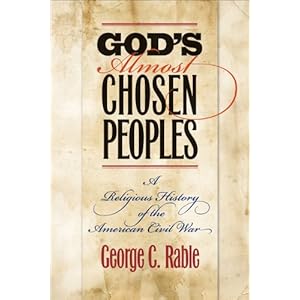
Something More: Secondhand Reflections on George Rable's Religious History of the Civil War

Congratulations to our contributor Ed Blum for the birth of his son Elijah James Blum! What do the birth of his son, some pop music from Secondhand Serenade, and George Rable's religious history of the Civil War have to do with each other? Nothing, you're thinking? Au contraire; read on.

Secondhand Reflections on George Rable’s Religious History of the Civil War
by Edward J. Blum

There’s one and only one book I’m reading closely these days: What to Expect: The First Year. With Elijah James Blum joining our crazy world on December 12, it has been indispensable. Through this bible of all things baby, I’m learning how to feel, how to act, and how to speak a whole new vocabulary: bilirubin; snurgles; meconium are but a few of the words in my new lexicon. For me, fatherhood is a reactive art. My days and nights are mostly encompassed by Elijah acting, Jen responding, and me trying to keep up with the whirlwind.

In addition to an album that transformed the music of the Beatles into soothing lullabies, one other album and one history book have become my regular companions. Between feedings, changings, and tummy time, I’ve found a few minutes to soak in Secondhand Serenade’s Something More and George Rable’s God’s Almost Chosen People: A Religious History of the American Civil War. The two may seem worlds apart, but they’ve come together in my rocking-chair imagination, and I think for good reason.

Secondhand Serenade is named for the nature of their music. Songs first written, sung, and experienced in private are transformed into ballads purchased on i-tunes, thrust too quickly into commercials, and discarded in a matter of weeks. We encounter the music secondhand, distanced from original intent and expression. By far, their best song is “Something More” (also the name of the album). It’s a power ballad to rival the finest of Celine Dion’s, and we only need a “king of the world” cinematic scene for it to become part of our national consciousness. Like most power ballads, “Something More” is about love and pain, desire and disgust. The singer is confused, angry, lost, and ashamed: “I lie awake again, my bodies feeling paralyzed / I can’t remember when / I didn’t live through this disguise.” The singer is “paying for his sins” and thinks that no words can “set him free.” He’s at war with another and within himself. He repeatedly admits and asks: “I’m stuck here in this life I didn’t ask for, / There must be something more, / Do we know what we’re fighting for?” The only answer – the only way to live amid his frustration – is to breathe and to believe: “breathe in, breathe out, / breathe in, breathe out. … There must be something more.”

George Rable’s characters from the 1860s had such similar feelings and asked such similar questions. What were Americans fighting for in the Civil War, and why did they continue to fight for so long? What sins were they paying for? And what was the “something more” that they all seemed to believe in, but couldn’t quite nail down? Like Abraham Lincoln in his Second Inaugural Address, the belief in a shared “something more” failed to stop the fighting, and they couldn’t understand why.

By reading thousands of primary and secondary sources, Rable (far and away one of America’s greatest Civil War scholars living or dead) offers the biggest, most comprehensive religious history of the Civil War ever produced. He tackles the North and the South, men and women, Protestants, Catholics, Mormons, and Jews. He travels with chaplains, tents with privates, and eavesdrops on presidents. More descriptive than argumentative, God’s Almost Chosen People considers so many sources that it is almost impossible to provide one or two central arguments. Yet Rable does. He finds that throughout the war, all sorts of Americans turned to providence to explain what was happening around them. The “something more” they knew they were fighting for was only explainable by looking to the heavens and believing that somehow, someway, God truly had the whole world (or at least the United States or Confederate States) in his hands.

The brilliance of Rable’s book – and what differentiates it in many ways from Harry S. Stout’s Bellah-inspired Upon the Altar of the Nation – is its secondhand nature. Although Rable claims in his introduction that religion could be both “wind and weathervane,” he more often than not renders it as weathervane. Battles happen; women and men die; political documents are signed; legal decisions are rendered; slavery is abolished; and then Americans reflect on the events religiously. They seek God’s providence in response to other events, constantly playing catch up just as I play catch up to Elijah’s needs at home. With this approach, Rable is able to show how widely and diversely religion suffused American society in the 1860s. Whatever the problem, whatever the event, whatever the circumstance, Americans turned to God and God’s providence for answers. By rendering religion secondhand, Rable has shown in epic proportion the omnipresence of the supposedly omnipotent.

And for Rable, the secondhand quality of religion emanates from his approach to religion itself – that it can only be studied secondhand. In this way, Rable wonderfully acknowledges the limits of his study. He (and we) cannot know the firsthand experiences of the women who lost loved ones, the privates who accepted new testaments after losing a hand of cards, or the presidents and generals who anguished (or relished) every death. When he analyzes a diary, a fast sermon, or a newspaper story (all of which Rable read in abundance), he recognizes that he interprets from afar. In this way, Rable demonstrates an incredible respect for his subjects and the gravity of the events.

Yet there are other seconds to consider. When W. E. B. Du Bois turned to seconds, he conjured the idea of “second sight.” He claimed that African Americans could see themselves and their surroundings with a sacred vision that whites could not. And Du Bois thought that the religious expressions of those with second sight could reveal the deepest elements of the soul – the “spiritual strivings” of individuals and communities. When Du Bois turned to the slave spirituals, he found not secondhand expressions, but expressions that revealed the most intimate parts of longing, feeling, and expression. This type of religious history of the war – one that approaches religious creation as a prime mover in historical change – could compel other approaches to the war.

That was not Rable’s project, though, and he shouldn’t be criticized for the book he wrote. God’s Almost Chosen Peoples is outstanding. Scholars of American religious history and the Civil War will have to engage it. And I’m glad that it’s so voluminous that I couldn’t lose it amid the diapers and the onesies.

Senin, 11 Oktober 2010

How Faith Transformed America: Blum on God in America

Paul Harvey

Your final reminder for God in America, to be shown starting tonight on your local PBS station. I've posted a few early press reviews of it in recent posts here. But for the most substantive review and critique to date, check out Ed Blum's take on the series over at Patheos. Ed summarizes some of the major themes, characters, and scholarly trends represented in the series, and then imagines what a series of this sort would look like if done ten or twenty years from now -- in other words, what scholarly work is emerging that will find its way into synthetic narratives meant for a more general audience. He finds three in particular:

1) The West will be more of a primary site in the narrative (as in, the western regions of the United States)
2) race will not be relegated as much to the Civil War and Civil rights eras
3 "the body and bodies will become an important place of telling and examining religion in America" -- in other words, "the body" as a site of religious expression will be more central.

While you're enjoying the series, make sure to go over and check out Ed's extensive post.

Minggu, 26 September 2010

Academic Blogging: Some Reservations and Lessons

Academic Blogging: Some Reservations and Lessons
by Edward J. Blum

Last summer, I was chatting with a collection of amazingly talented graduate students and newly minted PhDs in American religious history about the role of blogging. They all agreed that blogging was a godsend for those new to the profession, for it let them “be known.” Blogging offered an instant opportunity to present ideas, critique other works, and sound off publicly on any number of issues. Time and again, these brilliant scholars expressed their belief in the blogosphere: that it was the place to gain recognition.

I was worried. I wondered if the perils outweighed the possibilities. Paul Harvey’s American Religious History blog was created after I was finished with graduate school and had two monographs published. I was just at that moment becoming an associate professor and so “making a name for myself” had less immediate importance. I saw his blog and others as a place to promote and to play – not a place to stake a reputation.

I’ve been thinking long and hard about the academic turn to the blog, and my gravest concern is for junior scholars – knowing full well that by avoiding blogs, junior scholars may be missing out on many important opportunities. But here are my reservations and lessons:

1) Why would you give away for free the primary commodity you create? Your ideas are your intellectual property; when you publish them in a book, you and the press own them. You can make money off of them (sure, not a lot, but sometimes a nice chunk of change). You can receive credentials from them that include a job, promotion, and tenure. Just as much as publishers may benefit from a blog-inspired recognition, they may also not want to print concepts that can be found already on websites. I haven’t asked, but I wonder.

2) Peer review matters. Academic disciplines will lose all credibility without peer review; it is essential to what we do – as protection for the author and publisher, and as a way to get the best out of your work. When the five or ten or twenty reviewers (I can’t remember) for the Journal of American History sounded off on one of my dissertation chapters, I was shell-shocked. I could never have imagined there were so many problems with my essay. But those criticisms made it a better chapter, and my dissertation a stronger book. The JAH didn’t publish my essay, but the reviews transformed my approach to the topic. After graduate school, the number of people available to read your work may shrink. My experience is that there are fewer and fewer people who have the time to read my ramblings. Peer review allows the geniuses in our fields to challenge us, push us to new sources, and help with our prose. I’m grateful to have friends like Katie Lofton, who will read my essays and tell me what’s wrong with them – but it’s hard to make friends that brilliant and as the years pass on, we all seem to have less time for it. Blogs do not, as of yet, offer such a system of peer review and hence do not aid in that capacity in our development as scholars.

3) Post-publication review matters. Blog posts don’t get reviewed in the Journal of American History or the Journal of Southern History – books do. They are reviewed there and in other journals as another stage of peer review. It’s where we sound off – not just to say that this or that book “makes a significant contribution to” … whatever topic the book is on. It’s a place where real debates and real problems can be addressed. Comment sections in blogs aren’t the same, and they probably can’t go in your tenure file. Professional book reviews can and do.

4) Blog posts could hurt your reputation just as much (if not more) than help it. Fascinating blog posts probably won’t get you an interview or a job, although they may make your name noteworthy enough so the committee looks at your application (although I doubt this for most positions). Articles will, solid dissertations will, fantastic conference papers will. Blog posts are far more likely to hurt you in any number of ways: perhaps you write something that is too outlandish; perhaps you come off as too political (guess what, not all academics vote Democrat – some are more leftist, some are to the right – I learned this when one colleague of mine explained to me that even though I study and teach African American history, he hoped I didn’t vote as “they” did – an odd thing to say to a new colleague, but whatever). I’ve written a number of posts that I wish I could take back (usually the ones praising Matt Sutton’s work – and this, right here, is a joke, that could backfire if I didn’t point out it was a joke. And by this point, the joke is dead because I had to explain it so no one is even grinning). More honestly, I have in blog posts been rough and curt with some essential and important works (namely Barbara Dianne Savage’s very interesting Your Spirits Walk Beside Us), and I was wrong. I should have been more careful and thoughtful. Could that hurt me professionally – you betcha!

5) Blogs often function like the current American media: extreme, partisan, and amnesiac. Jon Stewart recently told Bill O’Reilly that all the messianic love for President Obama in 2008 set Americans up for heartache. Guess who said this in a Religion Dispatches blog essay in 2008? I did. Guess who remembers? Only me. As I see it, the current media is in the business of producing ideas each and every minute and there can be no regard for past claims, words, or interests. Stories and sound bites must be made new constantly. This is not how the scholarly world has functioned or should. We must take the time to think ideas through, to hash them out, to consider alternatives, and to weigh various other texts. Reacting to every new media story is not the path of most scholarly work; it’s the domain of the journalist.

6) Finally, and this is most apropos for our blog – this is a blog about religion and religions, the most powerful ideas, rituals, concepts, and communities that exist. As I understand the spiritual, it is the deepest core of people, ideas, organizations, and communities. Writing about it flippantly or without review or without consideration can be extremely damaging. I have done my fair share of rough handling with religion in these blogs, and I wonder at what cost. More and more, I think Robert Orsi is right when he calls us to be worry about our presentations of religion, especially of how those presentations get into the mass media. We’re observant to religious damages of the past, and certainly do not want to perpetuate them in the present and future (at least I do not).

So those are my concerns. I recognize the incredible work that blogs have done in American religious history. The Juvenile Instructor gang is amazing. The essays here are fantastic. Religion Dispatches is entertaining, insightful, and provocative. It’s not that we shouldn’t keep taking blog and technological leaps: it’s that, I think, we should look first.

Rabu, 22 September 2010

New Year, New You, New Books … Already?

by Edward J. Blum

We’ve only just begun the fall semester, but it won’t be long until book orders are due for the spring. So, as you’re putting in orders for old faithfuls like The Kingdom of Matthias (IBSN: 0195098358) or new loves like Freedom’s Coming (ISBN: 0807858145), you may want to consider the third editions of Major Problems in American History (ISBN: 0495915130). If you’re not familiar with my blog posts, then you need to know that most of them are self-promotional. If you are not familiar with this series, the Major Problems, then you should really get your hands on them. The collections match 8-10 primary documents from a given period or topic with 2-3 scholarly essays that debate the key points. I have used just about every one and students seem to love them. It’s high-quality one-stop shopping (more like Target than Walmart) for primary and secondary sources!

Sadly, the new edition for Major Problems in American History began with a loss. Just before revisions started, editor Jon Gjerde passed away, professor of history at UC Berkeley and author of some amazing books on the West, ethnicity, and rural life,. I joined my colleague Elizabeth Cobbs Hoffman (author of the fantastic book on the Peace Corps, All You Need is Love) to edit the new editions. Professor Gjerde did an incredible job establishing the main contours for the first volume and it’s his strong architecture I built upon.

The two new volumes highlight the role of religion and culture in significant, entertaining, and critical ways. Volume 1 (through Reconstruction) now has poems from Anne Bradstreet and court testimony from Tituba; it follows the emergence of American civil religion with patriot songs from the Revolution and odes to Washington; it careens into the antebellum period with new doctrines from the Church the Church of Latter-day Saints and salacious exposés on the Kingdom of Matthias. It has prophetic visions from Native Americans, new biblical interpretations from feminists locating egalitarianism in the Bible, and heavenly images of emancipation. For secondary documents, Volume I now has snippets from David Hall’s Worlds of Wonder, Days of Judgment on the colonial era and Nell Painter’s Sojourner Truth on antebellum religion and reform, where Truth’s adventures are matched with the analysis of Finneyite revivalism in Paul Johnson’s Shopkeepers’ Millennium.

Volume II amped up its religious coverage as well. Lost Cause ministers lionize the South, Brigham Young battles anti-Mormon ballads, Mark Twain satirizes the Battle Hymn of the Republic, Sister Aimee Semple McPherson uses new technology to defend the old-time religion, Father Coughlin denounces FDR, Vance Packard laments the religion of America in the Cold War, and Jerry Fallwell calls for the nation to return to the Bible.

Kamis, 19 Agustus 2010

New Scholarship: Opposition to Polygamy in the Postbellum South

by Edward J. Blum

For those of you still living in the present, I know this is a hard and confusing time. Reports of President Obama as a Muslim, debates over Ground Zero, and the start of the semester can trouble our souls. Perhaps you need an intellectual refuge. If you do, grab the current edition of the Journal of Southern History and read Patrick Q. Mason’s fantastic article on anti-Mormonism in the South <“Opposition to Polygamy in the Postbellum South,” Journal of Southern History 76, no. 3 (August 2010): 541-578)>. It’s a terrific study of how white southerners rallied against polygamy from the end of the Civil War to the beginning of the twentieth century. Sure, it’s not a fun story (it involves murder and mayhem just like most aspects of American history), but the essay offers a lot to think about from the past.

Sabtu, 22 Mei 2010

It's In the Blood: Religion in Reconstruction and WW I

by Ed Blum

I live exactly 0.92 miles from the beach. I know this is the precise distance because my dumb running watch always tells me how far I’ve gone and how slow I am (how can I be at 10 minutes already?!?). Recently, as I labor up and down the boardwalk of Pacific Beach, I’ve been listening to the sly lyrics and driving rhythms of AFI, an alternative band that was the hit of 2006. My favorite is “Love Like Winter.” It pulsates through my eardrums as I bop along the beachfront. It’s a fun song, and I won’t even try to explain the lyrics (“For of sugar and ice I am made, I am made” … perhaps the narrator is suggesting that he is a snow cone). It’s the repetition of one line that grabs me: “It’s in the blood, it’s in the blood, … She wanted love, I taste blood.”

For some reason, these lines have led me over and over to reflect upon two new books in American religious history: Derek Chang’s Citizens of a Christian Nation: Evangelical Missions and the Problem of Race in the Nineteenth Century and Jonathan H. Ebel’s Faith in the Fight: Religion and the American Soldier in the Great War. Both books deal with blood – but in very different ways. Chang examines missions among African Americans and Chinese Americans in the years after the Civil War and finds that religion had much to say about notions of what’s “in the blood.” Ebel joins American soldiers on the battlefields of the Great War and looks at how they religiously responded to the blood soaked worlds around them. Both books continue to demonstrate how religious history is leading the way in revisions of American history writ large.

Chang’s work takes us into the world of Baptist home missions on the East and West coasts of the late nineteenth century. He details the efforts and ideologies of the American Baptist Home Mission Society (ABHMS) as they reached out to newly freed African Americans in North Carolina and Chinese Americans in Oregon. Chang suggests that white missionaries and supporters of missions linked faith and citizenship in a concept of “evangelical nationalism” where an American identity was built upon Protestant (or perhaps Christian) faith. Underneath this seemingly-open nationalism, however, were assumptions about “evangelical” and “American” that were rooted in race and class. If African Americans or Chinese Americans were to become members of the nation, then they must conform to certain white demands. They must express adoration for white guidance, embrace the norms of middle-class domesticity, and accept some form of second-class citizenship because of their alleged racial differences and inferiorities to whites.

Chang also narrates a counter story, where African Americans and Chinese Americans recast and re-envision their place in the nation. African Americans pushed for their own models of leadership and for control over their institutions. Chinese Americans, and particularly several Chinese Christian missionaries, expressed confidence and authority. As communities, African American and Chinese American Christians enacted their place in the nation by occupying space and performed their spirituality through community songs and events. Perhaps heavy in ideas and light in evidence, Chang’s Citizens of a Christian Nation is a critically important book in American religious history and Reconstruction studies. First, he follows the lead of Daniel Stowell (to whom all scholars of religion and Reconstruction are indebted) in drawing more attention to the important place of faith, churches, and spirituality in the dilemmas and difficulties of Reconstruction. Second, Chang connects East to West via the ABHMS and points American historians to the importance of remembering the West (as Heather Cox Richardson has done in West from Appomattox for Reconstruction and as Tisa Wenger has done in We Have a Religion for religion; click the link for our interview with Wenger about her book).

Ebel brings us into the twentieth century and onto the bloody battlefields of WWI. He examines religion in WWI from the perspective of the soldiers and those who supported them. Ebel wants to understand (and to help us understand) how soldiers understand war. He finds that while American combat troops and war workers differed slightly in their approaches to the war, most found “redemption” in it. He brilliantly points out that “redemption” could have many different meanings. We know this is the case from Reconstruction – where redemption meant to southern white Democrats the return of their political and social rule; for African Americans, which John Giggie has detailed majestically in his pathbreaking After Redemption, “redemption” meant something very different in the late nineteenth century). For some in WWI, the war would mean worldwide redemption as God’s forces of good would defeat the demonic Kaiser and Crown prince. Or the war could bring national redemption. It could alleviate the conflict caused by massive immigration, for instance. Or for others, the war would redeem middle class and upper class men from the debilitating effects of overcivilization. Redemption could also function at the individual level, leading men to find “Truth” amid the war.

With a dizzying array of interesting points, Ebel provides a list of new avenues of study. In one chapter, he focuses upon the religious responses to the war by African American soldiers. In another, Ebel looks at the ways women understood the war spiritually. I thought the most interesting discussion in Faith in the Fight was the debate at the time over whether combat soldiers earned salvation merely by dying in battle. A “doctrine of immediate salvation for the fallen” emerged in the war, one that clearly revised evangelical approaches to salvation where faith in Christ was somehow necessary. Those interested in theology will find plenty of bloody meat here. Ebel efforts to determine the ways soldiers made theological sense of war, how they connected to liberal and fundamentalist theological trends, and how race and gender influenced religious worldviews. Faith in the Fight is an impressive book that all scholars of twentieth-century American religious history should read and that should be incorporated in all subsequent studies of WWI. (I’ve already used material from it for a few paragraphs in my current projects!)

The wheels of the American religious history bus keep rolling. Whether in Reconstruction or in WWI, Chang and Ebel show that religion can open our eyes to what’s “in the blood.”

Sabtu, 02 Januari 2010

Moses at Christmas

Moses at Christmas
by Ed Blum

I tried to ruin the blockbuster film Avatar. Not for everyone, mind you, just for my new brother-in-law, David. "Jen and I just got out of Avatar," I texted falsely. "Can you believe the Jackneff … is that how you spell it? … destroyed the village at the end. Jen figured out way early that Halpha was a traitor." I hadn't seen Avatar. There's no Jackneff; no Halpha. It was my brilliant way of tricking and hopefully irritating David, an animator who had been Facebooking about his excitement for Avatar for weeks.

"Bro, haven't seen it yet," David texted back immediately, "Not cool." I laughed and laughed. He fell for it. I called and explained that I was teasing and that I hadn't seen the movie. David mustn't have been too upset with me (or perhaps he had already purchased my Christmas present), for in my stocking he placed
America's Prophet: Moses and the American Story by Bruce Feiler. I had seen the book at Barnes and Noble and determined to get it at the library. Instead, I had my own Christmas copy. Flying home from the east coast, all hopped up on Bayer because of my sprained ankle, I had my dose of religious history to read.

Feiler's work passed the time well. It's a quirky, but fun, book.

Pitched to a general readership, I can only imagine scholars enjoying it. Feiler oscillates between historical analyses of Moses at various moments in American history to Feiler's personal experiences or interviews. So he jumps from Puritan sermons to his observations of Pilgrim reenactors, or from the words of the Founding Fathers to what the Liberty Bell sounds like to him. I had a great time venturing with Feiler to Cincinnati where he raced across the frozen Ohio River at midnight as if he was fleeing from slavery. But sometimes the personal anecdotes seem ridiculous. There's no one chasing him through the streets; the drama is fake and the reader knows it (just as it is in Dan Brown's disappointing The Lost Symbol). Feiler is probably at his best when interacting with director Cecil DeMille's descendants and piecing together the personal and social origins of his 1950s epic The Ten Commandments.

Feiler concludes that Moses taught American's a series of lessons. He taught them to have the courage to hope and rebel (in Exodus liberation style) and how to consolidate as a community (in law-giving and law-abiding style). He taught Americans how to form identities in difficult times (like massive immigration moments), how to fight the Nazis and Commies (with superheros and Charlton Heston), and how to deal with devastation (by accepting that sometimes you don't make it to the Promised Land).

And finally, Feiler proclaims that more than any other figure, Moses is the man - even more than Jesus. "Moses was more important to the Puritans, more meaningful to the Revolution, more impactful during the Civil War, and more inspiring to the immigrant rights, civil rights, and women's rights movements of the last century than Jesus," Feiler shouts. "Beyond that, Moses had more influence on American history than any other figure from the Bible or antiquity."

These are bold words. In modern America, it takes a lot of guts to challenge Jesus. Sure, two thousand years ago you could get away with arresting him or crucifying him pretty easily. But throughout American history, as Stephen Prothero and Richard Fox have shown brilliantly, Jesus has been a force. Prothero even suggests that the United States can best be understood not as a "Christian nation" or as a "pluralistic nation" but as a "Jesus nation." Now we have a challenge: Moses or Jesus. Historians, marshal your evidence and make your choice.

I'm not sure why Feiler insists on comparing Moses to Jesus in American historical influence. Perhaps it's his way of divesting American history of some of its overly Christian emphasis (like how some of my colleagues have quietly balked at Prothero's claim about the ubiquity of adoration for Jesus in American culture, explaining "I'd never put this in print, but I have always hated Christmas. You can't say that, though."). Do we need some statistician to quantify the number of books on Jesus and Moses in the Library of Congress or how many paintings there are of each one or of how many times members of Congress have referenced either one? Do we need to compare the box-office numbers of The Ten Commandments with those of Passion of the Christ? Do we need "Touchdown Jesus" to square off with Charlton Heston in a cage match?

It may be better to think of Moses and Jesus as tag-team partners in American history than separate entities. I'm guessing that the folks who want huge blocks of the decalogue inside and outside of courthouses tend to be the people who pray to Jesus. But I'm probably being too harsh. We historians are often found debating whether economic or political or cultural or religious forces were the most important in an era, as if any of these can neatly be separated. So perhaps we have Feiler to thank for a new scholarly discussion - which biblical character was the most important in American history - when, where, how, to whom? Regardless, thanks for the great present David.

Jumat, 07 Agustus 2009

Mission to Hollywood

Mission to Hollywood
by Ed Blum

Jen and I were sitting in the office of our pastor discussing how best to organize our congregation’s relationship to local and foreign missions. Somehow the topic of his daughter’s acting career came up. Rachel wants to be an actor, she discovered, after completing her degree in literature. She’s not sure when, but she’ll probably move to Los Angeles – to Hollywood – in her effort to make it in the industry. “We need more Christians in Hollywood,” Pastor Steve explained. I muttered into the awkward silence that punctuates so many of my conversations. With my best South Park Cartman voice, I said, "yeah, like Mel Gibson.”

Another awkward silence followed and then Pastor Steve and Jen burst out laughing. An object of intense social and religious scrutiny, especially after Gibson’s passion for Jesus and against Jews emerged several years ago, Gibson signifies an odd relationship between Christians and Hollywood in the twenty-first century. Then things got really strange (perhaps providential). As I jetted from there to a therapy session, I zoomed by a parked 18-wheeler with the words “Jesus Christ is NOT a Swear Word” emblazoned on the side. On the back of the big rig, a big Hollywood emblem was crossed out in Ghost Busters style. Geez, I thought, people in Southern California seem to think a great deal about the relationship between the film industry and religion.

Growing up in suburban New Jersey – where making money, just saying “no” to drugs, and interrupting people as a way to show you care were the cultural norms and the entertainment industry was something way out there – I never thought too much about religion and film. I tried to avoid movies with too much swearing or nudity (except for the time a youth group friend compelled me to see Natural Born Killers, which I still haven’t recovered from; yes, Kevin Pepper, you scarred me for life). Southern California is a different animal. If you aren’t in a band or trying to land your Screen Actors’ Guild card, you can’t be very important. The entire culture confuses me.

Thank goodness for Gerardo Marti. An incredible interpreter of congregational life who had examined in his first book a multiracial church in Los Angeles, Marti published last year Hollywood Faith: Holiness, Prosperity, and Ambition in a Los Angeles Church. It is an exquisite book on evangelical Christianity’s relationship with Hollywood, particularly on one congregation: Oasis Church. In a land of dreams and dreamers, of sex, drugs, and Tom Cruise, Oasis provides refreshing spiritual, social, and cultural water for its more than 2,000 members. A diverse congregation, Oasis is 45% African American, 40% white, and 10% Hispanic. It’s also full of wanna be actors, writers, dancers, and artist. In New Jersey, we would call these individuals “waiters” or “bartenders” or “receptionists,” but they self-identify by their “cover stories” of working in the entertainment industry. Oasis is a fascinating congregation for so many reasons – seated near the heart of Hollywood, racially diverse, and full of population of individuals who aspire to the entertainment industry.

Marti has not only identified a remarkable congregation, but he analyzes them, their history, and the relationship between Hollywood and religion with incredible insight, sensitivity, and theoretical savvy. After an excellent historical survey of the relationship between evangelicals and the film industry, Marti launches into his examination of the congregation itself. He shows how the church ministers and markets to its niche – individuals who love performance and the theater, who prefer fun over fundamentals, and who will fail in their careers far more than they will succeed. For these reasons, the church leadership outfitted an old movie theater into their sanctuary; they style the service and the church’s ministries after trends in the entertainment industry, and they address how to keep your dreams alive when they seem statistically impossible.

I think Marti is at his best analyzing how Oasis appeals to aspirants in the entertainment industry in ways similar to how historically black churches have appealed to embattled African Americans who often experienced economic problems, setbacks, and frustration more often than whites. Marti suggests, I think brilliantly, that Oasis bridges the gap between older black congregations that looked to “advance the dignity and rights of African Americans as a racial group” and the newer black churches that emphasize “individual upward mobility.” Oasis seems to have filled the gap not only for its African American members, but also for the others whose life experience may have resonances with people of color.

Marti’s book is a great read; it taught me a great deal about contemporary evangelicalism and Southern California. Someone who works in psychology and religion may inquire into the religious psychology of the individuals at Oasis; perhaps she or he will find a confusing mix of narcissism and altruism that can only be resolved by ecstatic faith. But those are considerations for the psychologically inclined, and not for Marti, an expert sociologist.

Rabu, 24 Juni 2009

Holy Mavericks, Batman

Holy Mavericks, Batman

by Ed Blum

Regardless of what recent survey results like the ARIS show, the quest to commune with God seems just as present in American society today as it has at any other time. Board any American airplane and you’ll probably see at least one white, middle-aged, slightly overweight evangelical reading William Young’s The Shack. In it, God reveals herself in a host of racialized forms to teach the protagonist new lessons of faith amid horrible life circumstances. And the main character’s life was pretty awful. His daughter had been murdered, the evidence left in some random shack, and God called him to converse at that location. The entire narrative is wrenching for the main character, from God’s racial manifestation, to the profane and sacred geography, to the loss of his daughter.

We can hear similar spiritual strivings if we listen closely to the sonic vibrations from the I-pod of the agnostic, freethinking, thin, and tattooed college student next to that evangelical. See her lips mouth the words, “I met God / on the corner of first and Amistad. / Where the west / Was all but won.” She is singing with the soulful beats of The Fray’s “You Found Me.” The song is asad one, where human misery once again forces the search for God. This God has no racial features, but He sits alone, “smoking His last cigarette.” God encourages the pained singer to “Ask anything.” A torrent of questions and accusations are flung at God. “Where were you, When everything was falling apart?” Why did You never call? Why did You never send letters? The end of the song shifts the location of holy finding. After the singer had lobbied everything he had at God, he now feels that God is the one who found him. “Why’d you have to wait? / To find me, to find me.”

Americans continue to search for a God to find them, to hear them, and to offer answers amid their pains and their tragedies. And for hundreds of thousands of American Protestants, five individuals provide the avenues to God: T. D. Jakes, Rick Warren, Joel Osteen, Paula White, and Brian McLaren.

In an amazing new book that had me feeling like I was sitting in the various congregations, hearing the sermons and being transformed by them, feeling the rhythm of the music, unconsciously absorbing the various means of media, sociologist Shayne Lee and historian Phillip Sinitiere show how these evangelical innovators recast traditional Protestantism for contemporary Americans who still want to find God (or be found by God). Holy Mavericks is a quick read and each chapter sparkles with close analysis of the main ideas and innovations of these pastors. It’s fantastic scholarship that runs from the sexualized presence of Paula White (who presents herself as vulnerable to speak to those with pain in their backgrounds) to the creepy smile of Joel Osteen (who has updated the power of positive thinking with amazing business and media acumen), from the stomping of T. D. Jakes (who has played both sides of the “gospel of prosperity” coin) to the goofy jokes of Rick Warren

(whose use of the internet is pretty savvy for a guy who wears plaid shirts reminiscent of the fictional character Al on Home Improvement). Holy Mavericks is a book not only for those who want to understand why these individuals have scored so well in the American marketplace of religion, but also for those who want to understand that marketplace.

I don’t want to bore readers here with a recitation of the theoretical underpinnings of Holy Mavericks (they have an excellent conclusion on the sociological theory that informs their analyses). And I don’t want to offer criticisms just for the sake of criticizing (an aspect of academic book reviewing I find as hackneyed as the “makes a significant contribution to INSERT FIELDS HERE” phrase that concludes almost every review). Oh shucks, maybe I do have one criticism in the form of a query. Why did Lee and Sinitiere compare the most politically liberal of the pastors and movements – Brian McLaren and the Emergent Church – to Al Qaeda, while Paula White is compared to Martin Luther, T. D. Jakes is understood through an analogy to jazz, and Osteen is likened to the “boy-next-door”? Perhaps this is just me being persnickety because when I had read McLaren’s A New Kind of Christian I thought it was nonfiction and searched for the fate of Neo. Alas, I’m off subject, but I would encourage readers to attend to the myriad analogies used in Holy Mavericks to see how Lee and Sinitiere make their case.

I do want to encourage the readers of this blog to get their hands on Holy Mavericks, enjoy a journey with the leaders of the evangelical masses, then return to “You Found Me” or to The Shack, and finally to ask whether the statistical data in the ARIS study is even worth studying. It may have you exclaiming, as I did, “Holy Mavericks, Batman, that survey data is as fishy as the Penguin.”

Sabtu, 07 Maret 2009

Calling This Blog Back to Its Pure and Godly Roots: A Modern-Day Jeremiad

A Jeremiad Over Religion in American History
by Ed Blum

I just finished reading Andrew Murphy’s terrific Prodigal Nation: Moral Decline and Divine Punishment from New England to 9/11 (also, see here for more and a "page 99" test). For those of us who’ve read our fair share on the Puritan Jeremiad or its use throughout American history, this is a refreshing book. Murphy focuses on three main historical moments: the seventeenth century when the American Jeremiad was created; the Civil War when the Jeremiad was tested; and modern America when the Jeremiad was “taken back” by the moral majority and their hopes to save the United States from its decline. This is an affordable, readable book that would be great for courses in American religious history that go from the Puritans to the present.

Murphy is a political scientist and what he does best is systematize and define. For the Jeremiad, he defines it with the following characteristics. First, Jeremiads identify problems that show a decline vis-à-vis the past; second, Jeremiads identify turning points (where society shifted from godly to sinful); and third, Jeremiads call for reform, repentance, and renewal (since, I’m guessing, we can only teach in groups of threes and in groups of three r’s). Most Jeremiads seem to share that structure.

So it got me thinking, what would a Jeremiad over this blog look like? How might I call this blog back to its beautiful and godly roots? Here’s what I came up with. First, I would laud the origins of the blog. It began simply with the vision of one pure man. Paul Harvey felt called in July 2007 “to foster discussion, sharing of links, and (I hope) eventually a group blog in American religious history.” The goal was for discussion and to share links. Perhaps a few others might join. Most pristine, Harvey began with a plug of my religious biography of W. E. B. Du Bois. It was a time of simplicity and harmony. And for a time, all went well. Paul and his co-editor Kelly Baker posted nice little links to various stories, to syllabi, and to new books and questions. All could read the blog in unity and be at peace with God.

But disaster struck in May 2008. It was then that a new contributing editor who seemed like an angel of light but was really a part of the antichrist’s plan to destroy the blog joined the crew. Dissension hit the blog almost instantly. When Dr. Harvey posted a picture of the new editor on the blog, he became angry. He demanded that the cover of his book be posted instead. It was the first time the genius of Harvey’s benevolent rule had been challenged. But it was only the beginning of the discord that this version of the antichrist would bring to the community. Attacking journal after journal, review after review, the enemy single-handedly transformed the blog from an arena of communal affirmation to one of strife and verbal tirades. Then he amassed a following of new editors and even connived me into his unholy attack on the community.

After May 2008, the blog went, figuratively, to hell. Stories emerged on new and bizarre topics. We could now read on the theology of George Carlin; even Paul Harvey posted about atheism in Phil Zuckerman’s book; evolution has been discussed on a blog about religion. What was happening? Liberal politicians like Barack Obama have been defended, and Phil Sinitiere and Jon Fea alerted us to too many books. All of it upsets the mind and has devastated the communal unity of our group. Peace has left us and now only discord and confusion.

What shall we do to be saved? Isn’t it clear, my fellow blog readers. We must return to the early time, the time when Paul posted short little snippets mostly about my books and material. The antichrist should be banished and hopefully slaughtered in the wilderness by Native Americans. Perhaps then and only then, we can reestablish this group as the last best blog on planet earth.

Kamis, 06 November 2008

Sober Reflections

Our Ed Blum has some of the best post-election analysis I've read in an essay at Religion Dispatches. It should be required reading for Obama supporters and detractors. Striking a Niebuhrian tone (in my mind, at least), Blum compares this year's "day of Jubilee" to that experienced at the end of the Civil War:

When we think of Obama as "savior-elect," we court trouble. When we forget history we weaken our own resolve; mysteries can be dangerous and days of Jubilee do not always end with eras of sublimity.

You can hear more of Ed's thoughts by listening to a San Diego NPR panel.

Jumat, 10 Oktober 2008

In a Different Voice of God

Editor's note: If you're like me, you're feeling exhausted after an awful week of financial meltdown, bogus political accusations about who's patriotic and who isn't, fatuous punditry on talk radio, George Wallace-like hate rallies, and the like. So, I'm giving everyone an extended weekend away from this dispiriting stupidity by keeping the next several posts on other subjects more at the heart of this blog's raison d'etre. We'll start with Ed's reflections on music, gender, teaching, and scholarship below. Ya'll have a good weekend, and take some time off from punditry and chatter and enjoy the beautiful fall. Listen to some good new music while you're at it.
________________________________________________________

In a Different Voice of God: Reflections on Music, Faith, Teaching, and Scholarship

by Ed Blum

If you are reading this, then you already know: I have terrible taste in music. My undergraduate students have become fully aware of this. When discussing Matt Sutton’s biography of Aimee Semple McPherson, one of them mentioned Sister Aimee’s opposition to “science.” I, of course, blurted out “she blinded with me science… SCIENCE!” Someone from the class should have echoed me with “SCIENCE,” but instead I got silence. Unnerving silence. Not a whisper; not a chuckle. Nothing.

Perhaps this is what Simon and Garfunkel meant. I asked if any knew the song, and a few sheepishly informed me that they had no idea what I was doing or talking about. They seemed embarrassed to know me. But if the courage to teach results primarily from sharing ourselves with our students (as Parker Palmer would have us believe), then my students need to know that I love terrible 80s music, that I watch youtube videos of other people playing World of Warcraft, that I’m tired of talking politics, and that if another writer for the History News Network plays politico, rather than historian, I might try to get the NSA involved (or at least the beautiful cryptographer from Dan Brown’s fictional Digital Fortress; and yes Gil Troy, I’m angry-blogging in your direction).

My students may also want to know that I’m going through a spiritual renaissance. The fingers and voice of a man who once professed that he “hated Christianity” is helping to change my soul. He’s a white boy who sings gospel and the blues. He’s a kid from North Dakota who sounds like he’s a son of the South. His name is Jon Gordon Langseth, Jr., (or at least that’s what wikipedia tells me) but he goes by Jonny Lang. I was turned on to Lang by a woman who (get this fun combination) served in the navy, works as a financial planner, and plays competitive Dodgeball (and yes, I implore her and her teammates to remember the five Ds of Dodgeball: “dodge, dip, duck, dive, and dodge”). Born in 1981, Lang released his first album in 1995. He played with “The Big Bang,” who selected their name either from scientific theory or from a really great hook up.

Lang’s combination of blues, rustic country, Motown funk, and jazzy funk (this description is almost completely stolen from his webpage has won him enormous praise. In 2007, he won the Grammy for best Rock or Rap Gospel Album. That album was titled “Turn Around,” and it’s the album that is speaking to my religious core.

One song in particular has called to me. “Only a Man” is much more than only a song for my soul. It is a beautiful evocation of the transformation many faiths promise to believers. Lang begins by wailing about how he “used to live” his “life in fear,” that he was “worried all the time.” In need perhaps of the serenity prayer (whether written by Reinhold Niebuhr or not), Lang continues, “I had no peace of mind.” This angst, this dissatisfaction, this trepidation – all of it leads Lang to realize that he is “only a man.” The solution is faith in God and Jesus. Lang “fell down and cried, Dear Jesus, rescue me again.”

At this point you may be asking yourself (not, as the Talking Heads sang in “Once In a Lifetime, “Where is that large automobile?” or “Where does that highway go to?” or “My God, what have I done”), why is Blum posting about this song? Is Blum such a narcissist that he merely writes about the songs he’s listening to and expects us to read about them on this public blog? Who the hell does Blum think he is? But wait, there’s an intellectual message here.

At the midpoint of Lang’s “Only a Man,” it gets emotionally and intellectually fascinating. God sings back to Lang. God – identified as “He” – chimes in: “What will it be now? / Will you choose me or keep swimming up stream now? / I’ve been in side your head hearing you scream out. / Well here I am, just take my hand and I’ll take out / All of the pain and all of the fear.” Pretty traditional Protestant Christian stuff here.

But if you listen to the track, the voice of God is a woman. It is a female presence that comes to save the day, to utter the words of God. Lang’s partner – Hailey – sings to him with the sweet and comforting words of God. And here we have another powerful paradox of American religious history, the gender bending, mixing and matching understanding of God. American religious patriarchy has functioned with a God who’s referred to as a “mother hen.” Protestant churches dominated numerically by women have praised pretty much all-male characters.

What we find with Lang’s “Just a Man” is God “in another voice.” Just as psychologist Carol Gilligan revised Freudian theory by showing that if we include women’s voices, then the paradigms of human development are distinctly different, Lang undermines religious patriarchy with God singing as a woman. And this is part of my own spiritual renaissance, the reckoning with the ways patriarchal thinking invades my scholarship, my teaching, my work, and my life.

Readers of my work will know that, just as Lang hated a form of Christianity, I hate the white God. I detest the ways modern society has racialized God, the divine, Jesus, and angels. The conflation of whiteness and godliness, I think, is one of the West’s worst sins. My first spiritual questions at the university, however, revolved around questions of gender and religion. It was Susan Juster who taught me to listen in religious history for different voices, particularly for gendered voices. So when I heard “Only a Man,” my misogynistic core was once again shaken, just as it had been by the powerful female voices in my undergraduate years (Michigan was the place to be in the 1990s if you wanted a change in your gendered worldview: Carol Karlsen, Carroll Smith-Rosenberg, Maria Montoya, and a host of others were there).

So back to the original question, how does my own spiritual journey impact my career? How would hearing God in a female voice in my own religious life change my teaching and scholarship? Perhaps it would lead me to acknowledge openly and honestly that I pay far more attention to race than I do gender and in so doing privilege a masculinist approach to scholarship and education. Perhaps it would lead me to admit that I minimized some of the gendered aspects of W. E. B. Du Bois’s life (his marital infidelity and his silencing of Ida B. Wells at moments) because it presents Du Bois as an imperfect prophet.

Perhaps I would have to acknowledge that I am more sensitive to cultural destructivity of some religious forms in the United States and not to others, and perhaps this bespeaks a latent form of inequality that creates a gendered hierarchy that has men on top and women on bottom (no sexual pun meant here, Paul Harvey; get your mind out of the gutter). Mostly, perhaps it means that I still need to be aware of how my cultural and social background and position continues to influence my teaching and my scholarship. Was this too much information? Perhaps. But it’s all part of my own efforts to, as Jonny Lang sang it and named Grammy-award winning album, “Turn Around.”

Selasa, 16 September 2008

Intellectual Confessions and the Book of Mormon


BY ED BLUM

If you’re like me (and I hope you aren’t, because that would mean double or triple or quadruple the insanity I already bring to the world), you are an American religious historian who has some intellectual confessing to do. You may have never read Bob Orsi’s The Madonna of 115th Street; you may secretly like revival meetings; you may think that “women’s history” is not “religious history” (or vice versa). For me, the first of my confessions is that I have never read The Book of Mormon. I teach about the Church of Latter-Day Saints all the time; heck, I even have friends who consider themselves part of the tradition. But I’ve avoided the Angel Moroni; I’ve steered clear of Alma and of Nephi.

This will all change now. Penguin Classics just released a beautiful new edition of The Book of Mormon with an introduction from one of the finest American religious historians of the past twenty years: Laurie Maffly-Kipp. The cover is gorgeous and the introduction drew me not only in the world of early 19th century America, but also into the tradition of a truly “American” faith (or is it profoundly unAmerican? ... I’ll let the historiographical slugfest continue with perhaps a twist to that question: if “women’s history is religious history,” as Ann Braude claims, then how does the history of Mormonism fit into American women’s religious history?).

Minggu, 20 Juli 2008

Summer of Love, Listening, Death Cab Meets Cutie, and Mortal Kombat


“Send Me an Angel”: Some Spiritual and Historical Ruminations on Contemporary Music


by Ed Blum

I’ve spent the summer on the road. Virginia may be made for lovers, but southern California is made for drivers. If I want to meet Matt Sutton for dinner in Huntington Beach, I have to drive; if I want to get to downtown San Diego, I have to drive. If I want to make a meeting, I have to drive. My poor little Honda Civic is taking a beating; thankfully my radio has been blaring some new songs that continue to inspire my spiritual strivings and interest in religion. I wanted to take you on a quick jaunt through the emotive, sensual, fun, and energizing moments I have had in the car with some new (and not-so-new) songs.

Since driving is my theme, it is fitting to begin with the band Death Cab for Cutie. I hate their name... or rather the second half of their name. For some reason, the word “cutie” irritates me. “Death Cab” strikes me as a better name, but that would be too dark for their fun, albeit eerie, pop. My favorite Death Cab song is “Soul Meets Body,” because it makes me think of the intersection of race and religion – where the soul and the body meet, collide, and blend. But that’s an old song, a more recent one chock full of religious inspiration is “I Will Follow You Into the Dark.” It’s a relatively slow song with simple guitar accompanying voice. One portion of the chorus brings me great hope. Lead singer Ben Gibbard smoothly voices of the hereafter:

No blinding light or tunnels to gates of white
Just our hands clasped so tight
Waiting for the hint of a spark
If Heaven and Hell decide
That they both are satisfied
Illuminate the NOs on their vacancy signs


I am fascinated by the idea of heaven and hell being satisfied, that both are full, that neither will take new visitors. It comforts me – perhaps I deserve to go to hell, but will not have to because there are no more vacancies. And heaven has rarely appealed to me. So what will the dark be like if heaven and hell are satisfied? I do not know, and I find the confusion inspiring.

Then, Death Cab juxtaposes an experience in Catholic School with alleged true love:

In Catholic school as vicious as Roman rule
I got my knuckles bruised by a lady in black
And I held my tongue as she told me
"Son fear is the heart of love"
So I never went back


Since I never went to Catholic school, I have no idea how common this is. I have heard a tale or two of the meanness of nuns; and we all know about the sexual voraciousness and deceit of the Catholic church, but the nun’s claim to be teaching love through the physical violence is striking. And, as historians, we know that Catholic school teachers have not been the only ones to use physical force to uphold principles. In the late 1850s, a Boston court dismissed charges against a teacher for beating a Catholic boy because he refused to read the Protestant 10 commandments. In this case, little Thomas Whall had his knuckles bruised not by a lady in black, but by a prejudiced, evil teacher who viewed Catholicism as an impediment to the glory of American liberty. Each time I hear these Death Cab lyrics I think about the stereotype of Catholic mistreatment of children and the amnesia about Protestant abuse. Then I feel a contradiction within myself about the song: I wonder if I’m OK with hell being satisfied when it comes to those who violate children? I wonder if I would want hell to have vacancies for men like the teacher who beat Thomas Whall?

Then there’s Coldplay’s “Viva La Vida.” Cold Play got a bad rap in the Judd Apatow film Forty Year Old Virgin. As actors Seth Rogin and Paul Rudd (two of my absolute favorites) played video games (I believe it was Mortal Kombat), they accused each other of being gay (a “put down” in films that elicits a ton of laughter and shows me just how homophobic our culture is). At one point, one explains that he knows the other is gay because he listens to Coldplay. I really enjoy Coldplay, and don’t see it connected to my sexuality at all. “Viva La Vida” is a fascinating song, where the chorus runs:

I hear Jerusalem bells a ringing
Roman Cavalry choirs are singing
Be my mirror my sword and shield
My missionaries in a foreign field

I’m not going to comment on the chorus, but it is so clearly replete with religious imagery that it strikes me as a spiritual onion – layers upon layers, some of which lead to tears when exposed. There is another line that captures my attention. Near the end, the singer exclaims: “For some reason I can't explain / I know Saint Peter won’t call my name.” Now, most lyric databases have Coldplay claiming that they know Saint Peter “will” call his name. But my ear hears another lyric. I hear the singer claiming that Saint Peter “won’t” call it. You can judge for yourself. But following my own ear, I am thrown back to the problem of heaven and hell – the problem from which Death Cab had almost saved me. What do I think of Saint Peter at the pearly gates? Will I get in? And what of the people I study? Did Saint Peter call their names? Or, and more importantly for my scholarship, how did their beliefs about heavenly lists influence their choices? Were American missionaries the bourgeois, imperialist, and hyper-nationalists I and so many others paint them as or were they people hoping that heaven had vacancies and that Saint Peter would call their name (or perhaps the names of the individuals they encountered abroad)?

These are the questions I have as I speed up the 5 to Los Angeles. These are the thoughts I have as I scroll through the radio stations. Just as songs like “Send Me an Angel," “Like a Prayer," and just about anything from Phil Collins led me to spiritual highs and questions as a teenager, so now Cold Play and Death Cab let me ruminate on my own spirituality and my life in the religious history of our nation.

There are so many other songs that I could discuss that whirl me into different worlds of American religious history. Bruce Springsteen, Dave Mathews, and The Killers all have great songs about Jesus that are helping me on that project; Eminem was inspiration for Reforging the White Republic; Jars of Clay, and their song “Redemption,” gave me the rhetoric and spirit to approach lynching and the sacred in W. E. B. Du Bois, American Prophet. Eventually, I plan on writing some on demons in America, and I have a coterie of devil songs just ready to roll on my I-Tunes. I would love to hear more about how music is influencing you, your religious life, and your scholarship. Please feel free to comment or drop me a line.

Selasa, 01 Juli 2008

Blum on This Republic Of Suffering

Kelly Baker

Contributing editor Ed Blum reviewed Drew Faust's This Republic of Suffering for the Christian Century. In this insightful review, Blum lauds Faust's exploration of "death dealing" as well as the moral unpreparedness of soldiers, both North and South, to kill. However, Blum claims that Faust explores the emotions and hand-wringing of white Americans while playing less attention to the institution of slavery and its impact on visions of death (and life). Blum writes:

There is much to applaud in Faust's study, but there are a few elements that may disturb readers. Faust's work embodies a recent and troubling trend in new studies not only of the Civil War, but also of the civil rights era in the 20th century. Attention has shifted from the historical role and centrality of African Americans during these climactic moments to the feelings and experiences of whites. Although Faust focuses some attention on the meaning of death for enslaved and free blacks in the mid-19th century, that aspect of her work lacks the nuance of her reading of white responses.Examples of this trend include historian Harry Stout's "moral history" of the Civil War, Upon the Altar of the Nation (2006), a work equal to Faust's in innovation, brilliance and scope. Stout not only brackets the morality of slavery, he also downplays the ethical implications of interracial interaction in the fields of education and religion in the Civil War South.

As for the civil rights era, Matthew Lassiter's much-heralded The Silent Majority examines the rise of new conservatism in the 1960s Sunbelt. Throughout his narrative, moderate whites take center stage in the struggles against the protectors of racial segregation. The overfocus on whites leads Lassiter to patently misleading claims like: "The grassroots open-school movements led by middle-class white parents from the cities and suburbs defeated the massive resistance program of the region's political leadership." It was, of course, the African-American teachers and lawyers and the students who braved stone-throwing and death threats who did the most to defeat the archsegregationists—or at least their role was just as important as that of middle-class white suburbanites.

Perhaps it seemed to Faust that if she made slavery a central element of the Civil War, death would no longer fit as the dominant theme. Although slavery was a status of "social death," as Harvard sociologist Orlando Patterson pointed out many years ago, during the Civil War almost 4 million slaves became civically alive with emancipation. They achieved freedom through mobility (by walking away from plantations, often heading to Union lines) and through military service. According to pioneering African-American historian W. E. B. Du Bois (in Black Reconstruction), for freed slaves the war was defined by new life, not suffering:

This was the coming of the Lord. This was the fulfillment of prophecy and legend. It was the Golden Dawn, after chains of a thousand years. It was everything miraculous and perfect and promising. For the first time in their life, they could travel; they could see; they could change the dead level of their labor; they could talk to friends and sit at sundown and in moonlight, listening and imparting wonder-tales. They could hunt in the swamps, and fish in the rivers. And above all, they could stand up and assert themselves. They need not fear the patrol; they need not even cringe before a white face, and touch their hats.

It is the failure to see life amid death that most detracts from This Republic of Suffering. Any quick look at the imagery and rhetoric of the Civil War shows an obsession with life and newness. In 1860, the Republican Party was imagined as a newborn baby of American liberty; in November 1863, in his Gettysburg Address, Abraham Lincoln claimed that the war brought a "new birth of freedom." After the Confederate surrender one African-American minister proclaimed in Washington, D.C., on the Fourth of July, "We come to the National Capital—our Capital—with new hopes, new prospects, new joys, in view of the future and past of the people." Even white supremacists have crafted the war as one of new life. America's first major motion picture, Birth of a Nation (1915), is the story of how the Ku Klux Klan remade the United States during and after the Civil War.