The following special journal CFP comes to us from John Corrigan, one of the editors of the journal Church History: Studies in Christianity and Culture, published by the American Society of Church History:
The editors of Church History: Studies in Christianity and Culture invite submissions for a special issue on the topic: “Emotion and Christianity: Feelings Toward and About Jesus and the Saints.” Papers may focus on any historical period and any geographical region. Please send queries or complete manuscripts to: Ms. Tammy Heise, Senior Assistant, Church History, Church-History@admin.fsu.edu.
Tampilkan postingan dengan label professional resources. Tampilkan semua postingan
Tampilkan postingan dengan label professional resources. Tampilkan semua postingan
Rabu, 29 Juni 2011

Rabu, 15 Juni 2011
The Future of Religion in America
Please welcome our new contributor Elesha Coffman. Elesha first posted here last week on the Religion and American Culture conference. She is an assistant professor of history at Waynesburg University and soon off to the Center for the Study of Religion at Princeton for a year's fellowship. Elesha's current work is on the Christian Century magazine and its role in establishing mainline Protestant identity and influence during the first half of the twentieth century -- a sort of "prequel" to the much-discussed decline of the mainline. Before graduate school she was a magazine editor, one of the reasons she is interested in print culture and the ways books and magazines create communities of readers. Welcome to Elesha!
“This is a big question,” the Religion and American Culture conference program admitted, “but what is the point of assembling a group like this unless it is to take a step back and ask the big-picture questions from a variety of perspectives?” The last session in Indy delivered on its promise by offering three very different reflections from scholars with very, very different ideas. It wasn’t that the panelists overtly disagreed about anything, as had the panelists and audience members at the previous session on scriptures. Rather, they responded to different versions of the main question regarding the future of religion in America, proving once again that the answer you get depends on the question you ask.
David Daniels, a seminary-based church historian, addressed his remarks to a question that might be posed as, “How will broad cultural trends affect American religion?” He probably came closest among the panelists to what the organizers had in mind, as their program notes queried “How will technology change religion, or be changed by it?” and “How will civil religion relate to traditional religion?” Daniels foresaw an America in which religious believers were more networked, more socially and ecologically conscious, and less bound by ascribed identities.
Mark Silk, a journalist and professor of religion in public life, spoke to the question, “Which religious groups will gain and lose ground in the coming years?” He based his predictions on trends identified by the American Religious Identification Survey, a project with which he is deeply involved. Silk advised his listeners to “short” the Protestant mainline and Roman Catholicism, which he expects to decline to 10 and 20 percent, respectively, of the American public in the next decade or so. He was more bullish on evangelicals and religious “nones,” groups he anticipates will swell to 40 and 20 percent of the population. (Silk did not mention Pentecostals separately, so presumably he counted them among the evangelicals, a decision many self-described Pentecostals and evangelicals would contest.) Those numbers left just 10 percent of Americans to be divided among all “others,” including world religions and new religious movements.
Julie Byrne, a religious studies scholar with interests in ethnography, took a completely different approach, considering, “What could scholarship on American religion look like in the future?” She took her own writing as a case study. Several years ago, she began to research an independent Catholic church, but before she could finish her book, the church fractured. At least one member of the church thought that Byrne’s research contributed to the splintering, as factions clashed, prematurely, over the attendance boom the book was expected to spark. This was the context for Byrne’s proposed “ethnographic uncertainty principle,” the suggestion that a scholar changes what she studies merely by studying it. So much for scholarly detachment. Byrne added to this cautionary tale a call for more creative presentations of scholarship, a call I jotted down in my notes as “Make art, not monographs.”
If it seems, from reading these summaries, that these three panelists were talking past each other rather than to each other, that’s pretty much what it seemed like in the room, too, despite the fact they were actually facing each other around a small, round table. I didn’t think this was a fatal flaw, however. The lack of direct engagement served to clarify some disciplinary distinctions that underlay a number of conversations that arose throughout the conference. As sociologist Rhys Williams had observed the previous morning, during a session that asked whether the secularization thesis still performed any useful work, “It really depends on, what do we want to know and why?”
The three panelists wanted to know different things for different reasons, and on behalf of different audiences. I expect Daniels’s students at McCormick Theological Seminary are very interested in how cultural trends will affect the interests and activities of religious Americans, while Silk’s interlocutors in journalism and the social sciences really want to know which groups are (to use terms that were hotly debated at the conference) winning and losing market share. Byrne’s questions about method are central for ethnographers, and her challenge to rethink the relationship between art and scholarship had implications for every discipline represented at the conference—though I’m still not sure what a “historical uncertainty principle” might look like or how my research into the early years of The Christian Century could be transmuted into art.
The future of American religion surely includes changes in cultural engagement, group affiliation, and scholarship. Ideally, scholars asking questions about those changes would stay in conversation, as they were in Indianapolis, even if they can’t always figure out how to talk to each other directly. Social scientists counting religious adherents need to be reminded how slippery and complicated religious identities can be. The field of religious studies, which tends to pay a lot of attention to outsiders, could benefit from confronting sociologists’ statistics on mainstream, majority groups. And scholars working within religious institutions and those working outside ought to be reminded periodically how the other half thinks. Is that too much to ask?
Minggu, 12 Juni 2011
Simple Things You See are All Complicated: Random Reflections on the 2nd Biennial Conference on Religion and American Culture
Paul Harvey
The simple things you see are all complicated
I look pretty young, but I'm just back-dated, yeah
The Who, "Substitute"
If it's a lie, then we fight, on that lie. But we gotta fight.
Slim Charles in The Wire
Elesha, Janine, and Kelly have initiated a vigorous conversation arising from one particular session at the 2nd Biennial Conference on Religion and American Culture which concluded just over a week ago. Because I had to leave just before this particular session, I don’t have much to add to it in particular, but I had a few stray thoughts on other parts of the meeting to throw up here. Today’s post will be lighter, more observations about some key phrases and indelible memories that I’ll carry from the conference. Tomorrow I hope to develop a few more serious thoughts about one session in particular, the one involving a discussion about the "bracketing" of religious belief in religious studies -- its rationale, its benefits, and its costs.
Before continuing, the last session was on "The Future of American Religion," but I was unable to be there, so am really hoping that one of ya'll out there will post on the discussion that went on there.

The first thought: a shout out to my partner in crime Philip Goff for organizing the conference in the first place, a huge undertaking of fundraising and organization. I don’ t know whether Phil got thanked at the end, but having lunch with him just before I left, he told myself and someone else present about his death struggle with the J.W. Marriott (the conference hotel) to get them to do what they had in fact been contracted to do (such as set up our room chairs in a circular pattern, put us in the room agreed to, etc.). Conference attendees don’t normally think about stuff like that, but suffice to say after threatening to call in his university lawyers and engaging in numerous conversations with the Marriott staff, the hotel at last came through with what they were contracted to come through with. That was a lot of work they had to go to just so we could sit around and talk.
All went smoothly, but not without a lot of background fighting leading up to the event. Anyway, since scholars tend to bitch and find fault with individual sessions or presenters or anything else, a shout out for those (Phil and his assistant Becky Vasko in particular) who make these things possible.
Second, I have no doubt that long after some of the substantive intellectual discussions have been forgotten, I’ll still remember some of the shorter or even “throwaway “ observations, conversations, and barroom late night jesting. Here are a few that stick with me (I had some others at the time, but they disappeared after the third martini).
One presenter, Su’ad Abdul Khabeer, discussing her research on the styles and head scarves of inner-city Muslim women, related that the women she studies refer to their scarf styles as “hood-jabs.” Her entire discussion of the phenomenon of "Muslim Cool" was the single most interesting ethnographic description I've heard in a good while, and a reminder of the tireless vitality of American religious cultures. She might have been the only person there from the discipline of Anthropology (maybe there were others, but I didn't see any), and as someone who did a minor field in Cultural Anthropology lo so many years ago I still enjoy hearing work from that perspective.
At the session on religion and market models, James Hudnut-Beumler, a scholar of religion and economics, author recently of In Pursuit of the Almighty's Dollar: A History of Money and American Protestantism, and Dean of the Div. School at Vanderbilt, related a conversation he had once with Ben Bernanke at some kind of conference or meeting. Bernanke asked him what he studied, and he replied “religion.” Bernanke answered back, “I can explain that.” Bernanke was being a little facetious, but only a little, for he went on to give an economic analysis, based on rational choice theory, on why women historically would predominate in many types of religious organizations (basically, their “wages” from this participation were equal to or greater than the discriminatory wages they would have faced – and would still face – in the secular marketplace and workplace). The idea here was both to suggest what we can learn from approaches drawn from market models of religion, as well as why we resist the hegemony of those models – the irritation we feel at the “I can explain that,” even when meant only half-seriously, is an irritation at a reductionism run amok.
And yet, reductionism is a tool that leads to significant insights (like, what's causing that e coli outbreak? and why are there more religious "nones" now than there used to be?), so it never hurts when humanists get exposed to social science scholars who use the word "data" a lot. There will always be a fair amount of cross-disciplinary carping at these kinds of conferences, a small price to pay for crossdisciplinary conversations.
At the very first session, we had a great “ethnographic moment,” in an impromptu discussion between Robert Orsi and Jan Shipps, renowned scholars both but slightly separated generationally, concerning whether we can “bracket out” religious belief in our studies. In reflecting on her pioneering studies of Mormonism, Shipps noted how she always said (or implied) “for them,” as in “for them, these visions were real.” Orsi replied that the problem with the “for them” bracketing was that it could easily lead to “for them, these visions were real – and they are crazy.”
I hope to develop a fuller post on this conversation early this week, as it was the session that ultimately interested me the most, but just this brief conversation between the two raised the same kinds of issues and back-and-forth responses which Orsi and Richard Bushman discussed recently in the journal Dialogue (see Chris Jones’s post on that), and which Orsi and Stephen Prothero batted back-and-forth several years ago in a discussion that is still frequently referenced – click here for a useful summary of that. I have noted recently that a lot of folks are assigning that discussion to students in classes, because it really gets to the heart of the matter of how scholars conceive of themselves and their work in religion.
Is the “whoosh” that we get from sporting events (or from some other mass group activity that induces emotional excitement in individuals) the same as the “whoosh,” the rapid firing of neurons and physiological response, that “we” get from religion? If so, is religion some sort of minor subdiscipline of cognitive psychology and neuro-biology? This became the theme of a lively discussion between Ann Taves (whose recent work has been done in collaboration, so I gather, with neuro-psychologists and other scientists) and Tracy Fessenden, who spoke eloquently of her resistance to adopting the scientific model of study as a means of accessing the huge money and prestige that scientists win at universities, in comparison to the perpetually impoverished and denigrated state of the humanities at many (most?) institutions nowadays – especially state institutions where “productivity” is measured in grant dollars raised. I don't mean to suggest that Taves was leading that direction -- certainly not true for the President of the AAR! But we are entering a new era of discussion (beyond the "two cultures" model) of sciences and the humanities, and there's an awful lot at stake in those discussions.
Rachel Wheeler concluded one session by noting how our generation of scholars always ends up saying, in effect, “it’s complicated.” That is certainly my classroom mode, and the message one would end up with at a conference like this. Yet others in the room, especially those in the social sciences, bring more concrete questions (and therefore answers) to the table, as when Roger Finke discussed some of the findings that can be gleaned from sociological studies of religious behavior such as he has conducted in some of his well-known studies. That brings us back to the discussion that Hudnut-Beumler and Ben Bernanke had about “I can explain that.” The humanists in the room stiffen their backbones against any explanation that does not invoke complexity and some degree of unknowability; some (not all) of the social scientists naturally are drawn to projects that focus on concrete questions and answers – has religious/philanthropic giving risen or fallen over time as a percentage of people’s incomes? Has the pay of clergy risen or fallen relative to other professions over the longue duree (answer: fallen, but you already knew that)? And so on.
As a humanist at heart, naturally I gravitate towards “It’s complicated” as my answer for most important questions. For the smaller questions, we can find answers, but for the bigger questions that drew me into academic studies in the first place, our answers will be tentative at best. Therefore, my classroom pedagogy tends to be deconstructively Socratic, in the sense of proposing questions, letting students pose hypotheses, poking holes/finding problems with those hypotheses, and then commanding them to “go and research some more” at the end of the period (they probably go to toga parties instead, but at least I want to leave them with the idea of the beautiful confusion of historical research). Is that, ultimately, where I want to leave it? I don’t think that will leave the assessment committee at my university very happy, since we are supposed to be assessing concrete bits of student learning.
But that leads to a final irony: I am chair of our departmental assessment committee (that's a committee of one -- but full of self-doubt as I am, reaching consensus is surprisingly difficult), so I get to develop the instruments to test exactly what bytes of data students "learn." Since I developed them, our instruments, therefore, essentially capture the degree to which students "get" the concept "it's complicated."
Is “boring from within” the way to beat a bureaucratic system that inevitably beats down individuals? On the other hand, as a lover and scholar of The Wire, I also know that, ultimately, the institution always wins, so we shall see whether, like Slim Charles, I "fight on that lie," just because we have to fight, or whether "boring from within" is simply carving a hole in my own academic soul.
Ultimately, in this age of the privatization of public goods such as education, the game does change, while it also just gets more fierce -- as Kathryn Lofton and Sylvester Johnson reminded us in their presentations on/critiques of (respectively) neoliberalism and its influence in market models of religion, and the relationship of American religion to the American imperial state. Reflecting further on the privatization of the public good of education (as in Colorado, where state funding now represents less than 8% of the CU budget) threw some cold water on the neural "whoosh" that conferences such as this, at their best, provide. (And if, like Janine, you live in Illinois, then that water bath is even colder.)
Senin, 04 April 2011
Columbia Guide to Religion in American History Book Cover

Paul Harvey
As you longtime blog readers know, we are very slow and reluctant to engage in any form of self-promotion here at RiAH, but every once in a blue moon will give in to the temptation to feature a book, out or forthcoming, from one of our contributors, or heck, even myself and a contributor.
Last year we celebrated the completion of the manuscript for the Columbia Guide to Religion in American History, and now it's into production and we have the launch of the book cover. This is going to be one of those very expensive reference works that are meant for libraries, so I hope some of you can alert your librarians at the appropriate time. Of course, if you feel like shelling out $75 or whatever it is for the book, go right ahead, but if you don't, I'll understand. Just make your univ. library do so.
Last year we celebrated the completion of the manuscript for the Columbia Guide to Religion in American History, and now it's into production and we have the launch of the book cover. This is going to be one of those very expensive reference works that are meant for libraries, so I hope some of you can alert your librarians at the appropriate time. Of course, if you feel like shelling out $75 or whatever it is for the book, go right ahead, but if you don't, I'll understand. Just make your univ. library do so.
Also, quite a few contributors to and longtime readers of this blog wrote pieces for this book (Lin Fisher, for example, opens the volume with a great piece on "Colonial Encounters," and Jane Smith of Harvard Divinity School, whom I interviewed previously on the blog, closes the main portion of the book with an essay on Islam in America), and I'm especially proud of a very lengthy and substantive introduction that Ed Blum and I produced for the volume, which features an exploration of ten major paradoxes of American religious history. The book also features some excellent bibliographic work produced by co-blogmeister Randall Stephens, including a filmography, discography, and list of electronic resources, as well as an extensive A-Z glossary of Am. religious history.
Selasa, 11 Januari 2011
Sanctifying Social Struggles: From New Contributor Heath Carter
Paul Harvey
I'm very pleased to introduce our newest contributor, Heath Carter. Heath is a Ph.D. student at the University of Notre Dame, where he's working under Mark Noll and John McGreevy on his dissertation "Scab Ministers, Striking Saints: Christianity and Class Conflict in Chicago, 1865-1914." One piece from this, which I was privileged to read in manuscript, has been published recently: "Scab Ministers, Striking Saints, and Class Conflict in 1894 Chicago," American Nineteenth Century History 11, No. 3 (September 2010): 321-49. For his first contribution, Heath reflects on a panel he just attended at the 2011 AHA.
_____________________________________________
Sanctifying Social Struggles Panel
Sanctifying Social Struggles Panel
by Heath Carter
As Randall and others have noted, this year’s AHA more than made good on its theme, “History, Society, and the Sacred.” The conference schedule was packed with an unprecedented number of panels showcasing the latest scholarship on American religion. On Friday morning I attended one – entitled “Sanctifying Social Struggles across the Mid-Twentieth-Century South” – that tackled a theme near to my heart (and dissertation!): the relationship between religion and class. Chaired by Lisa McGirr, the panel featured papers by Alison Greene, Jarod Roll, and Elizabeth and Ken Fones-Wolf, names that will be familiar to many readers of this blog. Both Greene and Roll recounted 1930s episodes in which religious ideals motivated social protest, with she focusing on tenant farmers in the Mississippi Delta and he on the fascinating figure of Claude Williams, who was at once a fundamentalist preacher, economic radical, and racial progressive. The Fones-Wolfs’ presentation underscored the strategic importance of religion on both sides of post-WWII labor battles, and included a riveting discussion of how corporations like Westinghouse and General Electric enlisted local preachers in their union-busting campaigns. The panelists earned well-deserved praise from commentator James Green, an eminent labor historian, who gracefully acknowledged having been remiss in neglecting religion in his own work. It was McGirr, meanwhile, who asked perhaps the most challenging question. She wanted to know whether the panelists thought their papers exposed the need for an overhaul of labor history as we have known it, or whether their arguments merely embellished older storylines. Far from settled, this line of inquiry should continue to generate much invigorating debate going forward. (Those interested in exploring some of these issues in further depth might start with the spring 2009 issue of Labor, which was devoted to the intersection of religion and class; also, be sure not to miss Roll’s prize-winning Spirit of Rebellion, published by U. of Illinois in 2010.)
Minggu, 09 Januari 2011
A Guide to Boston's Religiously Significant Sites
 Paul Harvey
Wish I had seen this before, rather than after, the AHA, but going to post because it might help fill out some of your itineraries (including my own) on trips to Boston:
Meaghan Dwyer-Ryan, A Guide to Boston's Religiously Significant Sites, from the published supplement to the just-concluded AHA meeting in Boston. The author includes short descriptions and histories not only of the usual suspects (Old North Church, etc.), but also to major Catholic and Jewish congregational destinations. Put this one in your bookmarks.
Here's one I didn't know about, just for a little taste:
German and Polish immigrants established Congregation Ohabei Shalom, Boston’s first Jewish congregation, in 1842 in the South End, and the first Jewish cemetery in East Boston in 1849. In 1852, the congregation constructed a synagogue on Warren Street, modeled after Newport’s Touro Synagogue. Increasing membership prompted further moves: in 1863, to the Warrenton Street Universalist Church (now the Charles Playhouse) and in 1886, to the Union Park Street Church (now a Greek Orthodox Church) in the South End. In 1928, the congregation built its current temple center on Beacon Street in Brookline (1187 Beacon St., 617-277-6610).
Kamis, 30 Desember 2010
Beyond the Protestant Nation: Religion and the Narrative of American History
Paul Harvey
We hadn't yet posted notes on the Saturday and (dreaded) Sunday morning sessions at the AHA in Boston, more on that forthcoming. But we definitely want to highlight one session of huge significance, which unfortunately got stuck in the no-man's-land of the Sunday morning (Jan. 9) at 8:30 a.m. slot at the AHA. Despite the unfortunate time placement, the panel "Beyond the Protestant Nation" ought to be one of the most interesting of the whole conference, and certainly of great interest for American religious history/studies scholars. I'm pasting in the abstract below, with the following note from panel organizer Chris Cantwell of Cornell University:
"The round table grew out of a conversation Orsi and I repeatedly return to, where it seems that scholars who work on Protestants are able to make far bigger claims about American history than historians who work on other religious traditions. The protestant work ethic, for example, tells us about the foundations of America's capitalist ethos. Catholic street feste, however, tell us about immigrants; not about America. Out of this conversation Bob and I put together a round table that features scholars who do not work on traditionally defined Protestantism to ask how would the American historical narrative change if we gave the questions and concerns of non-Protestant religions the same interpretive strength as Protestantism receives."
Here's the abstract:
Beyond the Protestant Nation: Religion and the Narrative of American History
American historians, like their counterparts in other fields of historical inquiry, have become increasingly interested in integrating religion into our historical narratives. Prominent religious figures now appear in survey courses; we see theological ideas contributing to the formation of political philosophies and programs; and we use popular ritual practices to convey the culture of an era. But in studying the most religiously diverse country in the world historians have implicitly perpetuated an interpretive hierarchy of American religious life that inflates the illuminating power of certain religious communities and circumscribes or even ignores the historical (and historiographical) contributions of others. For instance, exploring the contours of the Protestant work ethic or evangelical conceptions of the state tell us, scholars argue, about the foundation of America’s capitalist ethos or our core political values. Catholic street feste to particular saints or changes within Reformed Judaism, however, are about urban culture or the immigrant experience—about Catholics and Jews, not about “America.”
This roundtable seeks to bring the deeply rooted Protestant and religious presuppositions of American historiography to light to challenge its assertions. Historians who insist on the historical primacy of Protestantism (singular) are not describing the past; they are implicitly reproducing a particular nationalist ideology that has long equated the identity and wellbeing of the United States with “Protestantism.” “Protestant,” moreover, entails assumptions about the kind of religiosity that has been consequential in American history. Embedded in the enduring and unchallenged identification of America as “Protestant” is an implicit argument about religion and modernity that endorses specific ways of being religious. Jewish orthodoxy, Mormon revelation, Catholic devotionalism, spiritualist meetings, Pentecostal tongue speaking, and other ways of being religious are excluded or defined as historically marginal.
This roundtable proposes to invert this interpretative hierarchy to ask how the American historical narrative change if the historiographical questions and concerns of non-Protestant religious groups were given national significance. What questions would rise in importance? What questions would decline? How would our periodizations change? In short, the round table seeks to ask what it would mean to re-imagine the American historical narrative from a more robustly plural religious perspective—not to include other religious idioms in our stories, but to rethink the narrative itself from a post-“Protestant” perspective? The round table convenes a number of scholars who work on religious traditions other than “Protestant” to explore this question of a post-Protestant historiography. Lila Berman considers the consequences of Protestant paradigms in Jewish studies, where authors have contorted Jewish beliefs to underline their seamlessness with America’s “Protestant” values. Wallace Best argues that assumptions about the Protestant nature of African-American religiosity have obscured the spiritual beliefs of admittedly secular and non-believing black activists. Robert Orsi suggests that the way Catholics have been “American” demands revisions of the idea of a singular American modern. Catherine Albanese asserts that though loosely organized and poorly defined, metaphysical religiosities have been a potent “third force” in American history that has inflected and shaped much of what we see as purely mainline and evangelical Protestantism. Richard Bushman highlights the distinctive perspectives Mormons brought to many phases of American history and how these have engaged and shaped the contours of the nation.
Though each participant brings a particular insight to the panel, the roundtable hopes to put these perspectives in conversation with the audience to explore the possibilities of a post-Protestant historiography as a field.
Selasa, 28 Desember 2010
AHA Interviewing Advice and Some More Sessions of Note
Paul Harvey
Society for Historians of the Gilded Age and Progressive Era 3
Friday, January 7, 2011: 2:30 PM-4:30 PM
Orleans Room (Marriott Boston Copley Place)
Chair:
Elisabeth Lasch-Quinn, Syracuse University
Papers:
“Has He Paused and Taken Thought?” Mark Twain's "War Prayer," Pacifism, and the Impact of Empathy
John Pettegrew, Lehigh University
Spiritual Unity, Social Progress: The National Federation of Religious Liberals and the Legacy of the 1893 World's Parliament of Religions
Amy Marie Kittelstrom, Sonoma State University
Holidays for Humanity's Future: Festivals at New York's Ethical Culture School, 1890–1920
Emily Mace, Princeton University
Randall posted a few days ago about some sessions of note in religious history at the upcoming American Historical Association/American Society of Church History meeting, Jan. 6-9 in Boston. I thought I would note in addition, first, that for you graduate students who follow the blog here, Tenured Radical and John Fea both have posted excellent suggestions for job interviewing at the AHA, no one's favorite thing to do for sure but the suggestions here are valuable (I think I made every single mistake that Tenured Radical warns you against back in my day; wish someone had told me this then).
Also, a couple of our commentators here added a couple more sessions of interest in addition to those which Randall posted, and I thought I would repost those here for those who didn't see the comments on that post so wouldn't have seen those sessions noted.
1. The Black Women's Intellectual History Project is sponsoring a session on Friday morning (Jan. 7) from 9:30-11:30 on transnational perspectives on black women's religious leadership. Jon Sensbach, Natasha Lightfoot, and Eve Troutt Powell will be giving papers.
2. Cosmopolitanism and Religion in the Turn of the Twentieth Century U.S. Left
AHA Session 102Society for Historians of the Gilded Age and Progressive Era 3
Friday, January 7, 2011: 2:30 PM-4:30 PM
Orleans Room (Marriott Boston Copley Place)
Chair:
Elisabeth Lasch-Quinn, Syracuse University
Papers:
“Has He Paused and Taken Thought?” Mark Twain's "War Prayer," Pacifism, and the Impact of Empathy
John Pettegrew, Lehigh University
Spiritual Unity, Social Progress: The National Federation of Religious Liberals and the Legacy of the 1893 World's Parliament of Religions
Amy Marie Kittelstrom, Sonoma State University
Holidays for Humanity's Future: Festivals at New York's Ethical Culture School, 1890–1920
Emily Mace, Princeton University
Comment:
Leigh Eric Schmidt, Harvard University
Leigh Eric Schmidt, Harvard University
Selasa, 30 November 2010
North American Religions Series, NYU Press
Paul Harvey
New Series!
North American Religions
I'm posting below an announcement from New York University Press, about a new series in North American Religions for which the editors are soliciting ideas and manuscripts. Jennifer Hammer, the religion editor there, is coordinating the series; Tracy Fessenden (Arizona State), Laura Levitt, and David Watt (Temple) are serving as series editors. Here is the announcement:
New Series!
North American Religions
In recent years a cadre of industrious, imaginative, and highly intelligent scholars have focused their attention on North American Religions. The books and articles that they have produced have transformed the field. Scholars’ understanding of North Ameri- can Religions is far more subtle, expansive, and interdisciplinary than it was just a couple of decades ago.
North American Religions will build on this momentum. The series will focus primarily, but not exclusively, on religion in the United States in the twentieth and twenty- first centuries.
The editors of the series seek to cultivate books that explore a wide range of topics in intelligent and original ways. We welcome creative, adventuresome, and challenging books that are carefully researched and compellingly written. We wish to further scholarly conversation on such topics as lived religion, popular religious movements, representations of religion in the media, religion and social power, religion and cultural reproduction, religious and governmental institutions, and the relationship between secular and religious practices.
We are interested in working with scholars who start from the premise that religion itself matters even as they pay attention to the cultural, social, and political contexts of religious beliefs and practices. We are open to a wide range of methodologies, including ethnography, historical study, and the close reading of literary and other texts.
SUBMISSION REQUIREMENTS: The majority of books are anticipated to be single- or dual-authored. All works submitted for consideration must be broadly construed and critically engaged, ideally blending theory seamlessly within arguments and supporting interesting contentions with clear evidence. The “big picture” contribution of the work must be clear. Writing must be both accessible and engaging. We anticipate most authors will be situtated within religious studies or in closely related fields such as American studies, cultural studies, or cultural history. A proposal should be at least 6–10 pages in length and should include: A statement of the significance, need, and organization of the work. Its intended readership(s), including particular disciplines, any likely course adoption into specific types of common classes, any likely audience(s) outside the academy, and any relevant organizations/associations whose members may be interested in the work. A brief discussion of the closest 3–5 similar/competing works and how the proposed volume will distinguish itself. An annotated chapter outline with 1–2 paragraphs describing what each chapter will discuss. Ideally 2 or more sample chapters. An indication of the time line for completion and the anticipated length. Typical manuscripts should be roughly 80,000–90,000 words in total. A current copy of the author’s curriculum vitae.
Minggu, 17 Oktober 2010
Christianity and Scholarship in the Public Square, the Guild, and the Church

Paul Harvey
My blog contributors John Fea, Gerardo Marti, and Michael Utzinger joined me last weekend at a really wonderful event, the 20th anniversary conference and celebration of the Lilly Fellows Program at Valparaiso University. John, Mike, and I were postdoctoral fellows there (1993-95 for me, 99-00 for Mike, 2000-02 for John), and Gerardo was there giving a keynote address this weekend to an assembled group of representatives from various church-related colleges and institutions across the country. I was able to catch up with some old friends, meet some new ones (including some rising younger stars in American religious history), and enjoy hearing a variety of papers in Humanities and the Arts around the theme of "Finding One's Place." John Fea has blogged more about the program here. Graduate students who read this blog, make sure and check out the opportunities provided by this 2-year postdoctoral fellowship by clicking here.
Below is some more on a book of reflections on "Christianity in the Public Square" of higher education, based on talks given at the last Lilly Fellows reunion conference in 2007. I'm pasting the below in from John Fea's Way of Improvement Leads Home blog (hope you don't mind, John) -- it includes information on the short book as well as authors, titles, and descriptions of the contents:
_____________________________________
_____________________________________
This weekend I just received my copy of For the Whole of Creation: Christianity and Scholarship in the Public Square, the Guild, and the Church, ed. John Steven Paul and James Paul Old (Valparaiso University Press, 2010).
If you are interested in church-related higher education this may be a book worth reading. (I am not sure how to order a copy. Perhaps the best way to obtain one is to contact the Lilly Fellows Program at Valparaiso University--www.lillyfellows.org).
The book includes sections on "The Christian Academic and the Public Square," "The Christian Academic and the Academic Guild," and the "Christian Academic and the Church."
Here is the table of contents:
Foreword: Joe Creech
Tal Howard, "On Plausability, Post-Secularism, and Evangelicalism."
Jeffrey Zalar, "The Roots of Public Virtue in Christian Intellectual Practice."
Colleen Seguin, "Classrooms as Public Spaces."
Paul Harvey, "Exile from Valpo: On Being a Religious Scholar in the Historical Guild at the Public University Amidst a Charged Atmosphere of Religion, Politics, and War."
Maria LaMonaca: "My Teaching Load is None of Your Business, and Don't Steal My Desk: Seeking an Identity Among Academic Guilds."
Heath White: "The Profession is the World: Some Thoughts on Being in the Guild But Not of It."
J. Michael Utzinger, "Faith That Kills?: Reflections on Religion after 9/11."
Kathleen Sprows Cummings, "Have Women Souls?: The Council of Macon and the Dilemma of a Catholic Feminist Scholar."
Martha Greene Eads, "The Professor in the Parish: Beyong Gourmet Coffee and High-Quality Handouts."
John Fea, "Worshipping with 'Christian America': A Historian's Search for a Spiritual Home in Mainstream Evangelicalism."
Scott Huelin: "Dual Citizenship: The Politics of Belonging to Church and Academy."
If you are interested in church-related higher education this may be a book worth reading. (I am not sure how to order a copy. Perhaps the best way to obtain one is to contact the Lilly Fellows Program at Valparaiso University--www.lillyfellows.org).
The book includes sections on "The Christian Academic and the Public Square," "The Christian Academic and the Academic Guild," and the "Christian Academic and the Church."
Here is the table of contents:
Foreword: Joe Creech
Tal Howard, "On Plausability, Post-Secularism, and Evangelicalism."
Jeffrey Zalar, "The Roots of Public Virtue in Christian Intellectual Practice."
Colleen Seguin, "Classrooms as Public Spaces."
Paul Harvey, "Exile from Valpo: On Being a Religious Scholar in the Historical Guild at the Public University Amidst a Charged Atmosphere of Religion, Politics, and War."
Maria LaMonaca: "My Teaching Load is None of Your Business, and Don't Steal My Desk: Seeking an Identity Among Academic Guilds."
Heath White: "The Profession is the World: Some Thoughts on Being in the Guild But Not of It."
J. Michael Utzinger, "Faith That Kills?: Reflections on Religion after 9/11."
Kathleen Sprows Cummings, "Have Women Souls?: The Council of Macon and the Dilemma of a Catholic Feminist Scholar."
Martha Greene Eads, "The Professor in the Parish: Beyong Gourmet Coffee and High-Quality Handouts."
John Fea, "Worshipping with 'Christian America': A Historian's Search for a Spiritual Home in Mainstream Evangelicalism."
Scott Huelin: "Dual Citizenship: The Politics of Belonging to Church and Academy."
Minggu, 26 September 2010
Academic Blogging: Some Reservations and Lessons
Academic Blogging: Some Reservations and Lessons
by Edward J. Blum
Last summer, I was chatting with a collection of amazingly talented graduate students and newly minted PhDs in American religious history about the role of blogging. They all agreed that blogging was a godsend for those new to the profession, for it let them “be known.” Blogging offered an instant opportunity to present ideas, critique other works, and sound off publicly on any number of issues. Time and again, these brilliant scholars expressed their belief in the blogosphere: that it was the place to gain recognition.
I was worried. I wondered if the perils outweighed the possibilities. Paul Harvey’s American Religious History blog was created after I was finished with graduate school and had two monographs published. I was just at that moment becoming an associate professor and so “making a name for myself” had less immediate importance. I saw his blog and others as a place to promote and to play – not a place to stake a reputation.
I’ve been thinking long and hard about the academic turn to the blog, and my gravest concern is for junior scholars – knowing full well that by avoiding blogs, junior scholars may be missing out on many important opportunities. But here are my reservations and lessons:
1) Why would you give away for free the primary commodity you create? Your ideas are your intellectual property; when you publish them in a book, you and the press own them. You can make money off of them (sure, not a lot, but sometimes a nice chunk of change). You can receive credentials from them that include a job, promotion, and tenure. Just as much as publishers may benefit from a blog-inspired recognition, they may also not want to print concepts that can be found already on websites. I haven’t asked, but I wonder.
2) Peer review matters. Academic disciplines will lose all credibility without peer review; it is essential to what we do – as protection for the author and publisher, and as a way to get the best out of your work. When the five or ten or twenty reviewers (I can’t remember) for the Journal of American History sounded off on one of my dissertation chapters, I was shell-shocked. I could never have imagined there were so many problems with my essay. But those criticisms made it a better chapter, and my dissertation a stronger book. The JAH didn’t publish my essay, but the reviews transformed my approach to the topic. After graduate school, the number of people available to read your work may shrink. My experience is that there are fewer and fewer people who have the time to read my ramblings. Peer review allows the geniuses in our fields to challenge us, push us to new sources, and help with our prose. I’m grateful to have friends like Katie Lofton, who will read my essays and tell me what’s wrong with them – but it’s hard to make friends that brilliant and as the years pass on, we all seem to have less time for it. Blogs do not, as of yet, offer such a system of peer review and hence do not aid in that capacity in our development as scholars.
3) Post-publication review matters. Blog posts don’t get reviewed in the Journal of American History or the Journal of Southern History – books do. They are reviewed there and in other journals as another stage of peer review. It’s where we sound off – not just to say that this or that book “makes a significant contribution to” … whatever topic the book is on. It’s a place where real debates and real problems can be addressed. Comment sections in blogs aren’t the same, and they probably can’t go in your tenure file. Professional book reviews can and do.
4) Blog posts could hurt your reputation just as much (if not more) than help it. Fascinating blog posts probably won’t get you an interview or a job, although they may make your name noteworthy enough so the committee looks at your application (although I doubt this for most positions). Articles will, solid dissertations will, fantastic conference papers will. Blog posts are far more likely to hurt you in any number of ways: perhaps you write something that is too outlandish; perhaps you come off as too political (guess what, not all academics vote Democrat – some are more leftist, some are to the right – I learned this when one colleague of mine explained to me that even though I study and teach African American history, he hoped I didn’t vote as “they” did – an odd thing to say to a new colleague, but whatever). I’ve written a number of posts that I wish I could take back (usually the ones praising Matt Sutton’s work – and this, right here, is a joke, that could backfire if I didn’t point out it was a joke. And by this point, the joke is dead because I had to explain it so no one is even grinning). More honestly, I have in blog posts been rough and curt with some essential and important works (namely Barbara Dianne Savage’s very interesting Your Spirits Walk Beside Us), and I was wrong. I should have been more careful and thoughtful. Could that hurt me professionally – you betcha!
5) Blogs often function like the current American media: extreme, partisan, and amnesiac. Jon Stewart recently told Bill O’Reilly that all the messianic love for President Obama in 2008 set Americans up for heartache. Guess who said this in a Religion Dispatches blog essay in 2008? I did. Guess who remembers? Only me. As I see it, the current media is in the business of producing ideas each and every minute and there can be no regard for past claims, words, or interests. Stories and sound bites must be made new constantly. This is not how the scholarly world has functioned or should. We must take the time to think ideas through, to hash them out, to consider alternatives, and to weigh various other texts. Reacting to every new media story is not the path of most scholarly work; it’s the domain of the journalist.
6) Finally, and this is most apropos for our blog – this is a blog about religion and religions, the most powerful ideas, rituals, concepts, and communities that exist. As I understand the spiritual, it is the deepest core of people, ideas, organizations, and communities. Writing about it flippantly or without review or without consideration can be extremely damaging. I have done my fair share of rough handling with religion in these blogs, and I wonder at what cost. More and more, I think Robert Orsi is right when he calls us to be worry about our presentations of religion, especially of how those presentations get into the mass media. We’re observant to religious damages of the past, and certainly do not want to perpetuate them in the present and future (at least I do not).
So those are my concerns. I recognize the incredible work that blogs have done in American religious history. The Juvenile Instructor gang is amazing. The essays here are fantastic. Religion Dispatches is entertaining, insightful, and provocative. It’s not that we shouldn’t keep taking blog and technological leaps: it’s that, I think, we should look first.
by Edward J. Blum
Last summer, I was chatting with a collection of amazingly talented graduate students and newly minted PhDs in American religious history about the role of blogging. They all agreed that blogging was a godsend for those new to the profession, for it let them “be known.” Blogging offered an instant opportunity to present ideas, critique other works, and sound off publicly on any number of issues. Time and again, these brilliant scholars expressed their belief in the blogosphere: that it was the place to gain recognition.
I was worried. I wondered if the perils outweighed the possibilities. Paul Harvey’s American Religious History blog was created after I was finished with graduate school and had two monographs published. I was just at that moment becoming an associate professor and so “making a name for myself” had less immediate importance. I saw his blog and others as a place to promote and to play – not a place to stake a reputation.
I’ve been thinking long and hard about the academic turn to the blog, and my gravest concern is for junior scholars – knowing full well that by avoiding blogs, junior scholars may be missing out on many important opportunities. But here are my reservations and lessons:
1) Why would you give away for free the primary commodity you create? Your ideas are your intellectual property; when you publish them in a book, you and the press own them. You can make money off of them (sure, not a lot, but sometimes a nice chunk of change). You can receive credentials from them that include a job, promotion, and tenure. Just as much as publishers may benefit from a blog-inspired recognition, they may also not want to print concepts that can be found already on websites. I haven’t asked, but I wonder.
2) Peer review matters. Academic disciplines will lose all credibility without peer review; it is essential to what we do – as protection for the author and publisher, and as a way to get the best out of your work. When the five or ten or twenty reviewers (I can’t remember) for the Journal of American History sounded off on one of my dissertation chapters, I was shell-shocked. I could never have imagined there were so many problems with my essay. But those criticisms made it a better chapter, and my dissertation a stronger book. The JAH didn’t publish my essay, but the reviews transformed my approach to the topic. After graduate school, the number of people available to read your work may shrink. My experience is that there are fewer and fewer people who have the time to read my ramblings. Peer review allows the geniuses in our fields to challenge us, push us to new sources, and help with our prose. I’m grateful to have friends like Katie Lofton, who will read my essays and tell me what’s wrong with them – but it’s hard to make friends that brilliant and as the years pass on, we all seem to have less time for it. Blogs do not, as of yet, offer such a system of peer review and hence do not aid in that capacity in our development as scholars.
3) Post-publication review matters. Blog posts don’t get reviewed in the Journal of American History or the Journal of Southern History – books do. They are reviewed there and in other journals as another stage of peer review. It’s where we sound off – not just to say that this or that book “makes a significant contribution to” … whatever topic the book is on. It’s a place where real debates and real problems can be addressed. Comment sections in blogs aren’t the same, and they probably can’t go in your tenure file. Professional book reviews can and do.
4) Blog posts could hurt your reputation just as much (if not more) than help it. Fascinating blog posts probably won’t get you an interview or a job, although they may make your name noteworthy enough so the committee looks at your application (although I doubt this for most positions). Articles will, solid dissertations will, fantastic conference papers will. Blog posts are far more likely to hurt you in any number of ways: perhaps you write something that is too outlandish; perhaps you come off as too political (guess what, not all academics vote Democrat – some are more leftist, some are to the right – I learned this when one colleague of mine explained to me that even though I study and teach African American history, he hoped I didn’t vote as “they” did – an odd thing to say to a new colleague, but whatever). I’ve written a number of posts that I wish I could take back (usually the ones praising Matt Sutton’s work – and this, right here, is a joke, that could backfire if I didn’t point out it was a joke. And by this point, the joke is dead because I had to explain it so no one is even grinning). More honestly, I have in blog posts been rough and curt with some essential and important works (namely Barbara Dianne Savage’s very interesting Your Spirits Walk Beside Us), and I was wrong. I should have been more careful and thoughtful. Could that hurt me professionally – you betcha!
5) Blogs often function like the current American media: extreme, partisan, and amnesiac. Jon Stewart recently told Bill O’Reilly that all the messianic love for President Obama in 2008 set Americans up for heartache. Guess who said this in a Religion Dispatches blog essay in 2008? I did. Guess who remembers? Only me. As I see it, the current media is in the business of producing ideas each and every minute and there can be no regard for past claims, words, or interests. Stories and sound bites must be made new constantly. This is not how the scholarly world has functioned or should. We must take the time to think ideas through, to hash them out, to consider alternatives, and to weigh various other texts. Reacting to every new media story is not the path of most scholarly work; it’s the domain of the journalist.
6) Finally, and this is most apropos for our blog – this is a blog about religion and religions, the most powerful ideas, rituals, concepts, and communities that exist. As I understand the spiritual, it is the deepest core of people, ideas, organizations, and communities. Writing about it flippantly or without review or without consideration can be extremely damaging. I have done my fair share of rough handling with religion in these blogs, and I wonder at what cost. More and more, I think Robert Orsi is right when he calls us to be worry about our presentations of religion, especially of how those presentations get into the mass media. We’re observant to religious damages of the past, and certainly do not want to perpetuate them in the present and future (at least I do not).
So those are my concerns. I recognize the incredible work that blogs have done in American religious history. The Juvenile Instructor gang is amazing. The essays here are fantastic. Religion Dispatches is entertaining, insightful, and provocative. It’s not that we shouldn’t keep taking blog and technological leaps: it’s that, I think, we should look first.
Kamis, 23 September 2010
American Antiquarian Society Fellowship

(An announcement from H-AMREL, about a post-doc at the American Antiquarian Society, which has funded and provided a base for many excellent books and articles in American religious history):
Scholars who are no more than three years beyond receipt of the doctorate
are invited to apply for the Hench Post-Dissertation Fellowship, a year-long
residential fellowship at the American Antiquarian Society. The purpose of
the post-dissertation fellowship is to provide the recipient with time and
resources to extend research and/or to revise the dissertation for
publication. Any topic relevant to the Society's library collections and
programmatic scope, and coming from any field or disciplinary background, is
eligible. AAS collections focus on all aspects of American history,
literature, and culture from contact to 1876, and provide rich source
material for projects across the spectrum of early American studies.
The Society welcomes applications from those who have advance book
contracts, as well as those who have not yet made contact with a publisher.
The twelve-month stipend for this fellowship is $35,000. The Hench
Post-Dissertation Fellow will be selected on the basis of the applicant's
scholarly qualifications, the appropriateness of the project to the
Society's collections and interests, and, above all, the likelihood that the
revised dissertation will make a highly significant book.
Further information about the fellowship, along with application materials,
is available on the AAS website, at
http://www.americanantiquarian.org/post-diss.htm.
Any questions about the fellowship may be directed to Paul Erickson,
Director of Academic Programs at AAS, at perickso AT mwa DOT org
The deadline for applications for a Hench Post-Dissertation Fellowship to be
held during the 2011-2012 academic year is October 15, 2010.
Paul J. Erickson
Director of Academic Programs
American Antiquarian Society
Rabu, 22 September 2010
New Year, New You, New Books … Already?
by Edward J. Blum
We’ve only just begun the fall semester, but it won’t be long until book orders are due for the spring. So, as you’re putting in orders for old faithfuls like The Kingdom of Matthias (IBSN: 0195098358) or new loves like Freedom’s Coming (ISBN: 0807858145), you may want to consider the third editions of Major Problems in American History (ISBN: 0495915130). If you’re not familiar with my blog posts, then you need to know that most of them are self-promotional. If you are not familiar with this series, the Major Problems, then you should really get your hands on them. The collections match 8-10 primary documents from a given period or topic with 2-3 scholarly essays that debate the key points. I have used just about every one and students seem to love them. It’s high-quality one-stop shopping (more like Target than Walmart) for primary and secondary sources!
Sadly, the new edition for Major Problems in American History began with a loss. Just before revisions started, editor Jon Gjerde passed away, professor of history at UC Berkeley and author of some amazing books on the West, ethnicity, and rural life,. I joined my colleague Elizabeth Cobbs Hoffman (author of the fantastic book on the Peace Corps, All You Need is Love) to edit the new editions. Professor Gjerde did an incredible job establishing the main contours for the first volume and it’s his strong architecture I built upon.
The two new volumes highlight the role of religion and culture in significant, entertaining, and critical ways. Volume 1 (through Reconstruction) now has poems from Anne Bradstreet and court testimony from Tituba; it follows the emergence of American civil religion with patriot songs from the Revolution and odes to Washington; it careens into the antebellum period with new doctrines from the Church the Church of Latter-day Saints and salacious exposés on the Kingdom of Matthias. It has prophetic visions from Native Americans, new biblical interpretations from feminists locating egalitarianism in the Bible, and heavenly images of emancipation. For secondary documents, Volume I now has snippets from David Hall’s Worlds of Wonder, Days of Judgment on the colonial era and Nell Painter’s Sojourner Truth on antebellum religion and reform, where Truth’s adventures are matched with the analysis of Finneyite revivalism in Paul Johnson’s Shopkeepers’ Millennium.
Volume II amped up its religious coverage as well. Lost Cause ministers lionize the South, Brigham Young battles anti-Mormon ballads, Mark Twain satirizes the Battle Hymn of the Republic, Sister Aimee Semple McPherson uses new technology to defend the old-time religion, Father Coughlin denounces FDR, Vance Packard laments the religion of America in the Cold War, and Jerry Fallwell calls for the nation to return to the Bible.
Sabtu, 04 September 2010
The Spirit of the Law: Lecture Video, and New Book
Paul Harvey
Note: I'm reposting the following from the Legal History Blog; it gives you links to a lecture by noted legal/religious historian Sarah Gordon, of Penn Law School, and author of an important new book on the social history of religion and the law since WW II: The Spirit of the Law: Religious Voices and the Constitution in Modern America (Harvard U. Press). More soon on this book as I plan to read it as soon as I can. A more extensive review, which discusses the contents of the book in some detail, may be found here.
Sarah Barringer Gordon on The Spirit of the Laws
The University of Chicago Law School has posted the video of its 2010 Fulton Lecture in Legal History, recorded on May 13, 2010. Sarah Barringer Gordon, the Arlin M. Adams Professor of Constitutional Law and Professor of History at Penn Law School, lectured on “The Spirit of the Law: Separation of Church and State from 1945-1990.” Her address was a preview of The Spirit of the Law, published this year by Harvard University Press.
Harvard's describes the book thus:
Harvard's describes the book thus:
A new constitutional world burst into American life in the mid-twentieth century. For the first time, the national constitution’s religion clauses were extended by the United States Supreme Court to all state and local governments. As energized religious individuals and groups probed the new boundaries between religion and government and claimed their sacred rights in court, a complex and evolving landscape of religion and law emerged.
Sarah Gordon tells the stories of passionate believers who turned to the law and the courts to facilitate a dazzling diversity of spiritual practice. Legal decisions revealed the exquisite difficulty of gauging where religion ends and government begins. Controversies over school prayer, public funding, religion in prison, same-sex marriage, and secular rituals roiled long-standing assumptions about religion in public life. The range and depth of such conflicts were remarkable—and ubiquitous.
Telling the story from the ground up, Gordon recovers religious practices and traditions that have generated compelling claims while transforming the law of religion. From isolated schoolchildren to outraged housewives and defiant prisoners, believers invoked legal protection while courts struggled to produce stable constitutional standards. In a field dominated by controversy, the vital connection between popular and legal constitutional understandings has sometimes been obscured. The Spirit of the Law explores this tumultuous constitutional world, demonstrating how religion and law have often seemed irreconcilable, even as they became deeply entwined in modern America

Jumat, 28 Mei 2010
Baylor Oral History Research Fellowship Grant
From the AHA website, information on a grant I had some years ago that led to some very fruitful research time:
Grant of the Week: Oral History Research Fellowships from Baylor University
The Baylor University Institute for Oral History welcomes applications for one annual fellowship for the academic year 2010-11, open to individuals in any field who can benefit from the holdings of Baylor’s oral history collection. The fellowship is designed to bring scholars to Waco, Texas, to work with oral history materials (covering topics of religion, Central Texas history, Texas Baptist history, Baylor history, civil rights, music, theater, historic preservation, judicial history, business history, and rural life) housed in The Texas Collection special library. The fellowship carries a stipend of $3,000. The deadline for applications is June 11, 2010. See the fellowship page for more information and instructions on how to apply.
Senin, 17 Mei 2010
Divided by Faith: Conference and CFP
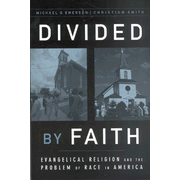
Conference Call for Papers
Divided by Faith: A Decade Retrospective
The John Wesley Honors College at Indiana Wesleyan University invites proposals for an interdisciplinary conference commemorating the tenth anniversary of Michael O. Emerson and Christian Smith’s groundbreaking book, Divided by Faith: Evangelical Religion and the Problem of Race in America, to be held on the campus of Indiana Wesleyan University in Marion, Indiana, on October 15-16, 2010.
The conference will begin Friday evening with a dinner and panel discussion with Michael Emerson on the impact Divided by Faith has had on scholars and church practitioners. Professor Emerson will also present a closing address Saturday afternoon.
Divided by Faith’s influence has been felt among a variety of academic disciplines. Over the past
decade, scores of historians, sociologists, and theologians have produced scholarship intersecting
with the book’s theme of the power of race in American religion. American religious historians
have explored the roots of segregated churches, sociologists have undertaken further investigations into ethnic and racial divisions of American congregations, and theologians have produced works suggesting that the days of racialized evangelicalism are numbered.
Ten years after its publication, the scholarly ground initially tilled by Emerson and Smith’s book remains fertile for researchers from multiple disciplines. In recognition of the growing scholarship being generated in this area, the John Wesley Honors College at Indiana Wesleyan University invites scholars working broadly on the overlapping topics of race and American religion to participate in this conference marking the tenth anniversary of Divided by Faith’s publication.
Ten years after its publication, the scholarly ground initially tilled by Emerson and Smith’s book remains fertile for researchers from multiple disciplines. In recognition of the growing scholarship being generated in this area, the John Wesley Honors College at Indiana Wesleyan University invites scholars working broadly on the overlapping topics of race and American religion to participate in this conference marking the tenth anniversary of Divided by Faith’s publication.
Successful proposals may consider a variety of topics related to the general theme of the
intersection of religion, race, and American society. Proposals should include an abstract of
approximately 500 words and a CV. Submissions from scholars and advanced graduate students
working in sociology, history, theology, or other relevant fields are encouraged. Presented papers
may also be considered for publication in an anticipated interdisciplinary volume on the influence of race in American religion. A limited amount of funding for travel may be available to students and scholars who are unable to obtain funding from their own institution.
Proposals must be received by July 15, 2010, and should be sent by email to rusty.hawkins@indwes.edu or by post to John Wesley Honors College c/o Rusty Hawkins; Indiana Wesleyan University; 4201 S. Washington; Marion, IN 46953.
Senin, 12 April 2010
Religion in the American West: New Blog and Seminar

Paul Harvey
Brandi Denison has started a new blog that some of you will be interested in: Religion in the American West, an offshoot of the Seminar on Religion in the American West of the American Academy of Religion. The seminar website will be featuring papers to be read in advance and discussed at the 2010 AAR in Atlanta. The new accompanying blog describes itself as follows:
This group blog is a place to initiate a rhizomatic mapping of religions in the American West. With multiple contributors focusing on a variety of places, times, and points of reference, this blog will aim to capture the diversity of narratives and approaches. Contributors will review books and journal articles, reflect on the rewards and challenges of teaching religion in the American West, share syllabi, comment on current events, point out conference paper calls, share primary source documents, and provide informal reflections on the subfield.
In the coming month, look for posts from James Bennett, Roberto Lint-Sagarena, Laurie Maffly-Kipp, Quincy Newell, Sara Patterson, and Tisa Wenger.
A warm welcome to Religion in the American West to the religion blogosphere.
Selasa, 09 Maret 2010
American Religion and Digital Humanities
BY MICHAEL PASQUIER
Recently, I’ve been collaborating with a small group of scholars on a digital humanities project. As is often the case, we’ve got lots of experience in the humanities—folks from across the disciplinary spectrum of the liberal arts—but hardly any grasp of the technical computer skills necessary to produce a website that meets the incredible standards of today. I’m the only historian of religion involved in the project, which, without getting into the details, focuses on antebellum America. Aside from the many things I’ve learned about xml-this and tangible-interface-that, I’ve also become familiar with the variety of digital humanities initiatives at universities, archives, libraries, and other academic organizations around the country. You don’t have to be a rocket scientist to recognize the potential for digital scholarship to transform the way we conduct ourselves as historians in the not-too-distant future. And yet, from what I can gather, there aren’t many folks in the field of American religious history who are at the cutting edge, or even the margins of digital scholarship.
There are plenty of good explanations for why most historians of American religion (and most historians in general) don’t involve themselves in digital humanities projects. First, there is a rather wide disciplinary gulf between computer people and humanities people. Effective communication and working relationships are rare. Truly hybrid scholars are even rarer. Second, the costs for starting a digital humanities project are astronomical compared to the typical research budgets of individual scholars. An NEH Level-1 s tartup grant, for instance, runs upwards of $25,000, while a Level-2 grant reaches $50,000. But when you’re looking at hiring consultants, traveling to conferences, hosting conferences, and paying graduate students to do the “dirty” work of inputting data—all for a measly prototype version of the still-imagined final product—there’s really no way of knowing how much everything will finally cost. Third, there’s the question of tenure. The framework for peer-reviewing digital humanities materials isn’t quite settled. The online scholarly organization NINES (Networked Infrastructure for Nineteenth-Century Electronic Scholarship) is one of the most respectable outlets committed to the production, collection, and dissemination of information about the digital humanities. For access to NINES’s scholarly projects, click here. For information on its review policy, click here. And for further readings on the digital humanities field, click here. You can also go to the website of the Alliance of Digital Humanities Organizations.
Below, you’ll find a short list of digital humanities projects out there. You’ll notice that some are more or less interactive than others; some resemble traditional archives while others incorporate more visualization tools; some are better suited for the classroom while others are strictly research oriented; some are prototypes and some are final products; some are free access and some require subscription; and some are already relevant to the study of religion in the United States. You’ll also notice how important it is for digital projects to have institutional and university support. Prepare to feel left in the dust.
University of Virginia’s Institute for Advanced Technology in the Humanities
Virginia Center for Digital History
Electronic Cultural Atlas Initiative
French and Spanish Missions in North America (This is one of the few sites directly related to religion in America. Our very own Art Remillard was one of its creators!)
Dickinson Electronic Archive
The Walt Whitman Archive
The Ambrose Bierce Project
The Edgar Allan Poe Digital Collection
The 19th-Century Concord Digital Archive
Virtual Jamestown
Digital Archaeological Archive of Comparative Slavery
Sites of (re)Collection
Electronic Enlightenment
Digital Karnak
Recently, I’ve been collaborating with a small group of scholars on a digital humanities project. As is often the case, we’ve got lots of experience in the humanities—folks from across the disciplinary spectrum of the liberal arts—but hardly any grasp of the technical computer skills necessary to produce a website that meets the incredible standards of today. I’m the only historian of religion involved in the project, which, without getting into the details, focuses on antebellum America. Aside from the many things I’ve learned about xml-this and tangible-interface-that, I’ve also become familiar with the variety of digital humanities initiatives at universities, archives, libraries, and other academic organizations around the country. You don’t have to be a rocket scientist to recognize the potential for digital scholarship to transform the way we conduct ourselves as historians in the not-too-distant future. And yet, from what I can gather, there aren’t many folks in the field of American religious history who are at the cutting edge, or even the margins of digital scholarship.
There are plenty of good explanations for why most historians of American religion (and most historians in general) don’t involve themselves in digital humanities projects. First, there is a rather wide disciplinary gulf between computer people and humanities people. Effective communication and working relationships are rare. Truly hybrid scholars are even rarer. Second, the costs for starting a digital humanities project are astronomical compared to the typical research budgets of individual scholars. An NEH Level-1 s
 tartup grant, for instance, runs upwards of $25,000, while a Level-2 grant reaches $50,000. But when you’re looking at hiring consultants, traveling to conferences, hosting conferences, and paying graduate students to do the “dirty” work of inputting data—all for a measly prototype version of the still-imagined final product—there’s really no way of knowing how much everything will finally cost. Third, there’s the question of tenure. The framework for peer-reviewing digital humanities materials isn’t quite settled. The online scholarly organization NINES (Networked Infrastructure for Nineteenth-Century Electronic Scholarship) is one of the most respectable outlets committed to the production, collection, and dissemination of information about the digital humanities. For access to NINES’s scholarly projects, click here. For information on its review policy, click here. And for further readings on the digital humanities field, click here. You can also go to the website of the Alliance of Digital Humanities Organizations.
Below, you’ll find a short list of digital humanities projects out there. You’ll notice that some are more or less interactive than others; some resemble traditional archives while others incorporate more visualization tools; some are better suited for the classroom while others are strictly research oriented; some are prototypes and some are final products; some are free access and some require subscription; and some are already relevant to the study of religion in the United States. You’ll also notice how important it is for digital projects to have institutional and university support. Prepare to feel left in the dust.
University of Virginia’s Institute for Advanced Technology in the Humanities
Virginia Center for Digital History

Electronic Cultural Atlas Initiative
French and Spanish Missions in North America (This is one of the few sites directly related to religion in America. Our very own Art Remillard was one of its creators!)
Dickinson Electronic Archive
The Walt Whitman Archive
The Ambrose Bierce Project
The Edgar Allan Poe Digital Collection
The 19th-Century Concord Digital Archive
Virtual Jamestown
Digital Archaeological Archive of Comparative Slavery
Sites of (re)Collection
Electronic Enlightenment
Digital Karnak
Kamis, 18 Februari 2010
Everywhere and Nowhere
Paul Harvey
In "Everywhere and Nowhere," in today's Inside Higher Education," Kevin Schultz (of the University of Illinois, Chicago) and I summarize some of the basic points made in our new article (of the same title) just out in the Journal of the American Academy of Religion -- you can access that article (free access) here, or in PDF form here. In the shorter piece and the article, we explore the paradox that "In a sense, religion is everywhere in modern American history, but nowhere in modern American historiography," as well as the two major exceptions to that generalization -- in the historiographies of civil rights and modern conservatism:
our general thesis that religion has been everywhere in history but nowhere in historiography has two major exceptions: in historical works on the civil rights movement and the religious right. When it comes to civil rights historiography, religious interpretations have vitally influenced scholarship; indeed, those who downplay the influence of religion tend to be the “heretics,” rather than the other way around. Meanwhile, we now have a small library of books on contemporary figures of the Religious Right, from Jerry Falwell to James Dobson to Phyllis Schlafly.
Noting these two exceptions raises important questions. For example, since these are two groups that have been historically racialized and/or marginalized, does that make it “safer” to incorporate religion more centrally into their intellectual trajectories? And to what degree do they influence the mainstream narrative? In other words, when we move from the mainstream to the margins, does it become safer to introduce religion as a central actor in people’s lives? And if so, will that scholarship focusing on the margins find its way into the mainstream narratives? The almost complete absence of religion from David Kennedy’s Freedom from Fear and James Patterson’s Grand Expectations, the two Oxford History of the United States volumes covering the period from 1932 to 1974, provides just cause for such reflection.
For an interesting companion piece looking at similar developments in the field of sociology, "Sociologists Get Religion," Inside Higher Ed., Feb. 9. A brief bit of it:
The new study on sociology arrives as a working paper of the Social Science Research Council, based on analysis of 587 sociology journal articles on religion, published between 1978 and 2007. The paper -- by David Smilde, a professor of sociology, and Matthew May, a graduate student, both at the University of Georgia -- finds much that would encourage scholars who want to see more research on religion. But the paper also raises questions about whether American sociologists may be too narrowly focused on some religious groups over others, and over the impact of outside funding, which is growing.
Among the key findings:
- The most important general sociological journals have been publishing a modestly growing number of articles about religion over the period studied.
- The articles show "a strong program" emerging on the role of religion in society. At the beginning of the period studied, religion was rarely the independent variable in the research, but by the end of the period, more than half of the articles had religion as the independent variable.
- For most of the period studied, there was an upward trend in positive findings about the role of religion and a downward trend in negative findings. The last five years have seen an increase in negative findings.
- American sociology's study of religion is dominated by religion in the United States and Christianity, with relatively little work on non-Christian religions or the Christian faith of non-Americans.
- Private funding has increased significantly for sociological research on religion, notably from several foundations.
- A positive correlation was found between receiving outside funding and positive findings about religion, although to the surprise of the authors, the strongest correlation was not from private sources of funds but from public sources. (The authors do not have a definitive theory on the source of this correlation and suggest it as a topic for further research.) The changes outlined in the report "are pretty significant" and show "a realization on the part of sociologists and other academics, too, of the enduring significance of religion in the modern world," said Neil Gross, an associate professor of sociology at the University of British Columbia. Gross studies the sociology of academic life, and while he noted "the stereotype that most professors don't pay attention to religion," he added that it has "never really been true."
Langganan:
Postingan (Atom)