Tampilkan postingan dengan label archives and museums. Tampilkan semua postingan

Senin, 06 Juni 2011

Foxed Paper and the Slight Smell of Mold: Reading, Browsing Actual Print Periodicals

Randall Stephens

Last week I visited the Midwestern Baptist Theological Seminary Library in Gladstone, Mo, just north of Kansas City. The staff was terrific and a bonus was an enormous collection of discarded books for sale--$1 or 50 cents/ea. I picked up Tim LaHaye's Battle for the Mind, and, oddly enough, a copy of Gordon Wood's Empire of Liberty.

Ideally, I hoped to browse through some denominational magazines and periodicals from the 1950s and 1960s for my next project on Christianity and rock/anti-rock. I was pleasantly surprised. The library had loads of Baptist and SBC serials dating back to the early years of the Cold War. Some of the titles I browsed through: Baptist Quarterly Review; Home Life; Baptist Training Union Magazine; The Student (A Baptist-style Jesus People-ish magazine, which Sam Hill actually wrote in). In addition to all that there were extensive runs of Christianity Today and Christian Century, along with quite a few other gems.

The Southern Baptist Periodical Index was a real help. But blast the indexers for not cataloging what I wish they had! (Page after page after page on "Missions.") I have seldom used the Index to Religious Periodical Literature (Chicago : American Theological Library Association.) But it's a tremendous resource for work on post-war American religion. And it gives a pretty good indication of the more popular magazines and journals that circulated at the time. See below the first page of the edition for 1971, listing a range of publications. (Click to enlarge.)


So, here are a few questions for all the RiAH research nerds and archive troglodytes out there: What do you suppose were the largest circulating and/or most influential denominational periodicals of the 1950s and 1960s? Which ones are the best for getting a sense of what men, women, and children in the pews were thinking? Why?

Selasa, 06 Juli 2010

How I Spent My Summer Vacation (Know Your Archives Part IX)

by Matt Sutton

I was hesitating to do a 2010 version of “Know Your Archives” for the sake of the Springfield, MO, Chamber of Commerce. But since Paul asked for it…

In late May I returned to the Flower Pentecostal Heritage Center for research. I was there eight years ago, on my first major research trip as a graduate student. At that time, I had no funding, but was offered access to a confidential file I really wanted to see on the condition that I show up in person. I did. I stayed as a shady Red Roof Inn and took the public bus to the archives each day. I figured my less-than-favorable view of the area was colored by my economic status at the time.

This summer, traveling as faculty of an under-funded state institution, I managed to swing a room at the Holiday Inn Express (with a view of the minor league baseball field) and a rental car (a very manly Chevy HHR) from Enterprise. The Assemblies’ archivists continue to be wonderful, and while there I met a recent Duke PhD who regaled me with stories of DVDs she had been watching of “amateurs and their machine guns” when not perfecting for herself the name-it-and-claim-it philosophy she was studying (she landed a great job—it must work). We checked out the picture of Grant Wacker’s grand-daddy in the pentecostal Hall of Fame and I learned that the father of another famous religious historian played a role in one of my favorite movies, A Thief in the Night.

Sadly, Springfield still looked the same as it did almost a decade ago. Jogging through downtown reminded me of walking around Detroit. It is a sad, bombed-out city.

From there I went to New York, first to do research at the Schomberg Center. Either New York is regressing, or I was in the wrong places at the wrong times. At one point a guy on the subway started flipping out. A woman pulled a canister of pepper spray out of her purse, un-holstered it, and threatened to pull the trigger. I prayed that I would not experience the effects of pepper spray in a small, confined, underground area (luckily I didn’t).

From there it was off to the NY Public Library. I spent a few hours working at a computer while another man quietly worked next to me. At one point another patron, intrigued by something on my neighbor’s screen, stopped and asked him about it. Out of nowhere he started screaming at her, calling her all sorts of expletives. Ah… big city life.

With the subway and the library providing some challenges, I decided to relax by jogging in Central Park. All was well until I passed an older Russian man, who for reasons that are still not clear to me, started screaming—at me. He must have known that I spent the ‘80s watching Stallone, Schwarzenegger, Red Dawn, War Games, and Spies Like Us. I just kept jogging.

From there it was on to the FDR library in beautiful Hyde Park. Trying to save some money, I opted not to rent a car and instead to stay in the Golden Manor Motel across the street from the library. I booked the $55/night room, but got a free upgrade to the $65/night room. It smelled worse than a hundred-year old Michigan basement on a hot humid day. I will spare you the rest of the details. An up-and-coming new Yale PhD told me that it was a decent place to stay. Apparently Yale is also suffering from the financial crisis. Nevertheless, the local pizza, a forty from the quickie-mart down the street, and the television remote-control (which I had to check out from the front desk) made for one exciting evening watching justice prevail as the Lakers stomped the Celtics to win the NBA championship.

Despite these travails, I returned home with suitcases full of scanned images and photocopies. Now, I better get back to actually writing this stuff up…

Archive Envy Redux

Paul Harvey

Over at Religion in the American West, James Bennett writes of archive envy as he bides his summer time stay-at-home-dad-ing and looks forward to future archival research ventures in his new field of religion in the West. Bennett's memories and query recall a thread here which went several rounds last year, and which we'll invite further reflections from anyone interested: Know Your Archives, the last entry of which was quite recently, Know Your [Digital] Archives.

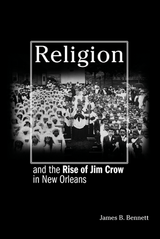
Bennett's post tells of past experiences with at Josephite Fathers archive in Maryland, where he researched for his book Religion and the Rise of Jim Crow in New Orleans, and concludes with this query:

For me, one of the most exciting parts of embarking on a new project is anticipating the new places I’ll do my research. What treasure troves of religion in the American West have you come across?

He invites posts there on experiences researching in archives on Religion in the West, especially the scruffier or off-the-beaten-path places where much of our favorite material and many of our most memorable experiences may have been found. You research road warriors, feel free to add to our Know Your Archives series with a post here or at Religion in the American West.

Selasa, 01 Juni 2010

Know Your [Digital] Archives

Michael J. Altman

I wrote a blog post for the Hacking the Academy project last week where I argued that digital collections could change the way we think about graduate seminars because they allow for easier original research without having to leave campus. A while back Michael Pasquier wrote a great post on digital humanities and religious history.  Building on his list of sources I wanted to point out two more great online archives I've used in the past year to write seminar papers that will eventually make their way (in some form) into my dissertation.

First, there is the pair of Making of America collections--one at Cornell and one at the University of Michigan.  As the websites describe them, they are:

Making of America (MOA) is a digital library of primary sources in American social history primarily from the antebellum period through reconstruction. The collection is particularly strong in the subject areas of education, psychology, American history, sociology, religion, and science and technology.
 The Cornell collection contains 267monographs and over 100,000 journal articles while the Michigan collection contains about 10,000 books.

The second collection is, I believe, a little less well known.  The University of Pittsburgh has a digital collection of 19th Century Schoolbooks that is fascinating to browse through.  It is a smaller collection, only 140 volumes, but there is some great stuff in there for folks interested in American civil religion throughout the century.

Both of these collections have titles and journals that deal with missions, religious education and other things of obvious interest to historians of religion.  However, the full-text searchability of these collections makes them even more useful.  In my own research I've turned up really interesting references to South Asian religions in places I would have never found in a traditional brick and mortar archive.  I also think these sorts of collections have a lot of potential in the classroom--both for teaching and as resources for original student research.  It's one thing to lecture on the tensions between North and South in the 1850s, but reading a southern schoolbook versus a northern schoolbook offers a very different feel for those tensions.

If anyone knows of other good digital collections for religious history let us know.

Kamis, 25 Maret 2010

"Thieves break through and steal" at the Methodist Archives

Paul may indeed be right that "Methodists just aren't that cool," but historical documents stolen from their archives still apparently fetch a hefty sum on the black market. Just ask William John Scott, Drew University freshman and (former) employee at the school's United Methodist Archives and History Center, who was arrested last week on charges of stealing several valuable documents from the archives (including 21 of the 23 Wesley letters the school owns, and "roughly 11 other important and historical documents, ... including letters from five United States presidents"). Scott is currently being held on $50,000 bond and could face up to 10 years in prison.

From the report in the New York Times:

The university became suspicious, according to an account provided by prosecutors, after an antiques dealer in England alerted officials in its library that he had been approached by someone offering to sell him original letters from the Wesleys. Ten of the letters arrived on March 3, via FedEx, according to the complaint, with two suffering some damage in transit.

Prosecutors said the unprofessional way the valuable documents were shipped did not sit well with the dealer, who then consulted Drew officials, given their expertise and collection of Wesleyana.

After a quick search of its archives, the university estimated that 21 to 23 of its Wesley letters appeared to be missing and contacted the F.B.I. The missing lot included a valuable letter, worth more than $5,000, from John Wesley to a friend and supporter, George Merryweather, dated Dec. 20, 1766. ...

University officials had not been aware that the presidential letters were missing until the search of the dorm room. But they were optimistic on Monday that they would ultimately recover any lost items. “For Methodists, these are treasures and so we’re hoping to get them back,” said Christopher Anderson, the Methodist librarian at Drew.

Selasa, 09 Maret 2010

American Religion and Digital Humanities

BY MICHAEL PASQUIER

Recently, I’ve been collaborating with a small group of scholars on a digital humanities project. As is often the case, we’ve got lots of experience in the humanities—folks from across the disciplinary spectrum of the liberal arts—but hardly any grasp of the technical computer skills necessary to produce a website that meets the incredible standards of today. I’m the only historian of religion involved in the project, which, without getting into the details, focuses on antebellum America. Aside from the many things I’ve learned about xml-this and tangible-interface-that, I’ve also become familiar with the variety of digital humanities initiatives at universities, archives, libraries, and other academic organizations around the country. You don’t have to be a rocket scientist to recognize the potential for digital scholarship to transform the way we conduct ourselves as historians in the not-too-distant future. And yet, from what I can gather, there aren’t many folks in the field of American religious history who are at the cutting edge, or even the margins of digital scholarship.

There are plenty of good explanations for why most historians of American religion (and most historians in general) don’t involve themselves in digital humanities projects. First, there is a rather wide disciplinary gulf between computer people and humanities people. Effective communication and working relationships are rare. Truly hybrid scholars are even rarer. Second, the costs for starting a digital humanities project are astronomical compared to the typical research budgets of individual scholars. An NEH Level-1 startup grant, for instance, runs upwards of $25,000, while a Level-2 grant reaches $50,000. But when you’re looking at hiring consultants, traveling to conferences, hosting conferences, and paying graduate students to do the “dirty” work of inputting data—all for a measly prototype version of the still-imagined final product—there’s really no way of knowing how much everything will finally cost. Third, there’s the question of tenure. The framework for peer-reviewing digital humanities materials isn’t quite settled. The online scholarly organization NINES (Networked Infrastructure for Nineteenth-Century Electronic Scholarship) is one of the most respectable outlets committed to the production, collection, and dissemination of information about the digital humanities. For access to NINES’s scholarly projects, click here. For information on its review policy, click here. And for further readings on the digital humanities field, click here. You can also go to the website of the Alliance of Digital Humanities Organizations.

Below, you’ll find a short list of digital humanities projects out there. You’ll notice that some are more or less interactive than others; some resemble traditional archives while others incorporate more visualization tools; some are better suited for the classroom while others are strictly research oriented; some are prototypes and some are final products; some are free access and some require subscription; and some are already relevant to the study of religion in the United States. You’ll also notice how important it is for digital projects to have institutional and university support. Prepare to feel left in the dust.

University of Virginia’s Institute for Advanced Technology in the Humanities

Virginia Center for Digital History

Electronic Cultural Atlas Initiative

French and Spanish Missions in North America (This is one of the few sites directly related to religion in America. Our very own Art Remillard was one of its creators!)

Dickinson Electronic Archive

The Walt Whitman Archive

The Ambrose Bierce Project

The Edgar Allan Poe Digital Collection

The 19th-Century Concord Digital Archive

Virtual Jamestown

Digital Archaeological Archive of Comparative Slavery

Sites of (re)Collection

Electronic Enlightenment

Digital Karnak

Kamis, 10 Desember 2009

Know Your Archives, Part VIII: American Catholic Archives Tip Sheet

BY MICHAEL PASQUIER

As all red-blooded Protestants of the 19th century loved a good convent captivity narrative, so too do all blue-blooded historians of the 21st century love a good archival horror story. Sadly, I have no such tale to add to the genre. I spent the better part of six years in and out of archives specializing in the history of American Catholicism. I concentrated my attention on Catholics in the antebellum United States. And I came away with the impression that most archivists of Catholic institutions hardly resemble the image of the gruff guardian of the church’s secrets whose sole purpose in life is to foil the research agenda of even the most alter-boyish of academics. Perhaps this has to do with the apparent harmlessness of my research topic—French émigré priests in the trans-Appalachian West. Or perhaps it’s to do with the fact that, as someone once told me, when it comes to gaining access to the personal papers of Catholic priests, the deader the better.

At any rate, here are a few archives that may help someone out there interested in 19th-century American Catholicism:

Thanks to the collecting acumen of 19th-century librarian and historian James Edwards, the University of Notre Dame Archives (UNDA) has become a sort of clearinghouse for all-things-Catholic in the United States. UNDA’s commitment to the accumulation and dissemination of Catholic Americana made this former graduate student’s life a whole lot easier. One week I could concentrate on the Diocese of Bardstown, Kentucky, collections, and the next I could shift gears to the Archdiocese of New Orleans, finding time in-between to consult microfilm versions of archives previously accessible only in France and Italy. Side note: don’t remind the archivists and priest-historians of Louisville and New Orleans of your love for UNDA. A Louisville priest once told me about his plan to sue UNDA for “stealing” documents related to Kentucky Catholicism; fortunately, cooler heads have prevailed. And if you find yourself in the Archives of the Archdiocese of New Orleans, you’ll notice that most 19th-century manuscripts are photocopied; that’s because an archbishop in the 1890s gave them to Notre Dame's Edwards for safekeeping. Let’s just say the New Orleans folks don’t brag about this fact.

Before you plan your trip to UNDA, look into applying for a Research Travel Grant from Notre Dame’s Cushwa Center for the Study of American Catholicism. You will not find an institution more supportive of American Catholic studies in the United States. I personally owe an incredible debt of gratitude to Timothy Matovina and Kathleen Sprows Cummings of the Cushwa Center for their kindness, generosity, and criticism. They are true ambassadors of the field.

If 20th-century American Catholicism is your thing, then the American Catholic Research Center and University Archives at Catholic University of America is a fine place to start. I consulted the papers of Peter Guilday and John Tracy Ellis (arguably the founding [ordained] fathers of American Catholic history) during my visit a few years ago. Manuscripts related to the Second Vatican Council are especially relevant to recent trends in the field of American Catholic studies. And CUA’s archivists have started to digitize some of their collections, including documents on the burning of the Ursuline Convent of Charlestown, Massachusetts, and the First Vatican Council (the 19th century, it should be said, is also well represented in CUA’s holdings). The archives also offer the Dorothy Mohler Research Grant to folks on an annual basis. Again, an all-around outstanding place to conduct research.

When it comes to regional archives (as opposed to the more national-oriented repositories at UND and CUA), I’d single out the Associated Archives of St. Mary’s Seminary and University in Baltimore, Maryland. Located on the campus of, you guessed it, St. Mary’s, the Associated Archives include the collections of the Archdiocese of Baltimore, St. Mary’s Seminary and University, and the Sulpicians of the United States, effectively offering historians of the early American Catholic Church with no better place to get one’s sea legs. The facilities were recently renovated and the archivists are incredibly generous with their expertise as both librarians and historians.

Lastly, a word of caution to those interested in American Catholic studies of the 19th and 20th centuries. Historians of American Catholicism (myself included) are in the habit of focusing most (if not all) of their attention on Catholic-specific archives like UND, CUA, and St. Mary’s. There are very good reasons for this pattern, not the least of which is the practical appeal of one-stop-shopping. But my recent work in earlier periods of colonial American history—periods covered less thoroughly in the collections of American Catholic repositories—has made me realize just how much I may have missed in my 19th-century studies. Walking into a place like UNDA can be exhilarating—where to begin? when will it end? so much!—but it can also be suffocating.

Photo #1: Knute Rockne, University of Notre Dame
Photo #2: United Mine Workers of America, Catholic University of America
Photo #3: Altar Boy Procession, St. Mary's Seminary and University

Minggu, 06 September 2009

Know Your Archives, Part VII: A Cry From the Wheaton Wilderness


The following is from Eric Brandt, a graduate student at Wheaton who's going to the Burke Library at Union Theological Seminary to do some research.

In the spirit of the recent posts on archival escapades, I am curious to know if anyone has been to the archives of the Burke Library at Union Seminary (NYC) in the Columbia University Libraries system. I'm a grad student at Wheaton College and in the beginning stages of research on the American Evangelical Alliance. As far as I'm aware, the Burke Library houses the largest collection of material from the Alliance. If anyone has been to the Burke archives, I'd be very interested to get some advice along the lines of what's been discussed on the blog recently (logistics, staff, work environment, etc.). Contact me at eric.brandt AT my DOT wheaton DOT edu, or better yet leave your advice in the comments section here.