Tampilkan postingan dengan label Christopher's posts. Tampilkan semua postingan

Senin, 20 Juni 2011

Blackness, The Book of Mormon, and Broadway: Part II

Christopher Jones

(cross-posted at the Juvenile Instructor)

When the news feed on my facebook began to be flooded with links to the same page last week, I excitedly clicked over the the Washington Post On Faith Op-Ed by John Mark Reynolds, professor of Philosophy at Biola University. Reading the title,"Amos and Andy and the Book of Mormon," I hopefully (but mistakenly) assumed that the article was evidence of Jared Farmer's critique--that lurking beneath the portrayal of religion in the Book of Mormon musical was not-so-subtle racism in the show's portrayal of Africans--starting to gain traction.

Instead, I proceeded to read the following:
"The Book of Mormon is a minstrel show for our present age with Mormons as the joke.

Ugly plays did not by themselves produce the Klan or keep some Americans from voting for African-Americans. Original sin was enough for that, but minstrel shows did give racism an artistic and comedic whitewash. When Americans were hurt by the cruel stereotypes, they were told it was 'just a joke' and were painted as petty for not laughing along."
Mormon, Reynolds appears to suggest, is the new Black. The comparison is problematic to say the least, even with Reynolds's caveat that "no group has been as cruelly treated as African Americans." Mormonism's "history of being persecuted" that Reynolds mentions certainly deserves attention, and has received such quite recently from several up-and-coming historians and scholars, including Patrick Mason, whose excellent new book on anti-Mormon violence in the postbellum South deserves wide readership, and Spencer Fluhman, whose forthcoming monograph from UNC Press on anti-Mormon literature in the nineteenth century can hardly come soon enough. In fact, instead of situating the Book of Mormon musical within the tradition of minstrel shows of yesteryear, Reynolds would do well to pick up a copy of Megan Sanborn Jones's recent volume from Routledge Press, Performing American Identity in Anti-Mormon Melodrama. Anti-Mormonism, it turns out, has its own history of being portrayed and performed on the stage; perhaps we would do well to look at and understand that history before making comparisons to blackface and minstrelsy.

Besides, by invoking Mormonism and race in the same breath, Reynolds wades into troubled waters. The subject is far more complicated than he acknowledges, and no op-ed can adequately address the topic. Mormons, to be sure, have a history of being portrayed as something other than racially white. Nate Oman's fine research on the legal aspects of this story is telling, and Paul Reeve's book-in-progress (under contract with OUP and entitled Religion of a Different Color: Race and the Mormon Struggle for Whiteness) promises to expand on the social and cultural aspects of it all in the 19th and 20th centuries.

And Mormons, of course, have not always been innocent victims in America's racial history, as even a quick glance over at the Juvenile Instructor's posts on Mormonism and race reveals. From the so-called priesthood ban, which denied the admission of Africans and African Americans to the Mormon priesthood and restricted their entry in Mormon temples until finally being rescinded in 1978, to the Book of Mormon's complex portrayal of American Indians, to the public opposition to the Civil Rights Movement by several high-ranking Mormon officials in the 1950s and 1960s, Mormons have often found themselves on the wrong side of America's pathetic history of racism. Mormons themselves even participated in and put on their own minstrelsy shows well into the 20th century.

Perhaps most glaringly, though, Reynolds's comparison of the Book of Mormon musical to "Amos 'n' Andy" passes over entirely the portrayal of Africans in the show. While lamenting "the cruel, tasteless jokes" and "mindless mockery" leveled at the Mormons, he ironically seems to have missed the "talented African American actors hamming up 'African-ness' for cheap laughs."

And in a final touch of irony too rich not to mention, several of my Mormon friends--most of whom, like the op-ed's author, are politically and socially conservative and outspoken supporters of Mitt Romney--who linked to Reynolds's piece on facebook with apparent satisfaction that someone from outside the church was finally defending their religion and co-religionists, excerpted the following paragraph to accompany their link:
"This new play will pander to our prejudices and treat our Mormon neighbors as we would never wish to be treated. Some Americans will allow it to confirm unthinking prejudice, while cowardly Mormons will applaud it hoping for crumbs of respectability."
Mormons applauding something while hoping for crumbs of respectability, indeed.

Selasa, 14 Juni 2011

Broadway, The Book of Mormon, and Blackness

Christopher Jones

(cross-posted at Juvenile Instructor)

Over at Religion Dispatches, Jared Farmer, professor of history at the State University of New York at Stony Brook and author of the excellent On Zion's Mount: Mormons, Indians, and the American Landscape, reviews the multiple Tony Award-winning broadway play, The Book of Mormon.

By all accounts, Trey Parker and Matt Stone's satirical look at Mormon missionaries in Africa is funny. With very few exceptions, everyone I've talked to that has seen it---including a number of believing Latter-day Saints---has praised both its humor and its ultimately touching (if somewhat condescending) message about religion: Religion (especially the brand of religion preached by Mormons) is naive, silly, and based on absurd beliefs and unprovable truth claims, but that belief can ultimately motivate adherents to do good, help others, and improve the world.

Farmer largely agrees with this assessment. "The Book of Mormon is fun, and occasionally uproarious," he writes. "If the giddy laughter I heard at the sold-out show on Easter Sunday is any indication, theatergoers love it." He then goes on to offer a more complete critique of the play than I'd previously seen, noting the ways in which Parker and Stone's portrayal of Mormon missionaries is sometimes on target ("Pairs of missionaries (“companions”) do often resent each other; sexual tension, homophobia, homesickness, and boredom strain the relationships of these co-workers/roommates. Many missionaries dislike their geographic assignments. Even as they compete against each other for baptisms in the field, missionaries often struggle to convert a single person in two years of service.") and other times not even close ("Pairs of missionaries are never equals; there is always a “senior companion” and a “junior companion.” The various missionaries (men and women) in an area are supervised by one (male) “mission president” and his wife, not by a three-person bishopric. ... The missionary program certainly no longer encourages Latter-day Saints to gather in Salt Lake City."), and the concludes by suggesting that "Most egregiously, the play mischaracterizes Mormon theology." This is tricky territory, as Mormonism has no systematic theology, and some of Farmer's points seem more credible to me than others. I think he's right that "Unlike evangelical missionaries who want to save you from going to hell, LDS missionaries want to help you reach your potential in heaven. Mormon eschatology is radically egalitarian, and very American: everyone gets a second chance, everyone wins," but his suggestion that "for Joseph Smith and his followers, the existence of the translated text—proof of Smith’s prophetic powers—was more important than its contents" is open to debate. Farmer's argument echoes that of a former generation of historians, but much new research on early Mormonism suggests exactly the opposite; that early Mormons read the book's contents with care and that the Book of Mormon's teachings shaped early Mormon theology in ways previously ignored.

Couched in between Farmer's analysis and critique of the Book of Mormon musical, though, is something that has been repeatedly mentioned in passing by numerous friends but never fully teased out---a seemingly significant critique of the Broadway hit that those too focused on the delightful ways in which the South Park creators mock Mormons have opted to either ignore or quickly dismiss. I speak of the show's racial overtones. Farmer summarizes the salient points:
The plot twists at the end raise questions about the racial politics of the show. Only a threat of American violence saves the villagers from the tyranny of the local warlord. Only the ingenuity of the white men provides Africans a useful religion. The dewy-eyed boys from Utah share the genius of Joseph Smith: the Yankee spirit of invention. The musical’s happy ending, complete with black missionaries in neo-Mormon garb, contains a strong note of American chauvinism.
And then offers his most stinging critique of the musical:
I cringed in my seat at the Eugene O’Neill Theatre as I watched talented African American actors hamming up “African-ness” for cheap laughs. It brought to mind the long, shameful history of Americans—black and white—performing blackness (often in blackface) on stage for white audiences. The Book of Mormon wants to have it both ways. It wants to make fun of The Lion King and its African stereotypes by substituting more authentic stereotypes. It wants to be transgressive and conventional, blasphemous and saccharine. This combination is not impossible, but incredibly difficult to achieve. Parker, Stone, and Lopez don’t pull it off.
If nothing else, Farmer's critique on this point raises important questions about the intersections of religious and racial representation and satire, and that, I think, is a conversation worth having.

Sabtu, 04 Juni 2011

Richard Bushman, Robert Orsi, and Mormonism's "Abundant History"

Christopher Jones

(cross-posted at Juvenile Instructor)

Over at the website for Dialogue: A Journal of Mormon Thought, the editors have posted a discussion (moderated by Susanna Morrill, associate professor of religious studies at Lewis and Clark College) between noted historians and scholars of religion Richard Lyman Bushman and Robert Orsi. Bushman and Orsi reflect on the potential Orsi's approach to "supernatural presence" and "abundant events" in modern Catholicism holds for scholars of Mormonism.

The conversation between these two seasoned scholars, which touches on the relationship between the scholar and her subjects, how to make sense of revelatory visions and the writing of the Book of Mormon, and the vocabulary used to describe such occurrences, deserves to be read in its entirety, but I'm including a brief excerpt below:

Richard: You also speak of the routes of influence radiating from such events. That’s a nice way of putting it; the word “routes” suggests an approach to what happens in consequence. Where do the abundant events lead? But it occurs to me that some of the responses of the Marian groups, which taken together could be thought of as a morphology of an abundant event, take a different form in the case of Joseph Smith. Rather than the abundant event dissolving the boundaries of subjectivity and establishing intimacies, in Joseph Smith’s case it leads to structure and organization. The people who are converted take on priesthood offices and go on missions; they have council meetings. As the influence radiates still further, you get minutes of the meetings and letters and all the paraphernalia of organization. I thought it would be interesting to talk about how events that are so similar at the core lead in different directions in the aftermath.

Robert: I appreciate the difference. I was thinking about that concept as I read the very powerful final chapter of Rough Stone Rolling, in which the people left behind at Nauvoo after Joseph’s murder continued to work on building the temple, though they knew they weren’t going to be using it after it was done because they would be leaving Nauvoo. It seemed to me that we needed some word to get at what happens between Max Weber’s idea of initial charismatic leadership of a new religion and its eventual institutionalization. It seems as if something else is going on there, almost as if the stones themselves were charismatic–the stones of this sacred building that would otherwise signify the routinization of Mormonism. So I take your point. It does lead in different directions, which might have to do with the specific peculiarities of modern Catholicism and modern Mormonism. I was struck by–as you want to put it–the radiation outwards of Joseph’s spirit and his vision through the organization.
Go here to read the rest of the interview.

Senin, 02 Mei 2011

Barack Obama and Óscar Romero

By Christopher Jones

Just over a week ago, I returned from a restful and relaxing vacation in El Salvador, where I enjoyed the beach, fantastic food, stress-free post-comps reading (in a hammock, no less), and spending time with family. I also spent a day in Santiago de María, a relatively small town located in the mountains of Usulután where my mother-in-law grew up (and where some of her family still lives). Among my favorite things in Santiago de María is driving down Ave. Monseñor Óscar Arnulfo Romero, named after the martyred Catholic archbishop whose assassination at the hands of U.S.-backed death squads in 1980 helped trigger the outbreak of the Salvadoran Civil War (Romero's brief stint at Bishop of the Diocese of Santiago de María immediately preceded his advancement to Archbishop of El Salvador). I noticed this time that the mural of Romero downtown had been touched up since my last visit there, with a note indicating that it had been done as part of last year's commemoration of the 30th anniversary of Romero's death.

My visit to El Salvador came almost exactly one month after President Barack Obama's visit to Central America's smallest country--a trip that included a much-heralded stop at the tomb of the deceased Archbishop. In large part because of the events in Lybia and elsewhere turned Americans' attention elsewhere, Obama's trip to El Salvador and Romero's tomb received little attention from pundits and commentators--an unfortunate oversight for those interested in the intersections of religion and politics on the international stage. I've been able to track down two insightful pieces reflecting on the significance of the event. The first, authored by Greg Grandin and published at The Nation, uses the opportunity to decry the immorality of the Central American Free Trade Agreement, concluding by offering his hope that
Obama finds inspiration in Oscar Romero’s life: Romero, after all, started his public career as a cautious moderate who believed he could quietly work with El Salvador’s ruling class to coax needed reform. The reality of Salvadoran society forced his conversion into an outspoken, confrontational leader who directly attacked those who perpetuated what he called “structural sin:” “When the church hears the cry of the oppressed,” Romero wrote before his murder, “it cannot but denounce the social structures that give rise to and perpetuate the misery from which the cry arises.” If Romero was alive today, he would recognize CAFTA’s Chapter 10, along with the broader, disastrous policies Washington is pursuing in the Mexico-Central America-Colombia security corridor, as prime examples of “structural sin.”

The second article, posted at Religion Dispatches by Michelle Gonzalez Maldonado, who speculates on the potential affect Obama's visit might have on Romero's candidacy for beatification, but who ultimately sees "Obama’s visit as symbolic of a shift in US attitudes toward Central America":
Gone I hope is the era of intervention and manipulation. The Central America of today is different from the one that saw Romero’s blood shed while saying mass. Some would argue that the crisis of gangs and drugs that is engulfing this region is leading to a crisis that will eclipse the civil wars of the 1980s and 1990s. And yet in spite of the growing violence, figures like Romero give us hope.
As Romero prophetically stated, “I should tell you that, as a Christian, I don’t believe in death without resurrection. If they kill me, I will be resurrected in the Salvadoran people.” The Salvadoran people today, the Catholic Church as a whole, and all who stand as defenders of human rights and denounce injustice should take after Obama and spend a moment remembering this modern-day martyr who did not die in vain but whose dangerous memory continues to empower and inspire us today.
While both of these scholars know much more about Latin American politics and religion than I, their reflections only scratch the surface of this all, and questions regarding the significance of Obama's visit to Romero's tomb remain. (Among the least-significant but most-perplexing is how on earth right-wing pundits did not jump on this opportunity to smear Obama by linking him anew to liberation theology). We're left to wonder with Maldonado if Obama's visit may in fact play any part in Romero's potential beatification (and the contested politics of memory and memorialization more broadly). And what, if anything, does Obama's visit reveal about his own Christianity? Perhaps most significantly, what does all of this mean to the Salvadoran people (including the million-plus Salvadoran immigrants in the U.S.)--those to whom Romero devoted his own ministry?

Jumat, 25 Februari 2011

Reassessing John Brooke's The Refiner's Fire


Christopher Jones

In 1994, Cambridge University Press published John L. Brooke's The Refiner's Fire: The Making of Mormon Cosmology, 1644-1844. As indicated by the subtitle, Brooke's work aimed for a wholly unique and provocative re-interpretation of Mormonism's origins. While it was generally met with praise in the academy and won the Bancroft Prize in 1995, the book was almost universally panned by historians who specialized in Mormon history, and received its harshest (and most polemic) critiques from believing Latter-day Saint scholars (and especially from pseudo-scholarly apologists, some of whom seemed intent on making the most out of the publicity that might come with reviewing an award-winning book).

In the almost two decades since Brooke's work appeared, the sometimes hostile and always intentionally-unique world of Mormon studies has undergone significant changes (though the ever-earnest apologists remain). So have the disciplines of history and religious studies. All of these changes have led a younger generation of Mormon historians to reconsider Brooke's argument and approach. When I recently re-read The Refiner's Fire while preparing for comps, I was surprised at what I'd missed last time through and at how much I liked much of what he was trying to do (and indeed, did). Over at the Juvenile Instructor, Matt Bowman has posted his own brief thoughts on The Refiner's Fire, together with those of Steve Fleming, whose currently in-progress dissertation aims to expand on and revise some of Brooke's central ideas, and Mark Ashurst-McGee, editor of the Joseph Smith Papers project, whose research focuses on Joseph Smith and folk magic and Joseph Smith's social and political thought.

Matt explains by way of introduction his own take on the book and its importance:

It’s my opinion that the further we get from the publication of John Brooke’s The Refiner’s Fire, a wildly inventive examination of Mormon origins through the lens of various esoteric European -isms (including occultism, the quest for hidden and often mysterical knowledge; hermeticism, a particular brand of the occult supposedly derived from ancient Egypt and for Brooke basically a restorationist concept that sought to regain Adam’s access to God, and the non -ism alchemy, or the transformation of the mundane into the exalted) the more interesting a book it seems. Its flaws - most revolving around the difficulty of transplanting such quirky early modern concepts as these to frontier America, though Brooke gives it a go with the vehicle of Masonry – have been well documented; its strengths have been less well recognized by LDS historians, who have tended to find the book, frankly, weird. Thus, too many of the doorways Brooke opened have remained unused.
The whole entry is really quite interesting and well worth the read.

Rabu, 12 Januari 2011

Methodism, Mormonism, and the Atlantic World

Christopher Jones

Cross-posted at the Juvenile Instructor.

____________________________________________

I recently opined on the benefits of situating the rise of Mormonism within the larger historical context of the (late) early modern Atlantic world. I would like now to briefly outline one example of what such an approach might look like. When I wrote my MA thesis on the subject of Methodist influence on early Mormonism, I was mostly interested in exploring the specific ways Methodist converts to Mormonism left their mark on early Latter-day Saint religiosity and paid little attention to the ways in which Methodism and Mormonism related to one another on a broader scale of Christian, American, or Atlantic history. In light of my more recent reading and research, however, I find it difficult to separate those two questions.

In chapter three of my thesis, I explored the ways in which Mormon converts from Methodist backgrounds understood their prior affiliation with Methodism as expressed in public sermons, tracts, and especially in private (and occasionally published) spiritual narratives. I found that contrary to sweeping assessments that Mormonism’s doctrine of “restoration made it abundantly clear that God had sanctioned one true church and that all others were false,” and that this identity left “no room for abstractions, ambiguities, or shades of gray” in the way Mormons understood Protestant traditions [1], Mormon converts from Methodism more often than not understood their conversion to Mormonism not as a wholesale rejection of Wesleyan religion, but rather as a final step in their search for truth. These converts explained that it was their former experience as Methodists that led them to accept the Mormon gospel. Methodism was thus insufficient or incomplete, not altogether incorrect, and Mormons recalled enjoying certain spiritual gifts, learning essential “truths,” and experiencing true Christian conversion during their time as adherents to Methodist teachings and churches. Joseph Smith, therefore, purportedly declared to the Methodist itinerant Peter Cartwright that “he believed that among all the Churches in the world the Methodist was the nearest right, and that, as far as they went, they were right,” and that “if the Methodists would only advance a step or two further, they would take the world. We Latter-day Saints are Methodists, as far as they have gone, only we have advanced further, and if you would come in and go with us, we could sweep not only the Methodist Church, but all others, and you would be looked up to as one of the Lord’s greatest prophets.” [2]

Related to Smith’s assertion that Methodists had “stopped short” of claiming the entire Christian gospel was the suggestion made by other converts that Methodists not only stopped short but even took a backward step by forsaking some of John Wesley’s teachings. Of course such a claim was not new or novel, and in the late eighteenth and early nineteenth centuries, many disgruntled Methodists leveled similar charges against leaders of the Methodist Episcopal Church in America and the Wesleyan Methodist Church in Great Britain, leading to a splintering of the movement over issues of church governance, mode and manner of worship, social issues, and theological emphases. Perhaps not surprisingly, it was from these several splinter groups that so many of Mormonism’s early converts and leaders came. And it was those same individuals who repeated anew the charges that mainline Methodists in the 1830s and 1840s had forsaken pure Wesleyanism. Brigham Young, who aligned himself with the Reformed Methodist Church prior to his conversion, thus had little kind to say about the Methodists of his day but held John Wesley in high regard, remarking on one occasion that he considered Wesley to be “as good [of a person] as ever walked on this earth, according to his knowledge,” and expressed his belief that “had the Priesthood been conferred upon [Wesley], he would have built up the kingdom of God in his day as it is now being built up. He would have introduced the ordinances, powers, grades, and quorums of the Priesthood.” [3] William Appleby (and Parley Pratt), meanwhile, praised Wesley’s take on spiritual gifts, and John Taylor, who led a small Methodist sect in Canada before converting to Mormonism, once accused Methodist preachers he encountered in the British Isles of forsaking their Wesleyan heritage, charging that “surely Messrs. John Wesley, John Nelson, Fletcher, and Bramwell, who were ornaments of the Methodist society, would have been ashamed to have been found in the situation in which Messrs. Heys and Livesey have placed themselves in.” [4]

I’ll leave it to others more interested in the accuracy of such charges to debate their relative merits. But it does seem clear to me that in looking at the historical trajectory of Methodism and Mormonism, one can point to ways in which Methodists did move away from key points of Wesley’s teachings and ways in which Mormonism can appropriately be seen as “restoring” some of those points. But what does all of this have to do with the Atlantic world?

Well, one of the most notable ways in which Francis Asbury, whom Wesley appointed as co-superintendent of Methodist efforts in America and who initiated the process leading to the establishment of a separate Methodist church in America (the Methodist Episcopal Church, founded in 1784), moved away from Wesley’s legacy was in his approach to missionary work. While both were proponents of aggressive and far-reaching missionary efforts, they envisioned those efforts in very different geographical terms. As Ian Straker recently noted, whereas “[John] Wesley defined the world as his parish,” and initiated a number of foreign Methodist missions, the “British born Asbury defined his world more narrowly,” limiting the missionary endeavors of his Methodist Episcopal Church largely to the North American continent (and ultimately to the United States alone). [5] While British Wesleyan missionaries continued to operate on both sides of the Atlantic (especially in Canada and the Caribbean), American Methodists aggressively spread throughout U.S. territory. In the early 19th century, Methodists became fierce advocates of American exceptionalism and in some crucial sense (my apologies to Mormonism), the MEC became the quintessential American church of the era, growing to become the largest Protestant denomination on the eve of the Civil War.

While it could be argued that Mormonism built on this pattern both in assembling an upstart and wide-reaching missionary force and in sacralizing the American landscape (and the underlying ideals of the United States), Mormonism also departed sharply from the example of Asbury and the American Methodists by restoring an emphasis on transatlantic (and indeed, worldwide) proselytization. Instead of restricting his church to the United States, Joseph Smith (like John Wesley and others before him) initiated a movement that operated in a truly Atlantic world, prompting the spread of ideas and of people back and forth across the ocean.

Interestingly, other dissident Methodists, like Lorenzo Dow and William Hammett, insisted on moving beyond the borders of the United States and across the Atlantic in their preaching careers. And other inheritors of the Wesleyan legacy, including the Holiness and (later) Pentecostal movements (whom David Hempton appropriately labeled Methodism’s “religious offspring”) also emphasized worldwide missionary programs, leading to their modern day success in Latin America and Africa, where they compete with (who else but) Mormons for converts.

_____________________

[1] Richard T. Hughes, “Soaring with the Gods: Early Mormons and the Eclipse of Religious Pluralism,” in Mormons and Mormonism: An Introduction to an American World Religion, ed. Eric A. Eliason (Urbana: University of Illinois Press, 2001), 27-28, 40.

[2] Peter Cartwright, Autobiography of Peter Cartwright, with an introduction by Charles L. Wallis (Nashville: Abingdon Press reprint, 1984), 225-226.

[3] Brigham Young, “Nature of Man—Happiness—Influence of God’s Spirit Upon Mankind, etc.,” July 3, 1859, in Journal of Discourses 7:5.

[4] John Taylor, An Answer to Some False Statements and Misrepresentations made by the Rev. Robert Heys, Wesleyan Minister, in an Address to His Society in Douglas and its Vicinity, on the Subject of Mormonism (Douglas: Penrice and Wallace, 1840), 9.

[5] Ian Straker, “Comments on Selected Themes [in John H. Wigger’s American Saint: Francis Asbury and the Methodists],”Methodist History 48:4 (July 2010), 221.

Selasa, 07 Desember 2010

Shakers, Mormons, and Religious Worlds

Christopher Jones

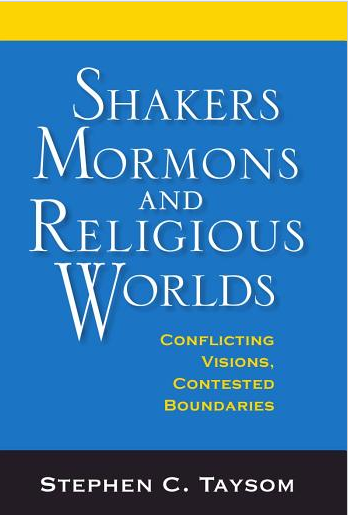
Last week I received in the mail a copy of Stephen Taysom's Shakers, Mormons, and Religious Worlds: Conflicting Visions, Contested Boundaries, recently released from Indiana University Press as part of their Religion in North America series. As I noted in a post a little over a month ago at the Juvenile Instructor, it is the first book on Mormonism to be published as part of that series.

Steve is a good friend and a thoughtful scholar, and I'm anxious to read through the book (just as soon as I finish grading final exams). I've read the dissertation that served as a starting point for the book manuscript, and while my own proclivities generally don't lean toward theory-heavy analyses, I found Steve's research insightful. He takes the comparison between the Shakers and Mormons further than anyone else has to date, revealing that even beyond their communitarian lifestyles and alternative marital practices and sexual arrangements, the two can be compared in fascinating ways. Looking at the rules that governed daily life in each community, their respective dietary codes, and their comparative modes of religious experience, Taysom adds much to our understanding of new religious movements in 19th century America (and provides some great fodder for lectures).

Over at the Juvenile Instructor blog, Matt Bowman has interviewed Steve about the book. Matt posted Part I this morning, and Part II should be following later this week. Part I describes where the idea for the book came from, the process of finding a publisher and revising the dissertation into a book manuscript, and Steve's reflections on the current place and trajectory of Mormon studies in the academic world.

If you or the religious studies geek in your life is looking for a last minute Christmas gift, consider stuffing her stocking with Shakers, Mormons, and Religious Worlds.

Rabu, 06 Oktober 2010

Glenn Beck, Methodism, and "Black Founders"

by Christopher Jones

Glenn Beck initially drew my interest because of his Mormonism—I sensed in Beck’s conspiratorial approach to politics something reminiscent of an earlier generation of Mormon public figures. The pervading fear of socialist subversion, combined with the particularly Mormon interpretations and understandings of human agency, the methods and aims of satanic opposition, and the divinely-inspired nature of America’s Founding documents, were reminders both that the influence of Cleon Skousen and Ezra Taft Benson’s religio-political views still loomed large among a certain segment of the Mormon population and that in them lay a narrative that had the power to appeal to not only conservative Mormons but other embittered Americans as well, suspicious of the government and intent on rescuing the nation from secularism and immorality (and make no mistake,
perceived secularism and immorality are as central to Beck’s movement as is some vague libertarian notion of fiscal responsibility). These topics have been discussed, analyzed, and reanalyzed at least a hundred times over by now (though some commentators rehash them anew and claim such discoveries for their own, all while butchering the identities of key people and ideas in Mormon history), and to be honest, I’ve grown weary of thinking about Beck, his Mormonism, and his agenda in general. In fact, I’d sworn off posting anything more on Beck here or at the Juvenile Instructor.

But one of Beck’s more recent forays into early American history has forced me to reconsider. It touched a nerve not because of Beck’s subtle invocation of Mormon themes, but rather because they addressed the subject of my current research—early American Methodism. Sandwiched in between Beck’s recent assertion that race relations in America were (with the exception of some unidentified “racists”) fairly harmonious before the years immediately preceding the Civil War and that provisions for Revolutionary War soldiers and veterans operated on a sort of colorblind basis is an intriguing discussion of what Beck oddly refers to as “the first real megachurch … a white and black megachurch.” The "megachurch" in question (which goes unidentified) is St. George's Methodist Episcopal Church in Philadelphia and the central figure is Richard Allen, eventual founder of the AME Church.

“Richard Allen,” Beck explains, “was a preacher at a white church—a megachurch. … And Richard Allen, this megapreacher, he tried to segregate.” Beck’s go-to guy for all matter historical, David Barton, chimes in, noting that “In the 1790s [Allen] proposed having a black denomination. And both whites and blacks said, ‘we don’t want that. We want the integrated stuff. We don’t want separate denominations.’ There was finally an overt act of racism in one church that kind of gave him the impetus to go ahead and start a black denomination. But for years, neither blacks nor whites wanted a separate denomination ‘cause they worshipped together in those churches, in Philadelphia and elsewhere.”

Rather than focusing on each of the several problematic points raised (the insightful scholarship of Albert Raboteau, Dee Andrews, and Richard Newman is recommended for those interested), I’d like to ruminate on the meanings and implications of two particular points.

First, I was struck by Beck and Barton omitting entirely any mention of Methodism. Richard Allen is simply “a black preacher” and St. George’s is simply a generic “megachurch.” Considering that Methodist theology and worship were so central to Allen’s identity as a Christian (and as a black man), and that his "black denomination" remained within Methodist Episcopal tradition, this seems as especially odd omission. This not only simplifies and distorts the history of St. George’s (and Methodism more generally) by ignoring the complex dynamics of early American religion, but also serves as a useful means of locating this supposed bastion of interracial harmony within the tradition so many of Beck’s listeners and viewers claim as there own today—conservative evangelical Christianity. This rhetorical maneuver, then, allows these conservatives to co-opt the legacy of interracial evangelicalism in early America (in much the same way that Beck has co-opted the legacy of Martin Luther King, Jr. and the Civil Rights Movement of the twentieth century).

Second, this conversation between Beck and Barton took place during a recurring segment of Beck’s show called “Founder’s Friday.” This particular episode was devoted to “Black Heroes in American History,” and was part of Beck’s stated effort to “spend more time learning about our black founders, and restoring this part of history” (a worthwhile effort, no doubt—at least theoretically). I was immediately reminded of Richard Newman’s biography of Richard Allen, Freedom’s Prophet, in which Newman sought to place Allen squarely within the tradition of America’s Founding Fathers. Echoing others, Newman reinforced the notion that Allen was a black founder, but moved beyond previous assessment by declaring that Allen was deserving of such a title not only because he founded black institutions but also because he “was essentially the forerunner of modern civil rights activists” and because “his belief in nonviolent but confrontational reform offered lessons for virtually every black leader who followed in his wake” (p. 4). As Alan Taylor summarized in his review of the book, “Allen was a Founder for all Americans. He emphasized a prophetic vision of America as a multi-racial democracy of equal rights and equal opportunity. His egalitarian vision was far more daring than anything considered by the more famous white Founders.”

In Beck’s vision of “black founders,” however, Richard Allen in cast as a foil to the interracial harmony he earlier enjoyed as a “mega-preacher” to “2,000 whites” by promoting “segregation.” Tellingly, then, what Beck sees as antithetical to his imagined ideal of American society, Newman see as admirable and daring. The implication of Beck’s narrative—that this “black preacher” and the black church he pioneered, are mere distractions to the real story of this Christian nation—serves as an interesting contrast to those who “seek a sense of authenticity” in black institutions and raises important questions about the place of the black church in the conservative white mind today.

Selasa, 28 September 2010

A Quick Overview of the Results from the Pew Forum's U.S. Religious Knowledge Survey

by Christopher Jones

The Pew Forum on Religion & Public Life has released the results of its U.S. Religious Knowledge Survey. This won't be entirely surprising to anyone here, but it turns out that Americans, as a whole, are religiously illiterate. Atheists, agnostics, Jews, and Mormons appear to be slightly less uninformed.

On average, Americans correctly answered half of the questions of the 32-question survey (you can take a shortened version of the quiz here). There's a lot to dissect in the results of this survey, but for the time being, here's a quick run-down of some of the findings that struck me as notable or interesting:
  • Mormons answered more questions correctly about the "Bible and Christianity" than did any other group, including white evangelicals, who finished a close second.
  • Racial minorities scored the lowest of all respondents overall, with Black Protestants scoring only marginally better than Hispanic Catholics.
  • Jewish and atheist/agnostic respondents knew significantly more about "World Religions" than other groups.
  • Only 11% of Americans know that Jonathan Edwards, as opposed to Charles Finney or Billy Graham, is associated with the First Great Awakening. To put that in perspective, that's only 3% more than knew that Maimonides was Jewish.
  • (Only) 93% of Mormon respondents correctly answered that Joseph Smith was Mormon.
  • Roughly half (54%) of Americans correctly identified the Koran as Islam's holy book.
  • Less than half (46%) knew that Martin Luther was instrumental in the Protestant Reformation.
  • A large majority of respondents (89%) knew that teachers cannot lead students in prayer at public schools.
  • 33% of Catholics correctly identified the first four books of the New Testament.
  • 4% of respondents thought Stephen King wrote Moby Dick (there were some questions not related to religion included in the questionnaire).
Like I said, there's a lot more in the full report to chew on, and perhaps other bloggers here will offer more substantive analyses in the coming days and weeks than I have here. The results are certainly deserving of further attention. In the meantime, I'm going to keep trying to figure out how 7% of Mormons don't know that Joseph Smith is one of them.

Jumat, 04 Juni 2010

The Tea Party as a Religious Movement: A Response

(Cross-posted at Juvenile Instructor)

Over at Religion Dispatches, Joanna Brooks has a two-part post asking “Who Says the Tea Party isn’t a Religious Movement?” In challenging Lou Ruprecht’s answer of “no,” Brooks notes that “for the Mormon sector of the movement (including Tea Party icon Glenn Beck), … the Tea Party taps into a powerful and distinctive complex of Mormon beliefs about the divinity of the U.S. Constitution and the last-days role of righteous souls from the Rocky Mountains in saving it from destruction.”

It seems to me that Brooks is spot-on in highlighting the religious dimensions of the Tea Party movement in the Jello Belt (that’s the Mormon Corridor in the intermountain West for those unfamiliar). And others have stepped forward to back her up, noting not only the distinctly Mormon characteristics of Tea Partiers in Utah, Idaho, and Arizona, but also the role religion plays in the minds of Tea Partiers elsewhere. Writing at the recently launched Religion in the American West blog, Brandi Denison explored the legacy bequeathed to Tea Partiers in western Colorado as a result of “the entanglement of land, religion, and capitalism in the American West.” “[T]he connections among land, Christianity as a justification for capitalism, and Christianity as site of refuge are strong and powerful ‘assemblages’” among Tea Party activists today.

While readily agreeing with those conclusions then, I’d like to take issue with the interpretation offered by Doe Daughtrey, a graduate student in Religious Studies at Arizona State whose research focuses on the intersections of Mormonism and New Age Paganism. As quoted in the second half of Brooks’s post at RD, Daughtrey suggests that

In a secularized, routinized, or demythologized Mormonism (which looks more like mainline Protestantism than the mystical tradition established by Joseph Smith), the religion is missing that distinctiveness, that tension of persecuted otherness. Beck and the Tea Party movement reenchant the experience of being Mormon . . . or at least they reawaken the Mormon cultural memory of prophetic millennialism.

Beck, a convert to Mormonism, recalls the strident prophetic voice that distinguished Mormonism from 19th-century Protestant groups. Many Mormons have a long cultural memory of persecution. Though they may welcome their church’s modern emphasis on their similarities to other religionists, I believe there remains a longing in them for the 'peculiar people' identity conveyed by the divisive prophetic voice and the historical experience of conspiracy.

While I fully agree (and was indeed among the very first to argue) that Beck is tapping into Mormon folk millennialism of yesteryear, I’m afraid Daughtrey has otherwise missed the boat on this one. To begin with, Mormonism today can hardly be accurately characterized as “secularized” in any meaningful sense and looks little like mainline Protestantism. As Matt Bowman notes in a comment left on the RD post:

Contemporary Mormonism looks far more like evangelical Protestantism than mainline Protestantism, in nearly every way possible. Iannacconne's work on strict churches is relevant here, as is the recent Pew Survey of American religions, which demonstrates that Mormons have _not_ actually 'disenchanted' in the way Daughtrey argues. Rather, Mormons engage in devotional practices like scripture study and prayer at rates more comparable to sects like the Jehovah's Witnesses and conservative evangelicals than to mainline Protestants or Roman Catholics. Consequently, Mormons experience things like personal answers to prayers, divine healings, and other spiritual experiences at much higher rates than almost any other religion in America.

Furthermore, while Beck (and his fellow Latter-day Saint Tea Partiers) are recalling a prophetic voice from an earlier era, that voice belongs to Ezra Taft Benson, who served as Secretary of Agriculture to Dwight Eisenhower while contemporaneously serving as an LDS apostle (and later in the 1980s and 90s as Church President), and not Joseph Smith or Brigham Young. It is Benson’s unique combination of politics and religion that combines scriptural teachings concerning moral agency and the Latter-day Saint “plan of salvation” with intense fears of socialist subversion here and now that Glenn Beck has echoed time and time again. It is Benson quotes and youtube clips that dot the pages of Mormon Tea Partiers’ blogs across the internet, and it is him who all of my conservative facebook friends in Utah quote as their status update anytime President Obama does something else with which they disagree.

But perhaps even more striking to me is Daughtrey’s claim that the Tea Party represents for Mormons a chance to “reenchant the experience of being Mormon.” Glenn Beck has done nothing to “recall the strident prophetic voice that distinguished Mormonism from 19th century Protestant groups.” And politically-far right Mormons, of course, are joining with other like-minded folks from a variety of faiths in organizing for their unique brand of activism. In fact, it seems to me that Glenn Beck has consciously (veiled references and sometimes subtle allusions to folk Mormon doctrines notwithstanding) attempted to market himself and his message as one that appeals not only to Mormons, but also to other politically conservative Christians. And it his utter success in accomplishing this---to the point of soliciting the willing assistance of David Barton on his show and managing to secure an invite to speak at Liberty University's commencement exercise---that has confused me since the beginning. Why hasn’t Beck’s Mormonism been the divisive wedge for evangelicals and others who generally refuse Mormonism (and Mormons) a seat at the table of orthodoxy?

Rabu, 12 Mei 2010

Surprising or Otherwise Interesting Primary Sources, Part V: David Allan Coe, Mormon Fundamentalist?


The semester has ended here (though it sure didn't feel like it ever would as I waded through the final exams and papers of my students this past week), and next up on my plate is a summer of research and reading for comprehensive exams. I'm happy to report that among the books on my reading lists are several written by contributors here. There's also a handful of recently-published monographs, and as I make my way through some of them in the coming months, I hope to post my thoughts/brief reviews.

But before I jump into that reading, I wanted to add my own contribution to the ongoing series of posts on surprising or otherwise interesting primary sources. As a bit of background to this post, let me explain that I grew up in Texas, just outside of Dallas, and along the way acquired a taste for a pretty wide array of music: While indie rock has long been my preferred genre, I also developed a liking for hip hop, Latin American pop, classic rock, and like any self-respecting Texan, country. Only I never really liked what I saw as the commercial country of the 1990s. I liked what others derisively labeled the "twangy" stuff, and I especially liked the outlaw country music and musicians from the 1950s, 60s, 70s, and 80s---Waylon Jennings, Merle Haggard, Willie Nelson, Johnny Cash, Jessi Coulter, and Hank Williams, Jr. But my favorite was David Allan Coe.

Coe, as far as I can tell, was always something of an outsider among this group of outsiders. Not from the South (he was born and raised in Ohio), Coe's semi-autobiographical music has always seemed like a self-conscious effort to simultaneously be part of this group of rebel musicians and to distinguish himself from them as more wild, more reckless, and more of an outlaw. He thus sang songs that emphasized his friendships with the other rebels ("Willie, Waylon, and Me", "The Ride", and "You Never Even Called me by My Name" all come to mind) while carefully crafting a public image that attempted to show just how radical he was and is. He spent his childhood in and out of reform schools, wrote of his supposed experiences in prison and on death row, claimed to have murdered more than one man, and boasted of being a polygamist. In spite of his rather beautiful baritone voice, Coe struggled initially to make it as a musician in Nashville, and recorded a series of X-rated albums (often under a pseudonymous name) to be sold at trucker stops to make ends meet. When he finally did make it big, he was known more as a song writer for others than he was for his own music. But he did enjoy some moderate success, and long after the rest of his rebel friends stopped making new music, Coe continued (and continues today) touring, playing in honky tonks and bars with both more traditional country musicians and younger southern rockers.

Knowing Coe's background then, I was not surprised to come across this series of clips (warning: extremely vulgar language) on youtube a few months ago. It's a 4-part interview of David Allan Coe on the late-night cable show Midnight Blue, hosted by Al Goldstein, pornographer and publisher of the magazine Screw. The interview itself proved less than interesting to me until I got to the very end of the first clip. Goldstein is discussing with Coe his noted ability to irritate and anger others (most notably Anita Bryant, for whom Coe wrote one his more vulgar and offensive ballads, entitled simply "F*** Anita Bryant"). At this point the conversation turned to religion of all things:
Coe: An example is, I started catching all this sh** from the Mormon church because I'm a Mormon and I'm telling people I'm Mormon and when you say you're a Mormon they want you to think "Donny Osmond," right? So I started getting all this bullsh**, "quit telling people you're a Mormon, you know? So I wrote this song.
That song, embedded below, laments that "the Mormon way of life is almost gone" and positions Coe as one of the remaining real Mormons, determined by his continued practice of polygamy and (as the song's title suggests) his belief in not only a heavenly father but also a holy (or heavenly) mother (full lyrics available here):


While the claims to be a polygamist should have tipped me off, I'd never heard anything about Coe's supposed affiliation with Mormonism before. Digging around a bit more, I discovered that he was supposedly raised by a Mormon mother father and an Amish mother, and as an adult contacted Mormon Fundamentalists in Big Water, Utah about converting and becoming a polygamist (updated additional info here). But the veracity of that claim (I haven't tried to substantiate it yet) seems beside the point here. Coe's claim to be a true practitioner of pure Mormonism, when viewed within the context of his carefully-crafted persona as an outlaw among outlaws, can be seen as yet another way of separating himself from the bunch.

Kamis, 25 Maret 2010

"Thieves break through and steal" at the Methodist Archives

Paul may indeed be right that "Methodists just aren't that cool," but historical documents stolen from their archives still apparently fetch a hefty sum on the black market. Just ask William John Scott, Drew University freshman and (former) employee at the school's United Methodist Archives and History Center, who was arrested last week on charges of stealing several valuable documents from the archives (including 21 of the 23 Wesley letters the school owns, and "roughly 11 other important and historical documents, ... including letters from five United States presidents"). Scott is currently being held on $50,000 bond and could face up to 10 years in prison.

From the report in the New York Times:

The university became suspicious, according to an account provided by prosecutors, after an antiques dealer in England alerted officials in its library that he had been approached by someone offering to sell him original letters from the Wesleys. Ten of the letters arrived on March 3, via FedEx, according to the complaint, with two suffering some damage in transit.

Prosecutors said the unprofessional way the valuable documents were shipped did not sit well with the dealer, who then consulted Drew officials, given their expertise and collection of Wesleyana.

After a quick search of its archives, the university estimated that 21 to 23 of its Wesley letters appeared to be missing and contacted the F.B.I. The missing lot included a valuable letter, worth more than $5,000, from John Wesley to a friend and supporter, George Merryweather, dated Dec. 20, 1766. ...

University officials had not been aware that the presidential letters were missing until the search of the dorm room. But they were optimistic on Monday that they would ultimately recover any lost items. “For Methodists, these are treasures and so we’re hoping to get them back,” said Christopher Anderson, the Methodist librarian at Drew.

Rabu, 10 Maret 2010

Leaving the Shakers for Love

A couple of years ago, a good friend of mine wrote to the last remaining community of Shakers at Sabbathday Lake, Maine, seeking permission to stay with them for a couple of weeks and observe their day-to-day lives and worship and then create poetry based on her observation and participation. Her lofty goal was not without precedent---the Quiet in the Land project had done it in 1996---but her query was met with silence. Undeterred, my friend and her mom set out to visit Sabbathday Lake (along with a number of other Shaker historic sites) in the summer of 2007.

While visiting Watervliet, New York, site of the first Shaker village in America, my friend first heard rumors that one of the four remaining Shakers living at Sabbathday Lake had renounced his vows and left the community to pursue a romantic relationship with a journalist who had recently written a piece on the community. Upon reaching Maine, the rumor was confirmed to be true, and my friend and her mom joked that the Shakers’ silence in response to her initial inquiry was because they were afraid of losing the only other remaining male member of the community.

So it was with interest that I read “He left the Shakers for love” in the Boston Globe Sunday Magazine a couple of weeks ago. The story---written by Stacey Chase, the journalist who fell in love with Shaker Wayne Smith while profiling the community---details the development of their romance, beginning with seemingly innocent flirting during her initial trips to the village and culminating in their September 2008 marriage. I was struck while reading by a couple of things. Chase curiously compares Smith’s renouncing his Shaker commitments in pursuit of love to other defectors throughout history:

Seven months after we met, he renounced his religious vocation and vow of celibacy after 26 years at the Sabbathday Lake community to pursue our relationship. It was 2006, and he was 43. “Sometimes you just know,” he says, tapping his heart, “here.”

Others have made similar sacrifices: King Edward VIII abdicated his throne; Maria Kutschera, later von Trapp, left the abbey; and, recently, Miami priest Alberto Cutie abandoned the Catholic Church. Only . . . the English monarchy and Roman Catholicism weren’t facing extinction. As the youngest Shaker (in 2006, the other members were 49, 67, and 79), Wayne would likely have become the last Shaker, and that prospect weighed heavily on him. His sudden departure not only shocked the three remaining Shakers, but it was as if it validated the protracted, public deathwatch of the Shaker faith.

I also found interesting the conditions of his leaving the community---Smith was granted a three-month grace period “to extricate himself from life at Sabbathday Lake,” while the community pooled together their limited collective resources and provided Smith with a used truck and $9,000 cash with which to start his new life. The two discreetly dated during the grace period (Chase remembers that they “dated discreetly, but it felt sickening, as if I were seeing a married man”), and then three months to the day that Smith officially became an ex-Shaker, he proposed. Despite the assistance provided to Smith upon his departure, “most of those associated with the [Shaker] order distanced themselves from Wayne---which stung him deeply.”

In Chase's telling, their story is one in which love trumps religious commitment, and everything works out in the end. Today the two are happily married, share a common faith (Smith converted to Methodism prior to their marriage), and Smith works as a maintenance worker at a biotechnology firm---a seemingly mundane ending to this anything-but-ordinary episode of amorous defection. Not particularly familiar with other instances of defection from the Shaker community in the past, I’d be interested in how this fits into that larger framework. How common is dissent and defection in Shaker history? Are there instances similar to this? How do the remaining Friends view the dissenter? Anybody know?