Kamis, 07 Juli 2011
Hannah Adams' Intellectual Grandchildren; Or, Maybe It Was All Liberal Protestantism, After All?
Robert: I feel that an earlier generation of scholars of religion was willing to consider these questions. The answers may not always have been satisfying–but I think of William James here, or even the early theorists of crowd behavior. There were scholars interested in talking about how we think about these sorts of human events, but I don’t see it anymore.
Richard: James is the perfect example of it–
Robert: But in the end he’s too individualistic for me!
Richard: Very Protestant, maybe?
Robert: Yes. [Laughs]
Maybe it's just me, but it feels like it's a strange time in the field of religious studies. I've been hiding in my dissertation cave for the past few months so maybe that's part of it. Yet, every time I poke my head out I keep noticing things. Little things. Reports of unease in the rooms of that conference in Indianapolis here, a dialogue about "presence" and "abundant events" that seems to run out of vocabulary before it can get off the ground there. To me, these moments signal the slow death of liberal Protestant religious studies and the grasping about for whatever will come next.
Paul already mentioned James Turner's Religion Enters the Academy but I want to come at the book from a different angle. Paul is right, William James is the hero of the book in the final chapter. But the first two chapters narrate the rise of the comparative and academic study of religion in America among liberal (mostly Unitarian) Protestants. In the first chapter, Turner brings Hannah Adams and Joseph Priestly to the fore as the early comparativists before 1820. Chapter two follows the growth of Unitarian and Transcendentalist interest in world religion from 1820 to 1875. This includes Thomas Wentworth Higginson's The Sympathy of Religions (1871), Lydia Marie Child's Progress of Religious Ideas through Successive Ages (1855), and James Freeman Clarke's Ten Great Religions (1871). Meanwhile, Harvard, Yale, and Princeton offered comparative religion as part of their ministerial training in the latter quarter of the century. The University of Chicago opened its doors in 1892 and quickly added a department of comparative religion. Then, a year later and in the same town, the World Parliament of Religions attempted to unite "all religion against all irreligion" with the help of many liberal Protestants. The long and the short of it--the history of religious studies is the history of liberal Protestantism.
It's not that early scholars of comparative religion happened to be liberal Protestants. Rather, Turner shows that comparative religion, and later religious studies, was a particularly liberal Protestant project. As he puts it, "Comparative religion during its first academic decades in the United States was thus a historically minded, text-based study, oriented toward articulated religious or ethical propositions. And the discipline's driving motive, stated or unstated, was t understand how non-European religions stacked up against Christianity" (65-66). It was a project by Protestants, for Protestants, using Protestant categories.
Enter our hero, William James. James shifted the categories in The Varieties of Religious Experience. Gone were texts. Gone were institutions. Gone were beliefs, creeds, and doctrines. James went after experience. James also threw out the hierarchy of "world religions" and placed religious experience on a level playing field, drawing on contemporary accounts of religious experience. James got rid of the Protestant categories, and took little interest in comparing Christianity to other religions. Turner ends the book noting that, in the end, William James won. Maybe. James is still taught in "Theory of Religion" courses. I even read Varieties in a graduate seminar a few years back. We don't read James Freeman Clark anymore.
But Robert Orsi's laugh takes all the wind out of Jamesian sails. Even William James is too Protestant--too individual. Religion for James was "the feelings, acts, and experiences of individual men in their solitude, so far as they apprehend themselves to stand in relation to whatever they may consider divine." I imagine Cotton Mather in his private solitude meditating on the grace of God not a procession in Italian Harlem.
As I read work on Asian religions, mostly Hinduism, the argument against the term religion--and by extension religious studies--seems rather easy. It's a Western term that doesn't fit well with the realities of Indian culture. Fine. We can have the debate if you want. But what if it isn't an East / West problem? What if the unease of religious historians not knowing their Bible or not wanting to admit to it, the back and forth of Bushman and Orsi trying to find a way to account for "abundant events," and the liberal Protestant history of religious studies are all linked? What if religious studies doesn't fit well with the realities of American culture? Maybe the unease in Indy and the search for adequate language to describe religious experience are really the unease of our liberal Protestant history and the search for a way out of it.
The field has been trying to shed its history for a long time now. As a religious studies major in college I took the "Theory of Religion" course. We read Durkheim, Freud,Weber and other European thinkers important to the field. Other than James we didn't read any Americans until we go to the late twentieth century--Eliade, J.Z. Smith, Russell McCutcheon. We ignored the American history of the field and its liberal Protestant baggage--poor James Freeman Clark.
William James won. But is that enough?
Senin, 13 Juni 2011
Religion Enters the Academy, Looks for Emergency Exit
And I don't know if I can do it,
Oh no, I've said too much, I haven't said enough.
REM, "Losing My Religion"
"Jason Kidd is . . . savant-like."
Rick Carlisle, Coach, Dallas Mavericks, on ESPN
My previously promised post reflecting further on one particular session of the 2nd Biennial Conference on Religion and American Culture isn’t going to happen today (tonight) as planned. Besides, Curtis Evans’s comment on yesterday’s post concisely summarized most of what I was going to say anyway.
But briefly, the discussion at the conference about interpreting supernatural events/experiences/”abundant events”/whatever you want to call them brought my mind to one of the classics of the field, William James’s Varieties of Religious Experience. And that was coincidental, because on the plane to the conference I just read a slender and very entertaining new volume by James Turner, Religion Enters the Academy: The Origins of the Scholarly Study of Religion in America. And let me say, next time you have a 2 or 3 hour plane ride to a conference, bring along this volume. It’s substantive and meaty enough to make you feel like you’ve earned a scholarly pat on the back, but it’s also funny and entertaining enough to distract you from the 3 year old in the seat behind you screaming his/her brains out and kicking the back of your chair for the entirety of the route from, oh, say, Denver to Indianapolis. Just saying.
This work is the published form of some recent lectures Turner gave at Stetson University in 2010. Unlike my experience with the Lamar lectures, which I gave in 2008 and then spent the next 2 1/2 years piddling around with, Turner was prompt in turning in his manuscript and getting it right out there for publication.
I’m going to take the lazy way out and plagiarize from the book’s website to give you a brief summary, one which captures the argument if not the dry wit and entertaining prose of the book:
Religious studies—also known as comparative religion or history of religions—emerged as a field of study in colleges and universities on both sides of the Atlantic during the late nineteenth century. In Europe, as previous historians have demonstrated, the discipline grew from long established traditions of university-based philological scholarship. But in the United States, James Turner argues, religious studies developed outside the academy.
Until about 1820, Turner contends, even learned Americans showed little interest in non-European religions—a subject that had fascinated their counterparts in Europe since the end of the seventeenth century. Growing concerns about the status of Christianity generated American interest in comparing it to other great religions, and the resulting writings eventually produced the academic discipline of religious studies in U.S. universities. Fostered especially by learned Protestant ministers, this new discipline focused on canonical texts—the “bibles”—of other great world religions. This rather narrow approach provoked the philosopher and psychologist William James to challenge academic religious studies in 1902 with his celebrated and groundbreaking Varieties of Religious Experience.
Turner concludes by writing, “Long recognized as a classic, Varieties now became something of a model. To be sure, the great majority of scholars of religion today study religions in ways far different from James, but many religious-studies experts do follow a Jamesian path to understanding religious experience.” He then goes on to cite a number of works, including Ann Taves’s Fits, Trances, and Visions, as examples of how James “stretched the map of religious studies in America" -- all the way from Boston to the experiments of the 60s to the pluralistic vocabulary of describing brilliantly "in the zone" point guards as savant-like -- an instance of neither saying too much, or not saying enough.
Then, late last week, I was talking to an academic editor for Bedford Books, and we were discussing some of the volumes in the wonderfully classroom-usable Bedford Series in History and Culture. I asked him what else was forthcoming in that series, and guess what he told me: Robert Abzug of the University of Texas is putting out a Bedford edition of a trimmed-down, annotated, sizable excerpt of Varieties of Religious Experience.
Will wonders never cease? This particular editor was a little skeptical of the project, but one of the series editors, the historian David Blight, apparently told one of the Bedford people that James's book had "changed my life,” and for that and other reasons the founder and head of Bedford Books became a major champion of the volume. So, apparently it is on the way.
True confession: I first read James in college, hated it, and gave up about halfway through. Of course, at that age my tastes in a number of things (excruciatingly rancid 3.2 beer, Herman Hesse, Quadrophenia, and those blobs of nothing that passed for "tofu" in the 1970s/early 80s) were very questionable, so it’s no wonder it took me some time and mentoring to understand James and some other classics of that sort. If the Bedford series volume succeeds, it will be the kind of introduction to the text that I didn’t have but needed. Here’s hoping.
In his discussion with Richard Bushman, which Chris Jones wrote about on our blog here, Robert Orsi discusses how we need a new language to interpret religious experience in a way that is neither overtly confessional or crudely reductionist. Bushman suggests that James provides one model, to which Orsi replies that that’s still too individualist (read: Protestant) a model, a point he elaborated on at the conference by noting how the understood subject of religious studies is the “autonomous subject.” Reading Turner’s history of the discipline, it’s easy to see how this became the case, and given the obstacles to its development (cultural, intellectual, political, etc.), it’s a wonder that “comparative religion” ever developed as a discipline in America at all. But it did, and now it's everywhere, in everyday vocabulary, hence Rick Carlisle's brilliantly offhanded description of Jason Kidd's mastery over the psychology of his team, and his mastery over the more talented Heat.
More on this as the week progresses, I hope, but as someone who has spent some time studying folks whose "abundant events" are less than politically neutral or benign, it makes me wonder how Orsi's attractive theories and wonderful discussion with Bushman affect work on religious intolerance and violence in America. Just a quick example comes to mind: sitting in the Southern Historical Collection archives in Chapel Hill years ago, I came across the letters of a white southern Spiritualist, who was writing correspondence to her deceased son in the way that nineteenth-century Spiritualists did.
The Spiritualists in Ann Braude's classic book Radical Spirits are, in a sense, easy to root for: they are women finding their voices, arguing for abolitionism and women's rights during their trances, and so forth. But this particular woman (who initially interested me because Spiritualism was almost totally a Northern thing in the antebellum era, so I was trying to figure out how it made its way South) was writing about a son who was involved in the massively repressive violence that was overturning Reconstruction in Mississippi -- specifically, her son, whom she now saw addressing her from the interplanetary realms in her own rationally inexplicable but emotionally/spiritually powerful event, was a white Redemptionist who was killed trying to deny the vote to black men in Clinton, Mississippi, in 1875, one of the "autumnal outbreaks" that President Grant famously grew weary of as the experiment of Reconstruction ran its course and the fateful federal compromise with southern white supremacy took hold.
This woman's experience clearly was real and powerful "to her," and I don't mean "to her, and she was crazy." I'm no Spiritualist, for sure, but can recognize culturally sanctioned forms of mourning as part of religious experience. But her experience was of hearing the voice of her deceased son who also happened to be a violent white supremacist.
I don't know what to make of all of it, but the fascinating discussion at the first session of the conference and continued online elsewhere just made me recall that reaction to that particular document in the archives.
Kamis, 09 Juni 2011
The best part of "Believe' is the 'Lie'
Continuing the conversations that Elesha and Janine started on the biennial conference on Religion and American Culture, here are my reflections on the issue of authenticity, belief, and the place of the scholar in American religions via road tripping and Fall Out Boy, sometimes we get what we pay for:
Are we growing up or just going down?
It's just a matter of time until we're all found out
Take our tears, put them on ice
Cause I swear I'd burn this city down to show you the light-- Fall Out Boy
Perhaps, I need better road trip music, or a better taste in music altogether, but my weekend at the Religion and American Culture biennial conference was defined by my aesthetics and my sensory experiences as much as the conversation and provocation that occurred. To make my way to Indianapolis from Tennessee, I plowed down the interstate surrounded by lovely green, falling rock signs, and the artifacts of Christianity in the South. A billboard proclaiming Harold Camping's May 21st prediction remained as an artifact of the possibility of the Rapture. Crosses reminded drivers to be safe on hazardous roadways as well as worked in giant form to counteract interstate porn shops that pop up all along the South. Other billboards documented Jesus’s stance on abortion, when life begins, and consumerism and commodity writ large.
Before I even started my standard road trip musical rotation, let’s say that I was primed for a conference to discuss the place of religion in American culture and see some of my favorite folks all in the same place. As I still mull over the presentations and conversation, Fall Out Boy became my downfall. My favored band of my grad school days with guy liner, spiky hair, and angst placed to infectious music. (Pete Wentz still makes me want to swoon, only sort of.) This means that my whole conference experience was framed, primed if you will, by songs that I cannot remove from my mental queue. In the song, “Sophomore Slump of Comeback of the Year,” Fall Out Boy vocalist Paul Stump belts out: “The best part of "Believe" is the "Lie"/I hope you sing along and you steal a line/I need to keep you like this in my mind/So give in or just give up…Are we growing up or just going down?” This song echoed in my head from the first session on academic assumptions about the study of religion until the final salvo with the future of American religions. It seemed fitting that I wanted to hum “the best part of ‘Believe’ is the ‘Lie’” as some of the best scholars in our field circled around the questions of our assumptions about religion, religious people, power, consciousness, and narrative because of the continual reflections (hand-wringing?) about the study of religion.
What is at stake in the study of religion-as-belief seemed to be an undercurrent of the proceedings, and how might we breach the difference between the whom and what we study and our positions as scholars. Can we believe/imagine/analyze alongside without the question of authenticity? Robert Orsi, in the first session, argued for approaches that understand how the gods become real and to develop an empiricism that allows for a study of shared religious consciousness. How can we develop a language that encompasses these experiences and make them intelligible to fellow scholars and a larger public?
If the scriptures session showed collective unease, I would note that unease was also apparent earlier in the conference in the questions and discussion that followed the first panel. How do we manage the collective experiences of visions of Joseph Smith, for example? At a pivotal moment in the discussion, Jan Shipps noted that she discussed experience as a “to them,” which Orsi stated might lead to the corollary “because they are crazy.” How do we discuss the real in religion? Why is "they are crazy" such a common refrain when we discuss some types of religious people? How do we manage the lie within believe? How do we research and write religion without reference to our own assumptions about religion?
While Janine noted that some scholars were nervous about staking their personal identity in relationship to their subjects, especially regarding personal religion, I would argue that my experiences vary because no one could possibly fathom that I could believe what my subjects do from Klansmen to Tim LaHaye to folks prepping for the zombie apocalypse. Of course, I couldn’t possibly believe X is the assumption. The unasked question is “could I?” The most important part of Believe is the Lie in this case. Luckily for me, most scholars-in-arms don’t think that I am (actively) furthering the agenda of my subjects. They might scratch their heads and wonder why I am even interested in such religion or by extension such people. Rhy Williams asked, “What about the Nazis?” And as always I find myself wondering, what is at stake in our assumptions about religion? Authenticity? Lie? Helpful? Harmful? Ambivalent? Human? Suprahuman? Supernatural? Natural? What do we bring to our studies? And why are we nervous about this?
In his review of Katie Lofton’s Oprah: The Gospel of an Icon at Immanent Frame, Jason Bivins documents that the book is about Oprah but it also about how we practice religious studies. He writes:
On the one hand, scholars no longer have the comfort of a kind of shallow critique (which Lofton identifies as either reflexive anti-consumerism or blunt constructions of Oprah’s “trap”). Neither, however, can we afford the luxury of scrutinizing these things forever at a distance—always Hegel watching Napoleon’s armies from Jena’s hills. The implications are great here, because of the way the field is haunted by one chief identitarian assumption, rooted equally in the old politics of representation and in methodological caution: authenticity. Lofton is concerned that “in our scholarly ambition to translate our subjects—to, as the phrasing often goes, take our subjects seriously—we have become sycophants to our subjects, reframing every act as an inevitably creative act.” In this she is part of a growing, and welcome tendency in the field.
Are we indeed sycophants to our subjects? Yes. No. Perhaps. Maybe. Is this what becomes of the question of the real? In her Lift High the Cross, Ann Burlein argues masterfully for “seeing with” to construct the religion, no matter how offending, of our subject. Yet the lingering notion from Bivins-via-Lofton is “that no method or tone, however fervently defended, can avoid the fact that we are always, already, from the moment we begin, complicit with our subject.” Perhaps, the unease is about our own complicity. Perhaps, it doesn’t matter. In her comments in the final session, Julie Bryne eloquently noted that no matter how we understand our study, it is ours. She described the “ethnographic uncertainty principle” in which we change what we study inalterably in our study. Our assumptions about religion inform how and what we do. We are complicit, but maybe, we should be less nervous about it. Or in the mortal words of Fall Out Boy: “We're the lifers here till the bitter end/Condemned from the start/Ashamed of the way/The songs and the words own the beating of our hearts.”
Sabtu, 04 Juni 2011
Richard Bushman, Robert Orsi, and Mormonism's "Abundant History"
Over at the website for Dialogue: A Journal of Mormon Thought, the editors have posted a discussion (moderated by Susanna Morrill, associate professor of religious studies at Lewis and Clark College) between noted historians and scholars of religion Richard Lyman Bushman and Robert Orsi. Bushman and Orsi reflect on the potential Orsi's approach to "supernatural presence" and "abundant events" in modern Catholicism holds for scholars of Mormonism.
The conversation between these two seasoned scholars, which touches on the relationship between the scholar and her subjects, how to make sense of revelatory visions and the writing of the Book of Mormon, and the vocabulary used to describe such occurrences, deserves to be read in its entirety, but I'm including a brief excerpt below:
Richard: You also speak of the routes of influence radiating from such events. That’s a nice way of putting it; the word “routes” suggests an approach to what happens in consequence. Where do the abundant events lead? But it occurs to me that some of the responses of the Marian groups, which taken together could be thought of as a morphology of an abundant event, take a different form in the case of Joseph Smith. Rather than the abundant event dissolving the boundaries of subjectivity and establishing intimacies, in Joseph Smith’s case it leads to structure and organization. The people who are converted take on priesthood offices and go on missions; they have council meetings. As the influence radiates still further, you get minutes of the meetings and letters and all the paraphernalia of organization. I thought it would be interesting to talk about how events that are so similar at the core lead in different directions in the aftermath.Go here to read the rest of the interview.
Robert: I appreciate the difference. I was thinking about that concept as I read the very powerful final chapter of Rough Stone Rolling, in which the people left behind at Nauvoo after Joseph’s murder continued to work on building the temple, though they knew they weren’t going to be using it after it was done because they would be leaving Nauvoo. It seemed to me that we needed some word to get at what happens between Max Weber’s idea of initial charismatic leadership of a new religion and its eventual institutionalization. It seems as if something else is going on there, almost as if the stones themselves were charismatic–the stones of this sacred building that would otherwise signify the routinization of Mormonism. So I take your point. It does lead in different directions, which might have to do with the specific peculiarities of modern Catholicism and modern Mormonism. I was struck by–as you want to put it–the radiation outwards of Joseph’s spirit and his vision through the organization.
Senin, 13 Desember 2010
On the Study of Evangelicalism in the Chronicle
.
. . . academic studies of American evangelicalism and related movements have been fairly few and far between compared with those of other religious subjects—such as early American religious history and religion and politics—and their authors have written primarily for audiences of their disciplinary peers. More recently, however, there appears to be a growing intellectual interest in the subject among nonevangelical readers and outside academe. Some of the most popular trade books on the subject are first-person accounts of non-Christians who have immersed themselves in particular evangelical or fundamentalist communities. Most notable are Jeff Sharlet's remarkable exposé, The Family: The Secret Fundamentalism at the Heart of American Power (HarperCollins, 2008), and Kevin Roose's The Unlikely Disciple: A Sinner's Semester at America's Holiest University (Grand Central, 2009), that is, Jerry Falwell's Liberty University. Sharlet is a religion scholar and journalist, and Roose is a former Brown University undergraduate and now a writer. >>>
Selasa, 07 Desember 2010
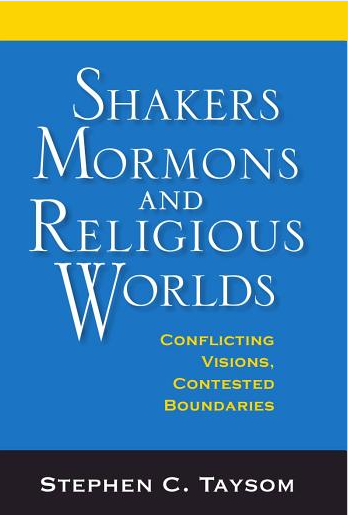
Shakers, Mormons, and Religious Worlds
Last week I received in the mail a copy of Stephen Taysom's Shakers, Mormons, and Religious Worlds: Conflicting Visions, Contested Boundaries, recently released from Indiana University Press as part of their Religion in North America series. As I noted in a post a little over a month ago at the Juvenile Instructor, it is the first book on Mormonism to be published as part of that series.
Kamis, 21 Oktober 2010
American Religious History at the AAR
The first morning, Saturday, is the main panel presenting new research in African American religious history. Monday afternoon, for those of you who can stay around until then (regrettably, not including me), is a dream team scholarly lineup discussing how Robert Orsi's Madonna of 115th St has affected (or not) the study of religion. Saturday afternoon at 1:00 features a panel discussion of our friend Tisa Wenger's work We Have a Religion, which we blogged about before here featuring an interview with the author.
The full program is searchable here.
Location: Marriott Marquis - L405-406
Missionary Innovation: African-American Religion and the New South
Presiding
* Josef Sorett, Columbia University
Presenters
* Lerone Martin, Emory University
Selling to the Souls of Black Folk: Atlanta, the Phonograph, and the Transformation of American Religion and Culture, 1920–1941
* Elizabeth Jemison, Harvard University
Writing and Righting Race: Women’s Interracial Cooperation in the Colored Methodist Episcopal Church and Methodist Episcopal Church, South
* Brandi Hughes, University of Michigan
(En)Gendering the Trans-Nation: The Missionary Sojourns of Black Womanhood from Atlanta through Monrovia
* Brandon Winstead, Garrett-Evangelical Theological Seminary
“We are Responsible to God”: Black Nazarene Women’s Theology of Evangelistic Responsibility and Its Relationship to Their Contributions to the Church of the Nazarene’s Gulf Central District, 1953–1969
Responding
* Paul Harvey, University of Colorado
Saturday 1:00 PM to 3:30 PM
Location: Hyatt Regency - Hanover E
Author Meets Critics: Thomas A. Tweed’s Crossing and Dwelling (Harvard University Press, 2008)
Presiding
* Daniel RamÃrez, University of Michigan
Panelists
* Richard Callahan, University of Missouri
* Marie Marquardt, Agnes Scott College
* Grant Wacker, Duke University
Responding
* Thomas A. Tweed, University of Texas
Saturday 1:00 PM to 3:30 PM
Location: Hyatt Regency - Hanover FG
Defining Religious Freedom: Reading Tisa Wenger’s We Have a Religion: The 1920s Pueblo Indian Dance Controversy and American Religious Freedom (University of North Carolina Press, 2009)
Presiding
* Ines M. Talamantez, University of California, Santa Barbara
Panelists
* Quincy Newell, University of Wyoming
* Greg Johnson, University of Colorado
* Kenneth Mello, Southwestern University
Responding
* Tisa Wenger, Yale University
Saturday 1:00 PM to 3:30 PM
Location: Hyatt Regency - Hanover C
The Lutheran Tradition: New Theological and Global Perspectives
Presiding
* Kirsi Irmeli Stjerna, Lutheran Theological Seminary, Gettysburg
Presenters
* Farisani Elelwani, University of South Africa
The Challenges Facing Lutherans in South Africa
* John Reynolds, Union Theological Seminary
The Heart in Sixteenth Century Physiology and the Role of Luther’s Theology in the Life of the Believer
* Hans Schwarz, University of Regensburg
Martin Luther’s Reception in Korea
* Cecilia Nahnfeldt, Karlstad University, Sweden
Lutheran Vocation and Gender Relations
Saturday 4:00 PM to 6:30 PM
Location: Marriott Marquis - L507
Seminar on Religion in the American West
Presiding
* Jane Naomi Iwamura, University of Southern California
Presenters
* Travis Ross, University of Nevada, Reno
Sectionalism in California’s Religious Periodicals: Place in Religious Rhetoric
* Jonathan William Olson, Florida State University
“Not Merely Asiatic but Pagan”: Religion, Chinese Exclusion, and the American West
* Barry Joyce, University of Delaware
Creating an Axis Mundi in the American Southwest: Religion, Science, and the Sacred at the Chaco Culture National Historical Park
* Brett Hendrickson, Arizona State University
Mexican-American Religious Healing and the American Spiritual Marketplace
Responding
* Tisa Wenger, Yale University
Sunday 3:00 PM to 4:30 PM
Location: Hyatt Regency - Hanover AB
Keywords in the Study of North American Religion: Anthropomorphism, Agency, and Vernacular
Presiding
* Gary M. Laderman, Emory University
Presenters
* W. Clark Gilpin, University of Chicago
Anthropomorphism: Human Connection to a Universal Society
* Elizabeth Jemison, Harvard University
Writing Agency: Reconsidering Agency in the Study of American Religion
* Rachel Lindsey, Princeton University
The Light of the World: Vernacular Photography and American Religion, 1839–1910
Monday 9:00 AM to 11:30 AM
Location: Marriott Marquis - M101
The Future of Southern Religious History
Presiding
* Paul Harvey, University of Colorado
Panelists
* Alison Greene, Yale University
* Michael Pasquier, Louisiana State University
* Randall Stephens, Eastern Nazarene College
* Curtis Evans, University of Chicago
* Ted Ownby, University of Mississippi
Responding
* Lauren Winner, Duke University
Monday 1:00 PM to 3:30 PM
Location: Marriott Marquis - M103-104
How Has Orsi’s Madonna of 115th Street Affected the Way We Think about Religion?
Presiding
* David Harrington Watt, Temple University
Panelists
* Judith Weisenfeld, Princeton University
* Stephen J. Stein, Indiana University
* Kathryn Lofton, Yale University
* Leigh E. Schmidt, Harvard University
Responding
* Robert Orsi, Northwestern University
Selasa, 05 Oktober 2010
2011 Summer Research Seminar: Congregations and Social Change
Adaptation and Innovation among Religious Communities
June 27 - July 22, 2011
I will be directing a research seminar at Calvin College next summer. I've met other readers and contributors from this blog during the oh-so-pleasant Michigan summers and enjoyed the stimulating dialogue and scholarly support encouraged through these seminars. This is an open invitation:

This research seminar will closely examine the ongoing relationships between congregations and processes of broad ranging, societal change. By incorporating a historical sensitivity and scholarship rooted in a sociological perspective, the seminar will continually connect societal arrangements with adaptation, reaction, innovation, and experimentation in congregational beliefs and practices. The focus will be on congregations of all types (whether church, synagogue, temple, or mosque) and encourages a look at both interpersonal dynamics (beliefs, micro-exchanges, small group interaction, etc.) as well as more macro-level phenomena (globalization, technological shifts, political systems, etc.).The analytical perspectives on congregations can include --
- singular case studies, particular historical periods,
- whole denominational networks (Mormon wards, eastern orthodox churches, Jewish synagogues, mosques and Islamic centers as well as Hindu, Sikh, Jain, Zoroastrian and other religious temples and missions),
- types of congregations (small, rural, independent, mega, etc.),
- regional centers (Southern California, Manhattan, Chicago Metro), and
- any other appropriate and manageable arena of analysis.
- changes or comparisons of liturgical design,
- formation and negotiation of political identity,
- mobilization tied to extra-congregational organizations or social movements,
- creation of age-targeted ministry (twenty-somethings to retirees),
- incorporation of creative arts,
- negotiated relationships between religious and civic service structures or public agencies,
- adoption of online social networking or use of new media and technology,
- management of multiethnic/multiracial dynamics,
- etc, etc.
This research seminar is most intended for current and recent doctoral students in fields related to religious and organizational studies (sociology, anthropology, history, ethnic studies, folklore, and others). While the seminar is designed toward social science-oriented scholars holding, or advanced to candidacy for, the terminal degree in their field (typically the PhD), I eagerly welcome humanities-oriented scholars as well theologically-oriented participants from seminaries and divinity schools. To the extent possible, I will select a group diverse in gender, ethnic, confessional, and disciplinary backgrounds, and with a variety of research sites (i.e., the confessional and/or social identities of the communities they plan to study). I also plan to choose among applicants a mix of participants ranging from doctoral candidates through recent doctorates in tenure-track positions and scholars working on their first or second books to mid-career scholars retooling with defined projects.
Rabu, 28 Juli 2010
Heidegger and the Quandary of Insider/Outsider Roles in Religious Research: A Methodological Note

As an ethnographer, I regularly immerse myself in religious communities both short and long term -- see a recent post at Duke Divinity blog about a recent church visit -- and as such am regularly confronted with what was introduced to me as “the insider/outsider problem of religion.” The dilemma centers around a core question: Who is best able to understand religion, the committed or the agnostic? More important, what are the challenges and solutions for achieving a satisfactory understanding of religion (not just for scholars, but for everyone) considering one’s stance? My first attempt to answer this question is printed in an extended appendix of my first book A Mosaic of Believers. But reading that now, and continuing to think on the issue, I’m finding my framing of both the problem and the answer to be much too glib.
My methodological answer there was essentially that immersion in a religious community along with a simultaneous immersion in a scholarly community allows scholars enough “distance” to reasonably comment on issues and concerns of scholars without being unredeemably caught up in the interests and pretensions of any particular religiously committed sphere. It’s a serviceable answer, passes muster for the pragmatic work most social scientists do every day.
Yet I continue to find the issue to be important, not the least of which is that I consider myself to be a religiously committed person. I am not entirely comfortable with the notion of a self that is caught in a back-and-forth motion, swinging between two blatantly idealized communities, and sustaining an assurance that I am able to not only keep these things in check but to truly believe that the doing of such a thing accurately represents our lived experience as researchers.
Looking back on my experience in doing the work of two ethnographies in the past ten years, I find my resonance, my “affinity,” to the churches I studied to contain more complexity than I usually have the time or the patience to consider. Not only did my stance as a sociologist create some tensions with in first study of Mosaic, but then my later relationship to the energetic Prosperity/Word of Faith church Oasis in Hollywood Faith (another article here) produced entirely new ambiguities as many aspects of the religiosity found there does not entirely lie with all my religious sympathies. Especially at Oasis, the boundaries of being an “insider” became so fluid (usually in considering all aspects of figuring out to what degree am I part of these people) that I no longer found the neat division between “insider” and “outsider” I wrote about in my appendix to be so helpful – and that perhaps my articulated stance is dangerously misleading to my scholarship.
This week I’ve been taking a trip through Martin Heidegger’s Being and Time (with help from Magda King) and am once again captured by his articulation of “authenticity” or “owned-ness” of our selves. Heidegger sees our humanity as ever-always caught up in the doing-of-things as we continually project ourselves into the world. But Heidegger’s important nuance is that we “fall” into the world by being so-easily enrapt in the an everydayness among fellow beings such that we don’t ever stop to consider the wider implications of what we are doing (descriptive) or, especially, the possibilities of who we may become (prescriptive) should we grasp onto our available limits within our finitude.His point is especially important to me as a researcher. Looking back at my initial answer to the question of the “insider/outsider problem,” Heidegger suggests that I may be leading a dis-owned, inauthentic existence in my methodological approach because I merely “fall” into the ways of being within these two communities. On the one hand I take on the lifeways of a religious community, and on the other hand articulate, translate, commiserate with the lifeways of a scholarly community, with my work constantly going back and forth across the in-between void in my person juxtaposing two seemingly “isolated” positions in an endless array until a satisfactory product (Book! Tenure! Career!) resolves itself -- which then propels into a new cycle.
It’s Heidegger’s notion of authenticity and “owned-ness”/"disowned-ness" that’s got me. He’s profoundly right that our normal day-to-day life, even as highly self-aware scholars, is to be caught up in our ways without question. It’s one of the liberating aspects of being historians and sociologists – we come to see through distance how embedded human beings are in the structures of their world without their being conscious of it. And it is the privilege of scholars that we self-consciously reflect on ourselves and our various apprehensions in order not to "fall" easily prey to facile pretensions of what we think we know. I strongly value this primary privilege of scholarship, the ability to embrace our self-reflexivity in productive ways, and I fear that my first answer to the study of religion misleads the earnest task of becoming a more-wholly-self-possessed person who is accomplishing the uniquely human task of carefully considering all the potentialities for yielding insights and knowledge in our world.
Heidegger's point becomes even more salient when I consider the dominating aspects of institutionalization – that human beings ritualize ways of being and knowing in such easy, non-problematic ways. I come to this: If religious scholarship is simply learning to engage the institutionalized spheres of “religion” on the one hand, and then articulate them within the institutionalized spheres of “scholarship” on the other, then we “fall” into highly ritualized ways of being that radically limit the potentialities for our work. Here I will quickly mention Courtney Bender’s wonderful new book The New Metaphysicals (see current dialogue at Immanent Frame) which thoughtfully engages the issues of institutionalization in religious life and in scholarship in a fresh way. The book has got me thinking about a lot of things (It is a wonderful conversational read), and it seems to fit this particular dynamic well. Her focus on “practices” is strategic, and it is perhaps this approach I must absorb even moreso since it appears to allow Bender to be far more “self-possessed” than I feel at the moment.
In the end Heidegger stimulates my courage to consider how it is that I regularly constitute my world not merely in my role as "scholar" but as a full person. I no longer wish to maintain a pretense of bounded areas which do not touch one another, especially when I am fully aware that it is “me” (the “I am”) who is engaged in my whole life. Rather than "fall" into a false sense that I am merely receiving and recording on the one end, then resolving and reporting on the other, knowledge in such simple-minded ways, I'm thinking that f I am to continue to grow as a scholar I must take much better possession of my own self and extract whichever awareness with accompanying conceptualizations as best I can so as to more fruitfully participate in truly authentic dialogues with my colleagues and other "beings" around me. It is hopefully taking the best aspects of the best conference sessions with the most stimulating, original, and engaged minds which I've witnessed at conferences and seminars over the years and accentuate that to a much higher degree into my work with friends, neighbors, and (dare say) even my own self.So, with more historians of American religion engaging in ethnographic practices I thought it might be worthwhile sharing these few preliminary thoughts here. Whether it is Heidegger or the resources from the historian’s craftbox or somewhere else I'm missing, I am in need of a much different conversation on the ability to sustain an “owned” scholarship of religion that respects our ongoing engagement with the world that maximizes the creative potential of our as-yet-unyielded insights.
Crossposted at my Praxis Habitus blog.
Kamis, 17 Juni 2010
Stephen vs. Stephen
| The Colbert Report | Mon - Thurs 11:30pm / 10:30c | |||
| Stephen Prothero | ||||
| www.colbertnation.com | ||||
| ||||
Selasa, 29 September 2009
Tufts University Positions in Religion
#1
Department of Religion Tufts University Medford, Massachusetts
Associate/Full Professor in Religion AY 2010-2011
Tufts University, Department of Religion, invites applications from distinguished scholars for a senior faculty position at the rank of associate or full professor. The field is open. The successful candidate will be expected to playa leadership role in the department, including service as department chair. The person hired will join a group of colleagues committed to both scholarship and teaching. Tufts University emphasizes interdisciplinarity, and there are ample opportunities for cross-department collaborations in the School of Arts and Sciences. The anticipated start date of the appointment is September 1,2010.
Qualifications: We are looking for an accomplished scholar with an outstanding research and publishing record. While the field is open, applicants should have a broad understanding of the academic study of religion across fields of specialization. Candidates must have a demonstrated commitment to excellent teaching and advising. Preference will be given to applicants who have a track record of achievement in departmental leadership, as well as the ability to reach across departmental boundaries to forge interdisciplinary bonds.
To apply: Please send a letter ofapplication and a current CV to: Kevin Dunn, Chair, Department of Religion, 302 Eaton Hall, 5 The Green, Tufts University, Medford, MA 02155. Short-listed candidates will be contacted for scholarly materials and the names of three references. Review of applications will be ongoing and will continue until the position is filled. We anticipate conducting on-campus interviews in the Spring semester of2010. Tufts University is an Affirmative Action/Equal Opportunity employer. We are committed to increasing the diversity of our faculty. Members of underrepresented groups are strongly encouraged to apply.
----------------------------------
#2
Department of Religion Tufts University Medford, Massachusetts
Sabbatical Replacement Faculty
Tufts University, Department of Religion, invites applications for sabbatical replacement faculty to offer the following two courses: History of American Religion (Spring 2010) and Introduction to Christianity (Fall 2010). Candidates must hold an advanced degree or be ABD in an appropriate discipline, and have experience teaching courses in Religion. In your cover letter please make clear which course or courses you are proposing to teach. Review of applications will begin November 1, 2009 and will continue until the positions are filled. Please send a letter of application, CV, sample course syllabi, and names of three references to: Kevin Dunn, Chair, Department of Religion, 302 Eaton Hall, 5 The Green, Tufts University, Medford, MA 02155. Tufts University is and Affirmative Action Equal Opportunity employer. We are committed to increasing the diversity of our faculty. Members of underrepresented groups are strongly encouraged to apply.
Selasa, 28 Juli 2009
Religious Studies vs. Theological Studies
A provocative essay appeared in yesterday's Chronicle of Higher Education. K. L. Noll offers up prickly ideas about the nature of truth and knowledge all the while distinguishing religious studies scholars from subjectivist, loopy
theologians. The essay reminds me of that great piece that appeared in Lingua Franca years ago titled "Is Nothing Sacred? Casting out the Gods from Religious Studies" (Nov 1996).Highlights from K. L. Noll's "The Ethics of Being a Theologian"
Theologians who do not think of themselves as unethical nevertheless sell their pew-sitting laity a bill of goods. The failure of theologians to remind the members of their churches and synagogues that the Bible is an anthology of ancient literature composed by ancient people in an ancient culture has consequences. The laity are entitled to know that any god described in a biblical text is an ancient god, a byproduct of the ancient culture that produced the text. The god of the Bible is the sum total of the words in the text and has no independent existence. It would be reasonable to begin every theological discussion with the disclaimer "the god described in this sacred text is fictional, and any resemblance to an actual god is purely coincidental." This is not an outsider's dismissive opinion, but the reality, and theologians have an ethical obligation to teach that truth even if they also want to believe and teach, as is their right, that a god exists.
Am I trying to imply that theology is without value? Certainly not. I do not presume to tell theologians how to be theologians, and I will not attempt to define the value of theology. I simply request that theologians fulfill basic ethical obligations, such as the affirmation that theology is not knowledge and must position itself apart from those academic disciplines that try to advance knowledge, such as history, anthropology, religious study, and (perhaps especially) the natural sciences.