Tampilkan postingan dengan label theology. Tampilkan semua postingan

Jumat, 15 Juli 2011

Rob Bell, Emergence, the Past, and the Future

After news this week of Mark Driscoll's homophobic facebook status, the emergent church again pops into the news cycle. For those of you not in the an emergent hotbed like Knoxville, the term might be unfamiliar. RiAH mentioned the emergent church while pointing to the controversy over Rob Bell's Love Wins back in May, so today's guest post tackles the label "emerging church." Our guest poster, Charlie McCrary, interviewed Bell for his thesis on Bell's evangelical anti-intellectualism. Charlie received his BA in religion from the University of North Dakota in May and begins the MA program in American Religious History at my alma mater Florida State University in the fall. His post reflects on Rob Bell, emergence, and the ambiguity of this very label. Charlie makes an excellent case for why scholars should be paying attention to the emergent church and their appeal as method to understand shifts in American evangelicalism.

Rob Bell, Emergence, the Past, and the Future

Charlie McCrary

The release of Rob Bell’s latest book, Love Wins, and the accompanying evangelical controversy thrust Bell into the broader American consciousness. CNN ran multiple stories about him, and Good Morning America hurried to book him. However, most media outlets, made suddenly aware of Bell, struggled to contextualize him. Most Christian media chose either to condemn or celebrate the book, and thus the “secular” media reported primarily on the theological brouhaha. Measured attempts to understand and analyze Bell and his context were almost completely absent.

Most categorizations of Bell associate him with the “emerging church” (or, sometimes used synonymously, the “postmodern church.”) This term is potentially useful, but it lacks a consistently helpful definition. This is due in part to the fact that many who use the term do so in order to stigmatize certain theological positions and not to analyze evenhandedly. In addition, many figures to whom the label is often applied tend to resist the label. The emerging church movement—or, “conversation,” as many would have it—is necessarily amorphous, as most within it recoil at “dogmatic” epistemological certainties and tend toward apophatic (de)constructions of theology. Also, a main feature of the movement is “cultural relevance,” and thus emerging folks tend to reinvent themselves fluidly.

Granted, it can be difficult to come up with some useful analysis for a group so diverse it includes Bell, Peter Rollins, Mark Driscoll, Brian McLaren, and Scot McKnight. That being said, I think there are two foundational points we should be able to use as our bases for inquiry about the emerging church. First, the word “emerging” itself implies a sort of protest, naturally prompting the question, “emerging from what?” The emerging movement should be seen as a self-conscious reform movement. Most emerging leaders’ books take the form of a response, a correction or expansion of the ideas with which his/her target audience is familiar. This leads to the second point: the emerging church is an evangelical movement. While the term “evangelicalism” is not easily defined and carries a variety of connotations, enough literature and use has been devoted to it that we at least have a sense of what it means. Emerging churches, by and large, function in typically evangelical ways, from the styles of worship music and preaching to the pastors’ book deals with Zondervan. The structure of an emerging church service or the layout of the sanctuary is usually much closer to an average Southern Baptist gathering than a liturgy- and doxology-infused Presbyterian service or a Catholic mass.

Furthermore, the form of Christianity from which emerging folks seek to emerge is usually some version of conservative evangelicalism. Emerging leaders have taken issue with prudish views of sex, a lack of care for the poor, the arrogance of systematic theology, the non-tenability of biblical literalism and young-earth creationism, and more. Given the above description, one might be tempted to characterize the emerging church as simply liberal Protestantism (and some critics have done this.) However, this characterization elevates the theological above all else and ignores the style, the aesthetic, the language, and all the other elements of the evangelical habitus, most of which remain alive and well in emerging churches. In this somewhat paradoxical way, the movement exists as a sort of protest against certain aspects of evangelicalism yet staged by individuals and communities who seek to do so within a steadfastly evangelical context. This is why emergence tends to be popular among college students and in cities with significant young-adult populations; students from evangelical backgrounds go to college and inevitably read Derrida or take a course on biblical literature/history or biology and experience cognitive dissonance. Rather than the two older options, covering one’s ears and claiming that “the world” is out to destroy one’s faith or abandoning religious belief (or at least evangelicalism) altogether, the emerging church represents for many a middle path, so to speak.

So why should scholars care about the emerging church? There are many reasons, but I think the significance of the movement can be summed up with temporal tropes: when we think of the emerging church, we are thinking of a group (or groups) of evangelicals who seek to emerge from the past and shape a new reality for themselves in the present. In turn, this will shape the future of American evangelicalism.

Last summer, I had the opportunity to conduct a mini-interview with Rob Bell via email. In his response to one of the questions he wrote, “People are desperate for narrative — a big story, something large enough to live for. That’s the question right now for millions — is there a story? One we can trust? I say yes. The other stories have failed, which, of course, creates all sorts of new opportunities.” The task for scholars is to identify and analyze what those “other stories” are, why they have failed Bell and his audience, and what “new opportunities” will be seized and what they mean for the future of American evangelicalism.

Selasa, 03 Mei 2011

Tuesday Merry-Go-Round: From Oprah to Rob Bell to Chick-Fil-A to R. J. Rushdoony's Righter-Than-Thou Economics (And Why They all Matter)


Paul Harvey

If you're like me and pushing your red pen up a Sisyphean pile of papers, you may not have time to get to any of these good reads right away, but I'll put some good stuff to read later for you up here so you can get to it when you can get to it. Yes, it's miscellaneous but good links day here.

First, we've noted here the great set of dialogues going over at Immanent Frame (with 12 substantive and engaging responses now) on Kathryn Lofton's Oprah: Gospel of an Icon. The latest entrant in the conversation is our friend Tracy Fessenden's O Tedious Selfhood, a wonderful and very funny take. A brief taste:

How has the trajectory of American religious history brought us to this place, this Oprah?

A thumbnail history might go like this: The Protestant sanctification of the commonplace, the discovery of divine light in the mundane array of objects and acts taken up by a priesthood of believers, proves a boon to American merchants and clerics alike. As Protestantism finds itself more and more at home in the New World, its religious dispositions and their modes of production become less separable from everyday life—indeed, they come to make up the fabric of everyday life. This means your life. The erstwhile Puritan discipline of self-scrutiny brings the things of the world increasingly into its purview, reading them for the shimmering glint of spiritual favor. Advertising, the most aspiring of evangelical preaching’s bastard offspring, offers the promise of entry into a more charismatic life in exchange for the dissipation of spiritual and economic capital: buy, believe, buy and believe more. Consumer choice and religious option open along the same paths, obscuring relational possibilities and imperatives that might bind you to a particular past, a more circumscribed future, to anything that might constrain the unfolding of your own best life. Women gain ground in the commercial revolution faster and more easily than they wrest standing from church authorities, leaving the latter to play catch-up with the consumer culture they helped to foster. Buy and believe. Find what works for you. Purveyors of spirituals and temporals alike ratchet up the “imperatives of comfort nestling modern women in a language of self-service.” “Self-service,” here, is pitch-perfect: Because you’re worth it. And by the way, you’re on your own. We’re now in Oprah’s world—“a world in which we find alluring the templates to which we are fitted,” as Jason Bivins gorgeously puts it, “a melancholy whose song of empowerment sells us resignation as the hope we know will be dashed.”

Next up, for you American Historical Association members, is Darren Dochuk's piece in the latest Perspectives, the monthly newsletter of the AHA: "Searching Out the Sacred in U.S. Political History." You'll have to be a member to get it online, or track it down in your library, and it's well worth the short read. Accompanying this, by the way, is the new anthology edited by Darren and Michelle Nickerson, Sunbelt Rising: The Politics of Place, Space, and Region, another fine volume from the University of Pennsylvania Press' "Politics and Culture in Modern America" series. The volume includes Darren Grem's great piece (which we blogged about here before) "The Marketplace Missions of S. Truett Cathy, Chick-fil-A, and the Sunbelt South," and it also includes a statistical political science-y analysis of "Religion and Political Behavior in the Sunbelt."

And what would a week here at the blog be without a little discussion of hell. We noted before Lauren Winner's take on the Rob Bell Love Wins controversy; I neglected then to note Krista Tippett's take on the same, also in the Washington Post.

Finally, those of you who follow Religion Dispatches will know of Julie Ingersoll's fascinating work there tracing down the significant, if somewhat hidden, influence of Christian Reconstructionism on various aspects of the contemporary right, (she is currently, I believe, writing a book on said subject). See, for example, "Huckabee Channels Rushdoony," and "Reconstructionists Celebrate 'Ruling Over the Earth' Day."

Mark Oppenheimer discusses this further in his piece "Christian Economics Meets the Antiunion Movement," from the New York Times a couple of days ago. Aside from discussing the topic of Gary North's economic views, the article also gives a brief (and funny) history of the dysfunctional family history of "Christian Reconstructionism" from its intellectual godfather R. J. Rushdoony to its contemporary exponent North. If you have no idea what any of this is, here's a very brief summary, from the piece:

Mr. North, who is Mr. Rushdoony’s son-in-law but was not on speaking terms with him from 1981 until Mr. Rushdoony’s death, focuses on how that biblical libertarianism applies to economics. He concluded that the Bible forbids any welfare programs, is opposed to all inflation, and requires a gold-coin standard for money.

Oppenheimer's piece addresses the always difficult historical question of tracing influences. He writes:

Professor Ingersoll concedes it is difficult to prove direct connections between Mr. North’s writings and Wisconsin antiunion conservatism. On the other hand, Mr. North might like to think he has influenced the Wisconsin debate, and he has written in vociferous support of Gov. Scott Walker.

And, as Professor Ingersoll cautions, influence does not always announce itself:

“I like to say, ‘How many Christians know who is Augustine is, and how he influenced them?’ ”

Minggu, 24 April 2011

New York Rock Star Jesus Christ Opens Gates to Heaven

Paul Harvey

Today's NY Times features a cornucopia of religion for your Easter
Sunday. To start, our new contributor David Stowe's "Jesus Christ, Rock Star," looks at why religion was once part of popular music, how the divide between "rock" and "Christian" music happened, and why that divide may be in the process of lessening (plus just for fun a link accompanying the article takes you to Barry McGuire's Eve of Destruction, a song that opens Todd Gitlin's capacious survey The Sixties: Years of Hope, Days of Rage):

Despite being a rare bright spot in an industry facing difficulties, music with explicit religious content has been largely segregated from non-religious pop music, both in terms of radio stations and audiences — so much so that it even has a name, contemporary Christian music.

This wasn’t always the case. For much of pop music history, religious themes had an uncontroversial place at the top of the charts, a presence most clearly felt in the late ’60s and early ’70s. But over the next decades, the politicization of faith, relying in part on the surge of youth into the country’s churches, turned religious themes into a forbidden zone for secular musicians.

Then you can hop over to John Leland (great name!), "The Evangelical Squad," which looks at evangelical entrepreneurs in some unlikely places in the NYC area, including the East Village. A brief excerpt, with a nod to Tony Carnes's Journey through NYC Religions which we blogged about here before:

But the church and its expansion into the East Village highlight a concerted groundswell of middle-class, professional evangelicals in Manhattan, an area many churches once shunned as an epicenter of sin. It is the place, many now believe, to reach the people who influence the world.

Though much attention has been paid to New York’s boom in immigrant churches, in recent decades the number of English-speaking evangelical churches south of Harlem has grown tenfold, to more than 100, said Tony Carnes, a researcher and founder of the online journal A Journey Through NYC Religions, who has studied New York churches since the 1970s. Without fanfare, the newcomers have created networks to pay for new churches and to form church-planting incubators, treating the city as a mission field.

"Because the institutions are new, Mr Carnes added, the city has become “like a Silicon Valley of church-planting. “You can come here, try new ideas, fail and start again,” he said. “It’s a hot area where failure isn’t a disgrace.”

Finally, our good friend Lauren Winner appears in the Book Review section, reflecting on all the recent brouhaha over Rob Bell's Love Wins. She writes of the long-lived yin-and-yang of exclusivity versus universalism in evangelical thought, including in the nineteenth century with Elizabeth Stuart Phelps's The Gates Ajar.

Lauren concludes:

So, too, Rob Bell is articulating the concerns of a generation of Christians schooled in toleration, whose neighbors and coworkers and siblings are Muslim or Buddhist or agnostic, a generation whose pluralist social commitments are at odds with theological commitments to limited salvation. Bell speaks for those Christians who take the Bible seriously but can’t imagine their secular friends aren’t going to heaven, too. He speaks for that woman in the pew who can’t bear the thought of spending eternity apart from her atheist brother. The tweeting gatekeepers of conservative evangelicalism may also share these concerns, but for them, the solution is to convert the unbelieving neighbor.

Jumat, 15 April 2011

Evangelicalism, Continental Philosophy, and the Deconstructed Church

by Gerardo Marti

While completing my manuscript on race and music in multiracial churches (more on that at a later time), I've had opportunity to focus on some intriguing contemporary developments among Evangelicals which has drawn the attention of a few people across disciplinary lines. As an outgrowth of this research, and thanks to a wonderful invitation from philosopher Jack Caputo, I spent much of last week at Syracuse University participating in The Future of the Continental Philosophy of Religion conference.

The conference in Syracuse was quite an event, a gathering of around 300 philosophers from the US and UK who specialize in distinctive readings of Hegel, Kierkegaard, Merleau-Ponty, Derrida, Deleuze and the like along with more recent thinkers like Zizek and Meillassoux (you can check out the conference program). I was pleased to hear Catherine Malabou, Thomas Altizer, and Merold Westphol interacting in sessions. With Harvey Cox, Clayton Crockett, and Philip Goodchild in the mix, it was really quite an occasion.

I was invited to present in a session on Peter Rollins, what I called "the phenomenon of Peter Rollins," as a means to explore one development in the Continental Philosophy of Religion. When I was invited to present, my response to Jack Caputo was something like,"You realize I'm a sociologist and not a philosopher, right?" They were quite willing to introduce a multi-disciplinary dialogue that described not only with the ideas of Peter Rollins but what he may represent as actions and movements in our broader religious context. With thirty minutes to share, I tried to unpack my best understanding of how Peter Rollins lies along a long path of renegotiating conservative Christianity that has been brewing for almost two decades.

Most of us know that the spectacular success of Evangelicalism in the 1970s through the 1990s created a self-sustaining Evangelical world—and that these successes created a backlash. Evangelical leaders came to seek ways to overcome the churched/non-churched divide. But the journey hasn’t been smooth.

As Evangelicals became attentive to creating a closed “Christian culture,” many disaffected evangelicals left their churches, becoming critics rather than compliant members. Listening to criticism from outside, atheistic thinkers resourced their critique. There emerged a number of Christian readers of secular philosophy who were pleased to take up an aggressive questioning of the certainty, “truth,” and the resulting morality and politics that came with it. Much of the underlying tone of such criticism draws on a hermeneutics of suspicion with its post-Marx, post-Nietzsche, and post-Freud sensibilities. Notions and paradigms promoted by these new "Christian" writers and thinkers is buttressed and often inspired directly by Continental Philosophy.

Attention to "postmodern thinkers" complimented a broader surge of interest in “postmodern philosophy” among Evangelical seminarians and church leaders. Christian publishers are still catching up to this hunger, producing more books building on recent philosophical work (e.g., Philosophy and Theology series from Continuum / T&T Clark and Church and Postmodern Culture series from Baker Publishing Group). In practice, a growing number of evangelical church leaders are moving from simple “Bible Study” to openly engaging Continental Philosophy through their books and concepts in small gatherings. On my twitter feed yesterday, I mentioned Gianni Vattimo's work, and that initiated a stream of follow-up discussions with fellow tweeps who pay attention to theology and religion.

This engagement with such deeply intellectual work represents a significant shift. Mark Noll in his Scandal of the Evangelical Mind articulated the historical basis for anti-intellectualism among Ameircan Evangelicals. Now we are seeing more educated Evangelicals who are finding their religious frameworks “lag” behind the theoretical or epistemological/ontological sophistication of their schooling. They have fundamental critiques of what they see as “modern” ways of reading the bible (hermeneutics), organizing the church (ecclesiology), and assessing morality and devotion (spiritual formation) and are forming new types of Christian gatherings to express their developing values.

Continental philosophy "works" because it involves thinkers whose work invokes a sustained social critique. Continental philosophy is concerned with structures, underlying structures of society (often drawn from Marxist orientations) and underlying structures of the psyche (often drawn from Freudian orientations). A pursuit of uncovering the working of underlying, non-conscious, structures, cultivates observations that eventually can move to practical efforts in what to talk to people about (preaching), what humans are to become (evangelism and discipleship), how community is to be lived together (ecclesiology and “loving one’s neighbor”), and how to act in the world (duty to God and others). These writings provide resources for being prophetic to the church and to the world.

These intra-Evangelical critics have been helped by the “religious turn” in Continental Philosophy and the greater availability of religious thinkers in this vein as primary and secondary works were made more available at the same time as the disaffection and pursuit of alternative frameworks happened among evangelicals. This includes writings from and about Jacques Derrida, Jurgen Habermas, Rene Girard, Jon-Luc Marion, Emmanual Levinas, Paul Ricoeur, Jean-Luc Nancy -- Slavoj Žižek,, Giorgio Agamben, Alain Badiou, Gianni Vattimo). Jack Caputos’s appropriation of Derrida, Levinas’s rejection of Heidegger, Marion’s religious reinterpretation of phenemenologists, and more emerge amidst this re-thinking, aggressively incorporating insights from philosophers who engage in distinctive readings of Hegel, Kierkegaard, Marx, Freud, Husserl, and Heidegger.

In the conference, I dared to raise Peter Rollins to a more significant level by placing him in a broader socio-historical context. Trained in post-structural philosophy, with a PhD from Queens University in Northern Ireland, Rollins intellectually stimulating style of speaking, writing, and consulting fits efforts to flesh out Christianity in new ways that are sensitive to societal shifts and emerging sensibilities. In other words, the happenings around his person are a manifestation of changes across mainstream Christianity. So while Peter Rollins is an interesting person in and of himself, I moved away from assuming that compelling ideas from a single, charismatic leader initiates social change. Instead, Peter Rollins unique “ministry” (which I place in quotes) is an interesting and timely development of American Christianity that finds resonance in the cumulative contradictions of modern Evangelicalism.

Overall, I suspect that Continental Philosophy is underpinning a profound reworking of theological questions including what is the church (ecclesiology), what it means to be human (anthropology), and how life is to be lived (ethics) -- at least for a significant segment of American Christians. Peter Rollins’s appropriation of Continental Philosophy fuels provocative practices in the form of preaching and new types of groups among those who resonate with his message. And it’s the practice of new religious gatherings (like "Pub Churches") that especially attracts the interest of this sociologist. If anyone can contribute any insight or corrections on this, I'm happy to interact on it.

Minggu, 06 Maret 2011

Bowling Alone With God while Catching Hell With Rob Bell

Paul Harvey

In the Wilson Quarterly, my scholarly co-conspirator (and occasional guest contributor here) Kevin Schultz reviews the new book by the eminent sociologist Robert Putnam and American Grace: How Religion Divides and Unites Us (we have mentioned the book briefly here before, and Robert Wright reviews it in theNew York Times here, while plenty of the book's other findings, reflections on them, and links to other discussions of the work are posted over at the Social Capital Blog). The findings are not especially surprising, for religious history scholars anyway, but Schultz commends the vast data sets surveyed in the book. In short:

Putnam and Campbell’s thesis, supported by numerous surveys, including two they conducted themselves, is that since 1950 the American religious landscape has become simultaneously more polarized and more tolerant. While 72 percent of Americans today think “America is divided along religious lines,” a “whopping 89 percent” (including 83 percent of evangelical Protestants) nevertheless believe that heaven is not reserved solely for those who share their faith, a finding that suggests tolerance absent just a generation ago.

It's amusing that this review coincides with the latest internet flare-up of religious polemics: Rob Bell, pastor of Mars Hill Bible Church, publishing a new book Love Wins which, so I gather, questions the existence of eternal hell. For that sin, he's being cast down into hell by some powerhouse evangelical theologians and gatekeepers (not that they could have read the book yet -- the condemnation came based on some a publisher's press release promo for the book). Eric Reitan summarizes the story over at Religion Dispatches, where he terms the reception to Bell's book "excommunication by tweet":

This short description launched a frenzy ofreactions within the evangelical community. Justin Taylor, vice president of editorial at Crossway,quickly posted a fierce condemnation—based solely on advance material. “It is unspeakably sad,” writes Taylor, “when those called to be ministers of the Word distort the gospel and deceive the people of God with false doctrine.” He concludes that Bell “is moving farther and farther away from anything resembling biblical Christianity.” Taylor’s post spurred a furor of tweeting and blogging, including a curtly dismissive tweet from Bethlehem Baptist Church’s John Piper: “Farewell, Rob Bell."

It reminds me of reading through countless denominational controversy polemics from the 19th century, esp. ones pitting the Methodists and the Baptists firing away at each other on Calvinism, infant baptism, and other controverted issues. Ultimately, that sound and fury signified little but the explosion of an antebellum evangelical empire. And internecine theological food-fights are fun to watch, and fun to study, in part because they suggest how much religion matters personally. And how much it doesn't matter in other ways. As Schultz puts it in his review, paraphrasing a part of Putnam and Campbell's book:

A Missouri Synod Lutheran pastor, confronted with data showing that more than four-fifths of his denomination don’t believe that one’s faith is the only avenue to heaven, remarked that he and his fellow pastors had “failed.” But while most clergy side with that pastor, most parishioners are quite happily tolerant. This is the American grace of the book’s title.

And I might mention that some Appalachian religious folk, the "No-Hellers of Central Appalachia," beat Rob Bell to the punch a long time ago (a brief summary of their tenets may be found here). There's nothing like hearing Universalism preached with an Appalachian inflection. The downside of their theology: no "Hell Houses" on Halloween. And that leaves us with the question: What would Jason Bivins do/study?

Selasa, 01 Maret 2011

Peter Gomes, Harvard Minister and Theologian, Dies at 68

Randall Stephens

This obituary for Peter Gomes appeared in the Boston Globe this morning. Gomes was a wonderful preacher and author. The sermons I heard him deliver at the Harvard Memorial Chapel were always as memorable as the were filled with meaning.

The Rev. Peter J. Gomes, who was known internationally as Harvard's pastor and was just as pleased to call himself a son of Plymouth, died Monday night at Massachusetts General Hospital. He had suffered a stroke in early December and his death was confirmed by a hospital spokeswoman.

He was 68 and had divided his time and identity between a 1799 house in his hometown and Sparks House, the 19th-century residence reserved for the leader of Memorial Church in Harvard Yard. . . .

Seamus Heaney, the Irish poet and Nobel Laureate, told The New Yorker that the Rev. Gomes's "style is full of cadence, roguery, and scampishness, which is redemptive. With Gomes there is always an element of masquerade as he tempts his audience into complicity."


The man who during four decades at Memorial Church would become known as the conscience and soul of Harvard, was the grandson of a Baptist preacher and was baptized a Catholic.
>>>

Sabtu, 11 Desember 2010

Premillennialists and Their Charts

Randall Stephens

It's hard to narrate the history of millennialism to a general audience without losing the plot in a thicket of obscure Bible verses, dispensational disorientation, and premill fatigue. Sure, there's a rage to explain. But how many paragraphs should a historian of American millennialism devote to "Armageddon," "tribulation," "Gog," "Magog," "Mark of the Beast"? (Paul Boyer navigated this well in his classic When Time Shall Be No More. That's a wonderful guide.)

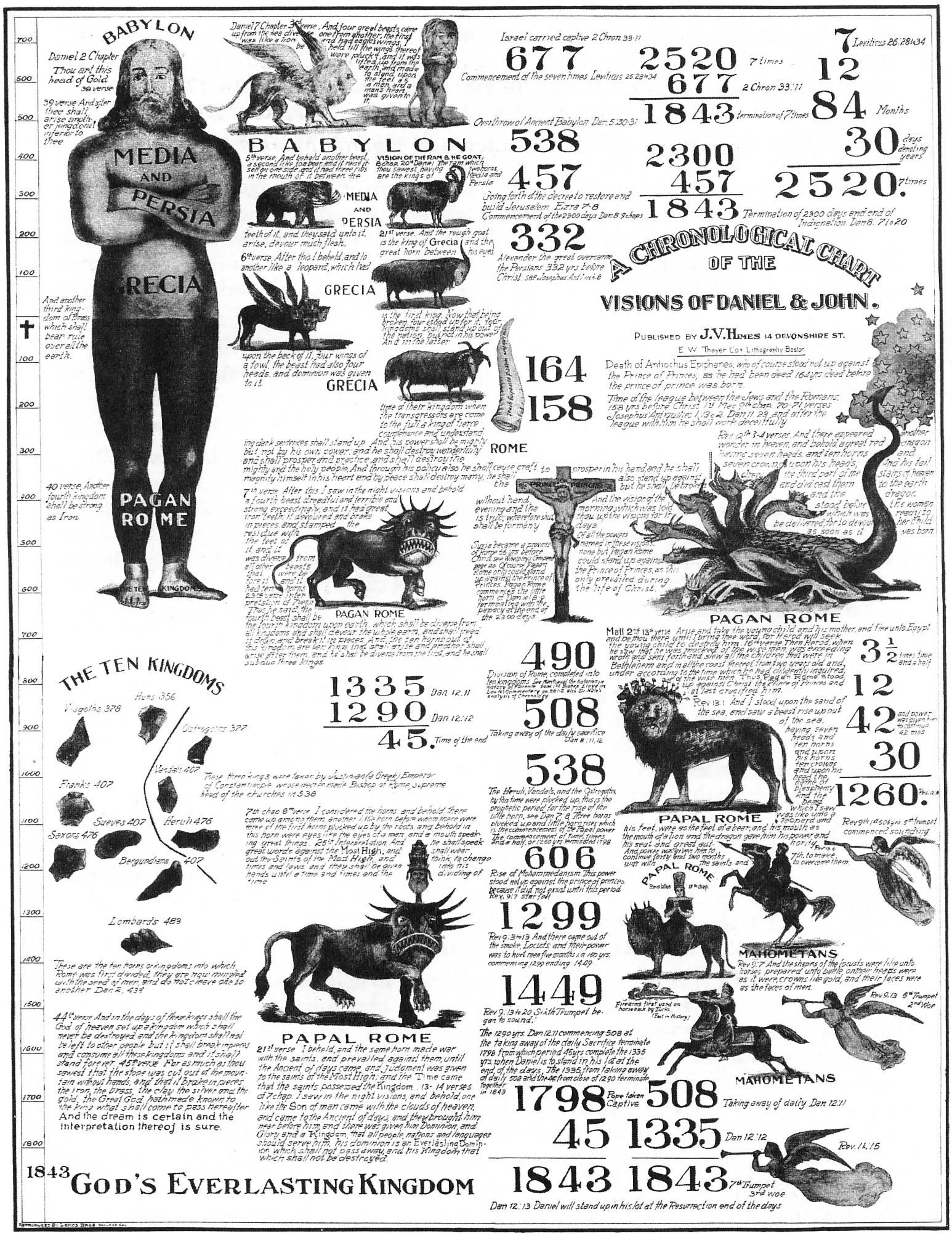
What better illustration of the Babel of premill confusion than the charts, diagrams, and cartoons premill experts used. The gleeful focus on minutiae, sidetracks, and the like dominates so much premill writing from the 19th and 20th centuries. It must not have been too difficult for a superfan of Star Trek to have turned his/her attention to the second advent in the 1970s or 80s.

So, I paste here some of my favorite confusing charts and illustrations. Try explaining any one of these to a room full of the uninitiated. It would be easier to wax eloquent about the distinguishing characteristics of the Klingons, Romulans, Ferengi, Vulcans, and Cardassians.

From William E. Blackstone's wildly popular Jesus Is Coming (1878). Degree of difficulty: 6 out of 10.


Click to enlarge this iconic Millerite poster from 1843, which deciphers prophetic math from Daniel and Revelation. Would like to see a black light version of it. Degree of difficulty: 9 out of 10.


From Isaac Cummings Wellcome, History of the Second Advent Message and Mission, Doctrine and People (1874). Degree of difficulty: 7 out of 10.


And finally, this one from a copy I picked up back in seminary days, Clarence Larkin, The Dispensational Truth: God's Plan and Purpose in the Ages (1920). This handsome text has some real mind-blowing charts in it. Degree of difficulty: 8 out of 10.


Senin, 19 Juli 2010

Strangers and Pilgrims, Travellers and Sojourners

Editor's Note: A previous reference and post on the Pilgrims provoked a flurry of emails from scholars and others quite passionate on the subject. So, again, mea culpa; more importantly, to atone for my sin of an unnecessarily flippant tone, I'm posting below author Jeremy Bangs's explanation of his recent very extensive work Strangers and Pilgrims, based on thirty years of research in the original sources, including many years researching in the original Dutch sources in Leiden.

A note along the same lines: I made reference earlier to Nick Bunker's new book as well as a review of it in
The New Republic. Jim Cullen appreciatively reviews this work, Make Haste from Babylon, over at HNN this week.
_____________________________________________

Strangers and Pilgrims
by Jeremy Bangs

Strangers and Pilgrims, Travellers and Sojourners – Leiden and the Foundations of Plymouth Plantation (Plymouth, Massachusetts: General Society of Mayflower Descendants, 2009). 894 pp. + xxxii; 134 ills. and maps. $55.

Of my eleven scholarly books and many articles, six concern the Pilgrims and Plymouth Colony. Four are document publications - the 17th-century town records of Scituate, Massachusetts (3 vols.), and Indian Deeds: Land Transactions in Plymouth Colony, 1620-1691. The Scituate records are more extensive than those of any other New England town outside Boston. They provide information that allows a reconsideration of the generalizations found in the detail studies of other towns from ca. 1970. In fact, most of those generalizations do not hold up to comparison with more extensive and explanatory documentation. Similarly, the information in the Scituate records contradicts the generalizations in David Hackett Fisher's famous work from the 1980s. The introductions to the Scituate records (totalling ca. 225 pp.) explain the implications for historiography.

I started that project merely as something to do, since I was living in Scituate at the time As the transcription progressed, I realized that the contents differed from what had become common knowledge - for example, it turns out that Scituate was the major town of Plymouth Colony after 1650, being sixty percent larger in population and economy than its nearest rival, the town of Plymouth. No one has paid attention to this in writing a history of the colony, or of New England. Scituate was an actively growing commercial center with interesting religious controversies as well, all overlooked in histories of New England. Similarly the introduction to Indian Deeds, again, ca. 225 pp, explains the significance of the documents that follow for the historiography of Indian relations with the colonists - The fifth book is a biography of Edward Winslow, third gov. of Plymouth Colony. Contradicting the assumption that Plymouth was of no wide importance beyond its own insignificant borders, this revises the history of Plymouth colony's early finances then continues with Winslow's role in the Cromwellian government. He returned to London in 1646 and rose in the committee structure of the government. Eventually he was appointed jointly by the Dutch States General and by Cromwell to be a member (acting as chairman) of an international committee whose task was to resolve commercial disputes remaining between The Netherlands and England after the first Anglo-Dutch war. His career puts Plymouth Colony in the middle of the now fashionable Atlantic history

As for Strangers and Pilgrims: Rejecting centuries of stereotyping both pro and con, Strangers and Pilgrims portrays the emergence of the Pilgrims as a coherent religious and social group whose goals and experimental choices when reacting to past and current events and circumstances made Plymouth Colony unique. Rather than providing neat, static definitions of who they were and then proceeding to conclude that their lives and their colony evaporated into insignificant myth, the book gives attention to the various shifting contexts – religious, political, social, industrial, and domestic - that called these people to responsive action. It is the culmination of thirty years' archival research in America, England, and The Netherlands.

The first chapter reviews the hopes that animated English Puritans when James I ascended the throne - hopes whose disappointment inspired Pilgrim leaders, William Brewster, Richard Clyfton, John Robinson, and John Smyth. They concluded that no true church could exist within the traditional hierarchies, parish structures, and rules retained from Roman Catholicism. Withdrawal from the Church of England led to persecution, while they and their congregations thought they saw God’s anger at England’s failure to achieve further reformation revealed in signs of divine wrath – the tsunami that devastated southwest England in January, 1607, followed by crop failure and famine throughout the country in the summer, the return of the plague in the fall, and a portentous comet towards the end of the year. Christians who had separated into a covenanted community seeking to lead a godly life felt the need to flee. Holland offered religious refuge.

Other English Separatists had found safety in Amsterdam a decade earlier, but sexual scandal among them threatened to associate the newcomers with their disrepute, a danger that increased when Rev. John Smyth re-baptized himself and some followers, calling up images of revolutionary Anabaptism with its end-time social chaos. Rev. John Robinson led the group now known as the Pilgrims to the university town of Leiden, famous for its cloth industry relying on refugee laborers. That city, however, had become the focal point of controversy that would split the Dutch Reformed Church and culminate in a military coup that put an end to the toleration for which Holland had become famous.

Familiarizing themselves with the town, the Pilgrims came into contact not only with the university and with Dutch Reformed and Mennonite churches, but also with English soldiers garrisoned throughout Leiden (such as Myles Standish) and with the thousands of French-speaking refugees who made up around 15% of the town’s population. Some people already in Leiden joined the Pilgrim church, while more new members came over from East Anglia, Kent, and London; the diversity of origins required communal attempts to build unity of purpose. This effort contrasts with any simplistic characterization of the structures of their colony in New England as representing a conscious or unconscious re-creation of regional folk customs and habits recalled from ye olde England.

Although the Pilgrims’ arrival in Leiden coincided with the beginning of the Twelve Years’ Truce in the Dutch revolt against Spanish Hapsburg domination, the peace was unstable. England was providing nearly half the soldiers in the Dutch army; King James exploited this dependence to demand ever greater influence in Dutch religious and political affairs. The Pilgrims found themselves under increasing pressure from England, whose ambassador successfully called for the suppression of the Pilgrims’ publishing project when he discovered offenses to the king’s majesty in Pilgrim calls for reform. King James demanded that Pilgrim William Brewster be arrested; an English bishop even made a clandestine visit to Leiden apparently to try to discover Brewster’s hiding place. The Pilgrims felt the pressure to seek a safer haven before Holland was once again engulfed in war

John Robinson participated in the university theological faculty's debates between double-predestination Calvinists (the Gomarists or Contra-Remonstrants) and their less rigid opponents (the Arminians or Remonstrants). The major focus of the controversy in Leiden was the appointment of Conrad Vorstius to be professor of theology. His opponents accused him of Socinianism and used that charge to convince King James I to retreat from religious toleration to a demand for Calvinist conformity in the Dutch church. Under his political pressure, Prince Maurits carried out a military coup, deposing the toleration-minded Remonstrants in government. The Synod of Dort then proceeded to condemn anyone with a broader theological view than that of the Contra-Remonstrants. The book's examination of documented political intrigue gives a new interpretation to the entire period in Holland. Although agreeing theologically with the decisions of the Synod of Dort, Robinson and the Pilgrims rejected calls to require everyone in Plymouth Colony to subscribe to the Heidelberg Catechism and the Belgic Confession, thus taking a position that had been among those for which the Remonstrants were condemned at Dort. In the Pilgrims' view, only the Bible and Apostles' Creed (which they thought had been composed by the Apostles) could be obligatory - everything else was inevitably imperfect because all things human are imperfect. Their colony became relatively tolerant because of this literalist understanding of the story of the Fall in Genesis.

With the Mayflower Compact, the Pilgrims established independent democratic government in their colony. Introducing the Dutch custom of civil marriage registration, the Pilgrims provided equitable laws for all colonists, whether or not members of the Pilgrim church. With their constitution of 1636, they conceived a representative government that gave no role to the clergy. Recognizing the Indians as equal creatures, the Pilgrims attempted to provide fair treatment for all in their courts; and they acquired land exclusively by sale or trade from the Indians who were understood to be the proper owners. Through their familiarity with the Dutch Union of Utrecht (1579), the Pilgrims helped form the United Colonies of New England (1643) on that model - a model that in turn served to inform the confederation structure of American independence in the late 18th century. Without any emphasis on presentism or triumphalism the book shows how the Pilgrims affected the societies in which they lived and were in turn affected by them.

Minggu, 11 Juli 2010

Gilbert's Jeremiad of LeBron the False Prophet, Part II

Todays' guest post comes from Matt Bowman, a Ph.D. candidate at Georgetown University who normally blogs at Juvenile Instructor. Matt follows up on my post from Friday focusing on the theological motifs in Dan Gilbert's open letter to Cleveland Cavaliers fans. Where I saw a theological muddle, Matt sees the tradition of the jeremiad.

LeBron James: false prophet
by Matt Bowman

Paul Harvey already has noted the muddled bricolage of religious invocation that is Cleveland Cavaliers’ owner Dan Gilbert’s screed against his now departed star, LeBron James, who left the city he was raised in and the franchise which drafted him to sign with the Miami Heat. As Paul notes, in one sense Gilbert’s frothing lapses into the sort of lumpy but fascinating theological mess that popular culture often makes of religion; this single sentence:

The self-declared former "King" will be taking the "curse" with him down south. And until he does "right" by Cleveland and Ohio, James (and the town where he plays) will unfortunately own this dreaded spell and bad karma.

manages to make hash of at least three and maybe four distinct religious traditions, invoking the karmic wheel of Indian subcontinent, the traditional vodou religions of Africa, a vague reference to the sort of curses which regularly plague folks in the Bible (and African Americans in the United States), and even, as Paul notes, a faint echo of Biblical commentary about Jesus’s rocky relationship with Nazareth.

But at the same time, people invoke these sorts of motifs for a reason, and I want to sketch out what I see as the larger religious processes (of betrayal/reconciliation, sin/redemption, affliction/purgation, and such) that are worked out on the basketball court in a number of religious ways (my earlier posts exploring the theology of basketball are here and here), and lurk here behind Gilbert’s unfortunate choice of Comic Sans. That is, as unlikely as it may seem, there’s coherence here.

What Gilbert’s really doing in this text is jeremiad, though a complicated one. He is calling Cleveland to repentance, for they have followed after a false prophet, sought after salvation which has turned to ashes and sin in their mouths. But while the jeremiad traditionally invoked the promise of former generations, Gilbert instead appeals to the promise of salvation that once hovered within grasp, and in a series of rhetorical inversions shows how it has been shorn of its finery. While James was once ritually adulated with Nike’s “We Are All Witnesses” campaign, which promulgated ads that did no less than promise LeBron as savior, Gilbert now uses the word to describe the agony of fan watching James’s betrayal. This is, as Gilbert puts it, “bitterly disappointing;” because, of course, “witnessing” is the source of salvation. The word itself invokes evangelical Protestant liturgies of conversion, as sinners are brought to their redemption through hearing the Word of God. In the religion of sports, however, the salvation of identification, of embedding one’s self in the transformative narrative of conflict and triumph, comes through the witnessing of the athletes on the court, of which we are witnesses. Quicken Area was therefore a church, and James’s betrayal of his fans on an ESPN spectacle Gilbert angrily labels “narcissistic” and “self-promotional” has transformed their rite of salvation into an infliction of agony for his own gain, rather than the means of grace which it was intended.

But Gilbert’s jeremiad does not end there; rather, following pattern, after presenting the problem it exhorts to redemption. And Gilbert promises, in best pastoral style, that the path to salvation is not lost; rather, the flock must simply find the correct path. In a rare correct use of apostrophes, Gilbert refers to James as the “chosen one;” a title once used in all seriousness, describing the power James was presumed to have to restore true salvific basketball to Cleveland. Now, however, James has been exposed as a false prophet. And this because, in what Paul rightly notes is one of the most fascinating lines in the document:

Some people think they should go to heaven but NOT have to die to get there.

James peddled cheap grace. By somewhat gleeful implication, Gilbert notes that in his seven year career with Cleveland, LeBron failed to win a championship. This, he maintains, was the inevitable result of James’s false religion, but now, liberated by the blinding and painful light of revelation, Cleveland has been rightly converted, and will set about making its own salvation. As Gilbert argues, this shameful display of selfishness and betrayal by one of our very own has shifted our "motivation" to previously unknown and previously never experienced levels.”

Ultimately, the purpose of this reverse jeremiad is purgation of sin, an expiation that follows Rene Girard’s analysis of the scape goat of the Hebrew Bible. Gilbert declares, in a rather muddy bit of theological reasoning, that James will bear the “curse” (ie, inability to win, to provide a truly transformative narrative of victory for its fans to find salvation in) with him to Miami, in a way somehow related to his exposure as a false prophet. What this means is that James is the bearer of Cleveland’s sins; he must be ritually cast out from their midst, in order to take with him the contagion that afflicts them. And thus we can understand Gilbert’s insistence that Cleveland is now somehow better off without him. After all, as Gilbert notes, Clevelanders now know that James is the “exact opposite” of “what we would want our children to learn. And ‘who’ we would want them to become.” (sic, on the apostrophes; as I glancingly observed earlier, Gilbert often uses them in baffling fashion.)

It’s therefore perhaps appropriate that Gilbert closes his letter promising that “Tomorrow is a new and much brighter day.” The apostate is cast from the midst; the community’s sins have been eliminated. And the true and only heaven hovers in the distance.

Jumat, 09 Juli 2010

Remember, LeBron, You Got to Go Through Hell Before You Get to Heaven

Paul Harvey

Mike Altman and others here frequently have called for expanding the boundaries of the sacred for analysis, and since various contributors here have posted on everything from Disney Religion to Green Day's American Idiot to early modern tattoos, I should think this would be a receptive venue for an expansive view of religious ritual.

All the same, there's plenty of room here for traditional theological analysis. I"m going to guest post something soon from Jeremy Bangs, about the theological/social worldview of the Pilgrims, which he believes challenges much existing scholarship in the area.

But before we get there, a priceless document for theological analysis has just come to our attention: Dan Gilbert, majority owner of the Cleveland Cavaliers, in an open letter addressed to "All of Northeast Ohio and Cleveland Cavaliers Fans Wherever You May Be Tonight." (He should have just plagiarized from Conan O'Brien's letter to his fans, which was addressed to "People of the Earth").

In case you've been living in a cave this week, let me bring you up to speed: LeBron James has decided to sign with the Miami Heat, joining new teammates Dwayne Wade and Chris Bosh. Said act was announced in an hour-long show of pretty boring absurdist theater (actually 2 hours, after the post-show coverage) last night on ESPN. Since NPR and the New York Times, Wall Street Journal, et al covered the story as well, I assume that those of you who could give a rat's behind about all this nonetheless could not escape the news story no matter how much you wanted to.

Of more interest to me is owner Gilbert's response (hilariously posted in Comic sans font, as blog reader Matt Bowman pointed out to me), full of sound and (impotent) fury. The letter might as well have been labeled: "LeBron Shouldn't Tap."

Theologically speaking, many important lines of American religious thought crash together (Nascar style) here. Let me count the ways, or at least a few of them:

1) a critique of a culture of narcissism, with a jab at the "narcissistic, self-promotional build-up" to the televised special. Here, of course, we are into Christopher Lasch land, and I'll just point you to this series of posts by our contributor John Fea for more there. Coming from an NBA owner, naturally this is pot calling kettle black stuff, but I'm less interested here in the evident hypocrisy than in the adoption of a pluralistic world of theological motifs.

2) "The self-declared former 'King' will be taking the 'curse' with him down south. And until he does 'right' by Cleveland, James . . . will unfortunately own this dreaded spell and bad karma."

Where to begin?? We have Ham's curse together with allusions to some sort of witchery (presumably Pat Riley is the Wizard). We have a common sense view of fairness and justice, and a defensiveness about Cleveland reminiscent of the biblical verse about what good could ever come out of Nazareth. The end reference to karma is likely just cultural cliche, almost completely shorn now of its religious referent (similar to how the term "redemption" is commonly used -- "wow, he really redeemed himself with that putt on the 18th") -- but more charitably, I will assume owner Gilbert has read Stephen Prothero and Thomas Tweed's extensive primary source volume Asian Religions in America, and thus speaks from a profound knowledge of the extensive influence from the nineteenth century forward of Asian religious concepts on the American psyche.

3) Weirdly juxtaposed alongside the abundant Arminian references to assured salvation and the bitterly expressed communal utopianism (guaranteeing that long-suffering Cleveland fans will enjoy the championship hardware before the false prophet LeBron ever does) is a profound aphorism of Hardshell Baptist theology:

"Some people think they should go to heaven but not have to DIE to get there."

I can hear the Appalachian preacher's end-of-line punctuation point -- "ha" -- at the end there, and the capitalization and thus verbal emphasis on DIE comes straight from many a camp meeting sermon a la Kentucky ca. 1805. But more likely, owner Gilbert got this theology via the way everyone else got it in the 1970s, from the Steve Miller Band's "Big Old Jet Airliner," with the line about having to go through hell before you get to heaven. Dante would have been singing along.

Finally, there is the emphasis from Romans 13, about all things working together for good. As Gilbert explains, "This heartless and callous action can only serve as the antidote to the so-called 'curse' on Cleveland, Ohio." Here, the false prophet has been exposed and driven out of town, and the alleged salvation that the prophet would bring can now be seen as just another sacrifice for Baal. The prophet was a conjuror, casting a spell and bringing the curse with the fetish bag of chalk powder (or whatever that white stuff was) thrown up before every game. Those fans who burned the jerseys understood that purification is the communal expiation to rid the last vestiges of the evil and witchery of the false prophet/conjuror. As the slaves sang, "Old Satan is a liar and a conjurer too, If you don't mind, he'll conjure you."

(Needless to say, the burning also calls to mind some of the most disturbing images of American history; for a much more serious analysis of that issue and the whole aspect of the hyperbolic anger directed at a routine business decision, see Tenured Radical's post "A Meditation on the American Way of Rage").

There's much, much more here, theologically speaking, and I invite comments to add to the mix. Until then, goodbye to the people I trusted. LeBron will get rich(er), for sure, but in the meantime he'll get busted.

Senin, 11 Januari 2010

Bodies of Belief and Christian Nationists Revisited

Paul Harvey

Over at Juvenile Instructor, Jonathan Stapley has some interesting thoughts and important critiques on ritual healing among early American Baptists as covered in Janet Lindman's Bodies of Belief: Baptist Community in Early America, a book John Fea previously reviewed for us on this blog. As a researcher in early Mormon healing rituals, Stapley pays most attention to the coverage of healing rituals in Lindman's work, and finds some issues with some of the details provided there.

Meanwhile, and leaving the world of scholarship for the world of propaganda, for those following the Texas schoolbook controversy which we briefly covered last summer (in which various propagandists are trying to do to history what the creationists would like to do to science education), the Austin Statesman has a piece filling you in on the latest. Our contributor John Fea (who is quoted in the Austin Statesman, and is writing a primer on this subject which promises to be required reading) comments on the piece here, and Jon Rowe comments cogently here. John apologizes for saying (inadvertently and without remembering it later) that Peter Marshall et al are "out to lunch," but if it looks like a duck and quacks like a duck, then it ain't an ad hominem argument to suggest that it is a duck. The record of Marshall's public statements in particular (most recently about Katrina) suggests that ridicule is a perfectly legitimate response when a public figure makes ridiculous statements, but nonetheless exercises undue influence on important matters of history education.

Selasa, 05 Januari 2010

Responding Religiously to the Great Recession

Darren Grem

Jim Wallis has a new book coming out soon on what he sees as the religious underpinnings and implications of the recent--and continuing--recession. As what I suppose is a boilerplate for that book, Wallis recently wrote this column for the Washington Post, offering a "religious response to the financial crisis." A selection:

Clearly, the financial crisis is a structural meltdown that calls for increased government regulation of banks and other financial players. Members of faith communities, such as those who joined me in front of the Treasury building, are helping to push for this sort of reform. But at its core, this is also a spiritual crisis. More and more people are coming to understand that underlying the economic crisis is a values crisis, and that any economic recovery must be accompanied by a moral recovery. We have been asking the wrong question: When will the financial crisis end? The right question is: How will it change us? This could be a moment to reexamine the ways we measure success, do business and live our lives; a time to renew spiritual values and practices such as simplicity, patience, modesty, family, friendship, rest and Sabbath.


It seems that any time Wallis writes a column, the volleys begin almost immediately. The American Enterprise Institute did not disappoint:

After reading his opinion piece in the Washington Post, however, I’m a bit baffled. What exactly does Wallis mean by a “religious response”? To be substantive, it should offer some added theological value not available elsewhere. And to be useful, any response must first understand the crisis itself. It shouldn’t just add biblical stories, phrases, or paraphernalia to common myths and misunderstandings of the crisis.

There's some more back-and-forth's on this matter available at your local Google.

Rabu, 02 Desember 2009

Original Sin and Everyday Protestants

I'm happy to announce our newest contributor on our permanent rolls: Steven Miller. Steven is no stranger to the blog, having posted here before (more recently on the Billy Graham/Richard Nixon tapes), and we've discussed his excellent book Billy Graham and the Rise of the Republican South in a number of posts. For his first post as contributor, Steven assesses a new book by Andrew Finstuen. Welcome to Steven!
--------------------------------------------------------------

Short Review of Andrew S. Finstuen, Original Sin and Everyday Protestants: The Theology of Reinhold Niebuhr, Billy Graham, and Paul Tillich in an Age of Anxiety (University of North Carolina Press, 2009)

The Age of Original Sin; Or, Listening to The Hour of Decision while Reading Christianity and Crisis And Summoning The Courage to Be

By Steven P. Miller

In the postwar United States, the word “crisis” appeared at least as often as “spin” and “network” do today. The early Cold War was a period of brooding about anxieties abroad and at home. American social critics lamented, collectively, an affluent society of organization men and status seekers wearing gray flannel suits and living in ticky-tacky houses. Through the lens of religious history, historian Andrew Finstuen offers a fresh perspective on the postwar crisis. For Finstuen, the postwar years were a golden age of public theology, a period when “lay theologians” took seriously the great Protestant questions of faith, grace, and most importantly, original sin (6). They listened to Billy Graham, to be sure, but many of them also read Paul Tillich and Reinhold Niebuhr. While Finstuen acknowledges the obvious differences within what he aptly terms this “curious trinity,” he argues that Niebuhr, Graham, and Tillich “shared a common theological principle: behind every sinful act was the indisputable, universal condition of individual sin” (47). The popular resonance of that shared principle, Finstuen argues, contradicts caricatures of 1945-1965 as a period of conformity. Rather it was an “original sin moment” reflective of “the sincerity and sophistication of religious thought and devotion at midcentury” (2; 186).

Regardless of how one responds to Finstuen’s thesis (I find it compelling), his book is notable for its blend of intellectual history and what the author, in an important move, calls “popular lived theology” (191). In a memorable opening chapter, Finstuen (drawing from postwar theologian John Bennett) identifies not one, but two postwar religious revivals: the “captive revival” of Dial-A-Prayer, the American Way of Life, and The Power of Positive Thinking; and the “theological revival” of Tillich, Niebuhr, and—Finstuen argues—Graham (13-46). Finstuen has read widely in Life, Look, Newsweek, and other contemporary periodicals, which served as surprising forums for the theological revival. Even more strikingly, he has delved into a treasure trove of unpublished letters to his curious trinity, uncovering an American moment when an Alabama high school valedictorian asked Niebuhr for commencement speech ideas, a Virginia homemaker wrote to Tillich about the “essential and the existential,” and seemingly everyone unburdened their souls to Graham (166). Finstuen thus is able to offer a fresh perspective on familiar figures. From the vantage point of lay theologians, Niebuhr emerges as “less a realpolitik political philosopher than a prophet-pastor”; Graham as “less a theatrical revivalist . . . than a genuine evangelist communicating both the severity of sin and the power of Jesus Christ to conquer sin”; and Tillich as “less a liberal, abstruse theological experimenter . . . than a translator of the classic doctrine of original sin for a modern age” (190). Finstuen’s largely affirming treatments of all three are rich, nuanced, and deserving of close study.

I cannot avoid quibbling with a few of Finstuen’s arguments and suggestions. His efforts to refute popular and academic criticism of his subjects—especially Graham—make the book unnecessarily defensive at times. In a way, liberals—theological, political, and otherwise—are easier historiographical targets these days than evangelicals. By the close of Finstuen’s original sin moment, liberal theology seems a god that failed. Yet it was viable enough to soon serve as a foil for postliberal theology, among other things. The labels “prophet” or “prophetic,” which Finstuen employs to describe Niebuhr and (occasionally) Graham, remain tricky. When applied to American society as a whole, they can suggest a degree of activism that, to cite but one example, both Niebuhr and Graham lacked on the issue of civil rights. Some readers will take issue with characterizing Graham as part of the theological, rather than the captive, revival. However, Finstuen should be commended for taking the evangelist’s jeremiads seriously.

Finstuen’s book transports readers to a time when big questions mattered—and when nearly everyone posed them. It is a period well suited for his methodology. The best works of intellectual history make unexpected, yet insightful connections using a comparative framework. The best works in the lived religion tradition demonstrate the limits of employing conventional categories of theological analysis. Finstuen succeeds on both fronts in this creative and thought-provoking study.

Jumat, 20 November 2009

New Book on John Wesley and Methodism

Randall Stephens

Cambridge University Press has a marvelous series called the Cambridge Companions to Religion. Of particular interest to readers of this blog will be: Dana Evan Kaplan, ed., The Cambridge Companion to American Judaism (2005); Stephen J. Stein, ed., The Cambridge Companion to Jonathan Edwards (2006); and John Coffey and Paul C. H. Lim, eds., The Cambridge Companion to Puritanism (2008).

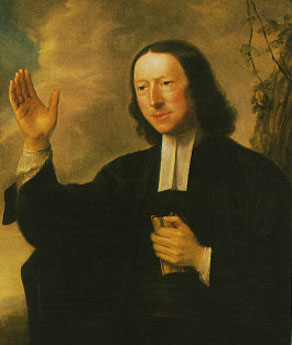
The Cambridge Companion to John Wesley (2009), edited by Randy L. Maddox and Jason E. Vickers, is the latest installment in the series. Wesley, of course, has had an enormous influence on American Christianity. His religion of the heart "strangely warmed" continues to exercise evangelicals, members of mainstream churches, and modern-day social gospellers. Wesley once tellingly wrote: “I am not afraid that the people called Methodists should ever cease to exist either in Europe or America. But I am afraid lest they should only exist as a dead sect, having the form of religion without the power. And this undoubtedly will be the case unless they hold fast both the doctrine, spirit, and discipline with which they first set out.” Over one hundred years later, Holiness folk and Pentecostals said, "amen and amen!"

CUP summarizes Wesley's impact and describes the The Cambridge Companion to John Wesley as follows: "A leading figure in the Evangelical Revival in eighteenth-century England, John Wesley (1703–1791) is the founding father of Methodism and, by extension, of the holiness and Pentecostal movements. This Cambridge Companion offers a general, comprehensive introduction to Wesley’s life and work, and to his theological and ecclesiastical legacy. Written from various disciplinary perspectives, including history, literature, theology, and religious studies, this volume will be an invaluable aid to scholars and students, including those encountering the work and thought of Wesley for the first time."

Contents

Introduction Randy L. Maddox and Jason E. Vickers; Part I. Wesley's Context: 1. The long eighteenth century Jeremy Gregory; Part II. Wesley's Life: 2. Wesley's life and ministry Kenneth J. Collins; 3. Wesley in context David N. Hempton; Part III. Wesley's Work: 4. Wesley as revivalist / renewal leader Charles I. Wallace; 5. Wesley as preacher William J. Abraham; 6. Wesley as biblical interpreter Robert W. Wall; 7. Wesley as diarist and correspondent Ted A. Campbell; 8. Wesley as editor and publisher Isabel Rivers; 9. Wesley's engagement with the natural sciences Randy L. Maddox; 10. Wesley as adviser on health and healing Deborah Madden; 11. Wesley's theological emphases Jason E. Vickers; 12. Wesley's emphases on ethics Rebekah L. Miles; 13. Wesley's emphases on worship and the means of grace Karen B. Westerfield Tucker; Part IV. Wesley's Legacy: 14. Spread of Wesleyan Methodism Kenneth Cracknell; 15. The Holiness/Pentecostal/charismatic extension of the Wesleyan tradition Randall J. Stephens; 16. The African-American wing of the Wesleyan tradition Dennis C. Dickerson; 17. Current debates over Wesley's legacy among his progeny Sarah H. Lancaster.