Tampilkan postingan dengan label fundamentalism. Tampilkan semua postingan

Senin, 30 Mei 2011

IT is Happening Here (Re-reading The Handmaid’s Tale)


by Steven P. Miller

Recently, I have been thinking about how the rise of the evangelical right influenced late twentieth-century American liberalism. My inquiry led me to take another look at Margaret Atwood’s dystopian classic, The Handmaid’s Tale (1985). I first encountered the novel during my high school days in the mid-1990s. Reading it—or at least knowing about it—was something of a rite of passage for aspiring members of the new class. (I never went through an Ayn Rand phase, thankfully, and hence never aspired to join the productive class.) The Handmaid’s Tale may or may not have inspired some of its readers to spray paint X’s across the ubiquitous Oliver North for Senate signs in Harrisonburg, Virginia.

The Handmaid’s Tale is a riveting story driven by the alternately righteous and resigned, but always ironical, narrative voice of “Offred.” She is the handmaid of Commander Fred; which is to say, she exists to bear his seed; which is to say, the Republic of Gilead (nee New England) is a nightmarish patriarchy. In fact, the “early Gilead era” is the conflation of all things right-wing; not merely patriarchal, it is also theocratic, nativist, racist, and belligerent. The only thing missing is capitalist, although Offred’s Commander does have a background in market research. The regime is a composite of past models: the predictable Stalinist USSR-Nazi Germany template (Born of a coup, Gilead is in a continuous state of mobilization; the state police force is known as the Eyes), antebellum slavery (The handmaids are breeders subject to the whims of Commanders and the spite of Commanders’ wives), and Puritan Massachusetts (The book is dedicated to convicted witch Mary Webster, an ancestor of Atwood’s). More striking are the contemporaneous analogues: apartheid South Africa, Khomeini’s Iran, Ceausescu’s Romania . . . and, most importantly, the religious right’s looming Christian America, which in the novel is firmly in place by the 1990s. Thus, fundamentalism—a category then in the process of being conceptually stretched from Dayton, TN, all the way to Tehran—was the new “it” (more like an IT) that can happen here (or there, for the Canadian Atwood), specifically, in a city not unlike Cambridge, Mass. (not too far from Canada, when you think about it).

If Gilead’s complementarian view of oppression is a little too convenient, its religious politics are downright incoherent. (Why exactly does Gilead war against the Baptists down South? Are they the Socialist-Revolutionary Party to Gilead’s Bolsheviks?) Theo-ideological consistency was not really the point, though, in this unabashedly political novel. Fundamentalists, after all, are not averse to making up some rules as they go along; they’d rather play Geneva than wait for the promised new Jerusalem. Gilead’s basis for legitimacy is the law-and-order God of the Old Testament. But the basis could just as well have been some other IT rooted in some other reactionary resource, so long as IT provided an alternative to a sexual revolution that, by late 1970s and early 1980s, had created an opening for counter-revolution. As Norman Lear said during the early days of People for the American Way, “every generation must deal with its own Infallibles.” For Atwood, the more historically distinctive thing was the target: sexual freedom and, by extension, women’s bodies, and by further extension, women’s humanity. (Here, Atwood’s own targets included feminist anti-porn activists as well as anti-feminist female dupes.)

So much for my very impressionistic re-reading of Atwood. Has this novel served any serious political significance—other than to scare the hell out of impressionable readers? Atwood’s attitude toward the Christian Right is that of the distant literalist; fear trumps contingency as a heuristic device. Thus, the book offers little in the way of counter-intelligence. It tells us next to nothing about the Christian Right’s appeal, save to point out its ironic—in the novel, tragic—overlap with feminist moralism. While gallows humor spills forth from the oppressed, the villains remain predictable in their two-dimensionality: The Commander is a traditionalist who makes an exception for himself; his wife, a former televangelist (“Serena Joy”) who now chafes at her separate sphere.

Still, The Handmaid’s Tale undoubtedly reminded many readers of what they had to lose. Perhaps Colorado Springs was the Salem of our time, and the Republican National Convention the new Munich. At the very least, the novel gave young liberals such as myself a handy foil during the mid and late 1990s—a time when, amid my mistaken belief that Michael Kelly’s The New Republic really was a liberal publication, it was not always easy to gauge the stakes of political discourse (Boy, did Michael Kelly hate Bill Clinton). Opposing the Christian Right seemed a clearer vantage point; if liberalism was anything, it was not fundamentalism. In an age of presumed backlash, it seemed more pressing to be libertarian than liberationist on social issues; the best way to celebrate freedoms was to defend them. But what about religion? If The Handmaid’s Tale was to be believed, then religion was an inherently destabilizing force in politics. But didn’t such talk play into the hands of the opposition? Wise figures on the right long had warned (with a wink) that, should the decadent tide fail to ebb, the back-lashing masses would find recourse in authoritarianism.

Then came “W.” A decade later, I teach this stuff. So many of my students interpret religion-in-general through the lens of politically-conservative-religion-in-particular. They may have read The Handmaid’s Tale (I will take a poll next semester), or perhaps they have just absorbed its echoes.

Jumat, 21 Januari 2011

Going Straight to Hell on a Crazy Train

By Michael J. Altman

Combining Paul's post of a Sarah Palin version of a classic song and Kelly's post about zombies, I bring you the best parody of Ozzy Osbourne ever. This comes courtesy of Westboro Baptist Church, the church that loves Jesus but probably hates you:


That's right, WBC is protesting Ozzy Osborne--a few decades late, if you ask me--making it official: "God hates Ozzy Osborne!"

Senin, 20 Desember 2010

Fundamentalism and Education in the Scopes Era

Paul Harvey

Now on to the 2nd review from this month's Choice. Haven't seen it yet, but I bet this book draws a lot of interest:

Fundamentalism and Education in the Scopes Era: God, Darwin, and the Roots of America's Culture Wars, by Adam Laats

Laats, Adam. Fundamentalism and education in the Scopes era: God, Darwin, and the roots of America's culture wars. Palgrave Macmillan, 2010. 258p index; ISBN9780230623729, $85.00. Reviewed in 2011jan CHOICE.

Laats (education, Binghamton Univ., SUNY) argues that a significant transformation in US religion and culture can be traced to the 1920s and the Scopes trial. Fundamentalists began the decade aggressively defending their majority conservative Protestant domination of public schools not only against Darwin, but also for prayer and Bible reading. They ended the decade a vocal minority, sometimes embracing and sometimes rejecting the pejorative stereotypes that the trial and media coverage created. Chronological chapters trace the rise, then fracturing, of fundamentalism, focusing on a handful of major figures and charting their responses to educational issues through their publications. State legislative battles trace the little-known advances of fundamentalist school reform in the years after Scopes and before the 1960s court decisions that reversed them. Laats pays little attention to the content of textbooks, curricula, and classrooms. The legacy of the era, he argues, was the creation of a separate system of education in the growth first of seminaries and Christian colleges--such as Dallas Theological Seminary, Bob Jones University, and Wheaton College in Illinois--and later of conservative Christian private schools founded to preserve biblical authority as much as racial segregation. Extensive notes. Summing Up: Recommended. Upper-division undergraduates and above. -- K. Gedge, West Chester University of Pennsylvania

Sabtu, 11 Desember 2010

Premillennialists and Their Charts

Randall Stephens

It's hard to narrate the history of millennialism to a general audience without losing the plot in a thicket of obscure Bible verses, dispensational disorientation, and premill fatigue. Sure, there's a rage to explain. But how many paragraphs should a historian of American millennialism devote to "Armageddon," "tribulation," "Gog," "Magog," "Mark of the Beast"? (Paul Boyer navigated this well in his classic When Time Shall Be No More. That's a wonderful guide.)

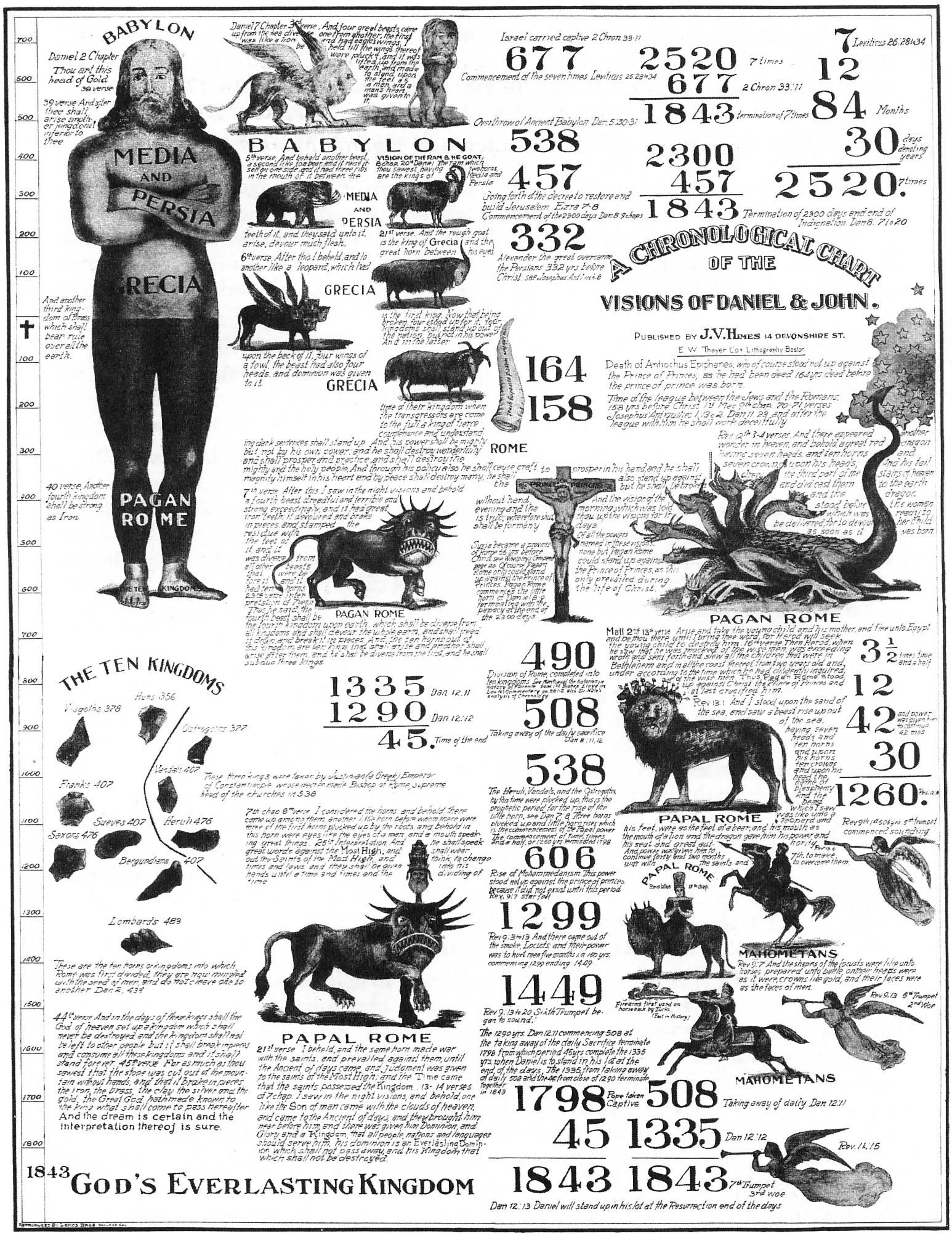
What better illustration of the Babel of premill confusion than the charts, diagrams, and cartoons premill experts used. The gleeful focus on minutiae, sidetracks, and the like dominates so much premill writing from the 19th and 20th centuries. It must not have been too difficult for a superfan of Star Trek to have turned his/her attention to the second advent in the 1970s or 80s.

So, I paste here some of my favorite confusing charts and illustrations. Try explaining any one of these to a room full of the uninitiated. It would be easier to wax eloquent about the distinguishing characteristics of the Klingons, Romulans, Ferengi, Vulcans, and Cardassians.

From William E. Blackstone's wildly popular Jesus Is Coming (1878). Degree of difficulty: 6 out of 10.


Click to enlarge this iconic Millerite poster from 1843, which deciphers prophetic math from Daniel and Revelation. Would like to see a black light version of it. Degree of difficulty: 9 out of 10.


From Isaac Cummings Wellcome, History of the Second Advent Message and Mission, Doctrine and People (1874). Degree of difficulty: 7 out of 10.


And finally, this one from a copy I picked up back in seminary days, Clarence Larkin, The Dispensational Truth: God's Plan and Purpose in the Ages (1920). This handsome text has some real mind-blowing charts in it. Degree of difficulty: 8 out of 10.


Jumat, 24 September 2010

God’s Own Party, cont.

by Steven P. Miller

In Dan Williams’ God’s Own Party: The Making of the Christian Right, we now have a go-to narrative analysis of the roots, rise, and resilience of the Christian Right. While Williams builds on earlier scholarship—especially William Martin’s memorable and anecdote-rich With God on Our Side—his book is an exceedingly original contribution based on deep (and I mean deep) research leavened by the wisdom of almost a decade’s worth of reflection. Williams writes with grace and clarity.

Williams describes a “ninety-year quest” (9), which started with the culture wars of the 1920s and intensified with the surprisingly (and overly) confident evangelical activism of the late 1940s and 1950s. (The early National Association of Evangelicals comes across as a proto-Moral Majority—something that those of us with our heads stuck in that Seventies decade should keep in mind.) After authoritatively covering the somewhat more familiar territory of the 1960s, 70s, and 80s, Williams, to his great credit, follows through with a deft ordering of the recent past. The power, glory, and spectacle of the George W. Bush years yielded to the uncertain trumpet of 2008 (which, in turn, was complicated by the blaring trumpet that is Sarah Palin).

Below are a few preliminary—and somewhat random—thoughts on how God’s Own Party informs what might be called the new evangelical history. (Later, I hope to do the same for Darren Dochuk’s no less eagerly awaited From Bible Belt to Sunbelt, which will appear in December.)

First, I affirm the use of “Christian Right” (as opposed to Religious Right) to describe an evangelical Protestant movement that, largely for strategic reasons, has included a broader range of actors. That said, a lot remains to be learned about the relationship between the Christian Right and the Catholic right. On this and other topics, Williams offers intriguing leads for future researchers (Attn. graduate students).

Williams gives “fundamentalist” vs. “evangelical” quite a bit of analytical heft, noting (echoing John’s study of Campus Crusade for Christ) that those identities were well defined only by the late 1950s before showing (my interpretation here) how they became less relevant by the 1980s, as the Reagan coalition took shape. Irenic Billy Graham and surly Bob Jones, Jr., had more than a few overlapping friends and positions, but Williams is very clear about their differences, especially concerning civil rights issues. He argues that “fundamentalists became ‘conservatives’ in opposition to the Kennedy administration” (59)—that is, well before New Right activists sidled up to Jerry Falwell, et al.

It’s hard to know just what to make of “Nixon’s evangelical strategy” (89), as Williams aptly calls it. His Nixon was an ambitious, but superficial manipulator of evangelical politics who went so far as to try to install his man (Veterans Administration official Fred Rhodes) as president of the Southern Baptist Convention. H. R. Haldeman and the once-born version of Charles Colson were equal parts ruthless and bumbling. Yet, as Williams notes, the salad days of the “silent majority” came after the fall, when Christian Right activists embraced its populist tone (“moral majority”). That’s “Nixonland” for you, I guess.

I sense an emerging scholarly consensus that abortion was a driving force behind the growth of the Christian Right from a very early date, even if W. A. Criswell tacitly endorsed Roe v. Wade and even if Jerry Falwell initially said little about the matter. Most such expressions of moderation occurred before the phrase “abortion on demand” became established, first as a concept, then as a statistic. To be sure, one might interpret that “concept” as a “rhetorical device.” But I think Williams is wise to avoid a cynical interpretation of evangelical pro-life politics. (For Francis Schaeffer, to cite one example, Reaganism was a proxy for opposition to abortion—not the other way around.)

Williams’ work is a story of (to quote an earlier version of the title) “Republican faith,” and it becomes clear in this book that, as early as the Eisenhower years, the GOP was the logical vessel through which to pursue conservative evangelical politics. This reality, as I read Williams, points to the overall pragmatism and patience of the Christian Right, not to its naivete or lust for power (as is sometimes suggested). If the Christian Right endures, as Williams believes it will, it will do so in large part because it made itself into a major wing of a major party.

Selasa, 08 Juni 2010

Is Anything Not a Sign of the Apocalypse?

Kelly Baker

These days, my brain alternates between at least two or three scholarly things/themes: the 1920s Klan and the apocalypse (and often vampires and religious intolerance, but that is for another day). The first, of course, is quite obvious. I am counting down the days until my manuscript is tied in a bow and shipped to my publisher. The second, however, started as a minor interest in apocalyptic scenarios in American culture more generally and in pop culture more particularly (see here and here for our other bloggers take on this topic), and it is possible that the apocalypse is becoming quite an obsession of mine. I am teaching a class on the Apocalypse in American culture in the fall, and I even have a Google news alert set broadly for apocalypse (what interesting things appear with that word in the title). According to bloggers, new pundits, and other various talking heads, almost anything is a sign of the apocalypse: Miley Cyrus, a myriad of commercial products, Americans in general, the environment, Obama, various political maneuvering, 2012, nuclear armament and disasters (natural or otherwise).

It is not surprising, then, that the BP oil spill would become one of the impending signs of Armageddon. Lisa Miller, over at Newsweek, reports that in some Christian fundamentalist circles the oil plume points to biblical prophecy come alive. She's a little light on the history of millennialism in America, but she pulls in the Millerites as a key example of the problem with predicting the end of the world. What is more interesting is that a part of the Christian blogosphere finds the oil plume in the Gulf
to be manifestation of Revelation. Miller writes:

Revelation 8:8–11[:]“The second angel blew his trumpet, and something like a great mountain, burning with fire, was thrown into the sea. A third of the sea became blood, a third of the living creatures in the sea died, and a third of the ships were destroyed … A third of the waters became wormwood, and many died from the water, because it was made bitter.” According to Revelation, in other words, something terrible happens to the world’s water, a punishment to those of insufficient faith. The foul water, according to the New Oxford Annotated Bible, mirrors one of the plagues God called upon Egypt on behalf of his people Israel.

Though maybe it’s Revelation 16:3: “The second angel poured his bowl into the sea, and it became like the blood of a corpse, and every living thing in the sea died.”

Some interpreters are very sure: The oil spill matches biblical prophesy and is another predictor of the end. One commenter at Godlike Productions argues that the redness of the oil seen in pictures can be interpreted as blood. “The water is tinted red from the oil … it ACTUALLY looks like blood. coincidence??? NOT!!!!” On Facebook, at least two discussion groups are devoted to mining the parallels between events in the gulf and those predicted in the bible; and in a heart-rending interview with CBS, a Louisiana minister named Theodore Turner, whose congregation is one third fishermen, said he knew it to be so. “The Bible prophesized hardships,” he said. “If we believe the word of God is true—and we do—we also know that in addition to prophesying hardships he promised to take care of us.”

Interestingly, Miller notes that there might be a problem with this interpretation because usually these catastrophes are punishment for very bad behavior, so what did the people of the Gulf do to deserve this? Nothing. Miller continues, "Yet through a biblical lens, it’s hard to see the oil spill as anything but God’s punishment for greed and a disrespect of Creation—and both of those sins fall mostly on the shoulders of the Republicans, who have been aggressively lobbying for more offshore drilling, without, obviously, ensuring that appropriate safeguards are in place. " Why I am not in the game of interpreting God's will, it is pretty clear that Miller's assessment might strike some as dead on.

I wonder what religion scholars in the Gulf region (here's looking at you, Mike Pasquier) think about Miller's assessment and the desire to place the oil spill in such a dramatic theological narrative. Watching coverage of the oil spill and BP's failures to stop the plume makes me feel ill and distraught because of the ecological and human consequences, but I am not sure I "see" the apocalypse. Yet, this scenario does feel more convincing as a one of many biblical disasters leading to the final days than teen pop star. Maybe there is too much geographic distance between me and the Gulf. More likely, it is because I have been reading so many articles, posts, etc. about the impending apocalypse. I can't help but wonder if anything can be a sign of the apocalypse, then maybe nothing is.


Kamis, 13 Mei 2010

Nightmare on Born-Again Street

Randall Stephens

Christian Nightmares is a blog for those with a dark, maybe even grotesque, sense of humor. It's not for everyone. I imagine that those who dig the comedy of Mr Show, Tim and Eric Awesome Show (Great Job), The Sarah Silverman Show, The Onion, The Wittenburg Door, etc, would be the target audience. So, a lot of seminary students, I think, would find it hilarious.

Christian Nightmares is edited by a friend of mine who resides in that cesspool of meta irony and biting wittsters, New York City. The idea is to collect all on-line fundie and evangelical detritus-- bizarre, disturbing, unwittingly tasteless, lunatic--on one blog. With little comment, the editor posts videos of ventriloquist dummy clowns witnessing to children, stories about Bodybuilding ministers accused of beating church kids, the worst of Christian rap, cornball album art, soul-winning gimmicks galore, huckster prophets, and on and on and on . . . I couldn't decide whether to cry or laugh hysterically when I first perused the site.

Of course, video blogs like the obscenely funny Everything is Terrible have been around for a long time. But they only occasionally feature super-heated evangelical kitsch. Christian Nightmares is your one-stop shop for a garbage barge load of cringe-inducing, pathetic content.

Selasa, 09 Maret 2010

I Hate Methodism; and G. K. Chesterton vs. H. L. Mencken: Battle of the Monogrammed Dudes. Surprising or Otherwise Interesting Primary Sources, Pt IV

Randall Stephens

I’ve been doing some nonfiction pleasure reading that overlaps with my work. (I try to avoid that sort of thing whenever possible, because it could nerd me out beyond all measure.) I like Herbert Asbury’s punch-punch, bludgeon, stab-stab prose. (Asbury sat at the feet of H. L. Mencken, like so many other talented, and even untalented, writers of his era.) So Asbury’s 1926 memoir about growing up in the stodgy Methodist town of Farmington, Missouri (Farmington, Misery for him) drew my eye when I saw it on a bookstore shelf some months back. As an added bonus Roy Blount, Jr. writes the insightful foreword to the 2003 edition of Up From Methodism: A Memoir of a Man Gone to the Devil. (I got it new from Half Price Books for $3.98! Half Price Books, please send the check to my office for that blurb.)

Farmington was no Manhattan. It was no Baltimore, either. In fact, it made Jefferson City, MO, look like the place to be. Columbia, seat of learning, by that logic, was Paris. Asbury—yes, bearer of that famous Methodist name and lineage—skewers the townsfolk with nary a sense of guilt. Locals are slack-jawed faith monkeys, mountebanks, dunderheads, joyless shrews, and worse. No moonshine swilling thrillbillies in pious Farmington. This hamlet was, in Iggy Pop’s words, “No fun to hang around.” Here’s a prime example of Asbury’s barbed prose (note the awesomely spare American style):

Under no circumstance could we play the fiddle in our house on Sunday, because of all music, that which came from the fiddle was the most sinful. It was the Devil's instrument. No fiddling on Sunday had been a cardinal rule of my father's family since Colonial days in Virginia, and later in Mississippi, and in North Carolina my grandmother had compelled her Negro slaves to put up their musical instruments from Saturday night to Monday morning. Eventually I took lessons from the music teacher in Farmington and learned to call the fiddle a violin, and as I grew older I played when I pleased, although not very successfully. But so long as the instrument remained a fiddle it was played in our house on Sunday on only one occasion. And then the performance was a neighborhood scandal, and only the fact that the instrument had been played by a Preacher saved us from getting into trouble with God and His representatives in Farmington.

Something else I recently came across—also written in the Jazz Age, though basically jazzless—was G. K. Chesterton’s shot across the pond. The rotund, witty defender of the faith and champion of the faithful took aim at H. L. Mencken. Mencken had gone a bit too far in his campaign to exorcise religious mania from the land. And, Chesterton wrote, religion could not be reduced to its most grotesque and wild manifestations. Just because America was thick with sawdust trail preachers spitting out idiotic sermons, it did not follow that all Christianity was as insipid or idiotic as the most simple-minded faith healer or snake juggler. Chesteron also set his sights on the Mercury editor’s high esteem of science. “The popular science, that rages in the American Press,” Chesterton mused, “is simply a dance of lunacy more ghastly than a dance of death.” Mencken is a kind of irreligious maniac. Crazed on the subject of irreligion. Sounds amazingly like current science vs. religion debates, doesn’t it?

G. K. Chesterton, “Mencken and the American Mercury,” Illustrated London News, June 23, 1928.

I have already noted that, if there is such a thing as religious mania, there is also such a thing as irreligious mania. Just recently, perhaps, it has been the commoner of the two. But a very interesting study of the matter comes from a country in which we may say, without injustice, that both are fairly common. I had occasion to remark recently, in this place, that an American paper had accused me of being an anti-American writer; and I commented on the curious irony that the American paper was itself an anti-American paper. Anyhow, most of the writers on it were at least more anti-American than I am. But, though I may be permitted thus to parry a purely personal charge, and a highly preposterous one, I should not like anyone to suppose that I do not both enjoy and value the magazine in question. I am quite well aware that Me. Mencken, the editor of the American Mercury, is really doing his duty as an American citizen in being an anti-American critic. I myself have been regarded often enough as an Anti-English critic, when I regarded myself as a patriot. In short, there are immense internal evils for Mr. Mencken to attack, and he is perfectly right to attack them. All is well so long as the good citizen abuses his own city. The trouble begins when the foreigner abuses it—or, almost as often, when the foreigner admires it.

But the particular point about the two types of madmen arises thus. It is very natural that Mr. Mencken should be mostly occupied with trying to restrain religious mania. To what extravagant lengths that sort of devotional demagogy can go in the Western democracy, it is necessary to study his notes to realise. The methods of Billy Sunday arc somewhat notorious; but compared with some of the religious ranters quoted in the magazine, one could almost mistake Billy Sunday for a rather shy and refined gentleman of the Oxford Movement. When theological problems are presented in the form of "Is God a Papa or a Father?" we all feel that the title is enough to tell us all we want to know about the sermon. When another Evangelist says that the American Radio Commission consists of five, but the one that broadcasted the Psalms only of three, the Father, the Son, and the Holy Ghost. we are, like Queen Victoria, not amused. When he observes cheerily, "We don't know what soap company broadcast in David's day, or what newspapers had a tic-up with the radio, but you are still tuning in on David's programme" ... we feel we have no strong desire to tune in on his programme. But, anyhow, the chief efforts of the American Mercury have to be directed towards this howling wilderness of sectarian sensationalism. It can hardly turn its attention to many other matters while so much of the dialectic on the other side is the multitudinous chattering of Monkeyville. The editor must face the fact: he must recognise the religious atmosphere of a Sabbath as wild as a Witches' Sabbath; he must sit tight and try to survive Sunday, or at any rate Billy Sunday. He must be grimly patient and wait till the Holy Rollers roll by.

But even here there is any amount of evidence of a quite opposite peril or potential madness. Men may be on what side they like in a controversy between Religion and Science. When both are sane, there is not the slightest difficulty about being on the side of both. But when both are insane, it is certain that Science is more insane than Religion. The popular science, that rages in the American Press and local government, is simply a dance of lunacy more ghastly than a dance of death. And an exceedingly valuable and important protest against it can be found in the same number of the Mercury from which I have picked the examples of theological hysteria. The protest is all the better because it is not the sort of protest that I should write, or that any person of my beliefs would write. The critic is writing entirely in the interests of Science, and is perfectly indifferent to the interests of Religion. He is probably quite as much of a materialist as the mad materialist; only he is not mad. And he enters a virile and telling protest against that science, which is his only religion, being dragged through the mire as a degrading superstition. He insists that most of the psycho-analysis of madness is simply mad psycho-analysis. It is a science conducted by lunatics for lunatics. Nor are there even learned and concentrated lunatics, like those who sometimes harden their hobbies into lunacies in the shadow of libraries. They seem for the most part, both in England and America, to be exceedingly cheap and superficial lunatics, who stick any random notions in their heads, as the others were supposed to stick straws in their hair. They are generally concerned with proving that people are irresponsible; and they certainly succeed in proving that some people are.

Sabtu, 20 Februari 2010

Listen America!

Randall Stephens

When Jerry Falwell issued his call to arms Listen America! in 1980, he intended to rally the troops. Or to use another metaphor, them dry bones needed reanimatin'. Falwell's words leapt from the page like shouts from a megaphone. "Listen, America! Our nation is on a perilous path in regard to her political, economic, and military positions."

I'm not sure if Ken Ham is taking cues from Lynchburg's fallen saint. Could be. Ham--from the creationist Answers in Genesis fame and director of the sprawling, high tech Creation Museum--is not happy with how things are going in his adopted country. (He's is originally from Australia. I guess that chinstrap beards are popular down under. Though it seems like a hardcore, new metal, Amish thing up here.) As Ham watches America being reduced to moral rubble, there's much to shake a fist at.

In Ham's version of contemporary history, the nation is in need of a swift Jeremiad-kick to the hind quarters. He targets agents of atheism, milquetoast theism, and wild-eyed secularism lurking around every corner in his second State of the Nation address. (See video here. The embedded version seemed to slow things down here.) He is particularly tough on President Obama, who had the audacity to hope that America was more than just a Christian nation. When Obama proclaims: "Whatever we once were, we are no longer a Christian nation—at least not just. We are also a Jewish nation, a Muslim nation, a Buddhist nation and a Hindu nation and a nation of nonbelievers," it rings loud alarm bells for Ham and Christian-nation amateur historians like David Barton and Peter Marshall.

Ham's address is interesting on a number of levels. (He takes my colleague and coauthor Karl Giberson to task at around 36:20.) I'm struck by the way that Ham, like millions of other fundamentalists now and from ages past, does not believe in hermeneutics. The Bible is so clear and direct--a one-stop shop for all life's problems--that there is almost no need for interpretation. According to the Heritage Singers, "God said it, and I believe it." Or, as I heard a seminary professor put it some years ago, fundamentalists take their miracles and their passages of scripture straight, no chaser. From a whirlwind of scripture passages emerges a few other themes. A thread of declension runs throughout, depicted well in the helpful cartoons. One major point (surprise) has to do with the fact that evolution is not a science. Another theme: America is slipping from the grasp of true believers. Quislings, meek Christians, have sold out.

Observers can find out a lot about a movement by looking at what it vilifies, damns, or fights. Billy Sunday was no fan of higher criticism and, by extension, Germans. Another Billy, Graham, fought tooth and nail against sin and commies in the late 1940s. Bob Jones, III, battled the feds, who wanted to strip BJU of its tax exempt status. One could go on and on.

I'm still asking the "why" questions about all of this. Why have fundamentalists, and many evangelicals, arrayed themselves against a host of enemies? What's the nature of that embattled feeling? . . . Help me, Matt Sutton!

Sabtu, 23 Januari 2010

Some Great New Work in American Religious History

By John Fea

Cross-posted at The Way of Improvement Leads Home.

I recently returned from the Winter meeting of the Louisville Institute where I had a chance to meet younger scholars who are doing some amazing work in American religious history. There are some great new projects out there which, if all goes well (and I have no reason to believe it will not) should be showing up in monographs somewhere in the next five to ten years. Here are three of the projects that I had the privilege of engaging over the course of the last day or two:

Alison Greene, Yale University: "'No Depression in Heaven: Religion in Memphis and the Delta, 1929-1941."

Alison described the Great Depression as a "watershed moment in American religious history." She focuses on the black and white residents of Memphis and the Arkansas and Mississippi Delta "tracing the Depression-era theological reorientation among laypeople and clergy, the corresponding changes in the relationship between belief and social action, and the shifts in power among American religious bodies." Religious leaders in the Delta responded to the economic crisis in several ways. Some stressed evangelism. Others "blended evangelism with social services." And a small group, driven by the thinking of Reinhold Niebuhr and others, critiqued capitalism and its "particular abuses in the South." In my opinion, the genius behind Alison's work is the way it is situated and grounded in a particular place--the Mississippi Delta. She has visited over twenty archives in her research and thus probably knows more about the twentieth-century religious history of this region than anyone else alive. Her finished work is going to make a major contribution to American religious history and southern history.

In honor of Alison's work, here is the Carter family:


Christopher Cantwell, Cornell University: "The Adult Bible Class Movement and the Transformation of Evangelical America."
Chris studies American evangelicalism and fundamentalism at the turn of the 20th century through the work of an organization known as the Adult Bible Class Movement." It should be stated up front that this is NOT an institutional history. The Adult Bible Class Movement, led by a charismatic leader named Frank Wood, claimed over five million members in the 1920s. Chris has found a wonderful window into evangelicalism and fundamentalism during this period. Not only does the Adult Bible Class Movement allow us to see fundamentalism from the perspective of the laity (men and women), but it provides much insight into the way fundamentalists organized for labor reform, prohibition, and other progressive causes. Chris's project has the potential to challenge a dominant narrative of American fundamentalism that is mostly concerned with clergy and ideas.

Brendan Pietsch, Duke University: "Dispensational Modernism."
Pietsch's work connects the dispensational movement within American fundamentalism (C.I. Scofield plays a prominent role in the dissertation) to what he calls "popular beliefs about the power of quantification, classification, and scientific analysis." He connects all those great dispensationalist charts dealing withthe "end times" to what he calls "classificatory desire" in popular culture. He is not as much concerned with the minutiae of dispensational theology as he is the way in which new styles of organization and management and architectural drawing may have influenced the movement. As he puts it: "dispensationalists labored to chart anew the spiritual world through own scientific methods."

I look forward to reading these books down the road.

Sabtu, 10 Mei 2008

"Evangelicalism Rebounds in Academe"

BY KATHRYN LOFTON

Another day, another breathless report of the evangelical incursion. This time, our journalistic source is an admirable one: Rice University sociologist D. Michael Lindsay (author of Faith in the Halls of Power: How Evangelicals Joined the American Elite) writing for the May 9, 2008 issue of The Chronicle Review. Of familiar pitch is the exclamatory that “evangelicalism is rebounding,” the statistical joy at evangelical Ivy League elitism, and the inevitable ethnic revelation (“I found that 90 percent of the members of the Yale chapter of Campus Crusade for Christ are Asian-American”).

After five paragraphs of such rehearsal, the article transitions to a narrative useful for any students of evangelicalism and fundamentalism seeking quotations on the mind(s) of those Christian men (and women, though fewer of those are imagined) pressing into hallowed halls. Lindsey serves up a summation of “evangelical scholarship” and its meeting of the “intellectual mainstream.” Included in the primer is an exuberant presentation of evangelical scholars, scholarship on evangelicals, and evangelical scholarship. The piece presumes an anxious readership, liberal and loathing of the menace that seems to have more money, more organizational power, and more disregard for plural postulates than the dominant academic mainstream. To that cohort, Lindsay supplies a comforting reminder and some clarification. His point is quelling: most of the evangelicals who have invaded liberal arts lands are of a cosmopolitan bent, and eager to keep the apple cart (his metaphor) upright. The question is whether the apple cart, frightened of its new handler, may collapse under the weight of presumptive infection. Lindsay says, rightly: probably not.

Jumat, 18 April 2008

Opining Without Opinion

BY KATHRYN LOFTON

Recently a student came to my office hours, asking about the upcoming exam. The class, “Nicole, Monica, and Katrina: An Introduction to American Studies” uses the murder of Nicole Brown Simpson, the Monica Lewinsky sex scandal, and Hurricane Katrina as documents in a study of U.S. spectacle. Most of the class is spent making a mess of things: elaborating the disastrous aftereffects of an unnatural disaster, examining the labyrinthine illogic of the Starr Report, and enumerating the compromised evidence and conflicting argumentation of Brentwood bedlam.

The student asked a couple ferreting inquiries about test topics, then laid in for the real. “So, I don’t really need to talk about the exam,” he said, “What I really want to know is, what do you think about all this?” He told me that he hated how professors don’t give their opinions, how it’s all messiness and purported objectivity. As I write this, it sounds a little tough on the guy, and I don’t mean to be. He was sweet, if a little digging. What did I believe, anyway? And why wasn’t I telling them? Did O.J. slaughter his ex on one hot night? Was Monica to blame for all that brouhaha? And did I despise Michael Chertoff?

I thought about that student, and that inquiry, as I read the latest CNN contribution to the FLDS exile: “Psychiatrist: Disobedience Equals Damnation In Sect.” Inside, we learn that the aforementioned psychiatrist is “Bruce Perry” a man who “has worked with families involved with groups such as the Branch Davidian sect in Waco, Texas, as well as some smaller groups.” His role in this case is testimonial, helping to determine who gets custody of the over 400 children removed from the ranch. Among his sterling insights is this delightful self-revelation: “While Perry said he considered the FLDS a separatist group, he acknowledged doing little reading on their doctrine and said he has not spoken to its leaders.”

I don’t know what to say about Perry. (That’s not exactly true. I do have many things to say about and to Perry, but for now I’ll merely offer that association with the Branch Davidian situation strikes me as a rather Arthur Andersen sort of reference.) I don’t know, yet, what one should or could say about these women and children. It is a very real debacle: mysterious phone calls, eerie images, painful patriarchy, and assumptive oppression. The stuff seeking Charles Bronson circa 1974 stepping in, coolly, to rescue the dark-haired dames and their precious, innocent children. But this isn’t film and it isn’t yet clear that any heroism might be culled from this sprawling compound of a mess.

Religious studies offers only more clutter to the cause, endorsing insider compassion and explanation, as well as outsider adherence to the criminal code and civil expectations of a society adjudicated by taxes and judicial determination. These two strategies (explication and adherence, examination and classification) are not always collaborative or constructive for the given political moment. But it is constructive for the intellectual moment. One of the admirable things about this enterprise, religious studies, is that it isn’t just one thing or another, it isn’t just exoneration or condemnation. It is the wobbling space between understanding and conversion, the space best described (today, by these semester-weary hands) as compassionate critique. It’s too early, way too early, to offer any one opinion on this multiple set of matters. So we watch and see, hoping that the fate of these women, these human beings, does not rest in Bruce Perry’s hands.

Rabu, 20 Februari 2008

Manhattan Evangelicalism

BY JOHN FEA

Today's Washington Post has an interesting article about The King's College, an evangelical college that occupies three floors in the Empire State Building. The article presents Kings as a sort of urban Patrick Henry College, the Virginia school that got a lot of attention last year thanks to Hannah Rosin's God's Harvard. Kings recently hired Marvin Olasky as its provost. Olasky, the editor of World Magazine and a journalism professor at Texas-Austin, is the man behind the term "compassionate conservatism."

I have no reason to doubt that The Kings College is positioning itself as an institution at the intersection of evangelicalism and poltical conservatism, but this is not the Kings College I remember as a North Jersey teenager who for a time lived within its evangelical orbit.

For much of the 1950s, 60s and 70s Kings was at the center of New York metropolitan area evangelicalism. It was founded by Percy Crawford, a youth evangelist who was an unofficial mentor of Billy Graham. The college would have ties to "Youth for Christ," the evangelistic ministry that Graham helped to found. In 1955, the college moved from the Jersey shore (where it was founded in Belmar in 1938) to Briarcliff Manor, New York, a posh Westchester County village. It attracted evangelical and fundamentalist students from throughout the metropolitan area. (I remember hearing stories about its competition for students and fierce rivalries on the soccer field and basketball court with neighboring Nyack College, the Christian Missionary Alliance school located just across the Hudson River). King's president Dr. Robert Cook became one of the region's most popular evangelicals. His daily radio broadcast, "The Kings Hour," was a staple on Christian radio. (I remember my parents listening to it in the 1980s. Cook ended every broadcast with the phrase, "Walk with the King today and be a blessing.") This was the kind of warm, pietistic, evangelistic, subcultural, and apolitical fundamentalism that Joel Carpenter writes about in his book Revive Us Again.

Financial hardship forced Kings to close its doors in 1994. Five years later it reopened in the Empire State Building with a more pronounced culture war agenda. The Washington Post piece today reminded me of just how much the goals and values of American evangelicalism--and some of their colleges--have changed in the last few decades.

Jumat, 21 Desember 2007

Crazy for God

BY JOHN FEA

I just got done reading Frank Schaeffer’s memoir Crazy for God. (See Paul's comments on the book from Oct. 5). The subtitle of the book really tells it all: “How I Grew Up as One of the Elect, Helped Found the Religious Right, and Lived to Take All (Or Almost All) of it Back.” For those of you who have never heard of him, Frank Schaeffer (or “Franky” as he was known to many evangelicals in the 1970s and 1980s) is the only son of Francis Schaeffer, the late evangelical theologian, cultural critic, and founder of the Christian study center in Switzerland known as L’Abri.

Frank Schaeffer is angry, and his book is painful to read in places, but he writes so well that it was hard for me to put this book down once I started reading. A few brief thoughts:

First, many evangelicals will read this book as a sort of guilty pleasure. Frank knows things about Francis and Edith Schaeffer that the public does not. And he is willing to spill the proverbial beans. Others will read this book as yet another attack on the Religious Right—this time by a former insider. Here are just a few little tidbits likely to drive evangelicals crazy and bring a self-reverential smile to their critics: Francis had a propensity for throwing heavy objects at his wife when he got angry with her. Frank learned to smoke pot from the son of John Harold Ockenga, the pastor of Boston’s famous Park Street Church. Frank and Os Guinness (his first name is irritatingly misspelled “Oz” throughout the book) often plotted together over which of the female L’Abri visitors Frank would “have a go at.” Edith Schaeffer always accompanied Francis on speaking trips because he demanded daily sex.

To be fair, the Schaeffers also come across as compassionate people who shared little of the intolerance of today’s Religious Right. Once Francis shed his 1930s and 1940s fundamentalist baggage, L’Abri became a happening place and Schaeffer became an evangelical authority on popular culture. Timothy Leary spent time at L’Abri and Led Zeppelin guitarist Jimmy Page carried around a copy of Schaeffer’s Escape from Reason. (Barbara Bush—yes THAT Barbara Bush—also spent time at L’Abri). One of Frank’s goals in this book is to show how men like Falwell, Dobson, and Robertson used the Schaeffers to further their own political ends. He wants to make it clear that Francis would have rejected most everything about the Religious Right if he were alive today. I am not so sure.

Second, and here I am building off a suggestion offered recently by Russ Reeves over at Tolle Blogge, this book is a fascinating story about how the son of an evangelical is able to remake himself. There is a Franklinesque (as in Ben) quality to his story. After Frank Schaeffer left the evangelical fold he had to start over again from scratch. He was no longer wanted on the evangelical lecture circuit and he could no longer bring himself to write evangelical books for evangelical publishers, even though some of them were still beckoning him. Rather than taking evangelical money for speaking engagements or advanced contracts, he stole pork shops from the local grocery store in order to feed himself. (He later paid the store back). He directed four really bad feature films (including “Baby on Board” with Judge Reinhold and Carol Kane) and was completely broke before MacMillan Publishing agreed to publish his novel Portofino. He eventually began to refer to himself as “Frank,” converted to Orthodoxy, and started writing a series of novels and non-fiction books about the experiences of American soldiers in the wake of 9-11. (His son, a marine, did a tour of duty in Iraq). When I saw him a few years ago on C-Span hawking one of these military memoirs, it took me several minutes and a few trips to Google before I realized that this New York Times best-selling author was the same guy I knew from the evangelical world.

Finally, historians of American evangelicalism will find Schaeffer’s memoir useful. I would imagine that he is not the most reliable or objective source, but his suggestion that Francis Schaeffer and his ambitious pro-life son provided intellectual firepower to the nascent Religious Right is convincing. In fact, Frank Schaeffer uses his memoir as an act of repentance. He claims that it was he who pushed his father to jump on the anti-abortion bandwagon. (Francis was skeptical since abortion was a “Catholic issue”). As a result, he laments that he is partially to blame for the politicization of abortion by the Religious Right and indirectly responsible for the election of George W. Bush and the deaths of so many young men and women in Iraq. This may be pushing things a bit far, but the suggestion is an interesting one.

Schaeffer’s memoir is a great read. I am now more eager than ever to read Barry Hankins’s forthcoming biography of Francis.

Selasa, 20 November 2007

The House Divided Against Itself That Still Stands


A House That’s More Divided Than You Think
By Randall Stephens

Nicholas Guyatt has written an enlightening piece on American evangelicals and conservative politics in the London Review of Books: “Blackberry Apocalypse” (November 15, 2007). (The article is only partially a review of Chris Hedges hyperbolically-titled American Fascists.) I imagine Benjamin Britain opening the LRB—dipping his scone into a cup of Darjeeling—and becoming so flummoxed by America’s Bible-belters that he has to readjust his monocle several times. “What, what! Have God-deluded Yanks gone fascist?” Hedges is not “the first to indulge in reductio ad Hitlerum,” Guyatt reminds us. In Richard Dawkin’s whirlwind tour of America’s flyover states he met Ted Haggard. The pre-scandal preacher’s megachurch services reminded Dawkins of Nuremberg rallies. Of course, minus Albert Speer’s Aryan Cathedral lighting affects.

Guyatt explores Hedges basic points about the looming Theocratic putsch, one that will not occur in a beer hall, presumably. Perhaps a fellowship hall? He then discusses Thomas Frank’s What’s the Matter with Kansas?, in which Frank claimed evangelicals were lured by the never-attainable values carrots of conservative Republicans. Guyatt asks: “How to make sense of the contradiction between Frank’s analysis and the desperate alarm sounded by Hedges?” My first thought was that both authors had exaggerated the issues to such an extent that neither had considered the real, far-more complicated world of evangelicals.

Like Dawkins, or David Livingstone, Guyatt has spent some time in the bush, trying to understand why these natives behave as they do. Guyatt has found that the apparent conservative Christian homogeneity is deceiving. He notes that American evangelicals are, indeed, divided by a range of issues:

Beyond the personal rivalries and posturing of evangelical celebrities, there are deep divisions within the religious right, as there are among conservatives more generally, over political issues such as climate change and immigration. Pat Robertson, who is probably the country’s best-known evangelical now that Falwell has died, declared himself a ‘convert’ on the issue of global warming last summer, insisting that ‘we really need to address the burning of fossil fuels.’ Even on immigration, an issue that traditionally unites conservatives, the religious right has struggled to adopt a single position.

This, I think, is the most interesting thing about Guyatt’s essay and what makes new research on post-War evangelicalism and conservatism so challenging, contentious, and potentially rewarding. Trade presses have rolled out plenty of Jeremiadic tomes on the dangers posed by conservative Christianity. Enough hardbacks to build a small chapel. Yet what has been missing until recently are works like Michael Lindsay’s Faith in the Halls of Power: How Evangelicals Joined the American Elite, a book that takes the divisions within the movement seriously.

“The religious right should not be treated as a monolith;” Guyatt warns, “nor should it be assumed that its adherents are interested in the same political outcomes. It may be that the liberal obsession with theocracy rather than apocalypse has distracted attention from some of the threats posed by Bible prophecy enthusiasts, especially in the field of US foreign policy.”

Hence, Guyatt weighs in on another hot topic, the Second Coming. “John Hagee’s recent book urging the US to attack Iran sold more than 700,000 copies in a few months. And Joel Rosenberg will send the latest Bible prophecy news to your Blackberry.” I’m still not sure what this means when it comes to how voters vote or legislators legislate. Yep, a Pew survey tells us that the vast majority of pentecostals, more than 80%, believe in the “rapture of the church.” Roughly 90% of adherents think Jesus will make his return trip in their lifetime. Still, that does not tell us much about actual behavior. I’m left scratching my head. What are we to make of the widespread belief in the premillennial return of Jesus or that avalanche of Left Behind books that has swept over the U.S. since the mid-1990s?

Jumat, 28 September 2007

More on God and Harvard

A quick followup on Kelly's post on Hanna Rosin's God's Harvard:

The blog "Fire and the Rose" has an outstandingly interesting post on the book, based in part of the blogger's personal experience coming from communities that would send their kids to a school such as Patrick Henry, and based in part on responding to John Wilson's interesting column on the same book, including his pinpoint strike of a conclusion:

The publicity material accompanying Rosin's book describes Patrick Henry as a "nerve center of the evangelical movement," which Rosin's "account captures … at a moment of maximum influence." Hmmm. This is a bit like homing in on a single madrassah and making ludicrously exaggerated claims for its centrality to the global Islamist movement. In fact, like that movement, evangelicalism—both as a global phenomenon and in its specifically American form—is radically decentralized. And one of the services that Rosin's book provides is to remind all of us—insiders and outsiders alike—how unwieldy and many-sided that movement is.

Reflecting on this, the Fire and the Rose concludes:

On the basis of my own experience, there is a difficult tension between conservative politics and following Christ’s call. The two do not mesh nearly as well as I was taught to believe growing up. Jesus is radically nonviolent. Jesus is radically against individual possessions and property. Jesus challenged the religious and political structures of his time. And the call to discipleship involves being on the margins of society rather than at the center of influence and power. The PHC mission of training cultural warriors to bring America back to its roots (assuming the myth of an original American Eden is true) requires that these graduates pursue the center over the margin—power over service, influence over discipleship, the way of America over the way of the cross. PHC is thus torn between training Christians and training Americans.

Sabtu, 15 September 2007

The Religious Right is Still Not Dead (John Turner)

John Turner sends the following on our discussion of the religious left/right, and on America as a Christian Nation:

Building on John Fea's fine post, I've noticed since last year's midterm elections obituaries not just of key figures in the Religious Right, but of the Religious Right itself.

Earlier this year in TIME, Jim Wallis proclaimed that "The Era of the Religious Right Is Over." Wallis argued that evangelicals are deserting conservative politics in droves, driven by progressive issues like global warming, HIV/AIDS, and Darfur.

The deaths of Jerry Falwell and D. James Kennedy provide further evidence for such obituaries. Pat Robertson's influence continues to slowly wane. Ted Haggard fell from grace. Even Jim Dobson doesn't seem quite as formidable as he did only a few years ago. It is, perhaps, the end of an era.

This is not, however, the first time that pundits have proclaimed the passing of the Religious Right. This usually occurs in conjunction with Democratic electoral victories, such as those in 1992, 1996, and 2006. Ironically, as recently as 2004, the Religious Right looked stronger than ever by mobilizing opposition to gay marriage. The Religious Right's perceived strength seems to wax and wane in tandem with that of political conservatism more broadly. If the Democrats do indeed win a convincing victory in 2008, the Religious Right will seem like the relic of a bygone era.

There have been predictions of the rise of the Evangelical Left since the early 1970s – perhaps it will truly come to fruition. And perhaps young evangelicals will continue to move in progressive directions on issues like abortion and homosexuality. Progressive evangelicals, however, are still a long way from constituting anything approaching a mass movement.

It's hard to predict the future, but even without Falwell and Kennedy, prognostications of the Religious Right's permanent decline seem premature. Religious Right organizations remain well-organized, wealthy, and dedicated. When organizations fade or implode, they are quickly replaced. The Christian Coalition replaced the Moral Majority; Focus on the Family filled the vacuum when the Christian Coalition lost its momentum. I wouldn't be surprised to read about the resurgence of the Religious Right in 2010.

Kamis, 13 September 2007

The Death of America as a Christian Nation? Hold the Funeral! He's Not Dead Yet!

Hold the Funeral! --BY JOHN FEA

I have been a fan of Diane Butler Bass’s work ever since I read her award-winning Standing Against the Whirlwind: Evangelical Episcopalians in Nineteenth-Century America (1995) during my graduate school years. I have not read some of her more recent books on American religious practice (although I hope to get to Christianity for the Rest of Us soon—waiting for the paperback!), but I do look forward to reading her occasional columns on sojo.net. (If you ever attended a vacation Bible school as a kid you must read Bass’s “Sock Puppet Church”).

Her most recent Sojourners essay, “American Christendom, RIP,” is a reflection on the death of D. James Kennedy, the Ft. Lauderdale Presbyterian minister who was a major leader of the Christian Right. (At last check a whopping 187 people had commented on the piece!). Like many pundits, Bass argues that Kennedy’s passing and the recent death of Jerry Falwell mark a “generational shift of leadership now occurring in evangelical Christian circles.” She focuses much of the piece on Kennedy’s enthusiastic cheerleading for the idea that America is a “Christian nation.” Indeed, Kennedy spent a good part of his final decades preaching sermons, writing books, and producing videos that extolled America’s Christian founding. Much of this work was done under the auspices of his recently closed Center for Reclaiming America for Christ. According to Bass, a new generation of evangelicals, particularly those who read theologians Stanley Hauerwas and William Willimon and are affiliated with the emerging church, is no longer interested in Kennedy’s “Christian America” because his “nostalgic world bears no resemblance to their own.” Young evangelicals find no use for Kennedy’s Christian civilization of the 1950s and prefer a progressive, confessional, and Anabaptist-informed political theology that understands the church as a countercultural agent in the world.

Fair enough. Bass has her finger on the pulse of the emerging church movement. It is true that the leaders of the emerging church have hitched their wagons to the wisdom emanating from Duke Divinity School. But perhaps we should wait just a bit before we hold a funeral for “American Christendom.” As Paul Harvey noted yesterday on this blog, a recent poll from Vanderbilt University’s First Amendment Center found 55% of those surveyed believe that the Constitution establishes a Christian nation. While it should not surprise us that 74% of Republicans surveyed believe that the Constitution should be interpreted in this way, it is a bit shocking to find that 50% of Democrats and 47% of Independents also hold to this view.

I do not know much about the First Amendment Center or the reliability of their polling data (I tend to agree with Paul that these numbers seem a bit high). But it does seem that Bass may be too optimistic about the impending doom of Christian Right “history.”

I hope to get back to the triumph of Christian Right history in a later post.

Kamis, 23 Agustus 2007

Love Jihad


An American(ist) in Turkey
By Jon Pahl, Ph.D.

II. Love Jihad?


One of the most misunderstood concepts in Islam is the Arabic term jihad, literally, “struggle.” Usually in the Western media, based on a very limited sampling of Islamist thought, the term is translated as “holy war,” or used to refer to armed warfare by Muslims against infidels.

This is clearly the primary meaning ascribed to it by Christiane Amanpour in her interesting, informative, but unfortunate series of pieces on “God’s Warriors” currently airing on CNN (Go to: http://www.cnn.com/SPECIALS/2007/gods.warriors/). [Editor's note: scroll down for a separate blog entry on the CNN series]. Like so many journalists, Amanpour likes to give attention to extremists. This highly selective attention to religion’s public presence can alarm viewers, stoke stereotypes, and replicate policies that treat people of faith (notably those who disagree with one’s own ultimate concerns—whether articulated or not) as crazy or needing to be contained by force.

On a recent trip to Turkey, I encountered a number of Muslims who are struggling (pun intended) to offer a more balanced understanding of jihad. For these people of faith, the primary meaning of jihad is the internal effort of individuals and communities to live out lives of responsibility before God, and in relationship to neighbors and all creation. Call it the love jihad.

My hosts for this trip were members of a grass-roots movement inspired by Turkish Muslim scholar M. Fethullah Gülen. According to Gülen, “jihad means using all one’s strength, as well as moving toward an objective with all one’s power . . . and resisting every difficulty.”(62) Far from being a “holy war,” the “greater jihad” is an internal process. Gülen defines it as “the effort to attain one’s essence.”(62) The objective of jihad is not dominance, but peace. It is about “overcoming obstacles between oneself and his or her essence, and the soul’s reaching knowledge and eventually divine knowledge, divine love, and spiritual bliss.”(62)

The primary obstacles to be overcome by jihad are not infidels or enemies, but internal dispositions and habits. “Malice and hatred are the seeds of hell scattered among people by evil,” Gülen contends. (51)

Gülen recognizes that conflict is part of history: “There are always going to be battles.”(98) He cites as examples of just conflicts the Turks’ defense of their territory as the Ottoman empire declined, in battles such as at Canakkale and Tablusgarp—where Mustafa Kemal established his reputation. To clarify his realism, Gülen turns to satire: “You have come to make us civilized. That’s good of you. Welcome. Look, you’ve brought soldiers!”(98)

But defensive war is the “lesser jihad.” Only Westerners who are “consumed with hatred,” and “immature Muslims” mistake “holy war” as the primary meaning of jihad.

Thus, self-styled “jihadis” like Osama bin Laden and other terrorists receive direct criticism from Gülen. “The rules of Islam are clear. Individuals cannot declare war. A group or an organization cannot declare war. War is declared by the state.”(129) More directly: “A Muslim cannot say, ‘I will kill a person and then go to Heaven.’ God’s approval cannot be won by killing people.”(129) And on Bin Laden: “[He] has sullied the bright face of Islam. He has created a contaminated image. . . [and] replaced Islamic logic with his own feelings and desires. He is a monster.”(132)

Such criticism is founded, by Gülen, upon a verse from the Qur’an that he cites repeatedly: “If one person kills another unjustly, it is the same as if he or she has killed all of humanity; if one saves another, it is the same as if he or she has saved all of humanity.”(5:32)

The central means of jihad, in contrast to those who imagine it being violent, is love. “Whoever has the greatest . . . love is humanity’s greatest hero, one who has uprooted any personal feelings of hatred and rancor. . . . These lofty souls, who daily light a new torch of love in their inner world and make their hearts a source of love and altruism, are welcomed and loved by people. . . . Love, the most direct way to someone’s heart, is the Prophet’s way.”(49)

This love is theological, as well as psychological and social: “God created the whole of creation out of love and Islam has embroidered the delicate lacework of this love. . . . Love is the raison d’etre for the existence of creation.”(99)

Success at this love jihad—which begins by recognizing with gratitude the gift of life, leads not to violence, but to altruism. “People consciously participate in [God’s] symphony of love in existence, and developing the love in their true nature, they investigate the ways to demonstrate it in a human way. Therefore, without neglecting the love in their spirit and for the sake of the love in their own nature, every person should offer real help and support to others. They should protect the general harmony.”(124)

A love jihad, in short, leads to peace and all the other virtues. About their attainment in history Gülen is relentlessly hopeful: “Goodness, beauty, truthfulness, and being virtuous are the essence of the world and humanity. Whatever happens, the world will one day find this essence. No one can prevent this.”(54)

For the love jihad is, finally, for the vast majority of Muslims like those who hosted me in Turkey, and who will not be profiled on CNN, God’s own struggle for peace and justice, through the fragile vessels of human beings.

All quotes are from M. Fethullah Gülen, Essays-Perspectives-Opinions (Somerset, NJ: The Light, 2006).

Photo credit: Statue of Arete (Virtue), Library of Celsus, Ephesus, Turkey, by the Author

Senin, 20 Agustus 2007

God's Warriors


God’s Warriors
Kelly Baker

CNN is airing a special, entitled God's Warriors, starting this Tuesday, Aug. 21st at 9 pm ET. The special, hosted by Christiane Amanpour, documents supposed warriors for God in Judaism, Islam and Christianity. For a preview, the CNN website contains various video clips for each religious tradition that provides a sample of what the larger documentary is like. For Judaism, Amanpour reports on Jewish settlements in Gaza that pit settlers against soldiers. For Islam, there is a riveting video on the importance of martyrdom in Iran as dedication to both religious faith and nation. For Americanists, the information of Judaism and Islam is more global, but I think this might still be helpful for understanding the current fascination among the media with violent “tendencies” within religious traditions. (I field questions from students all the time about whether Islam is inherently violent or not, and I am not sure whether this documentary will prove to be a resource for educators or add more fuel to the fire for my students at least.)

The segment on Christianity, at least from the previews, seems to focus on American evangelicals. This should not be surprising because of the popularity of Jesus Camp. There is a great video about Battlecry, which is a ministry for teens to help them survive in our “secular” society. The ministry also has fantastic Christian merchandise, which is a combination of punk and skater aesthetic. This is a ministry that strives to be “hip” while encouraging teens to embrace faith rather than the immorality of American culture.

Amanpour also has an interview with the late Jerry Fallwell, a week before his death, about his role in the anti-abortion movement in which Fallwell sticks by his assessment that 9/11 signaled God’s disfavor with the American nation. Overall, the God’s Warriors might prove to be interesting with the comparison between the Abrahamic faiths, and it might prove to be a provocative resource in the classroom.