Tampilkan postingan dengan label church history. Tampilkan semua postingan

Kamis, 13 Januari 2011

My Notes from the 2011 AHA and ASCH meetings

By Michael J. Altman

I've seen more snow at home in Atlanta than I did up in Boston. Weird. I spent a whirlwind two days up in Boston for the meetings of the American Historical Association and its smaller, more religious cousin, the American Society of Church History. There was plenty of religious history goodness to be had, but alas, I was on a time crunch. I flew in early Friday, stayed the night and flew back late Saturday. Here are my random thoughts, observations, and notes from the various panels I attended and things I found to occupy my time drawn from scattered marginalia in my conference book.

Friday afternoon's panel on cosmopolitanism and the religious left at the turn of the 20th century was very good. John Pettegrew (Lehigh University) offered an interesting argument for Mark Twain as a religious liberal and for Twain's belief in empathy as a force that bound humanity together. For Twain, argued Pettegrew, empathy was war's opposite and it allowed for a universal humanity. Emily Mace's paper (Princeton) analyzed some intriguing ritual festivals in the life of New York's Ethical Culture School. These festivals organized around civic values of democracy and equality, as respondent Leigh Eric Schmidt pointed out, were anything but Durkheimian collective effervesance. Nonetheless, Mace's point that we must not neglect ritual in the study of liberal religions is well founded. Finally, my favorite paper--if only because it was closest to my own research--was that of Ann Marie Kittelstrom (Sonoma State University). Kittlestrom traced the history of the National Federation of Religious Liberals in the wake of the 1893 World's Parliament of Religion. In the NFRL and its successors, Kittlestrom sees the beginning of a real cosmopolitan pluralism that appreciated differences while still holding onto shared universals. Leigh Eric Schmidt (Harvard University) responded to all three papers in turn but for me his big take away was the importance of sympathy--in contrast to Pettegrew's empathy. Sympathy, according to Schmidt, was a rich moral/social sentiment for bridging differences and imaging a cosmopolitan sensibility in the 19th century among religious liberals. Sympathy could be found in the subjects of all three of the papers presented

Friday night the American Society of Church History held a reception for graduate students at the Congregational Library on Beacon Hill. It is a beautiful library and it was a nice chance to talk to colleagues also along the graduate school path. Kudos to the ASCH for doing this! What was even better was that the ASCH arranged for a small group of graduate students to have lunch or dinner with some great historians on Friday and Saturday--for free! So, after the reception at the library a few of us went to dinner with the great historian of Mormonism Jan Shipps. We had a wonderful dinner and Jan was truly delightful to spend time with. She can tell some amazing stories. On Saturday lunch was arranged with Charles Lippy and dinner with Keith Francis. Again, kudos to the ASCH for setting up these meals. I wasn't able to take part in any of them on Saturday but they were great opportunities and only available within a smaller society like the ASCH.

By the way, I do love the smaller and more intimate setting of the ASCH in the midst of the glitz and glamor of the AHA. It's really the best of both worlds. Sort of like Mayberry and Manhattan at the same time.

Saturday morning, I got up and headed to a roundtable chaired by our very own Randall Stephens on "Bracketing Faith and Historical Practice." The panel featured Randall Balmer, Margaret Bendroth from the Congregational Library, Jon Roberts, Grant Wacker, and Lauren Winner. I won't say much in case Randall wants to post something later. The main question the panelists addressed was whether or not (or even if) historians should bracket their religious beliefs when practicing their craft. Balmer and Winner seemed confused that this was even a question. For them, it was impossible not to bracket one's faith and so historians should be upfront about where they are coming from. Roberts disagreed and argued for "norms" that guide the practice of history and call for objective "historical natuarlism." Grant Wacker offered what I thought was the best argument. Wacker pointed out that there is no hard and fast rule and that various political and social situations will guide a historians decisions about what to disclose and what to use in their interpretation of historical events and agents. Randall Stephens did a good job as chair in relating the various comments and furthering the conversation but I kept getting the sneaking feeling that Roberts and Balmer/Winner were just talking past one another and really arguing about the value of reflexive methodology and not the role of belief in history writing. It was a good conversation, however, and one that will hopefully continue.

After the roundtable I rushed over to the Westin, where the ASCH panels were meeting. It was my turn. I was part of a panel on Methodist Media. The panel began with a paper from Erika K. R. Hirsch (Boston University) who analyzed the role of worship in early Methodism. Hirsch argued that the personal experiences afforded in hymn singing and corporate prayer provided authentication of genuine piety. She tied this desire for authenticity to an early modern emphasis on empirism and verification by the senses. My take away from Hirsch was that we need to pay more attention to the role of practice in British and American Methodism. Elizabeth Georgian (University of Delaware) also emphasized the role of practice in Methodism in her paper on Methodist print culture in the early nineteenth century. Georgian argued that practice, not theology, was the source of debates between Methodists and Presbyterians in their respective periodicals. David Scott (Boston University) brought in a transnational element with his paper on Methodist educational missions in Asia during the nineteenth century. Scott argued that Methodist missions focused on education overseas because they were so focused on education already on the home front. Educational missions were a key part of Methodist identity at home and abroad. Finally, I kept the missionary theme going with my own paper on the Methodist Christian Advocate. I argued that the Christian Advocate allowed Methodist readers to map out the distant land of India, make contact with Indian Hindus (especially women), and travel to the mission field alongside missionaries. The full paper is available here. Russell Richey dispensed with the usual "5th paper" style response, as he put it, and instead posed some refining questions to each paper. Overall, I thought the panel went well but it's always hard to tell when you're the one up there.

After my panel I ate lunch at California Pizza Kitchen and headed to airport. A few final thoughts on the overall conference. As Tenured Radical has noted, it was weird going to a conference in a mall. There was also a ridiculous number of Starbucks shops within the bounds of the conference. I also struggled to find WiFi all weekend, but that could have been my own ineptitude. In the end, it was a fun trip that involved little sleep and a lot of running around in glass walled skywalks.

Sabtu, 06 November 2010

Big Church

Randall Stephens

Big, bigger, biggest. Americans dig superlatives. I didn't know that as a kid when the Stephens clan attended the enormous College Church of the Nazarene in Olathe, Kansas. It was and still is one of the defining features of my home town. It looks a little like a massive brick wigwam, or an enormous brick-covered circus tent, or bricked mother ship, with docking stations, resting on the prairie. (When the main sanctuary was built around 1980 I don't think "megachurch" had yet entered the neologism lexicon.)

As a youngster, maybe I assumed that most other people, too, attended churches with 2,000-plus members. Our church had stadium seating and a passion play that brought acres of Jerusalem--hills, shrubbery, buildings, a tomb, the Last Supper tablescape--into our sanctuary. I did visit some Missouri Wesleyan and Nazarene churches out in the sticks that didn't have orchestras, so I suppose I did soon realize that not everyone was blessed with a sprawling church complex.

You could get lost in the basement halls of our church. (I still remember all the smells of that basement when we had to scurry down there in the late 1970s during a tornado. Odors of Play Doh mingling with mold, perfume, and Old Spice.)

I wonder what future generations of historians will have to say about the megachurch. (Surely, sociologists and suburban anthropologists have plenty to say about it now. So did Andrew Sullivan in his Conscience of a Conservative.) What does the megachurch tell us about religion in America in the last 20 years or so? What does the disdain that most critics have for them tell us? If we took a snapshot of American evangelicalism in the 1880s or the 1950s and compared that with the megachurch context of today, what contrasts would come into focus? (Matt Sutton found some roots of the phenomenon in Sister Aimee and Angelus Temple.)

An excerpt of an AJC piece on the ever-present megachurch:

Shelia M. Poole, "Megachurches: Supersizing Faith," Atlanta Journal-Constitution, November 6, 2010.

Rock climbing walls, kids' spaces that resemble small Disneylands, bookstores, state-of-the-art sound systems. It's church -- supersized. In metro Atlanta and elsewhere, the number of megachurches, which have long been defined as having a weekly attendance of 2,000 or more, are still drawing huge numbers of worshippers and receiving millions of dollars in the collection plate. "Megachurches have really succeeded because they service all needs of the community, the spiritual and the social," said Lerone A. Martin, an assistant professor of American religious history at Eden Theological Seminary in St. Louis. . . .

These religious behemoths have received greater attention of late after a flurry of well-publicized litigation against one of the most mega of megachurches, the 25,000-member New Birth Missionary Baptist Church in Lithonia. New Birth is named as a defendant in five lawsuits, four of which allege that its prominent pastor, Bishop Eddie L. Long, coerced four young men into having sex.
>>>

Jumat, 08 Oktober 2010

Mormonism and Historical Thought at the CFH

Randall Stephens

I just attended a wonderful session at the 2010 Conference on Faith and History here at George Fox University, south of Portland, OR. This year's program contains a wide range of panels and plenary sessions. See it here. A number of younger scholars are taking part, asking questions about the intersection of faith and history and looking into how religious groups have grappled with the past.

The morning's session, titled "Things True or Useful: Mormon Ways of Writing History," dealt with the contested meaning of history, the sacred, and scholarship within the Mormon world. The papers included:

“History Thrown Into Divinity: Faith, History, and the Founding Events of
Mormonism” Matthew Bowman, Georgetown University

“Finding Connections between Faith and History: A Journey of Discovery” Rachel Cope, Brigham Young University

"‘The Sacred and the Profane’: Shipps, Eliade, and Mormon History” Ryan Tobler, University of Chicago

Susanna Morrill, Lewis and Clark College, drew the three together in her concluding remarks.

I found it striking that evangelicals share many of the burdens of self understanding and historical thinking (or unthinking) with Mormons. The panelists pointed to a statement, well known among Mormon scholars, made by a church official: “Some things that are true are not very useful.” History--critical, influenced by enlightenment rationalism--might "not be very useful." Matthew Bowman explained some of the nuances of that infamous remark. It first hit me as a somewhat typical, anti-intellectual statement. . . the sort you would hear among fundamentalist with reference to human origins science (thinking Kurt Wise here.)

The panelists also dealt with the somewhat tortured relationships believers and the church have had with the field of history. Questions about bracketing exercised the audience in the Q&A. (I wondered if historians and religious studies scholars have different senses of "empathy.") I always find these conversations helpful. They mark out the boundaries of history and role faith communities play in working out their collective memory.

I look forward to seeing the future work of each of these early-career scholars.

Now, if I can just find time to make it to Powell's Books. I can get there quickly enough. Budget Rental gave me a free upgrade to a new Mustang. Makes my own car seem like a mo-ped.

Selasa, 05 Oktober 2010

2011 Summer Research Seminar: Congregations and Social Change

Gerardo Marti

Congregations and Social Change:
Adaptation and Innovation among Religious Communities

June 27 - July 22, 2011

I will be directing a research seminar at Calvin College next summer. I've met other readers and contributors from this blog during the oh-so-pleasant Michigan summers and enjoyed the stimulating dialogue and scholarly support encouraged through these seminars. This is an open invitation:


Seminar Description

This research seminar will closely examine the ongoing relationships between congregations and processes of broad ranging, societal change. By incorporating a historical sensitivity and scholarship rooted in a sociological perspective, the seminar will continually connect societal arrangements with adaptation, reaction, innovation, and experimentation in congregational beliefs and practices. The focus will be on congregations of all types (whether church, synagogue, temple, or mosque) and encourages a look at both interpersonal dynamics (beliefs, micro-exchanges, small group interaction, etc.) as well as more macro-level phenomena (globalization, technological shifts, political systems, etc.).

The analytical perspectives on congregations can include --
  • singular case studies, particular historical periods,
  • whole denominational networks (Mormon wards, eastern orthodox churches, Jewish synagogues, mosques and Islamic centers as well as Hindu, Sikh, Jain, Zoroastrian and other religious temples and missions),
  • types of congregations (small, rural, independent, mega, etc.),
  • regional centers (Southern California, Manhattan, Chicago Metro), and
  • any other appropriate and manageable arena of analysis.

The seminar also welcomes any aspect of congregational life that can be examined in relation to social change, for example,
  • changes or comparisons of liturgical design,
  • formation and negotiation of political identity,
  • mobilization tied to extra-congregational organizations or social movements,
  • creation of age-targeted ministry (twenty-somethings to retirees),
  • incorporation of creative arts,
  • negotiated relationships between religious and civic service structures or public agencies,
  • adoption of online social networking or use of new media and technology,
  • management of multiethnic/multiracial dynamics,
  • etc, etc.

Seminar participants will read sociological and historical literature, engage ethnographic methodology commonly employed in contemporary research, and discuss their own work toward creating a community of scholarship oriented around common concerns. Ideally, each participant will produce a polished piece of writing as a result of the seminar, eg., completing a conference paper, journal article, dissertation chapter, book chapter, or publishable mass-media article. As participants work on their own congregations and social change research during the seminar, they will receive guided feedback in a supportive environment. Housing, daily lunch with other scholars, library access, and a small research stipend is provided for seminar participants.

Who May Apply

This research seminar is most intended for current and recent doctoral students in fields related to religious and organizational studies (sociology, anthropology, history, ethnic studies, folklore, and others). While the seminar is designed toward social science-oriented scholars holding, or advanced to candidacy for, the terminal degree in their field (typically the PhD), I eagerly welcome humanities-oriented scholars as well theologically-oriented participants from seminaries and divinity schools. To the extent possible, I will select a group diverse in gender, ethnic, confessional, and disciplinary backgrounds, and with a variety of research sites (i.e., the confessional and/or social identities of the communities they plan to study). I also plan to choose among applicants a mix of participants ranging from doctoral candidates through recent doctorates in tenure-track positions and scholars working on their first or second books to mid-career scholars retooling with defined projects.


on the director, guest speakers, and application process.

Application information is at the bottom of the page. Deadline is January 14, 2011.

Jumat, 13 Agustus 2010

Colonial Church, Dig It

An interesting article from a couple weeks back. Note religious historian Charles Hambrick-Stowe's involvement.

"Archaeologist will probe ground for old churches," The Ridgefield Press, 1 August 2010.

Connecticut State Archivist Nicholas Bellantoni will use a radar device to search for the exact location of the original meeting houses of the First Congregational Church of Ridgefield.

The project is part of the church’s preparation to celebrate its 300th anniversary in 2012. . . .

Dr. Charles Hambrick-Stowe, senior minister, and David Hein of the church’s 300th anniversary committee studied old photographs and maps with him at the site, on Main Street in front of Jesse Lee United Methodist Church. >>>

Jumat, 18 Desember 2009

Recent Themes in American Religious History


Paul Harvey

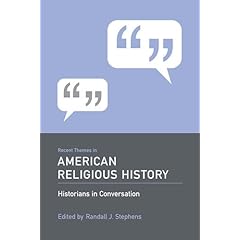
Just in time for your holiday shopping season, my blog co-editor has put together a terrific series of conversations, essays, and responses on American religious history into a tidy volume: Recent Themes in American Religious History: Historians in Conversation. A brief description from the book's Amazon page:

Described as “the New York Review of Books for history,” Historically Speaking has emerged as one of the most distinctive historical publications in recent years, actively seeking out contributions from a pantheon of leading voices in historical discourse from both inside and outside academia. Recent Themes in American Religious History represents some of the best writing of recent years on understanding the context and importance of religious thought, movements, and figures in the American historical narrative.

This collection of essays and interviews from Historically Speaking address several subjects central to religious history in the Unites States. The first section maps the state of American religious history as a field of study and includes interviews with award-winning senior religious studies scholars Robert Orsi and Stephen Prothero. Subsequent sections explore the challenges of assimilation faced by Jews and Catholics in the United States, the origins and historical significance of American evangelical Christianity, and the phenomenon of millennialism in America. The volume concludes with a discussion of religious experience as an indicator of the limits of historical understanding, and of the tension that exists between the two modes of knowing.

Edited by Randall J. Stephens, Recent Themes in American Religious History will appeal to students, scholars, and general readers of American history, American studies, and religious studies. The contributors are Kathleen Garces-Foley, Nicholas Guyatt, Thomas S. Kidd, Thomas Kselman, Bruce Kuklick, George Marsden, Wilfred M. McClay, John McGreevy, Robert A. Orsi, James M. O’Toole, Stephen Prothero, Leo P. Ribuffo, Jonathan D. Sarna, Christopher Shannon, Jane Shaw, Stephen J. Stein, and John G. Turner.

Members of any Young Scholars in American Religion class will appreciate the book's dedication to the 2007-09 class of Young Scholars.

A highlight of the book for me is the conversation about Robert A. Orsi's well-known piece "Abundant History: Marian Apparitions as Alternative Modernity," with responses by Thomas Kselman and Jane Shaw.


Jumat, 20 November 2009

New Book on John Wesley and Methodism

Randall Stephens

Cambridge University Press has a marvelous series called the Cambridge Companions to Religion. Of particular interest to readers of this blog will be: Dana Evan Kaplan, ed., The Cambridge Companion to American Judaism (2005); Stephen J. Stein, ed., The Cambridge Companion to Jonathan Edwards (2006); and John Coffey and Paul C. H. Lim, eds., The Cambridge Companion to Puritanism (2008).

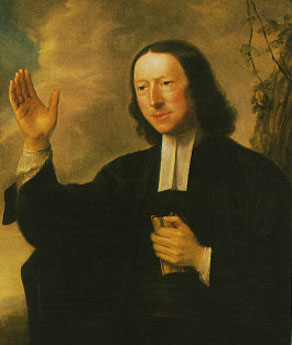
The Cambridge Companion to John Wesley (2009), edited by Randy L. Maddox and Jason E. Vickers, is the latest installment in the series. Wesley, of course, has had an enormous influence on American Christianity. His religion of the heart "strangely warmed" continues to exercise evangelicals, members of mainstream churches, and modern-day social gospellers. Wesley once tellingly wrote: “I am not afraid that the people called Methodists should ever cease to exist either in Europe or America. But I am afraid lest they should only exist as a dead sect, having the form of religion without the power. And this undoubtedly will be the case unless they hold fast both the doctrine, spirit, and discipline with which they first set out.” Over one hundred years later, Holiness folk and Pentecostals said, "amen and amen!"

CUP summarizes Wesley's impact and describes the The Cambridge Companion to John Wesley as follows: "A leading figure in the Evangelical Revival in eighteenth-century England, John Wesley (1703–1791) is the founding father of Methodism and, by extension, of the holiness and Pentecostal movements. This Cambridge Companion offers a general, comprehensive introduction to Wesley’s life and work, and to his theological and ecclesiastical legacy. Written from various disciplinary perspectives, including history, literature, theology, and religious studies, this volume will be an invaluable aid to scholars and students, including those encountering the work and thought of Wesley for the first time."

Contents

Introduction Randy L. Maddox and Jason E. Vickers; Part I. Wesley's Context: 1. The long eighteenth century Jeremy Gregory; Part II. Wesley's Life: 2. Wesley's life and ministry Kenneth J. Collins; 3. Wesley in context David N. Hempton; Part III. Wesley's Work: 4. Wesley as revivalist / renewal leader Charles I. Wallace; 5. Wesley as preacher William J. Abraham; 6. Wesley as biblical interpreter Robert W. Wall; 7. Wesley as diarist and correspondent Ted A. Campbell; 8. Wesley as editor and publisher Isabel Rivers; 9. Wesley's engagement with the natural sciences Randy L. Maddox; 10. Wesley as adviser on health and healing Deborah Madden; 11. Wesley's theological emphases Jason E. Vickers; 12. Wesley's emphases on ethics Rebekah L. Miles; 13. Wesley's emphases on worship and the means of grace Karen B. Westerfield Tucker; Part IV. Wesley's Legacy: 14. Spread of Wesleyan Methodism Kenneth Cracknell; 15. The Holiness/Pentecostal/charismatic extension of the Wesleyan tradition Randall J. Stephens; 16. The African-American wing of the Wesleyan tradition Dennis C. Dickerson; 17. Current debates over Wesley's legacy among his progeny Sarah H. Lancaster.

Rabu, 07 Oktober 2009

"When the Word of God Says One Thing . . .": A Dispatch from the Scandal of the Evangelical Mind Conference

Randall Stephens

Evangelicals, wrote Mark Noll in his 1994 book The Scandal of the Evangelical Mind, had not distinguished themselves as thinkers. With souls to save, revival tents to pitch, and casseroles to bake there was little time for philosophizing or pondering the wonders of the world.

Critics took aim at god-fearing anti-intellectualism. In typical fashion an H. L. Mencken understudy threw all dunderheaded fundamentalists onto the trash heap of history: "The neurotic, God-ecstatic, sex repressed, epileptic soul of the Puritan has always found its vent hole in the camp-meeting."

Mencken’s crew specialized in hyperbole, but they were, sorta, onto something. Revivalism’s chief apostles won over eager audiences by thrashing godless Teuton professors and consigning over-civilized eggheads to lakes of fire.

Here’s Billy Sunday—spitting preacher and God’s teetotally awesome acrobat—on the life of the mind:

"Religion needs a baptism of horse sense."

"What do I care if some little dibbly-dibbly preacher goes tibbly-tibbling around because I use plain Anglo-Saxon words? Jesus was no dough-faced, lick-spittle proposition. Jesus was the greatest scrapper that ever lived."

"If by evolution you mean advance, I go with you, but if you mean by evolution that I came from a monkey, good night!"

"When the word of God says one thing and scholarship says another, scholarship can go to hell."

It’s a short distance from Sunday’s saw-dust-trail aphorisms to Bill Gaither’s soft Victorian fideism of the 1970s.

Over 40 years ago historian Richard Hofstadter argued that Sunday (that was his real name) embodied much of what was dangerous, preposterous, and anti-intellectual about conservative Christianity. Noll’s 1994 book took some cues from Hofstadter, but Noll was far more subtle in his analysis of that mindlessness. “The evangelical ethos is activist, populist, pragmatic, and utilitarian,” Noll wrote. “It allows little space for broader or deeper intellectual effort because it is dominated by the urgencies of the moment.”

Last week’s conference at Gordon College—The Scandal of the Evangelical Mind, 15 Years Later—reconsidered some of the intellectual/anti-intellectual aspects of the movement. Presenters looked at where evangelicalism has been, where it is now and discussed what we might expect of evangelical intellectual life in years to come.

The conference was a great success, due in large part to the participants and attendees as well as generous support from Eastern Nazarene College, Gordon College, and the Lilly Endowment. And, it was fun to boot. (Just my kind of religious-history-nerd fun, that is.)

Marua Jane Farrelly conducted a public interview with Noll for our first session on Thursday night. A crowd of roughly 350-375 attended. Farrelly asked a number of pointed questions on Noll’s career as a historian and the intersection of faith and scholarship. Among other things, Noll commented on why he wrote the book and how it was received by a number of different communities: American and Canadian evangelicals, colleagues-at-the-time at Wheaton, and the academy overall.

The sessions on Friday were equally productive and provocative. I won’t say much about the roundtable that Karl Giberson and I did on conservative evangelical expertise on Friday morning. That might appear out of place, if not boastful, vain, and jerk-like. But, I will say that the comments of Jon Roberts and Jim Wallace were very insightful and helped us to rethink how we might conceptualize “expertise,” “authority,” and the nature of influence. After that, Noll delivered a thoughtful convocation in the Gordon chapel. He urged students, faculty, and others in attendance to embrace an intellectual calling.

In the afternoon David Hempton and Peggy Bedroth considered “Evangelicals and the Life of the Mind.” Hempton engaged a series of fascinating questions about evangelical “minds and mentalités”: “Why is it that American evangelicals are so resistant to scientific knowledge emanating from elite centers of learning? Why do many liberals and progressives have something approaching contempt for the evangelical mind, but a great deal of residual admiration for evangelical social praxis? . . . . What impact has the evangelical mind, or evangelical minds, on important public debates about the intellectual validity and social functions of religion raised by militant atheists like Richard Dawkins and Christopher Hitchens?” Bendroth followed with her paper, “Women, Anti-Intellectualism, and Evangelical Identity.” I was intrigued by her discussion of the scope and limits of interpretation. She focused in on historiography, and the “various ways that scholars have conceptualized the relationship between women and evangelical religion over the past several decades. From some fairly humble beginnings in the late 1970s, when nobody seemed to want to talk about women and conservative religion, the conversation has become more and more theoretically sophisticated.”

The final afternoon session convened before Noll gave some concluding remarks. This last panel on “Evangelicals, Politics, and Global Engagement” mapped out the surprising political and intellectual activity of contemporary evangelicals. Dennis Hoover and James C. Wallace explored recent demographic and cultural trends with attention to the big picture. Wallace took us through some of his extensive research with Tim Shah on the emerging evangelical intelligentsia. Hoover asked: “have American evangelicals moved from being activists to internationalists?” He concluded by noting, “when we circle back to consider again the basic thesis of The Scandal of the Evangelical Mind, we should be careful not to suggest that holding a position that happens to align with militant internationalism is necessarily the result of intellectual failure, while holding a position that happens to comport with liberal internationalism is necessarily the outworking of a rigorous intellect.”

It was a special treat for me to interview Noll on the subject of history before the conference got underway. His books and articles have influenced my own research a great deal. In the Youtube clip here (in two parts) I speak to Noll about his work as an American religious
historian and his view of the field as it has developed since the 1960s and 1970s. Notice that Noll gives mad props (my word, not his) to early-career scholars, like Heather Curtis, Ed Blum, Rachel Wheeler, Charles Irons, and Wallace Best.

For the future . . . I hope to host other speakers at Eastern Nazarene College who will look at how evangelicals have engaged the world of ideas in other fields. From the papers that came out of the Gordon-ENC conference—and others to follow—I ‘d like to put together an edited volume. That’s down the road apiece. In the meantime, I have revival tents to pitch and tuna-noodle casseroles to bake.

Senin, 21 September 2009

The Art of Religious Intolerance: Alma White and Branford Clarke

Paul Harvey

This is more the bailiwick of our assistant editor Kelly Baker (currently en route to Tennessee, I believe, where she is moving with her family) than me, but Lynn Neal, "Christianizing the Klan: Alma White, Branford Clarke, and the Art of Religious Intolerance," in Church History, 78 (June 2009): 350-378, is this week's recommended reading to send your way. Don't read it when you're in a foul mood already, as I did this weekend (this piece combined with unexpected cat illness and death really put a damper on things), because you'll need some ironic distance and humor to keep you from getting dragged down into this foul but fascinating material.

The visual culture of American religion has been quite a boom field in recent years, thanks largely to David Morgan, Salley Promey, Colleen McDannell, and some others. That's a good thing, because logocentrists like myself (and most historians, I would guess) need frequent reminding of the power of the visual. Neal's article does precisely that, but with somewhat different and far more polemically ugly (albeit visually interesting) material than in some of the other works in visual culture. Neal discusses the work of Branford Clarke, a British-born illustrator who hooked up with the Pentecostal evangelist Alma White, author of such classics as Heroes of the Fiery Cross. White's words and Clarke's illustrations proved powerful for developing the visual culture of 1920s Klansmen. My favorite of all, reproduced on p. 368 of the article, shows Jesus distributing the loaves and fishes, each loaf a tenet of the Klan; Jesus gives them to his Klansmen disciples, who then feed the multitudes. Lynn Neal concludes, of Clarke's version of the 1920s religion of fear: "They [the viewers] were provided with a way of seeing that divinized the Klan's mission, sacralized the American nation, and demonized the Catholic church. . . . Examining their [White and Clarke's] way of seeing reveals aspects of how people create and replicate religious intolerance, then and now. They provide us with a glimpse into those contours and teach us how religion often functions as a way for people to exorcise their fears and exercise their power."


Rabu, 02 September 2009

Know Your Archives: The Congregational Library

Randall Stephens

[Cross posted at the Historical Society blog.]

Henry Ward Beecher, America’s most well-known 19th-century preacher, was into books and libraries. “A library is not a luxury but one of the necessities of life,” he famously remarked. Fortunately for historians and all those interested in America’s past, Beecher’s Congregational denomination was also into books and libraries.

Last week I paid a visit to the impressive Congregational Library, located right next to the State House
on Beacon Hill in Boston. The Library has an extraordinary collection of historic documents, books, maps, and a range of material related to the congregational church, world cultures, and America. Established in 1853, with a modest 56 books, the Library now holds 225,000 items that chronicle the history of one of America’s oldest denominations.

The Library ranks with some of the more beautiful archives in the states. Its interior reminds me of a miniature version of the grand Jefferson reading room at the Library of Congress, with arched ceilings, paintings, and historic furnishings.

I spoke to Peggy Bendroth, executive director of the Library, about the work being done with the collection, the kinds of material housed there, and the role of the Library. (Bendroth’s publications on evangelicalism and her intimate knowledge of American Protestantism benefits those researchers who work at the Library.) I post here the video I made of my visit. Call it “Religion in American History Television.” (Real original title, I know.)

The Congregational Library has much to recommend it. I’ve been to plenty of cramped, denominational archives nestled in southern and midwestern industrial sections of suburbs. Most have hung ceilings, florescent lights, and church-like, indoor/outdoor carpet. So what, I’ve figured. I’m here to do research, not meditate on interior design. Yet, a nicely lit, pleasant environment does add something to the experience. (It’s the Boston Public Library appeal.)

Beyond that, there’s the issue of scope/time frame. The Congregational Library spans the ages as few other denominational archives or research libraries do. And since it’s been around for eons, it’s collected an avalanche of material. It all makes for a great experience for the casual visitor or the dedicated researcher.

Selasa, 30 Desember 2008

ASCH Sessions in New York City

Paul Harvey

Hope everyone going to the AHA and ASCH in New York City has a great time. My first AHA was in New York in 1991; in those days it was held right after Christmas, which ruined my Christmas holiday for lo-those-many-years-wandering-through-the job-market wilderness, but that year I went early for a hotel deal, and spent Christmas day before the AHA ice skating in the park, visiting Ellis Island, and soaking up the history in my front row seat in a little corner slice of heaven (i.e., the Village Vanguard).

Here are three ASCH sessions of interest coming up Saturday, one about one war and religion in American history, another on Holiness/Pentecostalism and the migration of AFrican Americans, and another on politics during the 2nd Great Awakening. I'll miss the intellectual ferment; I won't miss the job market. Good luck to those on it. Make sure you read Tenured Radical, because she gives great advice on academic job interviewing at the AHA and many other things besides; check the most recent posts there. Bon chance.

America's Wars and American Religion
American Society of Church History
Saturday, January 3, 2009: 9:30 AM-11:30 AM
Liberty Suite 5 (Sheraton New York)

Official:Melanie McAllister, George Washington University
Chair: Kenneth P. Minkema, Yale University

King David in Colonial America: Spiritual Valor and Military Heroism in Eighteenth-Century War Sermons: James Byrd, Vanderbilt University
The Cross of War”: Religion, National Sacrifice, and a New Foreign Policy in 1898: Matthew McCullough, Vanderbilt University
St. Charles the Lost: The Great War, Civil Religion, and the Martyrdom of Major Charles Whittlesey: Jonathan Ebel, University of Illinois
The Rhetoric of Religious Violence in Early America: Andrew Murphy, Valparaiso University
____________________________________________

From the Delta to the City: Holiness and Pentecostal Religion in the Great Migration

American Society of Church History
Saturday, January 3, 2009: 9:30 AM-11:30 AM
Madison Suite 2 (Sheraton New York)

Official: David Daniels III, McCormick Theological Seminary
Chair: David Daniels III, McCormick Theological Seminary

Speakers:
Wallace Best, Princeton University
Anthea Butler, University of Rochester
John M. Giggie, University of Alabama at Montgomery
________________________________________________

RETHINKING RELIGION, POLITICS, AND THE SECOND GREAT AWAKENING
American Society of Church History
Saturday, January 3, 2009: 2:30 PM-4:30 PM
Madison Suite 3 (Sheraton New York)

Official: Margaret N. Abruzzo, University of Alabama
Chair: Terry Bilhartz, Sam Houston State University

Campaigning for Converts: Mormons and the 1844 Presidential Election
John G. Turner, University of South Alabama

Bridging the Divide: Presbyterians, Interdenominationalism, and Nationalism in the Early Republic
Harrison Taylor, Mississippi State University

The Church in the Wilderness: William Miller's Sectarian Ideal in the Second Great Awakening
Matt McCook, Oklahoma Christian University

Senin, 06 Oktober 2008

Comrade Paul

Randall J. Stephens

[Nota bene: I don't mean our Paul (Harvey), but, rather, the Saint. Not that Harvey isn't both a saint and a comrade.]

The latest NYRB includes a wonderful essay on the apostle Paul. Columbia's Mark Lilla reviews books by Garry Wills, Jacob Taubes, Giorgio Agamben, Alain Badiou, Éric Marty, and Slavoj Zizek. Though he’s still widely criticized in some circles as misogynistic, a Hellenizer, a gnostic, a prude, and a tool of the state, others now find him to be a venerable revolutionary. Looks like he has some new, unlikely friends on the left. Lilla has written a very funny piece, which reminds me of Tom Wolfe's famous savaging of the antediluvian lit-crit crowd in Harper's. Lilla takes on muddle-headed Mandarins and Rococo post-Marxists with flair. There are some terrific passages:

Oddly, there is a lot of thought being given to Paul these days by inhabitants of the foggy academic archipelago encompassing critical theory, deconstruction, post-modernism, postcolonial studies, and the like. When the wretched of the faculty club gathered twenty-five years ago, conversation would naturally drift to Michel Foucault's views on corporal punishment; today you are more likely to hear a debate on the Epistle to the Romans as it bears on globalization and the war on terror. . . .

The worst [of the new books on Paul], for my money, is Giorgio Agamben's The Time That Remains. Agamben is the very model of the baffling postmodernist: obscure, pretentious, humorless. He is capable of writing that "the messianic pleroma of the law is an Aufhebung of the state of exception, an absolutizing of the katargesis " and of littering nearly every page with passages quoted in the original German, French, Greek, Latin, Hebrew, Spanish, Danish, Provençal, even (I'm not kidding) Hopi. Ezra Pound had nothing on Professor Agamben.

The essay on the web is for subscribers only. Yet it is available through many college, university, and public libraries.

Senin, 09 Juni 2008

ASCH Spring Meeting in Montreal, 2009

American Society of Church History, Spring Meeting, April 2009, Montreal, Quebec

Dear members and friends of the ASCH:

The biennial springtime meeting of the American Society of Church History will be held April 16-20, 2009, in Montreal, Quebec. We invite ASCH members to submit proposals for entire panels or for individual papers on any aspect of the history of Christianity. Our theme, however, will be “Mission and Empire in the History of Christianity.” We especially seek proposals that explore the ways that Christianity’s expansionist impulses have shaped the structure and exercise of political, cultural, economic, and social power by states and empires, as well as the ways that such entities have shaped the people, institutions, and cultures of Christianity. As 2009 is the 500th anniversary of the birth of John Calvin, we also seek proposals on Calvin’s life, thought, and influence. True to the history of the ASCH, but not to that of Montreal, this will be an English-language conference.

The historic city of Montreal is the center of Canada’s second largest metropolitan area and the home of numerous sites of interest to historians, including the Pointe-a-Calliere Museum, the Maison Historique George-Etienne Cartier, the Maison Saint-Gabriel, the Lachine Fur Trade Museum, and McGill University.

Please send submissions electronically to asch2009montreal@gmail.com no later than September 30, 2009. Proposals for individual papers should include a summary of the paper not to exceed 250 words and a CV including current mailing address, email address, and phone number.

Proposals for individual papers should include (a) a summary of the paper not to exceed 250 words with the subject, argument, and evidence clearly detailed; (2) a biographical paragraph or CV summary of the presenter (not to exceed 250 words); and (3) a current mailing location, email address, and phone number for the proposed presenter. Proposals for entire sessions—which are strongly preferred—should include all of the above for each presenter as well as (1) the session’s title; (2) a one-paragraph description not to exceed 250 words describing the session’s theme or topic; and (3) biographical data for the chair and the respondent. Sessions normally feature a chair, three presenters, and a respondent, although other arrangements are possible. Applicants will be notified when their materials are complete. The program committee reserves the right to reconfigure sessions as needed. All program participants are expected to register for the spring meeting.

Spring 2009 Program Committee: Bryan Bademan, University of Wisconsin-River Falls; Kenneth Minkema, Jonathan Edwards Center, Yale University; John B. Roney, Sacred Heart University; Andrea Sterk, University of Florida; Marguerite Van Die, Queens University

Rabu, 23 April 2008

Political Primaries, C.S. Lewis, and Remembering the Sun

Art Remillard

As I drove through my small western Pennsylvania town this morning, the campaign signs reminded me that six weeks of political frenzy have mercifully come to an end. To be sure, the election battles will continue, not only through November but into future elections as well. At times, I find myself hoping for the next election day to come, to put an end to the endless predictions and speculation. But at the same time, I lament this impulse to speed through life and risk overlooking every day's hidden treasures.

So I read with great interest this morning an editorial from New York Times columnist David Brooks. He reminds me that sometimes, as folk singer Pieta Brown said, I just need to “remember the sun.”

Below is an excerpt. If you're a C.S. Lewis fan, you'll appreciate both this and the reference to Michael Ward's essay in Books & Culture.

Over the past 15 months, I’ve been writing pretty regularly about the presidential campaign, which has meant thinking a lot about attack ads, tracking polls and which campaign is renouncing which over-the-line comment from a surrogate that particular day. But on my desk for much of this period I have kept a short essay, which I stare at longingly from time to time. It’s an essay about how people in the Middle Ages viewed the night sky, and it’s about a mentality so totally removed from the campaign mentality that it’s like a refreshing dip in a cool and cleansing pool.

The essay, which appeared in Books & Culture, is called “C. S. Lewis and the Star of Bethlehem,” by Michael Ward, a chaplain at Peterhouse College at Cambridge. It points out that while we moderns see space as a black, cold, mostly empty vastness, with planets and stars propelled by gravitational and other forces, Europeans in the Middle Ages saw a more intimate and magical place...

There’s something about obsessing about a campaign — or probably a legal case or a business deal — that doesn’t exactly arouse the imaginative faculties. Campaigns are all about message management, polls and tactics. The communication is swift, Blackberry-sized and prosaic. As you cover it, you feel yourself enclosed in its tunnel. Entire mental faculties go unused. Ward’s essay has been a constant reminder of that other mental universe.

Jumat, 11 April 2008

Studying Latino/a Pentecostals From a New Contributing Editor

Arlene Sánchez Walsh, our newest contributing editor, provides us with a glimpse of her work on Latino Pentecostals from Sojourners. Sánchez Walsh is an associate professor of Latino/a church studies and church history at Azusa Pacific University. She is the author of Latino Pentecostal Identity, which won the 2005 Hispanic Theological Initiative Book Award. She is working on a project for the Louisville Institute on race, ethnicity and American Pentecostalism and writing a textbook Pentecostalism in America (Columbia University Press). When she is not writing, she is kept very busy with an inquisitive five year old, and a not-so-sleepy 7 month old. Welcome aboard, Arlene!

A History of Separation
Arlene Sánchez Walsh

The article begins with a scene gleaned from a goldmine of resources for anyone interested in American Pentecostalism, especially the interaction between missionaries and Mexicans on the borderlands, Puerto Rico, and on the East Coast. Henry C. Ball is one of the more interesting missionaries, not because of any unique cultural/racial sensitivity (no doubt, Henry Ball was a missionary boss, racist, anti-Catholic, triumphalistic) but as a major figure in the Assemblies of God missions strategy of seeking Mexican converts on the borderlands, Ball needs to be reckoned with as a deeper figure than the pages of the Pentecostal Evangel would allow.

If we take Ball at his word, he was an eyewitness to many of the indignities that Mexican workers were subjected to throughout the early part of the 20th century: fumigation, unfair and unsafe work conditions, theft of wages, subtle racism and overt segregation. Ball's sympathies for his charges are intertwined with his disdain for their supposed sloth and hatred for their residual Catholicism. Ball never seeks to reconcile this cognitive dissonance, (not too different from most of us), with the earnest desire he claims to want to "save" Mexicans and partake in their new life as Pentecostals, one would assume that such magnanimous attitudes would dull the distrust, dislike, and out and out hatred Ball writes about throughout his career as an AG missionary (1912-70). Curiously, it does not. Content with denigrating Mexicans as he is trying to "save" them, Ball, like many early Pentecostal leaders (one might extend that to many of today's Pentecostal leaders), simply did not have the theological tools to develop a social conscience beyond coarse proselytism.

The Sojourners article takes the story of Latino/a Pentecostals in a different direction, it seemed proper though to note that one could make a major contribution to American religious history mining through places like the Flower Heritage Center at the Assemblies of God headquarters in
Springfield, Missouri. One could really begin to examine issues of race, ethnicity and power that fed into the rise of American Pentecostalism. Finally, if an enterprising scholar wanted to, they could move us all beyond the black/white dichotomy of American Pentecostal history and start writing a history of American Pentecostalism that begins on the borderlands and ends in a storefront in Newark, or a cemetery in East Los Angeles (don't get me started, I have too much to do already).

Kamis, 10 Januari 2008

Children, Mormons, and Renderings of African American Religion: American Religious History in _Church History_

BY KELLY BAKER

In the December 2007 (print) issue of Church History, there are three articles on interest for our blog. First is E. Brook Holifield's "Let the Children Come: The Religion of the Protestant Child in Early America." Holifield noted that there have been many quality studies of adult understandings of children, and he, instead, looks to the voices of children and how they understand their religious world views. It is delightful to see how Louisa May Alcott, Harriet Beecher (Stowe), and Charlotte Grimke grappled with religion as younger selves. Drawing from diaries of children, who lived between 1770-1861, he describes their poignant concerns over death, living a good life, and their focus on sermons.

Next, Thomas W. Simpson's "Mormons Study 'Abroad': Brigham Young's Romance with American Higher Education, 1867-1877" examines the how American Mormons were sent to American universities for specialized training in law, medicine, and other fields. Mormons believed that higher education would help them maintain their civilization as well as make non-Mormons envious of their advances.

The third essay, "Urbanization and the End of Black Churches in the Modern World," is by Curtis Evans (two mentions in one day!). This essay tackles the historiographical understandings of African American religion, and Evans argues, "What strikes me about the history of interpretations of African American religion is the way in which interpreters have asserted that peoples of African descent were 'naturally religious,' which meant that their religion was a product of biology and nature rather than of the 'supernatural'" (p.799). Evans presents the fascination of with 'natural' religiosity as well as calls for the end of "the Negro or Black Church as it has been historically constructed" (p. 822)

Kamis, 13 September 2007

The Death of America as a Christian Nation? Hold the Funeral! He's Not Dead Yet!

Hold the Funeral! --BY JOHN FEA

I have been a fan of Diane Butler Bass’s work ever since I read her award-winning Standing Against the Whirlwind: Evangelical Episcopalians in Nineteenth-Century America (1995) during my graduate school years. I have not read some of her more recent books on American religious practice (although I hope to get to Christianity for the Rest of Us soon—waiting for the paperback!), but I do look forward to reading her occasional columns on sojo.net. (If you ever attended a vacation Bible school as a kid you must read Bass’s “Sock Puppet Church”).

Her most recent Sojourners essay, “American Christendom, RIP,” is a reflection on the death of D. James Kennedy, the Ft. Lauderdale Presbyterian minister who was a major leader of the Christian Right. (At last check a whopping 187 people had commented on the piece!). Like many pundits, Bass argues that Kennedy’s passing and the recent death of Jerry Falwell mark a “generational shift of leadership now occurring in evangelical Christian circles.” She focuses much of the piece on Kennedy’s enthusiastic cheerleading for the idea that America is a “Christian nation.” Indeed, Kennedy spent a good part of his final decades preaching sermons, writing books, and producing videos that extolled America’s Christian founding. Much of this work was done under the auspices of his recently closed Center for Reclaiming America for Christ. According to Bass, a new generation of evangelicals, particularly those who read theologians Stanley Hauerwas and William Willimon and are affiliated with the emerging church, is no longer interested in Kennedy’s “Christian America” because his “nostalgic world bears no resemblance to their own.” Young evangelicals find no use for Kennedy’s Christian civilization of the 1950s and prefer a progressive, confessional, and Anabaptist-informed political theology that understands the church as a countercultural agent in the world.

Fair enough. Bass has her finger on the pulse of the emerging church movement. It is true that the leaders of the emerging church have hitched their wagons to the wisdom emanating from Duke Divinity School. But perhaps we should wait just a bit before we hold a funeral for “American Christendom.” As Paul Harvey noted yesterday on this blog, a recent poll from Vanderbilt University’s First Amendment Center found 55% of those surveyed believe that the Constitution establishes a Christian nation. While it should not surprise us that 74% of Republicans surveyed believe that the Constitution should be interpreted in this way, it is a bit shocking to find that 50% of Democrats and 47% of Independents also hold to this view.

I do not know much about the First Amendment Center or the reliability of their polling data (I tend to agree with Paul that these numbers seem a bit high). But it does seem that Bass may be too optimistic about the impending doom of Christian Right “history.”

I hope to get back to the triumph of Christian Right history in a later post.

Rabu, 25 Juli 2007

Mormon Pioneer Day


It's July 25th, and the new San Diegans Ed Blum (via Joanna Brooks, author of the oustanding book American Lazarus: Religion and the Rise of Native American and African American Literature, reviewed here) remind me that yesterday, July 24th, was Pioneer Day, commemorating the Mormon trek and settlement in Salt Lake City. I'll be putting it on the annual blog calendar. With the documentary recently on PBS (reviewed by the New York Times here, HT to Art in the comments section, and by a Mormon blogger here), the presidential address at the American Society of Church History by Jan Shipps (a true pioneer in scholarship on the history of the LDS church), and of course Mitt Romney's candidacy, it's time for American religious historians to incorporate Mormonism more carefully into the narratives and scholarship, beyond recounting the nineteenth-century originating events of the church.

In his review of the book that Philip Goff and I edited, Themes in Religion and American Culture, Douglas Winiarski surveyed the "winners" and "losers" in the market economy of American religious history as it's being written now. Based on the essays in our volume, he pronounced Mormonism a "winner" (mainline Protestantism, not surprisingly, was a "loser," in both cases referring to the amount of discussion each respective group got in the essays). Although I co-edited the book, I hadn't realized how extensive the discussion of Mormonism was throughout the text, and was surprised when I skimmed the text again after the review and realized that Winarski's parsing of the winners and losers in the current historiographical economy was pretty dead-on.

Jan Shipp's presidential address to the ASCH on the changing meanings of Mormonism is not online (and if you're reading this, you need to be a member of the American Society of Church History -- you can do so online, so click on the link and just do it, and you'll receive the excellent journal Church History). However, Shipps has a nice piece "A Religious Ritual Wrapped in a Civic Event," which discusses the changing meanings of Pioneer Day. Here's a quick summary; click above for the link.

In the mountain West, Pioneer Day long had the effect of sustaining an unofficial pattern of stratification within Mormon culture that placed the members of families who came to the region during the early decades of LDS settlement in the area above those who came later. This pattern is gradually being altered, and one reason may be that Pioneer Day is undergoing a transformation.

The agent of change is an expansion of the idea of what being a Mormon pioneer means. Instead of simply honoring long-deceased pioneer heroes and heroines, today’s Saints in the mountain West and outside it are being asked to be pioneers themselves by doing something special to build up Mormonism in these latter days--perhaps being the first member of one’s family to go on a mission, being a leader of a branch of the church in an area where the church has not before had an organized unit, or serving the church in some other way that demands sacrifice and courage.

Looking at it this way reveals that the hoopla is not all there is to Pioneer Day. A closer look at this celebration reveals a larger truth about the Latter-day Saints: nowadays all sorts of things are changing within Mormonism. The transformation of the idea of what it means to be a pioneer will surely help dissolve what amounted to a caste system within the Mormon community. But as the meaning of being a pioneer is being transformed rather than de-emphasized or discarded, Pioneer Day is likely to retain its significance as both a holy day and a holiday.