Tampilkan postingan dengan label puritanism. Tampilkan semua postingan

Sabtu, 27 November 2010

Pilgrims and the Political Agenda

Today's guest post comes from Jeremy Bangs, a leading expert on 17th-century history, the Pilgrims, and the Plymouth Colony. Bangs follows up a lively discussion in the comments section of an earlier post with more on the 17th-century historical context.

Jeremy Bangs

In our exchange in the comments section Tom van Dyke expresses annoyance at “scholars with a political agenda.” He “found no attempt anywhere to simply tell the story.” But he “did manage to get to Bradford's account ...”

The problem is that William Bradford is the first of the scholars with a political agenda writing about the topic of the Pilgrims’ early experiments with land distribution. Simply telling the story requires a little analysis of the context beyond a mere repetition of the text(s).

The background information about the financial circumstances of the Pilgrims’ colonial enterprise consists of descriptions by Bradford and Edward Winslow, together with business correspondence and contracts incorporated in Bradford’s memoir. From this we know that for the first seven years the colony was mortgaged to the company of investors. All the assets and increase of the colony were to be liquidated at the end of seven years, when the contracted debt was to be paid and the surplus distributed to the investors. Every colonist was counted as having at least one share in the venture because of the colonist’s labor. Some colonists also invested money and thus owned more than one share. Some investors of money did not become colonists but remained in London (and elsewhere). This arrangement meant that in Plymouth Colony there was no private property (not even property in personal labor) until 1627. All property belonged in common to the investors, but as investors the colonists also were co-owners proportional to their shares. This was capitalism, not communalism, and in no way socialism. The Pilgrims had wanted a different arrangement that would have granted them two days per week for private labor, whose profits were to be personal. But in the end their contract did not grant them even this amount of individualism. In setting up the colony people needed to find a way to conform to the total mortgage of their contract. In the first couple of years, rotating land assignments were made, following a medieval custom then practiced in the region from which the leaders came (northern Nottinghamshire and adjacent parts of Lincolnshire and Yorkshire). Dissatisfaction with this system (unfamiliar to some of the colonists) led to the decision to make unchanging assignments of field use after 1623, so that farmers could expect to use the same land from one year to the next; but this did not involve any property in the land, all of which was still to be liquidated at the end of the seven-year term. Thus scholars who identify the early system as a form of capitalist incorporation are correct, and no political agenda is implied by making this observation. Further, the early reports by Winslow and Bradford mention a bounteous harvest the first year. Scarcity the second year was the result of the arrival of thirty-five more colonists who came without supplies – not the result of poor harvests. This plenteousness is also reported in a letter by a visitor to the colony writing in 1621 (William Hilton). Winslow wrote that wheat and Indian corn had grown well, barley not very well, and peas not worth gathering. Bradford comments on a “great store of wild Turkeys, of whih they took many, besides venison, etc.”

Writing around a quarter century later, Bradford gave a different story – the anti-communalist version that has attracted the attention of Libertarians and others who fantasize about the Pilgrims’ discovering capitalism after experimenting with communalism. Tom quotes from that description. What is Bradford’s agenda, that inspired him to misrepresent the economic circumstances of the past? (As I have commented in my article, “A Level Look at Land Allotments, 1623”) Bradford wrote that part while confronting the social unrest arising from the actions of Samuel Gorton, John Lilburne, and the Levellers. Gorton had been troublesome in Plymouth before causing serious unrest in Rhode Island, where his opposition to taking oaths in court or as part of legal business contracts was abhorrent to representatives of established government. Gorton in New England and the Levellers in England preached a far-reaching equality that was thought to threaten society's stability by abolishing what Bradford and many others thought were divinely ordained differences of social standing and responsibility expressed in wise government. In the mid-1640's, Bradford used his recollection of this administrative shift (regarding land use) as the base upon which he could construct a propagandistic comment aimed at the social circumstances of the later period. In 1646 it was important to oppose Gorton and the Levellers' threat from England, important to consider that practical experience of human nature had disproved idealistic theory — "the vanity of that conceit of Plato and other ancients, applauded by some of later times; — that the taking away of property, and bringing in community into a common wealth, would make them happy and flourishing, as if they were wiser than God." Bradford ends his memoirs by noting that Edward Winslow had been sent to England in 1646 to defend New England against complaints of mistreatment lodged in London by Samuel Gorton.

Recent writers who emphasize the year 1623 rather than 1621 when writing about the Pilgrims’ thanksgiving have made a choice that is obviously driven by a political agenda. And simply telling the story is not what concerns them.

Rabu, 24 November 2010

Commie Pinko Pilgrims and Peaceful (?) Puritans

Paul Harvey

A little Thanksgiving history blogging for you. I hadn't quite realized how much of a cottage industry peddling the anachronistic "Socialist Pilgrims" thesis had become, but this piece from the New York Times explores the spread of this myth. I was shocked -- SHOCKED -- to learn how much of a role Glenn Beck and his historical henchman W. Cleon Skousen have played in marketing this story, My favorite part: the time when Rush Limbaugh added in the bit about how they grew organic vegetables, after they had learned that capitalism worked and produced an abundance which they could share with the Indians.

In "Peace, Love, and Puritanism," David Hall, of Harvard Divinity School, defends the Puritans against generations of Hawthornian and Menckenian scorn (and adds that, yes, wild turkeys probably appeared on the original menu). He writes:

Why does it matter whether we get the Puritans right or not? The simple answer is that it matters because our civil society depends, as theirs did, on linking an ethics of the common good with the uses of power. In our society, liberty has become deeply problematic: more a matter of entitlement than of obligation to the whole. Everywhere, we see power abused, the common good scanted. Getting the Puritans right won’t change what we eat on Thanksgiving, but it might change what we can be thankful for and how we imagine a better America.

Historiann has no problem with Hall's conclusion, but points out some of the darker underside to the history of feasting and fasting in America -- in particular, its long connection to war and tribalism:

Both fasts and feasts were opportunities to reaffirm tribalism, of a world view of us versus them. The history of fasting and feasting in the English communities of New England in the seventeenth and eighteenth centuries should be written in blood–both blood in the sense of kinship ties, and in the sense of the shedding of outsiders’ blood in war.

The history of fasting and feasting is "more complicated and much darker than Americans would like to remember," she reminds us. Reading the many pages on this subject in George C. Rable's God's Almost Chosen Peoples: A Religious History of the American Civil War, reinforces this point. About every five pages, it seems, someone from North or South is calling for a fast day, or preaching a fast day sermon. There was a lot of ostensible bowing, scraping, and humility, but ultimately it was all about killing. With all these fast days during the war, it's a wonder anyone ever ate.

John Fea reflects on what he would teach about the original Thanksgiving here, at his new column over at Patheos, and what it meant for the Pilgrims and the Wampanoag, who both had been through some brutal times, to share a brief celebration together. I hope your celebration goes well.

Jumat, 19 November 2010

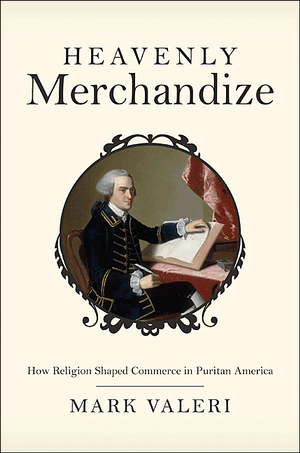
Heavenly Merchandize

Paul Harvey

Earlier we have blogged about Mark Valeri's Heavenly Merchandize: How Religion Shaped Commerce in Puritan America. Below I'm reprinting a review from Choice on this book, which should interest a number of you. Below the review is a snip from the book's website, which has some more information on the contents.

Valeri, Mark
. Heavenly merchandize: how religion shaped commerce in Puritan America. Princeton, 2010. 337p index afp; ISBN 9780691143590, $35.00. Reviewed in 2010dec CHOICE.
Historians surveying the first century of Massachusetts Bay's settlement often describe how colonists in 1630 understood themselves as part of a gemeinschaft, or community based on personal relationships where commitment to the larger social good outweighed individual self-interest. By 1730, the gemeinshaft had become a gesellschaft, or society where rational self-interest trumped communal commitments; relationships, based on the impersonal forces of a market system, were more distant. Valeri (Union Theological Seminary/Presbyterian School of Christian Education in Virginia) avoids such oversimplification, but his exhaustively researched, densely structured book provides a marvelously thick description of just such a transition. Against the conventional assumption that commitment to market values came at the expense of religion, however, Valeri argues that religion actively fostered that commitment. Concentrating on Boston, he demonstrates how prominent preachers provided a vocabulary--drawn largely from British economic theorists--that allowed successful merchants to understand their pursuit of profit, and eventually even the trade in slaves, as a moral imperative. A "postpuritan religiosity" "preceded, and therefore helped to make possible, the full fruition of a market order in early America." Students of early New England will find this indispensable; it should also appeal to anyone interested in the relationship between religion and the larger culture. Summing Up: Highly recommended. Upper-level undergraduates through faculty/researchers. -- L. B. Tipson Jr., Washington College
________________________________________________________
(
from the book's website):

Heavenly Merchandize offers a critical reexamination of religion's role in the creation of a market economy in early America. Focusing on the economic culture of New England, it views commerce through the eyes of four generations of Boston merchants, drawing upon their personal letters, diaries, business records, and sermon notes to reveal how merchants built a modern form of exchange out of profound transitions in the puritan understanding of discipline, providence, and the meaning of New England.

Mark Valeri traces the careers of men like Robert Keayne, a London immigrant punished by his church for aggressive business practices; John Hull, a silversmith-turned-trader who helped to establish commercial networks in the West Indies; and Hugh Hall, one of New England's first slave traders. He explores how Boston ministers reconstituted their moral languages over the course of a century, from a scriptural discourse against many market practices to a providential worldview that justified England's commercial hegemony and legitimated the market as a divine construct. Valeri moves beyond simplistic readings that reduce commercial activity to secular mind-sets, and refutes the popular notion of an inherent affinity between puritanism and capitalism. He shows how changing ideas about what it meant to be pious and puritan informed the business practices of Boston's merchants, who filled their private notebooks with meditations on scripture and the natural order, founded and led churches, and inscribed spiritual reflections in their letters and diaries.

Unprecedented in scope and rich with insights, Heavenly Merchandize illuminates the history behind the continuing American dilemma over morality and the marketplace.

Jumat, 13 Agustus 2010

Colonial Church, Dig It

An interesting article from a couple weeks back. Note religious historian Charles Hambrick-Stowe's involvement.

"Archaeologist will probe ground for old churches," The Ridgefield Press, 1 August 2010.

Connecticut State Archivist Nicholas Bellantoni will use a radar device to search for the exact location of the original meeting houses of the First Congregational Church of Ridgefield.

The project is part of the church’s preparation to celebrate its 300th anniversary in 2012. . . .

Dr. Charles Hambrick-Stowe, senior minister, and David Hein of the church’s 300th anniversary committee studied old photographs and maps with him at the site, on Main Street in front of Jesse Lee United Methodist Church. >>>

Kamis, 05 Agustus 2010

Religion and Economics, Puritan Style

On Sunday, the Boston Globe published Michael Fizgerald's interview with Mark Valeri on Puritanism and capitalism. Here's part of the intro. The full piece, including the interview, is here.

Michael Fitzgerald, "How Puritans became capitalists: A historian traces the moment when Boston’s dour preachers embraced the market," Boston Globe, 1 August 2010.

Even in down times like these, America’s economy remains remarkably productive, by far the world’s largest. At its base is a distinctive form of market-driven capitalism that was championed and shaped in Puritan era Boston.

But the rise of Boston’s economy contains a deep contradiction: The Puritans whose ethic dominated New England hated worldly things. Market pricing was considered sinful, and church communities kept a watchful, often vengeful eye on merchants.

How could people who loathed market principles birth a modern market economy? That question captivated Mark Valeri after he read sermons by the fiery revivalist Jonathan Edwards that included detailed discussions of economic policy. Edwards turned out to be part of a progression of ministers who led their dour and frugal flocks down a road that would bring fabulous riches, and ultimately give rise to a culture seen as a symbol of material excess.

In his new book, "Heavenly Merchandize,” Valeri, professor of church history at Union Theological Seminary in Richmond, finds that the American economy as we know it emerged from a series of important shifts in the relationship between the Colonies and England, fomented by church leaders in both London and early Boston. In the 1630s, religious leaders often condemned basic moneymaking practices like lending money at interest; but by the 1720s, Valeri found, church leaders themselves were lauding market economics. Valeri says the shift wasn’t a case of clergymen adapting to societal changes--he found society changed after the ministers did, sometimes even decades later. read on >>>

Rabu, 21 April 2010

The Thoreau Diaries

by Michael Altman

John Summers has a review of the new edition of Henry David Thoreau's The Journal 1837-1861 edited by Damion Searls over at the New Republic. Usually, I'm interested in Thoreau because of his thoughts on the Bhagavad Gita or The Laws of Menu but Summers makes an interesting point contrasting Thoreau with his Puritan forefathers:
Thoreau’s “inner voice” did not sound anything like John Winthrop, Cotton Mather, or Samuel Sewell. “It is a certain faeryland where we live,” he recorded along a walk one June afternoon. “I wonder that I ever get five miles on my way, the walk is so crowded with events and phenomena.” Like the Puritans, Thoreau envisioned New England as an enchanted world; but unlike their journals and diaries, he did not suggest an unconscious conversing intimately with God, and he broke decisively from their Augustinian style of self-accusation.
In Walden, Thoreau sits at the side of the pond and reads his Gita. He delights in the thought that the water at Walden and the water flowing from the Himalayas are one and the same and that he and the brahman share a drink together:

I lay down the book and go to my well for water, and lo! there I meet the servant of the Bramin, priest of Brahma and Vishnu and Indra, who still sits in his temple on the Ganges reading the Vedas, or dwells at the root of a tree with his crust and water jug.I meet his servant come to draw water for his master, and our buckets as it were grate together in the same well. The pure Walden water is mingled with the sacred water of the Ganges. With favoring winds it is wafted past the site of the fabulous islands of Atlantis and the Hesperides, makes the periplus of Hanno, and, floating by Ternate and Tidore and the mouth of the Persian Gulf, melts in the tropic gales of the Indian seas, and is landed in ports of which Alexander only heard the names.
On one level, it would tempting to read Thoreau's vision of unity between Walden and the Ganges and he and the brahman through the lens of the Gita and an adoption of Indian mysticism--after all, Thoreau claimed to be an American yogi. But Summers' small point illumines that more is going on here. Thoreau is part of a larger American Protestant tradition that sees the world through eyes of enchantment. While the Puritans may have seen evil in the wilderness and Thoreau found enlightenment in the woods, both intimately connected the natural and supernatural worlds. What draws Thoreau to the Gita is not only its philosophical difference from American Christianity but also its similarities to his New England ancestry. Thoreau's reading of the Gita emphasizes its commonalities with Puritan thought. In this early period of encounter between America and other religious cultures it is too easy to focus on the ways Thoreau or Ralph Waldo Emerson adopted and adapted Asian religious cultures without considering how they made sense of these new cultures as Americans (and a special kind of Protestant Christian American at that.) We have to really think through the American in American yogi.

Minggu, 31 Januari 2010

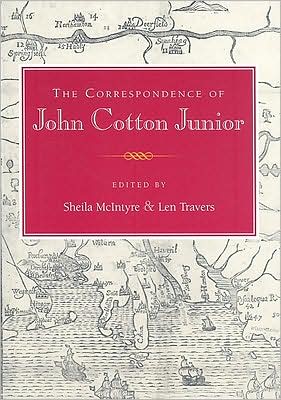
Misunderstood Puritans, John Cotton, and Scandal in 17th-Century New England: An Interview with Sheila McIntyre and Len Travers

Randall Stephens

John Cotton was one of the most ambitious and bedeviled Puritan ministers of late-17th century New England. He was pastor of the Wethersfield, Conn., church in his early twenties. He lost the pulpit as the result of a sex scandal and subsequently worked as an Indian missionary on Martha’s Vineyard. He regained some prominence as pastor of the Plymouth church, but was again brought low by scandal. He finished out his career as a minister in Charlestown, SC, dying in that outpost from yellow fever in 1699.

Lucky for historians, Cotton was an impressive letter writer who hungered for news from Boston and abroad. His missives and those he received tell us much about the religion of the era, wars, relations with Native Americans, Puritan family life, and much more.


Sheila McIntyre
(SUNY Potsdam) and Len Travers (UMass Dartmouth) have edited The Correspondence of John Cotton Junior (Colonial Society of Massachusetts and the University of Virginia Press), which contains roughly 400 letters written by Cotton or sent to him from 1662 to 1699. It’s a fascinating read, though the free-form spelling and abbreviations of the age take some getting used to. McIntyre and Travers provide a wonderful intro. All in all, the volume will help us rethink who the Puritans were.

I spoke to McIntyre and Travers in late January about the insights they gained and their view of John Cotton and his era.

Randall Stephens: John Cotton was a prodigious letter writer. In this regard, how unique was he among his contemporaries?

Sheila McIntyre: I discovered John Cotton's letters while working on a dissertation on letter-writing habits in early New England, so I can put his correspondence into pretty clear context. Most New Englanders of his education and class wrote letters regularly. (Lots of NEers who didn't have formal schooling or money did, too, just not as often.) However, aside from elite merchants, government officials (the Governor, for example) and some other prodigious correspondents (such as Cotton Mather or Samuel Sewall), Cotton's letter collection is incredible—both in size, and in the kinds of things he wrote about. His relative isolation in Plymouth combined with prestigious family connections give his letters power—he used his considerable network to help his rural community stay informed, and he shared news broadly (both by mouth & pen) even when he shouldn't have always been so candid. His letters reflect on every aspect of his professional, pastoral, and personal life—and the lives of many of his friends, neighbors, & enemies. Among the more than 400 17th-century correspondents I have read, he is my favorite—gossipy, authentic, candid, and smart.

RS: What picture of 17th-century New England do Cotton's letters give us?

SM: The best part of this letter collection is that it invites readers into the 17th century—a period of American history that is hobbled by stereotype more than most. If modern Americans remember anything about the Puritans, it's that they ate turkey with Indians and burned witches. John Cotton forces us to flesh them out—to let them be real people, not as unlike us as we might think. The 17th century is a wonderfully liminal world between medieval and modern: their "world of wonders" (to use religious historian David Hall's phrase) includes both science and magic. Cotton's world is small and huge at the same time: he writes about his neighbors' marital troubles AND the Glorious Revolution, often in the same letter. He is a passionate missionary, fluent in native languages and devoted to the native nations, but at the same time, he seemed not to flinch when Metacomet's son was sold into slavery to pay for the sins of his father. I'd like to think he disagreed with that cruel punishment, but he did not share any doubt in the letter.

Most importantly, Cotton was a loving husband and devoted father—he offers a powerful corrective to the image we have of loveless marriages & stern Puritan parents. Despite the apparent adultery (the only Puritan minister in NE I have found who was so convicted) Joanna & John were clearly and demonstrably in love. New England law would have allowed her to divorce him after the sexual scandal, but she chose to remain with him.

As parents, John & Joanna will surprise any reader who is stuck in the "breaking the will" paradigm, which I think is misplaced. For example, on November 30, 1696, two young students at Harvard College, William Maxwell & John Eyre, drowned while skating on Fresh Pond in Cambridge. John was actually in Cambridge when it happened, and remained for the funeral: which was lavish, and heart-breaking. While John focused his letters on the details of the event, and that he was with the boys just a few hours before it happened, Joanna’s letter about their drowning, centers on her fear for her own children: “O the poor Lads from perfect Health into Eternity in a few minutes, that thought no more of it than you. Never, never, never let this Providence be forgotten by you. I can hardly bear to think how I should have born the affliction if it had been you. The Lord pity the poor Parents.” She is NOT chastising herself for loving them too much; she admits that she wouldn't be able to bear losing them (even to God's loving hands).

Cotton was a loving softie of a father, who sounds much like any modern diaper-changing dad of our own day. He worries about their health, their education, their happiness, and how he is going to pay their college tuition bills. He wrote a particularly heart-wrenching letter to Joanna in August 1694. She was at another son’s house ready to help with an imminent birth, when John visited their youngest, twelve-year-old Theophilus, who was boarding with a schoolmaster in Duxbury. Theophilus hates school. “I went in the afternoone on purpose to see Theoph: who is well, but cryed most bitterly to me for a licence to come home this day, I told him.. if he would stay till next Saturday I should be come from Bos: & perhaps you, but I left him poore lamb, with his back turned & he heavily bemoaning his condition & begging he might come home to day, My parentall bowels yearned, but I gave him noe hopes only of Sar’s visiting him one day; He sayes they carry it well to him, all amisse I could get from him was, that the boys laught at him, there are 3 or 4 Duxb: boyes & he is alone & it may be they all set themselves to afflict him & his tender, proud spirit cannot beare it.”

Sounds to me like John is the one who cannot bear it!

RS: How did ministers like Cotton interpret King Philip's War and natural disaster? What does that tell us about Puritan religion in this era?

SM: What strikes me is that different people interpreted catastrophes differently, and often not as we might expect. Some of Cotton's correspondents referred to the Providential interpretation (God is punishing wayward NE), but Cotton himself rarely does. His innate "journalist" orientation leads him to focus on gathering details, and sharing those details. In his letters about KPW or the later Northern Wars of the 1680s & 1690s, he is most concerned with getting the names, dates & numbers straight, so he can reassure local families (his devotion to pastoral care trumps pretty much everything). He is less concerned with the typology of what it all means. His nephew, Cotton Mather, for example, described the devastating earthquake in Jamaica in 1692 as punishment for Port Royal's "sodom of wickedness." Cotton didn't echo that in his retelling. He certainly praises God's mercy when he shares good news about someone's health or a returned captive from the native wars, but he doesn't seem to focus on God's smiting hand.

Perhaps it is his own sinfulness that moderated his words, but I see forgiveness as the most powerful theme of his life—even after the second adultery scandal, his congregation voted to keep him on as pastor. After his death, most of the comment was on his redemption, not his sinfulness.

I think that Puritanism has been miscast as harsh & unforgiving—perhaps because scholars sometimes focus on the prescriptive literature (sermons & tracts) rather than on descriptive evidence (like Cotton's letters). Cotton's life exemplifies the welcoming embrace of early Congregationalism—apparently God and Cotton's congregation forgave him, it was the Boston ministers who couldn't.

RS: John Cotton suffered from political and personal scandals that shaped his ministry. How much can we know about the personal lives of ministers like Cotton from the evidence that has survived?

SM: As pieces of evidence, personal letters simply have a power unlike any other documents from that period—the early New Englanders breathe, cry, worry, rejoice, betray confidences, scheme, suffer, and fall in love in these letters. They become people, rather than the cardboard black hats American schoolchildren make in November.

While Cotton is certainly only one man, his letters include information about many, many other ministers, and his dedication to mentoring younger clergy (particularly in SE Massachusetts) is impressive. It was hard to be a minister in 17th cent NE - the pay was poor, the expectations high, and the job security pretty low. Many found themselves alone & overwhelmed on the frontier—they had a long way to fall after the heady intellectual days at Harvard together, part of a vibrant scholarly community. After graduation, many then found themselves out in rural parishes, hoping the Congregation remembers to deliver firewood. Better than any other kind of evidence, letters let us in to their lives—the lived experience of the Puritan faith

Len Travers: Sheila and I go round and round on this one—what was Cotton supposed to have done; was he really guilty, etc.—but I have always felt there is more to this case than meets the eye. You won’t find this all in the book, so this is an exclusive of sorts, but consider the following. First, it appears that Cotton’s first pulpit may have been a poisoned one from the start. Wethersfield, CT was already a troubled town by the time Cotton arrived there in 1659. This was the period of the so-called “half-way” church membership controversies that bedeviled many New England communities. Only months before Cotton’s Wethersfield ministry, some townsmen, disgusted with the church’s changing baptism policies, quit Wethersfield entirely and, along with Hartford dissidents, formed the Connecticut River town of Hadley, in Massachusetts. Not all of the dissenters had gone, however, and Cotton was bound to end up in the crosshairs of one faction or another. One of those complaining against Cotton in 1662 actually told the investigating committee there was a lingering “Judgment or Curse of god” on the town, that now “Would not Remove frome Wetherfield whilst mr Cott aboad ther.”

Second, and significantly, members of the Welles family also feature prominently in the complaint against Cotton. Thomas Welles, the governor of the colony, had named the new pastor, Cotton, the administrator of his will, also in late 1659. When Welles died a few months later, his estate was valued at £1,070—a sum well worth fighting over.

Now here’s where it gets interesting. Welles divided almost everything between his widow and his favored grandson, leaving his own children specifically in the lurch as to anything more from his estate. The widow was his second wife, and had children of her own from a previous marriage—you can guess where her share would ultimately go. Cotton, all of 20 years old, was responsible for carrying out the terms of the will, and in fact brought one of Welles’s sons to court to force him to comply therewith.

Things only went downhill from there; only three months before the scandal that starts off our book, Welles’s children had in turn brought Cotton to court to complain of his handling of the estate. So there were already hard feelings between the Welles family and Cotton—what effect did these have on their willingness to lodge complaints of a sexual nature against Cotton shortly afterward?

As the correspondence reveals, the Connecticut investigators cleared everyone of sexual misconduct (Cotton was not the only one), or at least had no verifiable evidence of such, but somehow, two years later, the Boston church saw fit to excommunicate Cotton for alleged “lascivious uncleane practices with three women.” Three women? How did that happen? And who were these unnamed women?

And lastly, I have to ask myself how Cotton’s mentor, Samuel Stone, could have permitted him to set foot in the minefield of that Connecticut town in the first place. Granted Cotton did not help matters, flinging reckless counter-accusations, but the inexperienced young preacher was clearly out of his depth. There is just too much we don’t know about this pivotal moment in Cotton’s life, but I suspect that sex may have had much less to do with it than initially appears.

Just sayin' . . .

Jumat, 18 September 2009

Sacred Cow Rights

Randall Stephens

I suppose many of you have seen the story making the rounds about Harvey Cox, his retirement cow, and the old tradition of grazing rights. If you haven't, though, this is well worth taking a look at! Sam Allis reported on the strangely arcane custom in the Boston Globe, "Holy Cow! Bovine to Visit Harvard Yard":

Al Vellucci, former mayor of Cambridge, famously wanted to pave over Harvard Yard for a parking lot. (He also wanted to turn the Lampoon building into a public urinal and reportedly said, “Well, that’s what it looks like, doesn’t it?’’)

But then asphalt would have ruined Harvey Cox’s grazing rights.

Cox, the celebrated Harvard religion professor, was the Hollis Professor of Divinity from 2002 until his retirement this past June after 44 distinguished years at Harvard. (He is now the Hollis Research Professor of Divinity.) The Hollis chair was endowed in 1721 and first occupied by Edward Wigglesworth the following year.

It is the oldest endowed chair in American higher education, and, more germane to this story, traditionally came with grazing rights in Harvard Yard for the cows of chair holders. Wigglesworth and his son who succeeded him exercised those rights. >>>

See also "Cow in the Yard," Harvard Magazine, 10 Septmeber, 2009.

Senin, 24 Agustus 2009

Timothy L. Wood: The Accidental Celebrity

By John Fea

Cross-posted at The Way of Improvement Leads Home

Timothy L. Wood is a good historian. I first encountered his work on seventeenth-century Puritan views of Roman Catholicism in a 1999 New England Quarterly essay. He followed this up with a solid monograph: Agents of Wrath, Sowers of Discord: Authority and Dissent in Puritan Massachusetts, 1630-1655 (Routledge, 2005). I don't know Wood, but a couple of years ago we were both recruited to serve on a panel focused on trends in colonial American history. Wood had to turn down the invitation, so we never got a chance to meet.

Recently this unassuming early American historian, who appears to have forged a scholarly career by keeping his head to the grindstone producing books and articles on Puritanism, has become the target of one of the worst forms of identity theft.

It all started when Wood realized that an on-line article was attributed to him comparing Barack Obama to Adolph Hitler. He first become aware of the piece when he started getting fan mail from the extremists who read the website that published it. Wood acted quickly. He informed the administration at the college where he teaches--Southwest Baptist University in Bolivar, Missouri--that he was not the author. The administration supported him and allowed Wood to put a post on its website disclaiming his authorship. (When I read the comments on this post I was suprised to learn just how many people had this piece of political chain mail forwarded to them).

Today's Inside Higher Ed is running an essay by Wood about the lessons he learned from this whole ordeal. How does something like this happen? I am assuming that Wood still does not know how the article ended up with his byline. Moreover, Southwest Baptist is a Christian college. I hope that this false attribution does not tarnish the witness of this school, not to mention Wood's career.

Needless to say, I am sorry that Wood had to go through all of this. I look forward to reading more of his informative scholarly work in the future.

Jumat, 23 November 2007

Black Friday

George McKenna's The Puritan Origins of American Patriotism is reviewed here by John Gray, author of Black Mass: Apocalyptic Religion and the Death of Utopia. Gray concludes:

This sense of being divinely chosen to save or redeem humanity, which was an integral part of Puritan thinking more than three centuries ago, is still at the heart of American identity today.