Tampilkan postingan dengan label fea's posts. Tampilkan semua postingan

Minggu, 30 Januari 2011

Was America Founded as a Christian Nation?

Paul Harvey

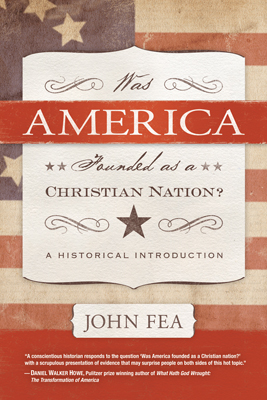
The question is badly posed, our contributor John Fea points out in his new book, to be available in just a couple of weeks, Was America Founded as a Christian Nation: A Historical Introduction.

Publishers' Weekly has a nice note on the book:

Fea, history professor at Messiah College, does not answer the title query because, he says, “it’s a bad question.” Instead, Fea urges, think like a historian. Turns out, history is not about picking the best fruit off the vine to support your opinion--or the opinions of TV talkers--it’s about doing your homework. He does just that to produce this primer, as he calls it, which defines “history,” “nation,” and “Christian.” Fea studied current position papers of proponents and opponents of the title’s question, and he read from the past: the Federalist papers, John Adams and Jefferson’s writings, state constitutions, debate resolutions. In part one, the author traces the concept of a Christian nation from 1789 to today; part two focuses on the American Revolution, from the British colonies’ points of view to the constitutional “wall of separation between church and state.” Part three, the most fluid and fascinating, profiles specific founders, their orthodoxy vs. their orthopraxy, especially concerning the topic of complex, un-Christian slavery. Fea’s style, clean and simple, persuades by history, not histrionics. (Feb.)

John has some more thoughts on defining the terms of the book here; his speaking schedule on behalf of the book over the next couple of months is here.

This is a book meant for a broad audience, and also (one hopes) will help public rhetoric turn it down a notch by introducing some sense of historical complexity and contingency. Congratulations to John, and we wish his book a most successful launch.

Rabu, 08 Desember 2010

Reno vs. Orsi on Catholic Studies in the University

By John Fea

Part of this post is cross-posted at The Way of Improvement Leads Home.

Recently Robert Orsi, the Grace Craddock Nagle Chair in Catholic Studies at Northwestern University, made the following statement in an online forum at Immanent Frame:

The deep hostility of the church for the modern world and its dreadful consequences are abundantly evident in the still unfolding child sexual abuse crisis in the global church. Priests and prelates systematically lied to legal authorities, deceived congregations, crudely intimidated parents and children, and duped medical professionals, in order to cover up crimes and protect the church. The papacies of John Paul II and Benedict are implicated, not least by protecting and honoring such egregious figures as Bernard Law and Marcial Maciel. The legal documents published by bishop-accountability.org reveal a deep contempt among church leaders for the institutional transparency and legal accountability that are seen as goods in modern political theory, for modern journalism and psychology, as well as a great fear of the laity (which is to say of the world beyond church walls). Read through these files and you will wonder what the Second Vatican Council, the church’s most explicit engagement with modernity, actually accomplished.

The various goods of modernity were hard won; the language of multiple modernities obscures the fact that Catholicism was one of the major obstacles to their achievement. This is not to absolve the modern of its horrors or to deny that sometimes Catholics stood in courageous and necessary opposition to it (although the church itself mostly did so for its own ends, otherwise it was quite willing to come to terms with even the vilest moderns). It is to call into question the positive valence of the phrase “multiple modernities,” to question the history it elides, and to recognize the brave opposition of secular modernity to Catholicism, which has been on balance a great good.

R.R. Reno, a writer at First Things and a professor of theological ethics at Creighton University, is "shocked" by these comments.  He not only thinks that Orsi's remarks are inaccurate, but he wonders how a person making these kinds of remarks can legitimately hold a chair in Catholic Studies.

Reno writes:

I’m in favor of academic freedom. Robert Orsi is entitled to his opinions, however foolish. And Northwestern is entitled to employ him. But a Catholic chair?

This is not a matter of mere titles. At Northwestern Orsi runs a Catholic Studies program.

The Catholic Church does not own the word “catholic,” but surely she has a legitimate interest in its use, especially by institutions and professors who seem altogether indifferent to—correction: profoundly antagonistic to—her teachings.
I’m sure Cardinal George in Chicago is not indifferent, and I certainly hope he can bring the administrators at Northwestern to see the lack of integrity involved in the false advertising of calling Orsi’s chair a Catholic chair. And if not the administrators, then at least the donors.

This raises an interesting question.  Does a scholar who holds an endowed chair in Catholic Studies need to be a Catholic or promote the beliefs and causes of the Catholic Church?

I have never quite understood the nature of a so-called "Catholic Studies" program at a secular university.  Northwestern offers a minor in Catholic Studies that seems to treat its subject matter in a rather detached, academic way:

Roman Catholic ways of thinking, living, and organizing the world have been fundamental to the making of the world’s cultures since the fifth century of the Common Era and remain important around the globe today. The Catholic Studies minor offers the opportunity to interpret the civilizations and cultures of the world through interdisciplinary approaches to Catholicism.  Students apply the critical tools of contemporary academic research and conversation to the study of the engagement of Catholics and Catholicism with the realities of their worlds.

Based on this description, it would seem that the Grace Craddock Nagle Chair in Catholic Studies at Northwestern could be held by anyone who studies Catholicism from a critical perspective, whether that person is Catholic or not.

An interesting comparison might be the Catholic Studies program at the University of Illinois-Chicago. This program, according to its website, was founded in conjunction with the University's Catholic Chaplaincy and the Archdiocese of Chicago.  The front page of the website has links to the college Newman Center, the Archdiocese of Chicago, the U.S. Conference of Catholic Bishops, the Vatican, the Catholic News Service, Commonweal, and America.  All of this suggests that the Catholic Studies program at UIC is an academic program that is something more than a detached study of Catholicism. 

If I remember correctly (and someone correct me if I am wrong), the UIC Catholic Studies program was an initiative promoted by then-academic dean Stanley Fish.  Fish set out to hire a practicing (do we say "orthodox?") Catholic (Paul Griffiths) for a chair in Catholic studies.  Again, someone can correct me about this, but I seem to remember that Fish saw this all in terms of the postmodern university--a form of postmodern perspectivalism. In other words, the faculty in the Catholic studies program at UIC was asked by Fish to interpret the world through a Catholic world view or Catholic theology.

Catholics and scholars of Catholicism out there--please help me understand this. 


In the meantime, watch Orsi's inaugural lecture:


Sabtu, 23 Januari 2010

Some Great New Work in American Religious History

By John Fea

Cross-posted at The Way of Improvement Leads Home.

I recently returned from the Winter meeting of the Louisville Institute where I had a chance to meet younger scholars who are doing some amazing work in American religious history. There are some great new projects out there which, if all goes well (and I have no reason to believe it will not) should be showing up in monographs somewhere in the next five to ten years. Here are three of the projects that I had the privilege of engaging over the course of the last day or two:

Alison Greene, Yale University: "'No Depression in Heaven: Religion in Memphis and the Delta, 1929-1941."

Alison described the Great Depression as a "watershed moment in American religious history." She focuses on the black and white residents of Memphis and the Arkansas and Mississippi Delta "tracing the Depression-era theological reorientation among laypeople and clergy, the corresponding changes in the relationship between belief and social action, and the shifts in power among American religious bodies." Religious leaders in the Delta responded to the economic crisis in several ways. Some stressed evangelism. Others "blended evangelism with social services." And a small group, driven by the thinking of Reinhold Niebuhr and others, critiqued capitalism and its "particular abuses in the South." In my opinion, the genius behind Alison's work is the way it is situated and grounded in a particular place--the Mississippi Delta. She has visited over twenty archives in her research and thus probably knows more about the twentieth-century religious history of this region than anyone else alive. Her finished work is going to make a major contribution to American religious history and southern history.

In honor of Alison's work, here is the Carter family:


Christopher Cantwell, Cornell University: "The Adult Bible Class Movement and the Transformation of Evangelical America."
Chris studies American evangelicalism and fundamentalism at the turn of the 20th century through the work of an organization known as the Adult Bible Class Movement." It should be stated up front that this is NOT an institutional history. The Adult Bible Class Movement, led by a charismatic leader named Frank Wood, claimed over five million members in the 1920s. Chris has found a wonderful window into evangelicalism and fundamentalism during this period. Not only does the Adult Bible Class Movement allow us to see fundamentalism from the perspective of the laity (men and women), but it provides much insight into the way fundamentalists organized for labor reform, prohibition, and other progressive causes. Chris's project has the potential to challenge a dominant narrative of American fundamentalism that is mostly concerned with clergy and ideas.

Brendan Pietsch, Duke University: "Dispensational Modernism."
Pietsch's work connects the dispensational movement within American fundamentalism (C.I. Scofield plays a prominent role in the dissertation) to what he calls "popular beliefs about the power of quantification, classification, and scientific analysis." He connects all those great dispensationalist charts dealing withthe "end times" to what he calls "classificatory desire" in popular culture. He is not as much concerned with the minutiae of dispensational theology as he is the way in which new styles of organization and management and architectural drawing may have influenced the movement. As he puts it: "dispensationalists labored to chart anew the spiritual world through own scientific methods."

I look forward to reading these books down the road.

Senin, 24 Agustus 2009

Timothy L. Wood: The Accidental Celebrity

By John Fea

Cross-posted at The Way of Improvement Leads Home

Timothy L. Wood is a good historian. I first encountered his work on seventeenth-century Puritan views of Roman Catholicism in a 1999 New England Quarterly essay. He followed this up with a solid monograph: Agents of Wrath, Sowers of Discord: Authority and Dissent in Puritan Massachusetts, 1630-1655 (Routledge, 2005). I don't know Wood, but a couple of years ago we were both recruited to serve on a panel focused on trends in colonial American history. Wood had to turn down the invitation, so we never got a chance to meet.

Recently this unassuming early American historian, who appears to have forged a scholarly career by keeping his head to the grindstone producing books and articles on Puritanism, has become the target of one of the worst forms of identity theft.

It all started when Wood realized that an on-line article was attributed to him comparing Barack Obama to Adolph Hitler. He first become aware of the piece when he started getting fan mail from the extremists who read the website that published it. Wood acted quickly. He informed the administration at the college where he teaches--Southwest Baptist University in Bolivar, Missouri--that he was not the author. The administration supported him and allowed Wood to put a post on its website disclaiming his authorship. (When I read the comments on this post I was suprised to learn just how many people had this piece of political chain mail forwarded to them).

Today's Inside Higher Ed is running an essay by Wood about the lessons he learned from this whole ordeal. How does something like this happen? I am assuming that Wood still does not know how the article ended up with his byline. Moreover, Southwest Baptist is a Christian college. I hope that this false attribution does not tarnish the witness of this school, not to mention Wood's career.

Needless to say, I am sorry that Wood had to go through all of this. I look forward to reading more of his informative scholarly work in the future.

Selasa, 23 Juni 2009

Bodies and Baptists

John Fea

Baptists, according to Janet Moore Lindman in Bodies of Belief: Baptist Community in Early America (University of Pennsylvania Press, 2008), believed in “a body-centered religion.” I must admit that I was initially confused by what she meant by this, but as I read through this compelling work of scholarship it became clear to me that Lindman is using the term “body” to describe both the individual human bodies of specific Baptist believers and the collective “body” of believers that made up the core of Baptist community in early America.

Lindman starts with two traditional chapters tracing the emergence of the Baptist movement in colonial Pennsylvania and Virginia. (Those interested in New England Baptists will find very little here. I would recommend going to works by Carla Pestana and Susan Juster). By focusing on early American Baptists in both places Lindman avoids the common temptation to paint all eighteenth-century Baptists as “stalwart believers” who “overcame persecution” and posed a radical threat to colonial religious establishments. This popular view, which was articulated best by Rhys Isaac in The Transformation of Virginia, fails to take into consideration the fact that the ecclesiastical nerve-center of early American Baptist life was Philadelphia and the surrounding mid-Atlantic. Here Baptists always enjoyed religious freedom. By giving mid-Atlantic Baptists a central place in her story, Lindman’s readers will get a much more balanced and accurate view of Baptist life in the period.

Frankly, I thought Lindman could have pushed this point even harder. Baptist historiography has been too Whig for too long. Eighteenth-century Baptists are only important to historians as revolutionary threats to establishment, models of the religious poor rising up against wealthy elites, evangelical egalitarians, or forerunners of American democracy. Mid-Atlantic Baptists, however, tended to be cautious egalitarians. They were of the middling sort in socio-economic status. And they were rather institutional and authoritative when it came to church governance. Some of them were staunch Old Sides during the First Great Awakening. Moreover, I have always wondered why no one is studying eighteenth-century Baptists as part of the Atlantic world. Were early American Baptists really so indigenous to the British colonial landscape?

Chapter One, “Little Tabernacles in the Wilderness,” is the best thing I have ever read on mid-Atlantic Baptist life. Lindman’s debt to Jon Butler is evident throughout this chapter. She concludes that the story of Baptists in Pennsylvania is the story of denominational order, particularly as it relates to the influence of the Philadelphia Baptist Association. But Lindman also argues that in the early years of Baptist life in the region Baptist identity was never entirely clear. Early Baptists, for example, were influenced by the followers of Quaker apostate George Keith. She writes: “The Keithian influence is evident in the adoption of Quaker practice by several Baptist churches, including bodily decorum in speech and dress.” Some early congregations “used numerals to denote days and months, authorized plain speaking and dressing, and prohibited sweating oaths or fighting.”

Lindman concentrates on the paradoxical nature of Baptist communities. Were they radical and egalitarian? Yes. But they were also quite conservative. Baptist views on race and gender contributed to this mixed identity. She writes:

Baptists adopted the spiritual equity of the New Testament but built an institutional structure based on racial and gender asymmetry; they supported the inclusion of blacks into church membership but created separatist policies and waffled over slavery; they recognized egalitarian notions among male and female members but limited the role of women in the institutional church; and finally they endorsed a circumscribed model of masculinity while white male members gained authority and dominance within church polity.

Lindman makes a successful attempt at analyzing Baptist conversion, ritual practice, and church discipline through the theoretical grid of gender and, to a lesser extent, race. These chapters make up the heart of the book. Baptist conversion was feminine in nature. It was emotional. It stirred the heart. It could lead to excessive bodily activity. It resulted in love and devotion between fellow believers. And it was similar to certain forms of African-American spirituality.

While Baptist conversion was an individual experience, it was also a communal one. Baptist clergy worked hard at creating a “body” of believers whose individual “bodies” had experienced conversion. This kind of community was fostered by rituals such as water baptism, the laying on of hands, and the practice of anointing with oil. Lindman writes: “The convert underwent a highly personalized experience of spiritual transformation and then willingly placed him-or herself and his or her body under the command of other believers in a specified religious community.”

Membership in the Baptist body required placing one’s individual body under the authority of church leadership. Baptist church discipline was conservative and masculine. “Through the process of defining and maintaining orderly conduct among their members,” Lindman notes, “Baptist churches infused a new religious authority into a social order based on gender and race. The Baptist religion repositioned the bodies of its believers for their successful entry into the godly community at the same time it marked them with secular conceptions of difference.” In the end, Baptists advocated a “theology of democratic religion that welcomes all true believers,” but disciplined individuals in ways that “coalesced with the dominant hierarchies of secular society.”

In her last three chapters, Lindman continues her treatment of race and gender in the early Baptist community. Chapter Six, “Sisters in Christ,” focuses on spiritual kinship among Baptist women and the battle for women’s suffrage in Baptist meetings. Chapter Seven, “Free People in the Lord,” argues that Baptists—both in Virginia and Pennsylvania—did not fully embrace the abolitionist cause despite their egalitarian theology. My favorite chapter is Chapter Eight, “The Manly Christian.” Here Lindman argues that Baptist belief required a new form of masculinity that rejected the rational, Enlightenment, competitive, independent, camaraderie-driven masculinity of secular society. At the heart of this new Baptist masculinity was not only the embrace of a conversion experience informed by certain feminist qualities, but also the determination to do spiritual battle with the devil for one’s soul and the courage to face adversity through persecution.

The best thing about Lindman’s book is the way her theoretical reflections are grounded in meticulous research in Baptist church records, diaries, and other archival sources. If you have one book in your library on early American Baptists it should be Bodies of Belief. This is a major contribution to American religious and gender history.
Jumat, 19 Juni 2009

Way of Improvement Leads to BaldBlogger


Paul Harvey

Don't miss the conversation between two of our contributing editors, Phillip Sinitiere and John Fea, as Phil interviews John over at Baldblogger about John's book The Way of Improvement Leads Home: Philip Vickers Fithian and the Rural Enlightenment in Early America -- Part 1 here, and Part II here.

Also, let me second John's congratulatory comments here about Phil's recent successes, earning his PhD, co-authoring a book, and getting a job all nearly simultaneously!:

"C
ongrats to Phil on his recent graduation from the University of Houston with a Ph.D in American history, on the publication of his new book, Holy Mavericks: Evangelical Innovators and the Spiritual Marketplace (NYU Press), and on his new teaching post in the history department at Sam Houston State."

A brief excerpt from the interview:

BB: What are some important things that modern readers can take from the life of Philip Vickers Fithian? Why does he matter for today?

JF: I try to speculate on this a bit in the conclusion of the book. For me, Philip’s story is an American one. He reminds us that Enlightenment cosmopolitanism always existed in compromise with local attachments. We Americans still pursue self-betterment through higher education. We travel around the globe and boast about our world citizenship. But we also long for the passions, love, and faith that bring meaning, in a transcendent way, to our lives. We are mobile people, but we also search for roots as part of our attempt to connect to particular pasts or places. We cherish unlimited progress even as we prepare ourselves for death. It seems to me that these tensions have always defined the American experience. In other words, many of us hope that our “way of improvement” will lead us “home.” Philip’s life has made me think about how I live my own life. When I started a blog [BB: and a Facebook group!] to help promote the book I realized that it was hard to separate Philip’s eighteenth-century story from my own convictions about life. Those familiar with my blog know that sometimes it is unclear when I am blogging about my own thoughts about place, cosmopolitanism, self-improvement, or ambition and when I am describing Philip’s story inThe Way of Improvement Leads Home. I am not sure if this lack of detachment makes me a bad historian, but I just can’t ignore the fact that many of Philip’s convictions and struggles are also my own.

Jumat, 29 Mei 2009

By John Fea

Cross-posted from The Way of Improvement Leads Home blog.

I just finished Vincent D. Rougeau's excellent Christians in the American Empire: Faith and Citizenship in the New World Order (Oxford, 2008). Rougeau is upset with the way in which Christianity has been distorted by the Religious Right. His main targets are Catholic neo-conservatives such as the late Richard John Neuhaus, George Weigel, Michael Novak, and the rest of the gang surrounding First Things. He writes as a faithful Catholic and offers a way of thinking about religion and politics from the perspective of Catholic social teaching. Rougeau, a law professor at Notre Dame, is not happy with the way in which members of the Republican Party claim the name of Christ but are driven by other gods: free-market capitalism, libertarianism, nativism, militarism, and moral absolutism. Christian neoconservatives, he argues, have been too selective in their embrace of Catholic social teaching. How else, he asks (for example), could they claim that the Iraq war was a "just" war despite the fact that the Vatican and the American Bishops opposed it?
A few of Rougeau's more intriguing (at least to me) points:

1). Our free market system is obsessed with materialism and consumerism. The free market has "enhanced living standards for millions of people around the world," but it has also bred greed and self-indulgence. Human freedom in a democracy is only sustainable when people learn how to care for their neighbors. Such relationships are difficult when the value of the human person is dictated by the free market.

2). American libertarianism glorifies the individual and results in "radical dissociation of human beings from one another." Republicans tend to embrace this kind of libertarian individualism more than the Democrats, but Democrats have offered no "meaningful alternative" to it. Democrats have promoted individual autonomy as the "favored mode of liberating persons from discrimination and other negative forms of social control that are entrenched in 'traditional society.'" The "left" in America is much less communal and Catholic than the "left" in other nations. "Left libertarianism" allows people to basically do whatever they please, as long as they are not harming anyone.

3). The Vatican is worried about America's "exaggerated individualism, its hyperconsumer spirit, its relegation of religion to the private sphere, its Calvinist ethos." The Vatican thinks that the "American Creed" is "heresy," but most "churchgoing Americans" disagree. American flags, which have long been a staple in Protestant churches, are now beginning to appear in Catholic churches as well.

4). Catholic social teaching is compatible with secular liberalism, especially when it is employed in defense of human rights and dignity. Rougeau lists its core tenets as human dignity (he engages Michael Sandel, Charles Taylor and Alasdair MacIntyre here), the common good, solidarity (human social connections that reflect humanity's "intimate connections to God"), and subsidiarity (the idea that particular communities must be considered alongside the universal human community).

5). Rougeau asks: Are Christians to be one-issue voters, pulling the Republican lever on the basis of the party's facial commitment to a pro-life position on abortion, yet ignoring the party's inconsistent support of life issues more broadly defined? What about the party's promotion of an economic program for the nation and the world that is clearly rooted in a North American libertarianism that Catholic social teaching excludes? On the other hand, can Christians support a Democratic agenda that is marked by the exaltation of the atomized individual in the social order and seems hostile to the role that families, traditions, and communities of memory and meaning might play in the shaping of an individual conscience?

6). The fact that Americans refuse to take "collective ownership" of anything "beyond the scope of their individual responsibility" has meant that the nation "has failed to embrace a shared narrative about the past that privileges African-Americans unique role in the nation's story." This is ultimately a failure of "collective memory." Solidarity "demands that all Americans recognize the unique burdens that have been placed on African-Americans throughout U.S. history." Rougeau thus calls for an Affirmative Action rooted in this kind of Catholic solidarity.

7). Selfishness and the "materialistic vision" of society makes it difficult "for law and public policy to confront poverty in the United States." Again, the key is "solidarity"--"those who are more influential, because they have a greater share of goods and common services, should feel responsible for the weaker and be ready to share with them all they possess."

8). Catholic social teaching defends the right to emigrate "when one' s ability to sustain the basic conditions necessary for a life of dignity is threatened."

9). Christian belief in the solidarity of all human beings means that "national favoritism" is "difficult to justify on moral terms." The nation-state is not divinely ordained. Loyalty to the state should be based on whether or not the state is promoting human dignity and the common good.

For my readers familiar with Catholic social teaching, many of Rougeau's ideas will be familiar. It strikes me that Catholic social teaching, when applied consistently, leaves one with no real political home. Nevertheless, it seems to be a much deeper and theologically reflective view of Christianity and public life than either the Republican or Democratic parties, or many Protestant evangelicals in power, seem to be offering.

Rabu, 28 Januari 2009

Turner Wins CT Book Award

By John Fea

I just found out that our own John Turner's Bill Bright and Campus Crusade for Christ: The Renewal of Evangelicalism in Postwar America was the winner of the 2009 Christianity Today Book Award in History and Biography. According to the CT website, the judges offered the following praise for the book:
Turner's neutrality and great technical chops are exactly what this subject needed. Yet this is no dry account: He possesses both an unerring ear for the apt quote and a keen eye for the revealing scene. With these tools, Turner creates a fascinating window into the vibrant and angular culture of Crusade and the churning activism of (especially) 1960s and '70s American evangelicals.

Congrats, John--an honor that is well-deserved.

Selasa, 30 Desember 2008

New Book: Encounters of the Spirit


By John Fea

I am just finishing up a review of Rick Pointer's excellent monograph, Encounters of the Spirit: Native Americans and European Colonial Religion (Indiana, 2007). The review will appear at some point in Fides et Historia. Here is the book's jacket blurb:

Historians have long been aware that the encounter with Europeans affected all aspects of Native American life. But were Indians the only ones changed by these cross-cultural meetings? Might the newcomers' ways, including their religious beliefs and practices, have also been altered amid their myriad contacts with native peoples? In Encounters of the Spirit, Richard W. Pointer takes up these intriguing questions in an innovative study of the religious encounter between Indians and Euro-Americans in early America. Exploring a series of episodes across the three centuries of the colonial era and stretching from New Spain to New France and the English settlements, he finds that the flow of cultural influence was more often reciprocal than unidirectional.

Since I am reviewing the book elsewhere I will not elaborate any further except to say that I have yet to see a book that does a better job at integrating the "New Indian History" with colonial religious history. Here is a draft of the last two sentences of my forthcoming review:

It is not an exaggeration to say that Encounters in the Spirit should force us to rethink everything we know about early American religious life. After reading Pointer’s work it is hard to think about Catholics, Puritans, Anglicans, evangelicals and Quakers in colonial America without also reflecting on the Native Americans who influenced their spiritual sensibilities.


Sabtu, 20 Desember 2008

Alan Wolfe on What Rick Warren's Acceptance of Obama's Invitation Really Means

Crossposted, with a few minor edits, from The Way of Improvement Leads Home

By John Fea

Alan Wolfe is optimistic about a future progressive turn among American evangelicals.

Writing in today's New Republic, Wolfe sees Rick Warren's acceptance of Obama's invitation to pray at the inauguration as a sign that evangelicals are moving out of their own secluded subculture and into the mainstream of American (political?) culture. Despite what many liberals and members of the LGBT community seem to think, Wolfe argues that Warren's willingness to accept Obama's invitation is more important than Obama offering it. Warren's acceptance of Obama's invitation, according to Wolfe, will (and has already) resulted in backlash from the more conservative wing of American evangelicalism. Wolfe's hope is that "Obama's election will lead the more extreme right-wing Christians to purge their ranks of people such as (Richard) Cizek (sic)--and Warren. Maybe we should encourage them to do so, for this will weaken them politically by drawing them even further from the center."

I am struck by four things about Wolfe's short piece.

First, Wolfe understands, unlike much of the recent press coverage, that Warren, despite his opposition to gay marriage and support of California's Proposition 8, is indeed a different kind of evangelical than those who associate with the Religious Right. Warren represents evangelicals concerned with cultural and political engagement in a way strikingly different from folks like Dobson, Falwell, and Robertson. He represents evangelicals concerned with the poor, global suffering, health care, and climate control. Warren does see eye-to-eye with the Religious Right on gay marriage, as most evangelicals do, but he stands more for the future of the movement than its past. This may seem like splitting hairs, but the difference is important. It goes a long way toward explaining why Warren accepted Obama's invitation.

Second, I think Wolfe, who seems somewhat giddy about the way that Warren's acceptance of Obama's offer to pray has divided evangelicals, is overly optimistic about evangelicals changing their minds about gay marriage and other social issues. Wolfe has studied evangelicals, but I am not sure he really knows them. The Christian college where I teach (a place where Wolfe will be visiting in the spring) has recently been addressing the question of Christian homosexuals. In fact, there have been some members of the student body who have been open about their homosexuality and have been interviewed for a feature story in the college newspaper. But despite these isolated cases, most college students I encounter at my particular Christian college (a Christian college often accused by conservative evangelicals of being too "liberal") still uphold traditional views of marriage and would be opposed to thinking about this social institution any other way.

Third, I DO think that Wolfe's accomodation thesis has some merits. Evangelicals, remember, are Protestants. And ever since the Reformation Protestants have felt free to change their interpretation of the Bible on a whim. Evangelicals have made this an art form. Wolfe, in other words, has evangelical history on his side. The story of American evangelicalism has always, as historians such as Nathan Hatch and Mark Noll have suggested, been one of cultural accomodation. (I make a similar argument, drawing from Noll and others, in The Way of Improvement Leads Home). I just think, as I argued in the previous paragraph, accomodation on gay marriage is going to take a lot longer than Wolfe projects.

Fourth, Wolfe writes as if Rick Warren, as an evangelical pastor, is breaking new ground by accepting Obama's invitation to pray. "Warren's decision to accept an invitation from a liberal president," Wolfe notes, "is as clear a symbol of the entry of evangelicals into mainstream culture as one can imagine." If this is the case, then what does Wolfe make of Billy Graham's decision to pray at both of Bill Clinton's inauguration ceremonies? (Graham was also a part of Lyndon Johnson's inaugural festivities). Clinton may not have been as "liberal" as Obama, but he was certainly pro-choice, pro-gay, and, if I remember correctly, drew intense heat for it from the evangelical community.

Kamis, 11 Desember 2008

More on the Beautiful Soul of John Woolman

By John Fea

If you did not see it, this weekend Book TV aired a great lecture by Thomas Slaughter on his new book, The Beautiful Soul of John Woolman. It is about one hour long, but I would recommend watching the first ten minutes and then go and read the book.

Kamis, 27 November 2008

Thanksgiving Op-Eds

By John Fea

Thanksgiving offers an opportunity for historians, critics, and pundits of all kinds to think historically about the day. Here are a few of today's efforts:

Kenneth C. Davis in the New York Times on the French "pilgrims" who predated the ones who came to Plymouth.

Andrew Beahrs in the New York Times on Mark Twain and the traditional Thanksgiving dinner.

Brad Hart at American Creation on George Washington's Thanksgiving Day proclamation.

Boston 1775 on the 1774 Thanksgiving proclamation of the Massachusetts Provincial Congress.

Millard Fillmore's Bathtub on Texas's claim on the First Thanksgiving.

Karl Jacoby sets the record straight in the Los Angeles Times.

The Boston Globe on how an influential editor of a Boston women's magazine convinced Abraham Lincoln to declare a national day of thanksgiving.

Larry Tise in the Chicago Sun-Times on how our holiday bird got its name.

Ira Stoll in the Wall Street Journal on Samuel Adams and Thanksgiving.

Happy Thanksgiving!

(Crossposted at The Way of Improvement Leads Home.)

Jumat, 29 Agustus 2008

Does Sarah Palin Speak in Tongues?

BY JOHN FEA

We know she is an Alaskan reformer. We know she is pro-life. We know she was a beauty queen and basketball star. We know she eats moose burgers. But does Sarah Palin speak in tongues?

According to some reports, Palin attends church at the Juneau Christian Center, a congregation affiliated with the Assembly of God. As many of you know, the Assembly of God is the largest pentecostal denomination in the world. It is known for speaking in tongues, healing, and an emotional and contemporary style of worship with a lot of hand-raising.

Palin appears to have grown up pentecostal or at least attended a local Assembly of God Church (Wasilla Assembly of God Church) during her junior high school years.

NOTE: In an interview with Time Magazine, Palin said she was born and baptized Catholic but now attends a "non-denominational Bible Church." (I am sure this will all be cleared up shortly).

If Palin is indeed a pentecostal, I am sure the pundits will compare her to two other noteworthy members of the Assembly of God who were also involved in Republican politics: Bush's Attorney General, John Ashcroft and Reagan's Secretary of the Interior, James Watt.

I am eager to hear what Matt Sutton and Randall Stephens, our "resident" pentecostsal experts, have to say about all this.

I have posted a longer version of this post at The Way of Improvement Leads Home.

Kamis, 28 Agustus 2008

Joel Hunter's Prayer

BY JOHN FEA

If you were watching tonight's Obama speech on broadcast television or a commercial cable network you missed it. After the usual celebratory hugs between the president and vice-presidential candidates and their families, pastor Joel Hunter approached the lectern to close the evening in prayer.

Joel Hunter is the pastor of Northland Community Church (now called "Northland: A Church Distributed"), a 10,000 member evangelical megachurch in Orlando, Florida. He is the former president of the Pat Robertson-founded Christian Coalition. He is a registered Republican.

Hunter's tenure as president of the Christian Coalition did not last long. In fact, he was gone in about four months. He resigned in November 2006 because the leadership and the base of the Coalition did not like his attempt to expand the mission of the organization to include climate change and the alleviation of poverty. Since then he has been one of the voices pushing for a broader evangelical agenda that goes beyond the issues of gay marriage, abortion, and stem-cell research. (He seems to uphold traditional views on all of these issues). Hunter is now associated with this new cadre of evangelical leaders that includes Rick Warren. He has also participated in events with the old guards of the evangelical left--Jim Wallis and Tony Campolo. He was one of the prominent participants in several faith and politics forums, including "Compassion Forum" at Messiah College last spring.

Here was his prayer:

We are all here to devote ourselves to the improvement of this country we love. In one of the best traditions of our country, would those of you who are people of faith join me in asking for God's help?

Almighty God, let your will be done on earth as it is in heaven. Give us a reverence for all life. Give us a compassion for the most vulnerable among us - the babies, the children, the poor, the sick, the enslaved, the persecuted. For all of those who have been left out of the advantaged world. Give us a zeal to clean the environment we have polluted while we create an economy where everyone who can work can have a job. Help us to honor those who defend our country by working harder and smarter for peace. Help us to counter those that incite fear and hatred by becoming people who are informed and respectful and are known for principles and projects that aim higher than our own group's benefit. Guide Barack Obama and all of our leaders to be agents of your will and recipients of your wisdom. And grant that all of us citizens will continually do our part to contribute to the common good by loving our neighbor as we love ourselves.

Now, I interrupt this prayer for a closing instruction: Because we are gathered in a country that continues to welcome people of all faiths, let us personalize this prayer by closing according to your own tradition. On the count of three, end your prayer as you would usually do. Amen! Let's go out and change the world for good!


His invitation to everyone to end the prayer according to their own faith tradition showed this new evangelical commitment to religious pluralism and, I am certain, will irritate and anger many on the Christian Right who will not understand how an evangelical minister could encourage people to pray to Buddha or Allah. (Hunter prayed in the name of Jesus). Hunter's appearance tonight reminds us that some evangelicals are changing and Barack Obama wants to win their votes.

Cross-posted at The Way of Improvement Leads Home.

Rabu, 27 Agustus 2008

Joe Biden's Catholic America


BY JOHN FEA

Much of the analysis of Joe Biden's speech at the Democratic Convention last night has focused on its attack on John McCain or its flubbed line about the vice-president answering the phone in the White House.

Perhaps I am reading too much into it, and perhaps some scholars of Catholicism can correct me, but it seemed that Biden's speech was informed by a small dose of Catholic social teaching, especially on the dignity of human work. He actually used the term "dignity" in relation to work four times.

Here were Biden's words:

My parents taught us to live our faith and to treasure our families. We learned the dignity of work, and we were told that anyone can make it if they just try hard enough. That was America’s promise.

Barack Obama...chose to go to Chicago. The South Side. There he met men and women who had lost their jobs. Their neighborhood was devastated when the local steel plant closed. Their dreams deferred. Their dignity shattered. Their self-esteem gone

And he (Obama) made their lives the work of his life. That’s what you do when you’ve been raised by a single mom, who worked, went to school and raised two kids on her own. That’s how you come to believe, to the very core of your being, that work is more than a paycheck. It’s dignity. It’s respect.

Because Barack made that choice, 150,000 more children and parents have health care in Illinois. He fought to make that happen. And because Barack made that choice, working families in Illinois pay less taxes and more people have moved from welfare to the dignity of work.

I could not help hear the influence of John Paul II's 1981 encyclical Laborem Exercens (On Human Work):

But the Church considers it her task always to call attention to the dignity and rights of those who work, to condemn situations in which that dignity and those rights are violated, and to help to guide the above-mentioned changes so as to ensure authentic progress by man and society.

If I am right here, Biden was arguing, in a very Catholic way, that the policy of the Bush-Cheney administration has created an economic environment in America that is equivalent to, in the Pope's words, a "situation in which that dignity and those rights are violated."

And then there was his reference to suffering. He talked about suffering in relation to the tragic death of his wife and daughter, but in this context it could have been indirectly applied to the suffering of the working man under Bush-Cheney's watch. He talked about how his mother taught him that "God sends no cross that you cannot bear.”

As some of you know, I grew up in working class north Jersey, the son of Italian and Slovakian Catholic parents. I have heard this kind of speech numerous times--a combination of the dignity of hard work, the American dream, faith and family, suffering and a tragic sense of life, and, for lack of a better term, a masculine sense of Catholic toughness and pride. (When bigger kids were picking on him, Biden's mother told him to “Bloody their nose so you can walk down the street the next day.”). This is the kind of Catholic ethnic identity that Matthew Jacobsen writes about in Roots Too: White Ethnic Revival in Post-Civil Rights America and, to some degree, John McGreevy writes about in Parish Boundaries.

Biden certainly has his disagreements with the American Catholic Bishops, especially on the issue of abortion (see Kelly's recent post), but this speech displayed the kind of hardscrabble, working class rootedness that the cosmopolitan, placeless, Protestant Obama really needs to win in November.

I have cross-posted this piece at The Way of Improvement Leads Home.

Senin, 18 Agustus 2008

Saddleback Forum Round Up

By John Fea

Here are few of the early opinion pieces on Rick Warren's Saddleback Forum on the Presidency (See Darren Grem's post below for links to the transcript).

Mike Madden has a very informative piece at Salon

Michael Gerson and Sally Quinn at the Washington Post give the nod to John McCain.

Bill Kristol at the New York Times praises Rick Warren and suggests he should moderate the official presidential debates this fall.

Alan Wolfe at the New Republic also thinks the real winner Saturday night was Warren, while Noam Scheiber disagrees with pundits who proclaimed McCain the winner.

As expected, Beliefnet covers the Saddleback Forum from every possible angle.

And my own take at The Way of Improvement Leads Home.

Senin, 04 Agustus 2008

Religion at Colonial Williamsburg

BY JOHN FEA

It has been over thirty years since I last visited Colonial Williamsburg. (I have vivid memories of sitting on the edge of a hotel bed with my father watching Richard Nixon resign the presidency on Aug. 9, 1974). So when I was invited to do a book talk on Virginia's Northern Neck, I thought I would turn the trip into a little family excursion to this so-called "National Treasure."

I have been writing a bit about Williamsburg over at my blog, but I thought I would comment here on the role religion plays at America's premier living history museum. Here are a few random thoughts:

First, I noticed that the re-enactors (particularly George Washington) made a lot of references to "God" and "Providence" in their speeches. (I did not hear "Jesus" or "Jesus Christ" mentioned). This, I think, is an accurate reflection of how Washington would have spoken, but I wonder how much pressure the "powers that be" at CW have received from the large number of conservative evangelicals and "Christian America" types who may have petitioned for more religious language. While I can't verify this, I have heard that the administration at Williamsburg have tried to address this issue.

Second, the stock of colonial and revolutionary history at the Williamsburg Book Sellers (located in the CW Visitors Center) is quite impressive. They had a nice section on early American religion, which included both scholarly and popular treatments of the era. The closest thing they had to "Christian America" literature was Peter Lillback's George Washington's Sacred Fire, an extended argument for Washington's Christianity.

Third, the Jamestown National Park treats the role of religion in the colony, but they are careful to explain that it was not the driving force behind the settlement. There is a foundation of an Anglican Church dating back to 1639 located next to the newly discovered Jamestown fort. As the story goes, in 1994 archaeologist William Kelso started digging for the fort in the place he did because he believed that if the church had been previously found, then the fort could not have been far away. He, of course, was right.

Fourth, the National Park Service has a monument to Rev. Robert Hunt, the first Anglican who dedicated the settlement to the glory of God. There is also a huge cross behind the fort, a symbol of the original Anglican presence in Jamestown. Both of these religious displays played an important role in last year's 400th anniversary celebrations sponsored by Pat Robertson and a Christian America organization called Providence Forum. (I have blogged about these before).

Fifth, the African-American and Baptist experience in Virginia is vividly portrayed in a program that focuses on Gowan Pamphlet, a Black preacher, and James Ireland, a white Baptist preacher who was supposedly the most persecuted Baptist in the colony. This presentation was excellent and the characters were very clear about Virginia Baptist's early commitment to the separation of church and state.

Sixth, I stopped in at the historic Wren Building on the campus of William and Mary College. Those who follow religious news may remember the 2006 debate over whether or not a cross should be displayed in the Wren Building Chapel. (W&M religion professor David Holmes debated conservative think tanker Dinesh D'Souza on this issue. You can see the debate here.) What struck me about my visit to the Wren Chapel was the fact that this cross is actually quite small (about two feet in height). From what I understand, a compromise was reached in this case. The cross remains in the chapel, but it is now on display on the side of the room in a glass case rather than on the altar where it was originally located.

Overall, I was quite impressed with the way religion was integrated into everyday life at Colonial Williamsburg and the surrounding historical parks. It seems that one would be hard pressed to criticize the Foundation for failing to take notice of this essential aspect of early American life.

Kamis, 24 Juli 2008

What We Can Expect From McCain at Compassion Forum 2

John Fea

As a follow up to Matt Sutton's recent post about the Obama-McCain showdown at Rick Warren's church I thought our readers might find this video interesting. (This is painful to watch on so many levels).


ADDENDUM:
In the comments section, John Turner has offered a different view of McCain as a man of faith that is worth adding to this post. (Much less painful and, from where I sit, quite inspiring).

Minggu, 13 Juli 2008

God's Country

by Randall Stephens

Religion in American History contributing editor John Fea has written an insightful piece on contemporary Christian providential views of history. ("Thirty Years of Light & Glory," Touchstone: A Journal of Mere Christianity, July/Agust 2008. Thanks to Don Yerxa, my colleague here at ENC, for pointing me to the review.) Fea highlights the work of Peter Marshall, son of Peter Marshall the famous chaplain to the United States Senate. Peter the younger has reportedly sold nearly a million copies of his 1977 book The Light and the Glory, co-authored with David Manuel. (I'm green with envy. Why don't people care this much about southern pentecostals?) Like Hal Lindsey's mega-selling apocalyptic romp, Late Great Planet Earth, or Rick Warren's soulfood for hungry Christians, The Purpose Driven Life, Light and the Glory does not come up on the radar screens of academics. Yet...

Here's Fea:

It is easy to understand why on the The Light and the Glory has had such staying power in the Evangelical world. While mainstream texts treat American history as if God did not exist, Marshall and Manuel offer a narrative of early American history focused on the sovereignty of God. The authors also tell their story in compelling prose. They occasionally inject their own voices into the narrative to explain how they crafted their argument through research and prayer.

Fea also observes:

Because Marshall and Manuel sought facts from history that seemed to fit their thesis, their narrative is dominated by the story of early New England.Jamestown is covered and dismissed in one chapter, and other colonies (such as William Penn’s experiment in Pennsylvania) and religious movements (such as the Baptists and Anglicans) that shaped early American life are ignored.

I emailed John and asked how Lord Dunmore's revolutionary proclamation freeing slaves who would fight for the Brits would fit into this story. Or, what are Christians in Virginia to make of the deadly combo of tobacco and slaves that so boosted the flagging Chesapeake colony? The triumphalism and selective literalism of so much providential history should warn off Christians. In addition to that one must acknowledge that things change over time. Old Scratch at work in late 17th century Salem is not the same devil that many Christians believe in today. And what made sense to 18th or 19th century Christians might seem utterly wrong or immoral to today's evangelicals. All that doesn't seem to bother providentialists. Certainly, the history writing of D. James Kennedy, Newt Gingrich, David Barton, and others is a creative endeavor. Many conservatives, Christians and others, are looking for a usable past. (See this Harper's reading I posted on my Early Republic syllabus site: Mark A Beliles and Stephen K. McDowell, America's Porvidential History.) Such efforts still seem senseless to the uninitiated.

Senin, 07 Juli 2008

Royalism and Savagery in the New Common-Place

By John Fea

The July 2008 Common-Place went on-line yesterday. There is not much on religion here, but two book reviews caught my eye. First, Kathleen DuVal reviews Peter Silver's Bancroft-Prize winning Our Savage Neighbors: How Indian War Transformed Early America. This is the story of the violent relationship between the Scots-Irish (mostly) and native Americans on the Pennsylvania frontier. I have given the book a quick skim (perhaps I will give it my own review here when I eventually get around to reading it) and I think the readers of our blog might find it interesting. In many ways, the conflict on the eighteenth-century Pennsylvania frontier was a religious and racial war, with the white Presbyterians displaying savagery toward the Indians, and white Quakers suffering persecution for defending the natives and advocating for peace. Duval writes:

Silver's superb analysis and stunning prose create unsettling implications for other times of war. Lambasting Quakers' efforts at peace and toleration as "collusion with killers" (108) and accusing thoughtful people of being "tasteless" (85) for discussing context when white bodies had been damaged—these attacks on reason are hardly confined to eighteenth-century Pennsylvania. In Silver's skilled hands, they are both historically specific and frighteningly timeless.

The other review is of Brendan McConville's The Kings Three Faces: The Rise and Fall of Royal America, 1688-1776. (See my coverage of the book on this blog and my HNN Review). Benjamin Irvin writes:

Readers who wish to burn their own golden calves must lace up their boots, for McConville ranges far and wide. His analysis of rough music and skimmington as rituals for the enforcement of early American gender norms ranks among the very best treatments of the subject. And yet not until a belated and maddeningly brief discussion of patriarchy and family roles does McConville relate those folk customs to the rise and fall of royal America. (Would that the Elizabethtown Regulars who flogged a notorious wife beater on his "Posteriors" had instead branded the royal arms on that same spot [183].) Similarly, McConville's chapter on imperial reform offers a fruitful exploration of the many imaginative proposals floated by imperial consolidators for the reorganization of Britain's eighteenth-century dominions. Aligning this book with a late renaissance in imperial history, this chapter points the reader toward a breathtaking vista of Albion and Indian what-might-have-beens. It further discloses certain colonists' willingness to resolve their political grievances within a constitutional framework, a testament to their thorough integration into the British Empire. And yet this chapter stands apart from the rest of the book in its detachment from the ceremonial and material culture by which British North Americans avouched devotion to the Crown.

I have been spent the last week or so in the archives reading the letters of Anglican priests. The combination of Irvin's review and my own findings has reminded me that there was a very vibrant religious royal culture in early America. But the concerns of Anglican clergymen about those pesky "Dissenters" also suggests that this culture was constantly under attack. Whatever the case, McConville's work will serve as a staring point for some of my own work.

(Also of note: Lloyd Pratt reviews Matthew P. Brown's The Pilgrim and the Bee: Reading and Book Culture in Early New England).