Tampilkan postingan dengan label Founders. Tampilkan semua postingan

Sabtu, 04 Juni 2011

Faith of the Founders (My Review of John Fea in the Christian Century)

Paul Harvey

I was very happy that the Christian Century asked me to review John Fea's Was America Founded as a Christian Nation: A Historical Introduction -- and even more glad they gave me relatively ample space (over 1200 words anyway, better than the average review) to develop some thoughts on John's book. The review is here. Here is an excerpt, and then continue at the jump:

Faith of the founders

Was America founded as a Christian nation? No, is John Fea's answer to the question posed in his title. But the answer is yes if we consider how Americans (especially from 1789 to 1865) understood themselves as a Christian nation. And then again, maybe it's just a bad question, Fea concludes, because it arises not from a rich understanding of the past but from present-day polemics. Only when we remove it from that context can we begin to make sense of it.

Continue <<<

Kamis, 31 Maret 2011

John Fea on the TV

Randall Stephens

RiAH friend and contributor John Fea was recently featured on C-Span's Book TV. Fea appears on a March 18 panel on The Founding Fathers and Religion. He speaks about his new book Was America Founded As a Christian Nation?: A Historical Introduction (Westminster John Knox, 2011). Check the video out here. (Sorry, can't embed it.) Here's the summary:

Authors talked about their books on the American Revolution and role played by religion in the founding of the United States. They also responded to questions from members of the audience. Tatiana van Riemsdijk moderated. The participating authors were: Barbara Clark Smith, author of The Freedoms We Lost: Consent and Resistance in Revolutionary America; John Fea, author of Was America Founded As a Christian Nation?; and John Ragosta, author of Wellspring of Liberty: How Virginia's Religious Dissenters Helped Win the American Revolution and Secured Religious Liberty. "Founding Fathers and Religion" was a panel at the Virginia Festival of the Book in Charlottesville, Virginia, held in the City Council Chambers on Friday, March 18, 2011.

Minggu, 30 Januari 2011

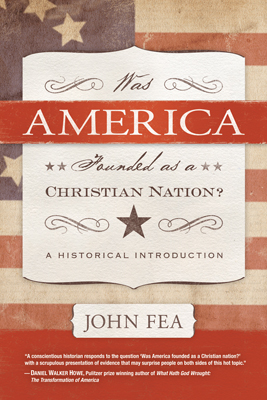
Was America Founded as a Christian Nation?

Paul Harvey

The question is badly posed, our contributor John Fea points out in his new book, to be available in just a couple of weeks, Was America Founded as a Christian Nation: A Historical Introduction.

Publishers' Weekly has a nice note on the book:

Fea, history professor at Messiah College, does not answer the title query because, he says, “it’s a bad question.” Instead, Fea urges, think like a historian. Turns out, history is not about picking the best fruit off the vine to support your opinion--or the opinions of TV talkers--it’s about doing your homework. He does just that to produce this primer, as he calls it, which defines “history,” “nation,” and “Christian.” Fea studied current position papers of proponents and opponents of the title’s question, and he read from the past: the Federalist papers, John Adams and Jefferson’s writings, state constitutions, debate resolutions. In part one, the author traces the concept of a Christian nation from 1789 to today; part two focuses on the American Revolution, from the British colonies’ points of view to the constitutional “wall of separation between church and state.” Part three, the most fluid and fascinating, profiles specific founders, their orthodoxy vs. their orthopraxy, especially concerning the topic of complex, un-Christian slavery. Fea’s style, clean and simple, persuades by history, not histrionics. (Feb.)

John has some more thoughts on defining the terms of the book here; his speaking schedule on behalf of the book over the next couple of months is here.

This is a book meant for a broad audience, and also (one hopes) will help public rhetoric turn it down a notch by introducing some sense of historical complexity and contingency. Congratulations to John, and we wish his book a most successful launch.

Rabu, 06 Oktober 2010

Glenn Beck, Methodism, and "Black Founders"

by Christopher Jones

Glenn Beck initially drew my interest because of his Mormonism—I sensed in Beck’s conspiratorial approach to politics something reminiscent of an earlier generation of Mormon public figures. The pervading fear of socialist subversion, combined with the particularly Mormon interpretations and understandings of human agency, the methods and aims of satanic opposition, and the divinely-inspired nature of America’s Founding documents, were reminders both that the influence of Cleon Skousen and Ezra Taft Benson’s religio-political views still loomed large among a certain segment of the Mormon population and that in them lay a narrative that had the power to appeal to not only conservative Mormons but other embittered Americans as well, suspicious of the government and intent on rescuing the nation from secularism and immorality (and make no mistake,
perceived secularism and immorality are as central to Beck’s movement as is some vague libertarian notion of fiscal responsibility). These topics have been discussed, analyzed, and reanalyzed at least a hundred times over by now (though some commentators rehash them anew and claim such discoveries for their own, all while butchering the identities of key people and ideas in Mormon history), and to be honest, I’ve grown weary of thinking about Beck, his Mormonism, and his agenda in general. In fact, I’d sworn off posting anything more on Beck here or at the Juvenile Instructor.

But one of Beck’s more recent forays into early American history has forced me to reconsider. It touched a nerve not because of Beck’s subtle invocation of Mormon themes, but rather because they addressed the subject of my current research—early American Methodism. Sandwiched in between Beck’s recent assertion that race relations in America were (with the exception of some unidentified “racists”) fairly harmonious before the years immediately preceding the Civil War and that provisions for Revolutionary War soldiers and veterans operated on a sort of colorblind basis is an intriguing discussion of what Beck oddly refers to as “the first real megachurch … a white and black megachurch.” The "megachurch" in question (which goes unidentified) is St. George's Methodist Episcopal Church in Philadelphia and the central figure is Richard Allen, eventual founder of the AME Church.

“Richard Allen,” Beck explains, “was a preacher at a white church—a megachurch. … And Richard Allen, this megapreacher, he tried to segregate.” Beck’s go-to guy for all matter historical, David Barton, chimes in, noting that “In the 1790s [Allen] proposed having a black denomination. And both whites and blacks said, ‘we don’t want that. We want the integrated stuff. We don’t want separate denominations.’ There was finally an overt act of racism in one church that kind of gave him the impetus to go ahead and start a black denomination. But for years, neither blacks nor whites wanted a separate denomination ‘cause they worshipped together in those churches, in Philadelphia and elsewhere.”

Rather than focusing on each of the several problematic points raised (the insightful scholarship of Albert Raboteau, Dee Andrews, and Richard Newman is recommended for those interested), I’d like to ruminate on the meanings and implications of two particular points.

First, I was struck by Beck and Barton omitting entirely any mention of Methodism. Richard Allen is simply “a black preacher” and St. George’s is simply a generic “megachurch.” Considering that Methodist theology and worship were so central to Allen’s identity as a Christian (and as a black man), and that his "black denomination" remained within Methodist Episcopal tradition, this seems as especially odd omission. This not only simplifies and distorts the history of St. George’s (and Methodism more generally) by ignoring the complex dynamics of early American religion, but also serves as a useful means of locating this supposed bastion of interracial harmony within the tradition so many of Beck’s listeners and viewers claim as there own today—conservative evangelical Christianity. This rhetorical maneuver, then, allows these conservatives to co-opt the legacy of interracial evangelicalism in early America (in much the same way that Beck has co-opted the legacy of Martin Luther King, Jr. and the Civil Rights Movement of the twentieth century).

Second, this conversation between Beck and Barton took place during a recurring segment of Beck’s show called “Founder’s Friday.” This particular episode was devoted to “Black Heroes in American History,” and was part of Beck’s stated effort to “spend more time learning about our black founders, and restoring this part of history” (a worthwhile effort, no doubt—at least theoretically). I was immediately reminded of Richard Newman’s biography of Richard Allen, Freedom’s Prophet, in which Newman sought to place Allen squarely within the tradition of America’s Founding Fathers. Echoing others, Newman reinforced the notion that Allen was a black founder, but moved beyond previous assessment by declaring that Allen was deserving of such a title not only because he founded black institutions but also because he “was essentially the forerunner of modern civil rights activists” and because “his belief in nonviolent but confrontational reform offered lessons for virtually every black leader who followed in his wake” (p. 4). As Alan Taylor summarized in his review of the book, “Allen was a Founder for all Americans. He emphasized a prophetic vision of America as a multi-racial democracy of equal rights and equal opportunity. His egalitarian vision was far more daring than anything considered by the more famous white Founders.”

In Beck’s vision of “black founders,” however, Richard Allen in cast as a foil to the interracial harmony he earlier enjoyed as a “mega-preacher” to “2,000 whites” by promoting “segregation.” Tellingly, then, what Beck sees as antithetical to his imagined ideal of American society, Newman see as admirable and daring. The implication of Beck’s narrative—that this “black preacher” and the black church he pioneered, are mere distractions to the real story of this Christian nation—serves as an interesting contrast to those who “seek a sense of authenticity” in black institutions and raises important questions about the place of the black church in the conservative white mind today.

Surveying Religious Knowledge: The Founding Fathers, and the Pew Poll

Paul Harvey

For anyone interested, an announcement from History News Network:

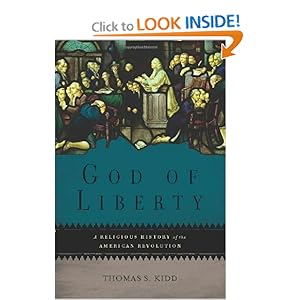
Join Thomas Kidd, author of
God of Liberty: A Religious History of the American Revolution for a live Q&A on HNN's Ning Network at 3 p.m. Eastern on Wednesday, October 13.

Kidd's take on the poll of Americans' religious knowledge, which Chris Jones blogged about here a few days ago, may be found at "
The Founding Fathers Would be Shocked at Our Religious Ignorance." He makes the point that the relatively high degree of religious knowledge evinced by skeptics, noted by the recent pollsters, is not new.

Over at Immanent Frame, a variety of other scholars offer their views on, and take a number of shots, at, the Pew Poll:
Surveying Religious Knowledge. In her contribution, Kathryn Lofton asks, if a person is polled about rock and roll history and is unable to identify Big Mama Thornton, does this make them ignorant of rock and roll history? She continues:

For now, I can only observe that a survey which pits religious groups against one another in a Quiz Bowl, and which imagines that praying Protestants ought to know the authority of Martin Luther, tell me very little about religious knowledge, and tell me even less about what the humanities do to serve such a surveyed public. It may be that we live in a budgetary time that begs for base descriptions of our basic (un)knowing. I would only warn that the minute we believe the answers we offer begin with multiple choice questions is the same minute when we cede our complexity to that formation of ignorance.

Selasa, 24 November 2009

Rebunking the Pilgrims?

[crossposted at the THS blog]
Randall Stephens

As Americans prepare to stuff their faces with turkey, pie, turkey pie, and all manner of bread-related foods, and clock in millions of hours of TV football viewing, it’s worth considering the Pilgrims, originators of America's holiday. (I was just thinking that a Martian would have a very hard time understanding how football and overeating are linked to an otherworldly religious sect.) How do Pilgrims fit into American history and religious history in general?

How low the founders of our national myth have fallen. Nineteenth-century Protestants celebrated the Pilgrims as hearty, pure-of-heart forbearers. Yet even in the 19th century Pilgrims had their share of detractors. Eli Thayer, the Kansas prophet, and the Unitarian minister Edward Everett Hale fussed about the place of Pilgrims in American history. Every lowly Kansan (which I proudly count myself among) had more grit and determination and was more deserving of panegyrics than were the not-all-that-great Pilgrims.

In 1881, Mark Twain delivered an uproarious address, in the form of a plea, to the New England Society of Philadelphia. Why all this “laudation and hosannaing” about the Pilgrims? he asked his audience. “The Pilgrims were a simple and ignorant race. They never had seen any good rocks before, or at least any that were not watched, and so they were excusable for hopping ashore in frantic delight and clapping an iron fence around this one.” “Plymouth Rock and the Pilgrims” was a classic piece of Sam Clemens’ contrarianism. As the whole country went mad with Pilgrim fever, Twain shouted, “Humbug!”

Good fun. But did Twain’s comic take on those “ignorant,” “narrow” Pilgrims win the day in the 20th century? And did it win the day minus the comedy? Historian Jeremy Bangs thinks so. In 2004, he wrote:

Those inspiring Pilgrims of my youth have taken a beating! According to today’s historians, the Pilgrims were among the least significant of England’s American colonists. Their tiny Plymouth Colony was soon absorbed by the larger and more prosperous Massachussets Bay. The Pilgrims were no friendlier to Indians than other Europeans in the Americas—which is to say, they were greedy, duplicitous purveyors of genocide. Nor did they invent democracy: the Mayflower Compact was just an expedient means of maintaining order in a new environment. And their first “Thanksgiving” was nothing more than a replica of a traditional, secular English harvest feast. The Pilgrims didn’t even call themselves Pilgrims, a term coined by the 19th-century Americans who invented these virtuous forbears out of thin air in an effort to grace the relatively new United States with a glorious past. Indeed, about the only aspect of my schoolboy Pilgrims that has survived this assault is their poverty.

The truth about the Pilgrims—and yes, I do still call them Pilgrims—is perhaps closer to the “myth” than to what we can learn from today’s textbooks.

So Bangs offers an erudite rebuttal to the Pilgrim’s modern-day cultured despisers. His Strangers and Pilgrims, Travellers and Sojourners (General Society of Mayflower Descendants, 2009) sets the Pilgrims in their thick historical context. His well-written scholarly account has no rival as far as scope and detail goes. The book has a whopping 894 pages and by my reckoning weighs nearly 4lbs. As a bonus, it's richly illustrated with a variety of prints and photographs (Bangs has spent much time working on the material culture of English separatists.)

Bangs writes that Samuel Elliot Morrison, Darret Rutman, and Theodre Dwight Bozeman dismissed the Plymouth colony as insignificant, a backwater. Add to that Malcolm X’s turn of phrase: “We didn't land on Plymouth Rock, my brothers and sisters—Plymouth Rock landed on us!” (I'm not sure if Brian Wilson's immortal words count as a critique or a drug-related bit of wordplay: "Rock, rock, roll, Plymouth Rock roll over . . .") Since the 1970s, a simple formula has guided much wisdom on the Pilgrims: Indians = good; Pilgrims = bad.

Why do the Pilgrims deserve a new look? Their lives and the record they left tell us something basic about the European roots and the hot Protestant context of America’s first English settlers. The Pilgrims later significance, Bangs notes, also reveals a great deal about what future generations wanted to remember (and one might add, forget) about early colonial America. Bangs argues: “No history of the Plymouth Colony, no history of Leiden, no history of the Netherlands so far explains adequately the Pilgrims' defining experience in exile.” Travellers and Sojourners “undertakes the necessary task of starting over, not simply to add incrementally to what is already known about the Pilgrims in Leiden but instead to reconceive the question of who the Pilgrims were and what contributed to the choices that make them interesting historically.”

Jumat, 20 November 2009

New Book on John Wesley and Methodism

Randall Stephens

Cambridge University Press has a marvelous series called the Cambridge Companions to Religion. Of particular interest to readers of this blog will be: Dana Evan Kaplan, ed., The Cambridge Companion to American Judaism (2005); Stephen J. Stein, ed., The Cambridge Companion to Jonathan Edwards (2006); and John Coffey and Paul C. H. Lim, eds., The Cambridge Companion to Puritanism (2008).

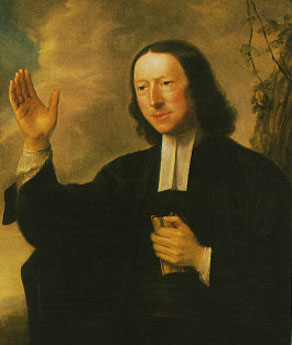
The Cambridge Companion to John Wesley (2009), edited by Randy L. Maddox and Jason E. Vickers, is the latest installment in the series. Wesley, of course, has had an enormous influence on American Christianity. His religion of the heart "strangely warmed" continues to exercise evangelicals, members of mainstream churches, and modern-day social gospellers. Wesley once tellingly wrote: “I am not afraid that the people called Methodists should ever cease to exist either in Europe or America. But I am afraid lest they should only exist as a dead sect, having the form of religion without the power. And this undoubtedly will be the case unless they hold fast both the doctrine, spirit, and discipline with which they first set out.” Over one hundred years later, Holiness folk and Pentecostals said, "amen and amen!"

CUP summarizes Wesley's impact and describes the The Cambridge Companion to John Wesley as follows: "A leading figure in the Evangelical Revival in eighteenth-century England, John Wesley (1703–1791) is the founding father of Methodism and, by extension, of the holiness and Pentecostal movements. This Cambridge Companion offers a general, comprehensive introduction to Wesley’s life and work, and to his theological and ecclesiastical legacy. Written from various disciplinary perspectives, including history, literature, theology, and religious studies, this volume will be an invaluable aid to scholars and students, including those encountering the work and thought of Wesley for the first time."

Contents

Introduction Randy L. Maddox and Jason E. Vickers; Part I. Wesley's Context: 1. The long eighteenth century Jeremy Gregory; Part II. Wesley's Life: 2. Wesley's life and ministry Kenneth J. Collins; 3. Wesley in context David N. Hempton; Part III. Wesley's Work: 4. Wesley as revivalist / renewal leader Charles I. Wallace; 5. Wesley as preacher William J. Abraham; 6. Wesley as biblical interpreter Robert W. Wall; 7. Wesley as diarist and correspondent Ted A. Campbell; 8. Wesley as editor and publisher Isabel Rivers; 9. Wesley's engagement with the natural sciences Randy L. Maddox; 10. Wesley as adviser on health and healing Deborah Madden; 11. Wesley's theological emphases Jason E. Vickers; 12. Wesley's emphases on ethics Rebekah L. Miles; 13. Wesley's emphases on worship and the means of grace Karen B. Westerfield Tucker; Part IV. Wesley's Legacy: 14. Spread of Wesleyan Methodism Kenneth Cracknell; 15. The Holiness/Pentecostal/charismatic extension of the Wesleyan tradition Randall J. Stephens; 16. The African-American wing of the Wesleyan tradition Dennis C. Dickerson; 17. Current debates over Wesley's legacy among his progeny Sarah H. Lancaster.

Selasa, 14 Juli 2009

The Eyes of David Barton Are Upon You

Paul Harvey

All the freakin' live-long day, Texans.

Yes, it's time again for the culture wars in Texas, this time over the teaching in K-12 history texts. The politically appointed board breaks down along familiar lines: scholars in the field of history (imagine that) sit on the committee alongside others who are . . . umm. . . well, less qualified, shall we say, in the field of history. Heck, Lynne Cheney looks like Leopold Von Ranke compared to these guys. Nonetheless, like Forrest Gump and influenza, these guys seem to turn up everywhere.

The three reviewers appointed by the moderate and liberal board members are all professors of history or education at Texas universities, including Mr. de la Teja, a former state historian. The reviewers appointed by conservatives include two who run conservative Christian organizations: David Barton, founder of WallBuilders, a group that promotes America's Christian heritage; and Rev. Marshall, who preaches that Watergate, the Vietnam War and Hurricane Katrina were God's judgments on the nation's sexual immorality.

Watergate!? That's weird. Whatever. Don't they remember the Lynrd Skynrd line about Watergate in "Sweet Home Alabama"? Other highlights from Marshall's career as a public policy analyst and commentator are here. Read it and then ask, "does your conscience bother you? Tell me true."

Anyway, Marshall and company are leading the charge to sanitize the texts of icky stuff they don't like. A lot of that icky stuff happens to involve non-white people; there's a shocker. Here's my favorite:

Delete César Chávez from a list of figures who modeled active participation in the democratic process.

Two reviewers objected to citing Mr. Chávez, who led a strike and boycott to improve working conditions for immigrant farmhands, as an example of citizenship for fifth-graders. "He's hardly the kind of role model that ought to be held up to our children as someone worthy of emulation," Rev. Marshall wrote.

Last time I checked, Mr Chavez was awfully religious, so you think Barton and Marshall would latch onto that. Is it because he's Catholic, or because he's a Latino? Or both?

Then there's Anne Hutchinson of colonial Massachusetts fame, airbrushed out of colonial history. Same goes for Thurgood Marshall -- gone! Shazam, Sgt. Carter!

If this was my home state of Oklahoma, no one would care -- too small-time. But this is Texas -- a market big enough to affect textbook writers everywhere (as has been the case previously with science standards).

Like star fullback Tim Riggins so eloquently intones in Friday Night Lights -- "Texas forever" . . . [tequila shot downed] . . . " No regrets." The Dillon Panthers got their Jumbotron (thanks to Buddy Garrity's greatest line ever, "Have you ever seen two people engaged on a Jumbotron?"), and Texans will get the textbooks they deserve. My guess is students will keep not reading them, regardless of who's in and who's out. On the other hand, standards matter, even if only symbolically, and besides, can't they find a cowboy or cowgirl or two to kick Marshall's butt once and for all -- is that too much to ask, Texas? All together now, on three: Clear minds -- full hearts -- can't lose.

UPDATE: A reader and recent visitor to Colorado Springs wrote and said the following: Focus on the Family pushes Barton's Drive Thru History America series, and I overheard an interesting conversation between a public school history teacher and his friend at Focus Welcome Centers. They were very enthusiastic about Drive Thru History America and talked about how he would be able to show it to his students in spite of it being a Christian product since it is not explicitly evangelizing. A little bit of sneaky preaching in the class room.

Minggu, 28 Juni 2009

Civil Society and Religion in the Early U.S.


by Chris Beneke

The Sunday
Boston Globe "Ideas" section includes an interview by Samuel P. Jacobs with Johann N. Neem, associate professor of history at Western Washington State. The subject is Neem's book, Creating a Nation of Joiners: Democracy and Civil Society in Early National Massachusetts (Harvard, 2008), which considers, among other things, the role of churches and ministers in America's emergent civil society. The book, Neem writes, "questions the assumption that America's voluntary tradition emerged naturally out of the democratic ideals of the American Revolution. Americans were uneasy about becoming a nation of joiners and accepted it only when other options failed." Here's an excerpt from Jacobs' interview with Neem:

IDEAS: We think of freedom of association as a right like freedom of assembly. But this idea is not a concept we can date back to the American Revolution.

NEEM: Today we are much more pluralistic. We tend to think of society as divided up into groups with their own interests, each of which has the right to divide up and pursue their own welfare. That is our modern right, which emerged out of this idea that the hope for a government with one interest is constantly being threatened by people dividing. Freedom of association emerges as a way for outsider groups to continue to pursue their private or political causes. Freedom of association is in a sense the embodiment of a failure of a certain kind of revolutionary hope.

IDEAS: Another thing that we read backwards onto the founders, you argue, is a separation between church and state.

NEEM: One of the things that is important to remember is that Massachusetts had a tax-supported church until 1833. The only competitors, in a sense, were Connecticut in 1818 and New Hampshire in 1819. Only in New England. Most of the states separated church and state right after the Revolution. Why did they do that? Why did it last so long is the question. The answer is that in many ways the public church as well as the militia or the public school were seen as sources of social unity by providing a common institutional experience and also common values.

IDEAS: In many parts of the US, today’s church leaders have become as important as political leaders. How engaged were church leaders in Massachusetts in the 19th century?

NEEM: Church leaders, as well as religious people, congregants, were very active in politics. What is interesting is that the church leadership in Massachusetts started to discover in the 1820s and 1830s that their influence would be greater less through state sanction and more through the cultivation of their congregants. Increasingly church leaders said less we need an alliance with the state, in fact that is a handicap. What we need is to convert people and then mobilize those people. Some of the most mobilized Americans in the 1820s and 1830s were Evangelicals coming out of these churches.

What is a continuation is the ways in which the church has some of the most active citizens. Citizens who still have the ability to write legislators, to organize themselves, are coming out of churches. You see it today not just in today’s conservative movement. You saw it in the civil rights movement coming out of the African-American churches. It is not really liberal or progressive or conservative, it has to do with how citizens participate in public life.

Selasa, 16 Juni 2009

Christian Witnessing

by Chris Beneke

How Christian was the early national U.S.? Providing a credible answer to that question is not as easy as some politicians and journalists would have us believe.

Short of blurting responses that accord with our ideological prejudices, we can cite the founders(the most popular approach), use church membership data, or skimpier but perhaps more revealing church adherence data, consult state and federal constitutional language, examine early national publications, diaries, letters, etc. Unfortunately, there was no Pew Forum on Religion and Public Life on Religion & Public Life in 1790. So to determine who went to church and what believers believed we must rely on often un-reliable observers and scattered records.

Ronald P. Formisano and Stephen Pickering introduce another form of evidence in the summer issue of The Journal of the Early Republic. Their focus is the early national debate over witness competency (i.e. the religious tests that were imposed on potential witnesses in the early republic).

Formisano and Pickering are not the first to look at such laws. But they appear to be doing it more systematically than anyone before them. The authors’ key finding “is that religious tests for ‘witness competency’ remained on state statute books and in judges’ decisions a much longer time” than scholars have generally thought. Formisano and Pickering point out that “[m]any state courts retained religious tests for most of the nineteenth century” (it’s not clear that anyone knows how many and for how long. It appears that a conservative estimate would be: 1) a dozen or more states, and 2) into the early twentieth century). A witness’s success in passing such tests usually hinged on whether she or he believed in “a future state of rewards and punishments.”

Formisano and Pickering identify two primary judicial approaches to witness competency in religious matters. The first emphasized that "a future state" entailed belief in an afterlife of rewards for some and punishments for others, which excluded Universalists who professed that every soul would eventually be saved. A second, more common approach accommodated Universalists by allowing that a belief in rewards and punishments in this life could also be a sufficient qualification. On the whole, the trend was away from strict religious requirements for witness competency and toward their abolition. Nonetheless, these laws changed much more slowly than those that had maintained tax support for Protestant churches. Their persistence gestures towards a fairly robust Christian sensibility in the understanding of early national law and culture. In the end, however, Formisano and Pickering are careful to observe that “[n]either a narrow interpretation of the First Amendment nor … the ‘nonpreferentialist’ advocacy of federal aid to religion follows from the recognition of Christianity being ‘interwoven’ in the common law and influencing other areas of governance and ritual within the states.”