Tampilkan postingan dengan label religion and the american revolution. Tampilkan semua postingan

Sabtu, 04 Juni 2011

Faith of the Founders (My Review of John Fea in the Christian Century)

Paul Harvey

I was very happy that the Christian Century asked me to review John Fea's Was America Founded as a Christian Nation: A Historical Introduction -- and even more glad they gave me relatively ample space (over 1200 words anyway, better than the average review) to develop some thoughts on John's book. The review is here. Here is an excerpt, and then continue at the jump:

Faith of the founders

Was America founded as a Christian nation? No, is John Fea's answer to the question posed in his title. But the answer is yes if we consider how Americans (especially from 1789 to 1865) understood themselves as a Christian nation. And then again, maybe it's just a bad question, Fea concludes, because it arises not from a rich understanding of the past but from present-day polemics. Only when we remove it from that context can we begin to make sense of it.

Continue <<<

Senin, 25 April 2011

A Cheerful and Comfortable Study of Colonial Material Religion

Paul Harvey

Since yesterday I mentioned Lauren Winner's essay in the Sunday Times book review, which reflected on Rob Bell and American conceptions of hell (and heaven), seems like a good time to showcase this review of her new book A Cheerful and Comfortable Faith, recently published by Yale -- the review is from Choice.

Winner, Lauren F. A cheerful and comfortable faith: Anglican religious practice in the elite households of eighteenth-century Virginia. Yale, 2010. 272p bibl index afp ISBN 0-300-12469-4, $45.00; ISBN 9780300124699, $45.00. Reviewed in 2011may CHOICE.

This study by Winner (Duke Divinity School) of the domestic religious life of elite families in Colonial Virginia both builds upon and modifies earlier work, including Dell Upton's Holy Things and Profane (1986). As Upton did, Winner focuses primarily on material objects as evidence; however, she deals not with public, male-dominated church buildings but rather with articles found in and around the home: needlework, baptismal bowls, prayer books, articles related to food preparation and consumption, and garments and rings worn in times of mourning. Winner's argues that although their roles were circumscribed, Anglican women nevertheless carved out a sphere in which they subtly contested the authority over religious matters claimed by clergy and male relatives and that their religious life, though not as dramatic as that of their Puritan counterparts, was an authentic appropriation of Anglican tradition in a Colonial setting. Winner's work is thoroughly and imaginatively researched, informed but not overwhelmed by theory, adequately illustrated, and accessibly written. This book is an important contribution to Anglican, elite, Colonial, material, and gendered dimensions of American religious life. Summing Up: Highly recommended. Upper-level undergraduates through researchers/faculty.
-- P. W. Williams, Miami University

Rabu, 16 Februari 2011

An Interview with Chris Beneke on The First Prejudice

Randall Stephens

About a week ago Paul blogged on Chris Beneke and Christopher S. Grenda's, The First Prejudice: Religious Tolerance and Intolerance in Early America (Univ. Pennsylvania Press, 2011). The edited volume, "presents a revealing portrait of the rhetoric, regulations, and customs that shaped the relationships between people of different faiths in seventeenth- and eighteenth-century America. It relates changes in law and language to the lived experience of religious conflict and religious cooperation, highlighting the crucial ways in which they molded U.S. culture and politics." I recently caught up with Chris by email and asked him some questions about the project and the work being down on tolerance/intolerance.

Randall Stephens: What is the unifying theme of The First Prejudice: Religious Tolerance and Intolerance in Early America?

Chris Beneke: Our title, The First Prejudice, plays on the popular understanding of religious liberty as the nation’s “First Freedom.” It also draws on the proposition that religion was initially the source of the deepest prejudice to afflict early Americans and the object of the first large-scale efforts to mitigate prejudice. We asked our contributors to be attentive to the distinguished and extensive historiography on church and state, but not beholden to it. The idea was to create a history of religious tolerance and intolerance that took into account a broader range of religious and cultural interaction than histories of religious liberty have traditionally done. For us, it presented an opportunity both to build a compelling new narrative of early American religious history-where religious differences are at center stage-and to develop a common set of reference points and questions that would frame more useful conversations about tolerance and intolerance in America.

Stephens: Why did religious tolerance develop in the West when and where it did?

Beneke: In a sense, it depends on what you mean by tolerance (I know it’s annoying when historians say that, but there, I’ve gone and done it). If you mean what Willem Frijhoff calls “everyday ecumenism,” or at least everyday cooperation and non-violence, then it’s very old indeed. Historians have been hard at work in the archives over the past two-plus decades, discovering that sort of tolerance in surprising places across medieval and early modern Europe. But as a commonly accepted ideal, as a stated commitment to some form of equality, and a legal practice that guaranteed a modicum of protection, tolerance is something that developed in the intellectual capitals of northern Europe during the late seventeenth and eighteenth centuries. And though I risk irritating my intrepid co-editor and some contributors by saying this, I think that it took hold in a much more fundamental and irrevocable way in the early national United States.

Stephens: When it comes to religious tolerance did the early United States differ all that much from Great Britain and western Europe?

Beneke: Here's the very short answer: official church establishments persisted across most of Europe into and beyond the twentieth century. In the United States, they did not. The U.S. may have maintained an unofficial Protestant establishment for many decades (via instruments such as the common law, public education, state religious tests.), but the fact that it was un-official and the fact that it was accompanied by substantive protections for free exercise, was critically important. For all the disingenuity involved, an un-official establishment was surely more hospitable toward religious minorities than almost any official establishment might have been. Maybe just as importantly, the commitment to disestablishment and religious liberty meant that the religiously intolerant had to explain themselves and find ways to wrap bigotry in the mantle of tolerance.

These factors have always kept American religious intolerance in check.

Stephens: How did particular religious groups or individuals "wrap bigotry in the mantle of tolerance"? Are you referring to anti-Catholic crusading in the mid-19th century?

Beneke: That’s a very good example. One common theme in American religious history is the excoriation and the marginalization of the allegedly intolerant, a point that John Corrigan and Lynn Neal have recently made well. Roman Catholicism is a prime example. Mormonism is another. More recently, it’s been Islam. Of course, as the controversies over burqas in France illustrate, we aren’t alone in this. In general, however, if you want to limit religious violence and religious discrimination, it’s better to have strong public norms in favor of tolerance, than not.

Stephens: It seems that the scholarly literature of tolerance/intolerance and the religious/irreligious roots of America's founding can't help but be tied to contemporary debates about church and state. Could you say something about the connection between the history being written on these subjects and the current debates about religion in American public life?

Beneke: I really hope that people who have a say in the decisions on these issues today-including judges and law clerks-will read The First Prejudice. But it would be a poorly prepared judge or law clerk that read only our book. As much as we sought to engage the literature on church-state relations, our conclusions were about seventeenth and eighteenth-century people who lived in a very different world.

Having said that, I think there are some scholars-notably Sarah Barringer Gordon and Tisa Wenger-whose recent books connecting religious studies and religious history to church-state issues resemble ours and do speak directly to larger questions about religion in modern public life. Steven K. Green and David Sehat have also expanded our appreciation for the subtle ways in which freedom can be limited, even under conditions of formal disestablishment. But our collective, comparative attention was focused on early modern Europe. It’s partly for this reason that The First Prejudice supplies a broader (if I were immodest, Randall, I would say “essential”) context for historians who are looking at the intentions of the founders and the political, cultural, and juridical legacies that developed thereafter. It’s just not possible to understand the reasoning behind the First Amendment, and similar provisions made in the states, without knowing a good deal about the contemporary meaning of religious liberty, the contours of religious interaction, the landscape of different faiths, and the social conditions that regulated relations between them. That’s what our contributors provided. Brilliantly.

Minggu, 30 Januari 2011

Was America Founded as a Christian Nation?

Paul Harvey

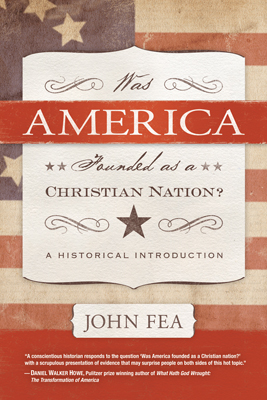
The question is badly posed, our contributor John Fea points out in his new book, to be available in just a couple of weeks, Was America Founded as a Christian Nation: A Historical Introduction.

Publishers' Weekly has a nice note on the book:

Fea, history professor at Messiah College, does not answer the title query because, he says, “it’s a bad question.” Instead, Fea urges, think like a historian. Turns out, history is not about picking the best fruit off the vine to support your opinion--or the opinions of TV talkers--it’s about doing your homework. He does just that to produce this primer, as he calls it, which defines “history,” “nation,” and “Christian.” Fea studied current position papers of proponents and opponents of the title’s question, and he read from the past: the Federalist papers, John Adams and Jefferson’s writings, state constitutions, debate resolutions. In part one, the author traces the concept of a Christian nation from 1789 to today; part two focuses on the American Revolution, from the British colonies’ points of view to the constitutional “wall of separation between church and state.” Part three, the most fluid and fascinating, profiles specific founders, their orthodoxy vs. their orthopraxy, especially concerning the topic of complex, un-Christian slavery. Fea’s style, clean and simple, persuades by history, not histrionics. (Feb.)

John has some more thoughts on defining the terms of the book here; his speaking schedule on behalf of the book over the next couple of months is here.

This is a book meant for a broad audience, and also (one hopes) will help public rhetoric turn it down a notch by introducing some sense of historical complexity and contingency. Congratulations to John, and we wish his book a most successful launch.

Sabtu, 08 Januari 2011

Constitutional Fundamentalism, Minus Some of the Fundamentals

Paul Harvey

My piece at Religion Dispatches, posted yesterday, reflects on the meaning of "original intent" after the reading of the Constitution in the House of Representatives Thursday. What does it mean to treat the Constitution as "sacred," but skip over the parts in which the original intent of an entirely different era leaves us uncomfortable, not unlike reading passages from any number of other sacred scriptures? Read it here. A short taste here:

No Person held to Service or Labour in one State, under the Laws thereof, escaping into another, shall, in Consequence of any Law or Regulation therein, be discharged from such Service or Labour, but shall be delivered up on Claim of the Party to whom such Service or Labour may be due.

As the 112th Congress convened on Thursday, January 6, 2011, the first order of business was a religious ritual designed to underscore the import of a historic transition of power: a reading of the US Constitution. Or rather, a reading of it without some of its ickier original parts, such as the original fugitive slave provision quoted above. It was constitutional fundamentalism without some of the fundamentals.

Julie Ingersoll's post, also at Religion Dispatches, reflects in a similar fashion on the reading. John Fea weighs in here.

Rabu, 27 Oktober 2010

Of Tea Parties, Historical Fundamentalism, and Antihistory

Linford D. Fisher


It’s always nice when academic and pleasure reading coincide. Jill Lepore’s The Whites of Their Eyes: The Tea Party’s Revolution and the Battle over American History (Princeton, 2010) is a bit like that—fun to read, informative, insanely timely, and likely to generate excitement in certain circles for a variety of reasons.


The book is essentially a commentary on the twenty-first century Tea Party by way of the 1970s and the 1770s and is—by Lepore’s own admission—a strong argument against “historical fundamentalism,” which, as she describes it, is "marked by the belief that a particular and quite narrowly defined past—'the founding'—is ageless and sacred and to be worshipped; that certain historical texts—'the founding documents'—are to be read in the same spirit with which religious fundamentalists read, for instance, the Ten Commandments; that the Founding Fathers were divinely inspired; that the academic study of history (whose standards of evidence and methods of analysis are based on skepticism) is a conspiracy and, furthermore, blasphemy; and that political arguments grounded in appeals to the founding documents, as sacred texts, and to the Founding Fathers, as prophets, are therefore incontrovertible."


The Tea Party folks, she contends, promote not just “kooky history” in their appropriation of Revolutionary themes and employment of Founding rhetoric; they practice antihistory, that is, they conflate the then and the now. The Founders are not just in the eighteenth century, they are here with us now; their struggles are our struggles. “In antihistory,” Lepore muses, “time is an illusion.”


The core of the book is a lively retelling of the Revolutionary Era from the 1760s through the late 1790s. The 1773 Boston Tea Party, ironically, gets precious little play; ditto for the 1775 Battle of Bunker Hill (invoked in her title; for the Tea Party proper, you’d have to turn to Ben Carp’s Defiance of the Patriots: The Boston Tea Party and the Making of America [Yale, 2010]). Juxtaposing the messy, contested, exhilarating world of the late eighteenth century with the projection of an idealized past created by the Tea Party is both jarring and effective. Framed this way, the story almost tells itself, or so it seems. Regular readers of Lepore’s New Yorker essays will find familiar discussions of Benjamin Franklin, Thomas Paine, and Phillis Wheatley, although there is loads of new material, too, like the delightful sections on Jane (Franklin) Mecom (on whom a biography is forthcoming at some point). Along the way, the reader learns a great deal about the rise of the present Tea Party and how its antihistory came to be in the first place, namely, the historical profession's failure in the wake of the bicentennial of the 1970s to craft a responsible and satisfying historical narrative for the American populace to call their own. Into this lacuna, the Tea Party gladly stepped. In a sense, then, the Tea Party’s (mis)use of history is partially our fault.


As is the case with most books like this, those who should read it, won’t. The book is clearly pitched toward the reading “public”—however defined—who may, in the end, be convinced by the pleasant mix of first-person narrative, historical storytelling, and trenchant analysis, all while hopscotching Lepore-ishly between the eighteenth century and the present. Most obviously, the book is bound be dismissed by the Tea Partiers and their sympathizers as yet another blathering rant by the liberal elites who not only drink the Kool-Aid but help to mix it as they conspire against the American people. The Whites of Their Eyes, however, is hardly that. In many ways it is rather a plea for a particular kind of public discourse and a more accurate use of history. And—in surprising ways—Lepore has spent far more time than you or I with Tea Party folks, trying to understand their rhetoric, concerns, and use of history. Each chapter opens with a fascinating first-person account of attending a Tea Party meeting or rally, before zipping to the eighteenth century and back again.


This book provoked all kinds of questions for me: about the use of history; the decision to write a book like this; and—most of all—what it was like hanging with Tea Party folks. I had to know. And so, over steak salads by the open windows of the Grafton Street Pub perched on the corner of the unseasonably humid Harvard Square, I hijacked the final minutes of a previously-scheduled luncheon with Jill to talk about her book.


LF: In a sense, portions of this book read like an ethnography of the Tea Party. How did—if at all—the experience of attending rallies and meetings in pubs affect your perspective (positively or negatively) of the Tea Party folks and their aims?


JL: My ideas definitely shifted as a result of spending time with the Tea Party people. From the beginning, I always outed myself as a Harvard historian who was writing an article (for The New Yorker; the book idea grew over time) and that I was interested in how people view the Revolution. Most people at the Tea Party meetings didn’t ask more about me. They wanted to talk about themselves. So I listened. Most people felt misrepresented by the mainstream media; everyone I talked to said this. Everyone in the left-wing press was saying the Tea Party was all about race; but for these people I talked to it was not about race. People were upset about that. Austin Hess was offended at being called a racist; he said we lived in a post-racial world. I took him at his word and wanted to be sympathetic with him. I’m not saying it has nothing to do with race. But that’s why they love the American Revolution, because they see it as a white, pre-racial movement, which of course it wasn’t. But that’s sort of the point of the book, and why I gave it the title it has [The Whites of Their Eyes].


LF: This must have taken a lot of intellectual discipline to go and only listen.


JL: I had a lot of fun, actually. Like with the Egan brothers; they were hilarious—exactly like my family. Being at the meetings was pretty much like every family dinner I’ve had since I was eight—was never a Thanksgiving dinner without a pitched political battle. We were family and yet we disagreed. So rather than these meetings being a foreign experience, it was familiar. I never tried to persuade people; I always wanted them to persuade me. People called me “Jane Goodall” because I took notes furiously and furrowed my brow. It’s not a move that a lot of scholars would make, to go and just listen. I did come to think that I understood better, but I still disagreed. For example, I was really trying to figure out people’s position on healthcare. I pressed George Egan on this point, and he told me this heartbreaking story of his three-year-old daughter who was sick and hospitalized and the hospital sent him a bill for ten thousand dollars. He had no insurance, but he got a second job and paid it off over time. And then—this is what surprised me—at the end he said something like, “That’s why I’m against Obamacare. Because I had to pay for it and others should, too.” The same story could be used as an argument for universal healthcare, but that’s not how he was using it. In the end, I think I did become more sympathetic to what they were about. I got to know them. I found myself in the position of defending the Tea Party to my colleagues and friends. I grew to like these people; I didn’t think they were crazy, even though I still disagree with them.


LF: What do you hope that people take away from this book? And have you felt that people are “getting” what you are trying to do?


JL: I’d like people to have a different vision for what political discourse could be like in this country, one that is based on historical evidence and respectful dialog. Argument and evidence are important. Often I need to preface my talks around the country with a plea for restraining emotions and practicing a more evidence-based, measured discourse that is generally lacking in political life today.


I have gotten a lot of positive feedback from various people—schoolteachers, politicians. My colleagues have been uniformly supportive. Same with people I see at events. I was at an event in Washington D.C., on a panel at the National Press Club with Dick Armey (Freedom Works), someone from Fox News, and a person from the New York Times. And a whole group of Freedom Works folks walked in holding—to a man, each woman—color photocopies of my New Yorker essay on the Tea Party. They came to fight. But after the session, a lot of the Freedom Works people came up and said they appreciated what I said. These people really wanted to talk to a real history professor who was taking them seriously. I met a guy in Texas who told me: “You’re the first liberal I’ve talked to that made any sense.” After one talk, a conservative Christian couple approached me and wanted to convince me that the Constitution grants only god-given rights. Neither of us convinced the other, but they appreciated that I was willing to talk. I’m not sure those people “get” me or will like the book, but they are willing to talk to me.


LF: Is this a new direction for you—tackling present issues, arguing for a particular kind of public engagement in the historical profession?


JL: I’ve always thought there should be places to talk about shared concerns, which is why I started Common-Place with Jane Kamensky. It is a place where academics, librarians, teachers, can all share ideas. I appreciate all kinds of historians—we need both Gary Nash and Gordon Wood, for example. I think debate is important; recently in my seminars I’ve set up a series of debates where students read historical speeches and essays and spend time making the case for the historical person they have been assigned. And it works. Students get all animated and put on southern accents or whatever. But of course the next day they are slouched back in their chairs. But it is still worth it.

Selasa, 12 Oktober 2010

God In America, Part One: An Exercise in the Evangelical Whig View of Early American Religious History

 By John Fea

Cross-posted at The Way of Improvement Leads Home

I just got done watching Part 1 of the PBS series "God in America." I know I am behind (Part 2 aired tonight), but such is the life of a blogger, professor, and a new department chair.

The series begins with the Franciscan attempts to convert the Pueblo Indians to Christianity in the 17th century.  This, of course, is a sad chapter in American history.  The Spanish friars were militant.  Their evangelistic zeal led to the destruction of Pueblo sacred sites and all sorts of brutality.  The high point of this story is the Pueblo revolt of 1680, the Indian rebellion that put an end to the Spanish presence in the west and proved that Christianity would not come to America unchanged.

This is a nice way to begin, but it has absolutely no connection to the rest of Part One's narrative.  One gets the impression that this was just tacked on to the beginning of the program because SOMETHING needed to be said about native Americans.  The story line of the native Americans, and the Spanish for that matter, are quickly dropped in favor of what I call in the title of this post the "evangelical Whig view" of American history.  This script could have been written by George Bancroft.

And where is slave religion?  (Let's hope it is discussed later in the series).

The Puritans are next. Steven Prothero of Boston University establishes himself as our guide through this history, but we also hear from a star-studded lineup of historians that include Michael Winship, Frank Lambert, Mary Beth Norton, Stephen Marini

Much time is spent on Anne Hutchinson. Too much time.  Prothero is very good at showing the Protestant individualism of the Puritans and how Hutchinson, in some ways, seemed more Protestant than the Puritans.  Hutchinson is clearly the star.  There is more time spent on her story than on the Puritans who removed her from the colony.  Was the Hutchinson trial really the most important moment in 17th century New England history? Would the people living in Puritan New England have seen it this way?  Absolutely not. The Halfway Covenant, King Philips War, the Salem Witch Trials, and a host of other events would have been more important to the Puritan "city on a hill," but these events do not fit easily into the Whig narrative.

The portrayal of the Hutchinson trial is well-acted and the trial transcript is used as the script.  Winship claims that during this trial Hutchinson "rips him (John Winthrop) to shreds."  Norton celebrates the rebellious spirit of Hutchinson.  Prothero concludes that Hutchinson is the future of America--she represents liberty of conscience and religious freedom.

The documentary then jumps to George Whitefield. Marini stresses the individualism of evangelical religion. (By the way, I would love to take a class with Marini--so much passion and energy!)  Harry Stout mentions Whitefield's appeal to the emotions and the imagination.  Lambert connects Whitefield's evangelical, individualistic Protestantism to that of Hutchinson.  A clear intellectual and spiritual genealogy is developing here.

The discussion of the First Great Awakening does a great job of explaining evangelicalism as a real and powerful religious movement that impacted people's lives.  The documentary uses a host of quotes from the diaries of Whitefield converts to make this point.  Very well done.

But overall the treatment of the Great Awakening is blatantly Whig. One is left with the impression that the Great Awakening was more of a political movement than it was a religious movement. Stout talks about the way Whitefield's evangelicalism challenged "the old aristocratic order" and even suggests that the Great Awakening led to the popular idea that "we are the people."  Then Daniel Driesbach talks about the way that the Great Awakening brought the colonies together.  One clearly gets the impression that these historians are setting us up for the American Revolution.  I tell my students that the Great Awakening created a transatlantic religious network that made the colonies more British and Protestant.  "God in America" would prefer to see it as the seedbed of individual liberty, revolution, and American identity.

And then, in the last three minutes of Part One, we get the triumph of the evangelical Whig narrative or, what Jon Butler has called "Born Again History."

The narrator states that people began to insist that it was their right to worship in the church of their choice.  Evangelical religion is said to have provided the American Revolution with a sense of "moral" urgency. Prothero says that following the First Great Awakening, the Revolution was "inevitable" and "perfectly logical."

In the end, the story of "God in America"--at least early America-- is best told by following a direct line between Hutchinson and Whitefield, culminating in the American Revolution.  At times I thought I was sitting in a lecture at Glenn Beck University.

Thomas Kidd Lecture, Fri, Oct 15, Eastern Nazarene College

Randall Stephens

A note for any of y'all who live near Boston.

FRIDAY, OCTOBER 15, at 3:00pm, Shrader Lecture Hall, Eastern Nazarene College, Quincy, Mass: Thomas S. Kidd (Baylor University), "God of Liberty: A Religious History of the American Revolution." The Donald S. Metz Lecture in American Christian History.

Thomas Kidd is the author of a variety of books and article on American religion in the colonial and revolutionary eras. His The Great Awakening: The Roots of Evangelical Christianity in Colonial America was published by Yale in 2007. University of Notre Dame historian Mark Noll described the book as “Well researched, clearly written and authoritatively argued. There is no book of comparable breadth, either chronologically or geographically.” Kidd also published The Great Awakening: A Brief History with Documents, with Bedford Books in 2007. His American Christians and Islam: Evangelical Culture and Muslims from the Colonial Period to the Age of Terrorism was published by Princeton University Press in 2008. Walter Russell Mead thus praised American Christians and Islam in Foreign Affairs: “This concise and well-organized study offers readers an excellent summary of American popular attitudes toward Islam from the eighteenth century onward.”

Kidd will be speaking on his new book God of Liberty: A Religious History of the American Revolution (Basic Books, 2010), which Harry Stout described as "a history of religion and the American Revolution that addresses the revolutionary war in substantial detail. Thomas Kidd brilliantly examines the role of religion in the Revolution, and explores the intersection of religion and the Republic, neither of which can be fully understood without reference to the other. Kidd demonstrates in persuasive detail how the idea of religious liberty informed the meaning of the Republic at its deepest level."

The lecture is part of a series on colonial America. Gordon Wood and Jill Lepore will speak on campus in November.

Jumat, 08 Oktober 2010

God of Liberty: BookTV

To follow up on Paul Harvey's earlier post about Thomas Kidd's God of Liberty: A Religious History of the American Revolution, this weekend BookTV is airing a lecture Kidd delivered recently at Indiana Wesleyan University. (Incidentally, as Paul also posted, Indiana Wesleyan is hosting a conference organized by religion scholar Rusty Hawkins, Divided by Faith: A Decade Retrospective, next week.)

Find additional information and show times of Kidd's lecture here.

Rabu, 06 Oktober 2010

Glenn Beck, Methodism, and "Black Founders"

by Christopher Jones

Glenn Beck initially drew my interest because of his Mormonism—I sensed in Beck’s conspiratorial approach to politics something reminiscent of an earlier generation of Mormon public figures. The pervading fear of socialist subversion, combined with the particularly Mormon interpretations and understandings of human agency, the methods and aims of satanic opposition, and the divinely-inspired nature of America’s Founding documents, were reminders both that the influence of Cleon Skousen and Ezra Taft Benson’s religio-political views still loomed large among a certain segment of the Mormon population and that in them lay a narrative that had the power to appeal to not only conservative Mormons but other embittered Americans as well, suspicious of the government and intent on rescuing the nation from secularism and immorality (and make no mistake,
perceived secularism and immorality are as central to Beck’s movement as is some vague libertarian notion of fiscal responsibility). These topics have been discussed, analyzed, and reanalyzed at least a hundred times over by now (though some commentators rehash them anew and claim such discoveries for their own, all while butchering the identities of key people and ideas in Mormon history), and to be honest, I’ve grown weary of thinking about Beck, his Mormonism, and his agenda in general. In fact, I’d sworn off posting anything more on Beck here or at the Juvenile Instructor.

But one of Beck’s more recent forays into early American history has forced me to reconsider. It touched a nerve not because of Beck’s subtle invocation of Mormon themes, but rather because they addressed the subject of my current research—early American Methodism. Sandwiched in between Beck’s recent assertion that race relations in America were (with the exception of some unidentified “racists”) fairly harmonious before the years immediately preceding the Civil War and that provisions for Revolutionary War soldiers and veterans operated on a sort of colorblind basis is an intriguing discussion of what Beck oddly refers to as “the first real megachurch … a white and black megachurch.” The "megachurch" in question (which goes unidentified) is St. George's Methodist Episcopal Church in Philadelphia and the central figure is Richard Allen, eventual founder of the AME Church.

“Richard Allen,” Beck explains, “was a preacher at a white church—a megachurch. … And Richard Allen, this megapreacher, he tried to segregate.” Beck’s go-to guy for all matter historical, David Barton, chimes in, noting that “In the 1790s [Allen] proposed having a black denomination. And both whites and blacks said, ‘we don’t want that. We want the integrated stuff. We don’t want separate denominations.’ There was finally an overt act of racism in one church that kind of gave him the impetus to go ahead and start a black denomination. But for years, neither blacks nor whites wanted a separate denomination ‘cause they worshipped together in those churches, in Philadelphia and elsewhere.”

Rather than focusing on each of the several problematic points raised (the insightful scholarship of Albert Raboteau, Dee Andrews, and Richard Newman is recommended for those interested), I’d like to ruminate on the meanings and implications of two particular points.

First, I was struck by Beck and Barton omitting entirely any mention of Methodism. Richard Allen is simply “a black preacher” and St. George’s is simply a generic “megachurch.” Considering that Methodist theology and worship were so central to Allen’s identity as a Christian (and as a black man), and that his "black denomination" remained within Methodist Episcopal tradition, this seems as especially odd omission. This not only simplifies and distorts the history of St. George’s (and Methodism more generally) by ignoring the complex dynamics of early American religion, but also serves as a useful means of locating this supposed bastion of interracial harmony within the tradition so many of Beck’s listeners and viewers claim as there own today—conservative evangelical Christianity. This rhetorical maneuver, then, allows these conservatives to co-opt the legacy of interracial evangelicalism in early America (in much the same way that Beck has co-opted the legacy of Martin Luther King, Jr. and the Civil Rights Movement of the twentieth century).

Second, this conversation between Beck and Barton took place during a recurring segment of Beck’s show called “Founder’s Friday.” This particular episode was devoted to “Black Heroes in American History,” and was part of Beck’s stated effort to “spend more time learning about our black founders, and restoring this part of history” (a worthwhile effort, no doubt—at least theoretically). I was immediately reminded of Richard Newman’s biography of Richard Allen, Freedom’s Prophet, in which Newman sought to place Allen squarely within the tradition of America’s Founding Fathers. Echoing others, Newman reinforced the notion that Allen was a black founder, but moved beyond previous assessment by declaring that Allen was deserving of such a title not only because he founded black institutions but also because he “was essentially the forerunner of modern civil rights activists” and because “his belief in nonviolent but confrontational reform offered lessons for virtually every black leader who followed in his wake” (p. 4). As Alan Taylor summarized in his review of the book, “Allen was a Founder for all Americans. He emphasized a prophetic vision of America as a multi-racial democracy of equal rights and equal opportunity. His egalitarian vision was far more daring than anything considered by the more famous white Founders.”

In Beck’s vision of “black founders,” however, Richard Allen in cast as a foil to the interracial harmony he earlier enjoyed as a “mega-preacher” to “2,000 whites” by promoting “segregation.” Tellingly, then, what Beck sees as antithetical to his imagined ideal of American society, Newman see as admirable and daring. The implication of Beck’s narrative—that this “black preacher” and the black church he pioneered, are mere distractions to the real story of this Christian nation—serves as an interesting contrast to those who “seek a sense of authenticity” in black institutions and raises important questions about the place of the black church in the conservative white mind today.

Surveying Religious Knowledge: The Founding Fathers, and the Pew Poll

Paul Harvey

For anyone interested, an announcement from History News Network:

Join Thomas Kidd, author of
God of Liberty: A Religious History of the American Revolution for a live Q&A on HNN's Ning Network at 3 p.m. Eastern on Wednesday, October 13.

Kidd's take on the poll of Americans' religious knowledge, which Chris Jones blogged about here a few days ago, may be found at "
The Founding Fathers Would be Shocked at Our Religious Ignorance." He makes the point that the relatively high degree of religious knowledge evinced by skeptics, noted by the recent pollsters, is not new.

Over at Immanent Frame, a variety of other scholars offer their views on, and take a number of shots, at, the Pew Poll:
Surveying Religious Knowledge. In her contribution, Kathryn Lofton asks, if a person is polled about rock and roll history and is unable to identify Big Mama Thornton, does this make them ignorant of rock and roll history? She continues:

For now, I can only observe that a survey which pits religious groups against one another in a Quiz Bowl, and which imagines that praying Protestants ought to know the authority of Martin Luther, tell me very little about religious knowledge, and tell me even less about what the humanities do to serve such a surveyed public. It may be that we live in a budgetary time that begs for base descriptions of our basic (un)knowing. I would only warn that the minute we believe the answers we offer begin with multiple choice questions is the same minute when we cede our complexity to that formation of ignorance.

Kamis, 01 Juli 2010

This Land is Our Land: Surprising or Otherwise Interesting Primary Sources, Part VIII, Fourth of July Edition

Randall Stephens

In honor of the weekend's rockets red glare and wild competitive eating contests, I post here a couple of primary source items related to the National Reform Association. The NRA was a post-Civil War organization that hoped to amend the constitution and acknowledge America's explicitly Christian character. The effort failed, but stirred up plenty of dust in the process.

From an 1876 NRA circular:

The National Association, organized to maintain existing Christian features in the American government, and to secure the Religious Amendment of the Constitution of the United States, met in Philadelphia on the 9th inst., for the transaction of its annual business. The Hon. Felix R. Brunot, of Pittsburgh, President of the Association, occupied the chair. Steps were taken to secure articles of incorporation, under the name of the National Reform Association. The maintenance of the Sabbath Laws, the retention of the Bible in the common schools, the defence of the Judicial oath and other Christian features of the government, and the securing of suitable religious acknowledgments in all new State Constitutions, were expressly recognized as among the objects of the society. The next national Convention was appointed to be held in Philadelphia during the last week in June, 1876.

A National Liberal League response from Equal Rights in Religion: Report of the Centennial Congress of Liberals, and Organization of the National Liberal League, at Philadelphia on the Fourth of July, 1876 (Boston, 1876), 128-129:

Thomas Paine, Thomas Jefferson, Alexander Hamilton, John Adams, Benjamin Franklin and George Washington, all liberals and freethinkers, taking advantage of the hatred and jealousy of each sect for the others at the time of the Constitutional Convention, succeeded in placing the general government upon a purely secular basis. They expected that the noble example thus established by the supreme law of the land would be followed in all the State Constitutions. But unfortunately not a single State followed so wise a precedent. . . .

To question the truth of the Old and New Testament Scriptures was by law pronounced
"blasphemy," punishable by fine, whipping, sitting in the pillory with a rope about the neck, and twelve months imprisonment.

Under this law, in January, 1834, a jury of Bostonians convicted Abner Kneeland of blasphemy for declaring that—"The Universalists believe in a God which I do not, but
believe that their God, with his moral attributes (aside from Nature itself), is nothing but a chimera of their own imagination." For this expression of his honest sentiments, this aged, intellectual and worthy man was deprived of his liberty and sent to jail in Boston less than half a century ago!

Such outrages upon civil and religious liberty, and the spirit manifested by over-zealous members of the National Reform Association at the above meeting, give to Thomas Jefferson's strictures upon the clergy of Massachusetts, New Hampshire, and Connecticut,
a still wider application. In his History of the United States, Mr. Hildreth tells us that Jefferson" held up those States in his private correspondence as unfortunate, priest-ridden communities, led by the nose by a body of men who had got a smell of union between Church and State, the natural enemies of science and truth, associated together in a conspiracy against the liberties of the people."

Selasa, 29 Juni 2010

The Strange Career of Thomas Paine

I'm pleased today to guest post another contribution from Benjamin Park, a graduate student at the University of Edinburgh who normally blogs at Juvenile Instructor. Ben's post concerns material he had researched for his master's thesis, about reactions/responses to Thomas Paine from The Age of Reason to Christopher Hitchens to the Tea Party Movement. Ben's previous guest post for us may be found here.

Thomas Paine in American Memory
by Benjamin Park

I recently visited the American Philosophical Society’s library in Philadelphia, PA. Besides housing a treasure-trove of early American documents, and being housed in a beautiful building across the street from Independence hall, the APS Library also offers tourist-friendly exhibits in its front lobby. I was excited to see a showcase dedicated to Thomas Paine—the focus of my research trip and center figure of my master’s thesis. Further, I was intrigued to notice that while the display exhibited numerous items—first editions Common Sense, The Crisis, The Rights of Man, and several letters or cartoons exemplifying Paine as a heroic American revolutionary—it did not include the one pamphlet that is the focus of my study: his deistical, anti-institutional religion tract, The Age of Reason. Whether this was a conscious decision or not, it merely continues the long and ambiguous relationship between Thomas Paine and American culture.

The importance of Paine’s writings in influencing the creation of a new American persona in the 1770s would be difficult to overstate: his pamphlets and editorials forged a national identity based in opposition to the British monarchy and as a starting point for a worldwide democratic revolution; “The cause of America is in a great measure the cause of all mankind,” he declared in Common Sense. Indeed, Paine became the prototype figure for the young republic as he continued his defense of radical democratic principles, later taking his show on the road to England and, when unsuccessful there, France, just in time for the boiling point of the French Revolution.

But it was his years in France that altered his position in the American pantheon. Not only did he become associated in the public mind as the face of an increasingly unpopular revolution—at least at the federal and elite level—but he had finally gained the gusto to publish on what he felt was the second of a two-part revolution for American society: that the political revolution would “be followed by a revolution in the system of religion.” “All national institutions of churches,” he declared in Age of Reason, “appear to me no other than human inventions set up to terrify and enslave mankind, and monopolize power and profit.” Paine had confidence that, just as the American colonists embraced his message two decades before, the American citizens would now recognize the frailty of Christian logic, reject the oppression of organized religion, and welcome a society based on natural religion and anti-biblical morality.

Of course, Paine’s prediction proved not only to be wrong, but drastically wrong, and his reputation suffered deeply as a result. While the first edition of his Age of Reason sold remarkably well, the backlash against his deistic views were as numerous as they were vehement (and only increased after Paine published a second volume of diatribe). Pamphlets responding to Paine were published from every region of the young nation as well as every denomination of the increasingly competitive religious marketplace; respondents ranged from Congregationalist Timothy Dwight to Unitarian Joseph Priestley, and from Baptist Daniel Humphreys to Universalist Elhanan Winchester. These responses—the focus of my master’s thesis—number over one hundred and offer an important glimpse into 1790s America. However, while each individual text represented a different outlook for the future of America to the extent that they shatter the idea of a homogenous view of American society during the period, they unite in an important way: not only was Paine wrong, they argued, but his views were un-American. Paine, once at the crux of the American identity, was now the antitype for a nation increasingly drawn to morality based on revealed religion, an epistemology based on biblical common sense, and an exceptionalist culture pitted against Paine’s cosmopolitan milieu.

Paine’s reputation would only get worse over the next few decades, especially after a puzzling decision in 1796 to publish an open letter lashing out against then-President George Washington. Even the Jeffersonian Democrats who synthesized with Paine’s radical republican views felt a need to distance themselves from the perceived “atheist” who soon became the bogeyman for the Evangelical culture. Paine’s previous role in the revolution diminished as well: when Mercy Otis Warren wrote the popular history of the American Revolution—a job Thomas Paine was originally assigned to write—Paine’s influence was literally relegated to nothing more than a footnote. When monuments and plaques were raised in honor of the nation’s founders within the next century, anything remembering Paine was conspicuously absent, all because his deistical tracts overshadowed his revolutionary propaganda. “It took a brave man before the Civil War to confess he had read ‘The Age of Reason,’” Mark Twain fittingly wrote toward the end of the following century.

This does not mean that Paine has forever remained in the shadows, however; far from it. The controversial writer has had several resurgences in the twentieth century, from FDR’s use of The Crisis at the start of World War II to Ronald Reagan’s invoking of Paine to prophesy the greatness of America’s future. The largest—and perhaps most ironic—revival, though, has been the use of Paine by the Tea Party movement. Attracted to his views of limited government, Glenn Beck assigned a man identified as Thomas Paine to announce Beck’s 9/12 project last year; then, perceivably inspired by Paine, Beck published his own Common Sense as the manifesto for the right-wing movement, even republishing the entirety of Paine’s same-titled classic within its covers as a way to seemingly validate his message. Paine’s works are perhaps being printed in more editions today than ever before, and his simple yet powerful voice thunders throughout many Tea Party rallies.

Of course, what is absent is any mention of the other half of Paine’s revolutionary argument: the evolution away from Christianity. This is, of course, no surprise given the religious underpinnings of much of the movement. (Also amusingly missing is Paine’s critiques of the US Constitution.) Paine is only useful to today’s pundits for his political commentary, while the religious portion of his message is conveniently swept under the rug. Just as with any historic figure in modern times, though, it’s the pliability of his persona that makes Paine so relevant to today’s world—pliable enough to be used by Glenn Beck to critique big government on the one hand, and by Christopher Hitchens to critique modern-day society and religion on the other.

In the end, Glenn Beck, modern-day Tea Party Protestors, political commentators on both ends of the spectrum, cultural critics arguing from either side of many debates, and even the esteemed American Philosophical Society are only continuing a national tradition of choosing what parts of our history to emphasize and what parts to ignore. In a sense, many echo the resolution a New York Republican Society pronounced two centuries ago: “May [Paine’s] Right’s of Man be handed down to our latest posterity, but may his Age of Reason never live to see the rising generation.” Such is the malleable nature of national memory, especially when religion is predominantly involved. Perhaps, however, Paine would be pleased to receive any acknowledgement in today’s world, no matter how disjointedly it comes.

Rabu, 23 Juni 2010

David Brainerd, God, and the Founders: Choice Reviews

Paul Harvey

Someone pointed me to this book some time ago, but I've never had a chance to take a look at it. Some of you here will be interested, however, so I'm posting the short Choice review below of Vincent Phillip Muñoz, God and the Founders.

Muñoz, Vincent Phillip. God and the founders: Madison, Washington, and Jefferson. Cambridge, 2009. 242p index; ISBN 9780521515153, $85.00; ISBN 9780521735797 pbk, $24.99. Reviewed in 2010jul CHOICE.
Muñoz (Notre Dame) argues that Supreme Court decisions on religion that have cited the Founding Fathers have ignored the complexity of their views. First, he carefully analyzes the writings and political actions on religion of Madison, Washington, and Jefferson, chosen because of their important roles in establishing and defending religious liberty and separation of church and state. Madison favored nonrecognition of religion by the state, Washington advocated supporting religion insofar as it served to inculcate personal morality and civic virtue, and Jefferson sought freedom of opinion but also wanted to weaken the clergy's power and to foster a rational religion undermining orthodox Christianity. Muñoz then uses the Founders' positions to analyze post-1940 Court rulings on establishment and free-exercise cases, providing a chart to illustrate how individual justices voted. Finally, he shows the weaknesses in the Founders' perspectives and in recent jurisprudence and offers as a doctrine with many advantages a modified Madisonian "No legal privileges, no legal penalties." This is an important book; it is well researched and intelligently argued and has important public policy implications. This reviewer's two reservations are that Virginians do not represent all the Founding Fathers, and "profundity" as a test may not represent the politics of religious liberty. Summing Up: Highly recommended. Especially law schools/theological seminaries; upper-level undergraduates through researchers/faculty. -- J. W. Frost, emeritus, Swarthmore College
________________________________________________________________

Another review of interest from Choice here: John Grigg, The Lives of David Brainerd: The Making of an American Evangelical Icon. Some more extensive commentary on this work may be found here.

Grigg, John A. The lives of David Brainerd: the making of an American evangelical icon. Oxford, 2009. 276p bibl index afp; ISBN 9780195372373, $65.00. Reviewed in 2010jul CHOICE.
David Brainerd (1718-1747) lived a short, inspirational life, emerging from establishment origins in Connecticut through the tempest of the Great Awakening to a brief but personally transforming career as a missionary to the Lenape Indians in Pennsylvania and New Jersey. Thereafter, Brainerd's life became a malleable example for evangelical writers from Jonathan Edwards and John Wesley to Richard Hasler and Ranelda Hunsicker to render Brainerd as a Calvinist, an Armenian, a self-sacrificial missionary, and a Jesus person. Historian Grigg (Univ. of Nebraska-Omaha) now offers both a sound analysis of these posthumous protean and contradictory depictions and a convincing depiction of the real life of Brainerd in historical context. Caught in the maelstrom of the Great Awakening, Brainerd was expelled from Yale and subsequently employed by the Society in Scotland for Propagating Christian Knowledge, where his success at converting Delaware Indians became the source of his fame. Grigg's Brainerd embodies the persevering saint who came to view converted Lenape as siblings among God's redeemed, while unregenerate whites recalled for him the allegedly unconverted established clergy from his student days at Yale. Grigg's exemplary study permits a fuller understanding of the history of 18th-century evangelicalism and revivalism. Summing Up: Highly recommended. All levels/libraries. -- E. R. Crowther, Adams State College

Senin, 31 Mei 2010

George Washington's Religion, the Founding, and the Perils of Glorified Self Published Books


I'm pleased to guest post a contribution from Jon Rowe, who normally blogs at American Creation and at his own blog as well. Jon has done a lot of reading on religion and the American founding, and has the following thoughts on a popular history text, George Washington's Sacred Fire by Peter Lillback, which has stormed from Glenn Beck's show onto the top seller lists. On Glenn Beck's show, they had the following conversation:

BECK: Yesterday, it was like 475,000 on Amazon.com. I think it was two or three when I checked.

LILLBACK: Up to two now. Thanks to you. Boy, I'll tell you, you're the best publicist in town.

BECK: This is — America, this is a book that every house should have. Buy this book. It is an avalanche of information. It so discredits all of the scholars and it's amazing. Best — best book on faith and the founding I think I've ever read.


Wow -- "all of the scholars" are wrong! With Fox News street cred like that, who could ask for anything more? Immanent Frame has more on this bizarre story
here (the story notes a silver lining, which is the attention given to the excellent historian Thomas Kidd after his appearance to talk about George Whitefield and the Great Awakening).


Review of
George Washington's Sacred Fire

by Jon Rowe

Peter A. Lillback’s
George Washington’s Sacred Fire, now a top seller on Amazon.com thanks to Glenn Beck’s promoting it, attempts to overturn wisdom conventional in scholarly circles that George Washington was a Deist, but rather argues Washington was an orthodox Trinitarian Christian. Lillback is President of Westminster Theological Seminary and a notable figure in the “Christian America” movement.

That “the masses” are buying the book in great numbers is ironic. Most ordinary folks will not, like me, finish or even read a fraction of a 1200 page book with 200 pages of fineprint footnotes. No, this book aims squarely at respected scholars, notably experts on Washington's life, from Paul F. Boller to James Flexner, who claim Washington was some kind of Deist.

Boller's
George Washington & Religion, among respected historians, is the generally accepted standard-bearer work of scholarship on the matter. And Boller claims Washington some kind of "Deist," that evidence lacks for his Christian orthodoxy.

To his credit, Lillback is familiar with almost every claim Boller makes and seeks to answer them. Most "Christian America" scholars asserting Washington’s devout Christianity simply ignore such evidence, like for instance that Washington refused to take communion in his church such that his own minister termed him a "Deist" or "not a real Christian.”

Lillback does answer the claim that GW was a strict Deist, that is one who believes in a non-interventionist God and categorically rejects all written revelation. Though some notable scholars have so claimed, Boller did not. And Lillback didn’t need to write 1200 pages to demonstrate Washington believed in an active personal God. Michael and Jana Novak and Mary V. Thompson both have written books in the 300 page range that prove Washington’s belief in an active Providence.

Indeed, Boller admits that Washington’s Grand Architect “Deist” God was an active intervener. Here Lillback rightly objects that terming such theology “Deism” when that term, to too many modern ears, connotes a non-interventionist God, is problematic. George Washington was a theist, not a Deist.

But Boller rejects Washington’s “Christianity” because, as he put it,
[I]f to believe in the divinity and resurrection of Christ and his atonement for the sins of man and to participate in the sacrament of the Lord's Supper are requisites for the Christian faith, then Washington, on the evidence which we have examined, can hardly be considered a Christian, except in the most nominal sense.

So Boller and Lillback both agree that Washington believed in an active Providence. They disagree on whether Washington’s creed is properly termed “Deist” or “Christian.” And Lillback, to solidify the case for Washington’s “Christianity,” disputes Boller’s above passage and terms Washington “orthodox.”

The problem is, the evidence Lillback offers from Washington’s mouth, though it shows belief in an active Providence, fails to refute Boller’s challenge. Instead, Lillback strives mightily to "read in" orthodox Trinitarian concepts to Washington's more generic God words, and otherwise to explain away evidence that casts doubt on Washington’s belief in orthodox Trinitarianism.

In over 20,000 pages of Washington’s known recorded writings, the name “Jesus Christ” appears only once. One other time Jesus is mentioned by example, not name. And both of these were in public addresses, written by aides but given under Washington’s name. Nowhere in Washington’s many private letters is the name or person of Jesus Christ invoked. Though Washington’s private correspondence mentions “Providence” and other more generic God words very often.

Why this is so, Lillback can only speculate. And Lillback slams Boller for enaging in similar speculation. For instance, Lillback,
not Washington himself, claims GW didn’t discuss Jesus because he was afraid of profaning Jesus’ holy name. When pondering why Washington let the one references to Jesus written by an aide pass, Boller claims Washington must have been pressed for time, or would have revised the document before he signed it. Lillback terms Boller’s speculation “feeble.” If so, Lillback’s speculation on why Washington avoided mentioning Jesus’ name is equally “feeble."

Though Washington didn’t, as far as we know, identify as a “Deist,” Lillback can marshal only one letter, to Robert Stewart, April 27, 1763, where Washington claims to have been a “Christian.”

More often, he talked of Christians in the third person, as though he weren't part of that group. The following statement of Washington’s, to Marquis De LaFayette, August 15, 1787, is typical: "I am disposed to indulge the professors of Christianity in the church, that road to Heaven, which to them shall seem the most direct, plainest, easiest, and least liable to exception."

Or, to Edward Newenham, October 20, 1792: "I was in hopes, that the enlightened and liberal policy, which has marked the present age, would at least have reconciled Christians of every denomination so far, that we should never again see
their religious disputes carried to such a pitch as to endanger the peace of Society." (Emphasis mine.)

Since Lillback can’t prove Washington’s Trinitarian orthodoxy from his words, he instead turns to GW’s membership in the Anglican/Episcopalian Church. Since that body formally adhered to orthodox Trinitarian doctrine, Lillback argues, Washington, as an Anglican, did as well.

Indeed, Lillback charges if Washington were a member of an orthodox church, at times taking oaths to its officially orthodox doctrines, but didn’t believe in those doctrines, he was a hypocrite. And he saddles more “secular” or “skeptical” scholars with smearing the Father of America as a hypocrite. As we will see below, Lillback’s logic falters.

Lillback doesn’t do well with the reality that deistically and unitarian minded figures abounded in the churches that professed orthodoxy in that era. Washington’s church attendance of, on average, once a month is consistent with such reality. Further, the two American Presidents who followed Washington, without question, fit that description. And the three who followed them likely did as well.

Deistically and unitarian minded members of orthodox churches were the ones who, like Washington, systematically avoided communion in said churches because they didn’t believe in what the act symbolically represented: Christ’s Atonement.

This was the explanation that Washington’s own minister, Rev. James Abercrombie, offered when he reacted to Washington‘s behavior. He noted, "I cannot consider any man as a real Christian who uniformly disregards an ordinance so solemnly enjoined by the divine Author of our holy religion, and considered as a channel of divine grace."

Lillback offers another explanation, which again, is sheer speculation: That GW didn’t commune because he had problems with “Toryish” ecclesiastical authorities. Instead Washington was a “low church,” latitudinarian Anglican, while still an orthodox Trinitarian Christian.

No doubt, as a leader of a Whig rebellion, Washington did have a problem with Tories. Lillback’s explanation, however, doesn’t avoid the charge of hypocrisy that he accuses skeptical scholars of making. Washington, when he became a Vestryman for example, didn’t take an oath to “low church” latitudinarian Anglicanism, but rather, those oaths were “high church” and demanded loyalty to the crown. And those oaths and doctrines demanded Anglican believers partake in the Lord’s Supper.

Many Anglicans remained loyalists precisely because their church taught a theological duty to remain loyal. Washington was in rebellion, then, not just against England, but against his church’s official doctrines. If not to believe in the official doctrines of your church, indeed, doctrines in which you took oaths, makes you a hypocrite, then Lillback unavoidably falls into a trap that he set for scholars who argue GW was not an orthodox Christian.

Lillback attempts to marshal other facts that prove Washington’s orthodox Christianity. As President, Washington communicated with many pious churches in a friendly manner, and friends and acquaintances often would send him sermons for which GW invariable gave perfunctory thanks.

Straining, Lillback sees this as evidence of Washington’s orthodox Christianity. True, Washington did seem to approve orthodox figures and sermons. But, trying to be all things to all people, Washington also seemed to approve heterodox and heretical figures as well.

For instance, Washington stated, “I have seen and read with much pleasure,” an address by Richard Price, a non-conformist minister and author, that slammed the Athanasian creed, the quintessential statement of Trinitarianism that Washington’s Anglican church used. Washington also stated to the Universalists, a notoriously controversial church that preached universal salvation,

It gives me the most sensible pleasure to find, that, in our nation, however different
are the sentiments of citizens on religious doctrines, they generally concur in one thing; for their political professions and practices are almost universally friendly to the order and happiness of our civil institutions. I am also happy in finding this disposition particularly evinced by your society. (Emphasis mine.)

Twice when speaking to uncoverted Native Americans, Washington referred to God as the “Great Spirit,” suggesting they all worshipped the same God. This is even more generous than claiming the Muslims’ “Allah” is the same God Jews and Christians worship -- a sentiment to which most “Christian Americanists” balk -- because Allah at least claims to be the God of Abraham, while the “Great Spirit” made no such claim.

Lillback, of course, tries to dismiss these as outliers. Yet the two times GW referred to God as the “Great Spirit” are exactly as many times the name or person of Jesus is found in Washington’s entire writings.

On Washington’s non-Christian death, where he asked for no ministers and said no prayers, Lillback likewise makes excuses. Indeed, in addition to a great deal of facts, “George Washington’s Sacred Fire” contains much idle speculation, illogical arguments, and redundant prose in 1200 pages. No respectable academic publisher would publish a book that length where so much could have been edited down. “Providence Forum Press,” the publisher, is part of a group of which Lillback himself is leader. This is essentially a glorified self published book.