On this past Thursday night, Glenn Beck said goodbye to Fox News and television sets, and hello to GBTV, his internet news channel. Here's a recap of the last show involving Jon Stewart, Hitler, and God. Over at Religion Dispatches, I editorialize about his departure, his legacy of history-making, and his brand of nationalism. Here's a glimpse:
Much of the coverage concludes that Beck is, at best, “bonkers.” Alex Pareene of Salon.com, however, realizes that perhaps this is not “some sort of victory”; that leaving Fox is not the end of Beck, but rather that his legacy might not be as a talking head but as an amateur historian, the creator of Beck University, with a clear, and popular, articulation of nation. The tagline for BU promises, “learn history as it really happened” with David Barton responsible for courses labeled Faith 101, 102, and 103, in which students can (of course) learn about the faith of the Founding Fathers.
Beck’s mantle of telling history like it really “was” is packaged, glossy, and consumed. Yet this mantle, or even legacy, does not solely belong to him. The struggle to reclaim the nation, or “restore honor,” began long before he, the John Birch Society, Joseph McCarthy and the like joined it in the mid-twentieth century. Americans, from the Reconstruction Klan in the 1860s, the Know Nothings of the 1890s to the second Klan of the 1910s and 1920s, to home-grown Christian fascists of the 1930s, sought to protect a nation in peril from any perceived threat, be it Catholic, Jew, African American, or Communist.
Perhaps the easiest place to connect in to all this discussion is at the piece at the CNN Belief Blog, where our valued colleague writes:
As she departs from her ritual slot, there will be a vacuum for some. Yet if history has taught us anything, it is that the void will not be left gaping for long. “The false messiah is as old as the hope for the true Messiah,” wrote Jewish theologian Franz Rosenzweig. “He is the changing form of this changeless hope.”
Oprah represented humanity’s ceaseless interest in spiritual responses to personal problems. We now live in her world: one of first-person confessions, required makeovers, and spiritual consumption.
The measure of her consequence will be not in whether or not she mattered to you, but whether the world you occupy looks more like hers than you know.
Hat tip to my co-author Karl Giberson for pointing me to this great video. If this is not already on-line at Christian Nightmares, it should be. The song and video is proof that reggae is not for everyone.
Jesus didn't tap, but he did like to go hang out in the wilderness. So does Bear Grylls. Grylls is the star of Man Vs. Wild on the Discovery Channel. If you haven't seen it, the basic idea is simple. Take a witty, fit, and good-looking guy with an accent, give him a pair of cargo pants and a stick of gum, then drop him off in the middle of nowhere and watch him try not to die while cameras document it. It's awesome. Really.
Grylls recently did an interview with Relevant, an evangelical magazine for "savvy, spiritual, 20somethings." In contrast to Art's post about macho Christianity, the Grylls story offers a different sort of male Christian role model. Grylls describes his faith as simple and thinks of his relationship with God as a feeling of being "home" or being "held." As the story puts it:
“What does it mean? It’s about being strengthened. It’s about having a backbone run through you from the Person who made you. It’s about being able to climb the biggest mountains in the world with the Person who made them.
”When it comes to faith, life and survival, Grylls isn’t one to complicate things. Overthinking, overanalyzing ... it’s the stuff that gets you killed.
Grylls' view of the Christian life, like Billy Sunday and other macho men of God, emphasizes simplicity. It doesn't require much thought to hit the sawdust trail, nor does it overthinking help you catch a wild rabbit. Real Christian men just react. Real Christian men also have strength. But Gryll's strength isn't the Billy Sunday or Jason David Frank brand. Rather, it's more Henry David Thoreau or Thomas Merton. It's about personal achievement and self-realization. It's about climbing mountains, fording rivers, and fishing instead of overpowering the world for Christ. It's about survival instead of conquest.
This simplicity of faith in Jesus stands in stark contrast to "religion."
“I remember having one moment when some really good friends turned their back on me in a really nasty way,” Grylls says. “And I remember praying a simple prayer up a tree one evening and saying, ‘God, if you’re like I knew you as a kid, would you be that friend again?’ And it was no more complicated than that. And actually the amazing thing is that all God asks is that we sort of open the door and He’ll do the rest. So often we kinda hide behind our yearning for love and acceptance with loads of complicated theological questions, and actually once that’s stripped away what we really are is just somebody who wants to have that relationship with your Father.”
Grylls says there was something comforting about realizing Jesus wasn’t all about religion—that Jesus was, in fact, “the least religious person you’ll meet.”
“Jesus never said, ‘I’ve come so you can feel smart and proper and smiley and religious,’” Grylls says. “[Faith] is about finding life and joy and peace."
This split between Jesus and religion fascinates me. In the early 19th century American Christians tended to think of "religion" in terms of "true Religion" (Christianity) and the rest--usually four groups (Muslims, Jews, and Pagans/Heathens). By the early 20th century "religion" was a category within which Christianity fell alongside another ten to half-dozen religions (suddenly we have Daoism, Hinduism, Buddhism, Shinto etc.) Now, in the early 21st century I hear more and more (usually evangelical) Christians claiming that Jesus wasn't religious at all--in fact true Christianity isn't about religion--it's about a relationship with Jesus. I'm not spiritual, or religious, I'm with Jesus.
So, this kinder gentler masculine Christianity emphasizes simplicity, a personal realization, and a personal relationship with Jesus. But at the end of the article, there's one more piece added to the puzzle. Grylls is a family man.
His family consists of his wife, Shara, who he met while training to climb Mt. Everest, and his three sons, Jesse, Marmaduke and Huckleberry—the last of which was born this past year on their houseboat....Grylls also points to their shared faith as a critical element in their marriage. “We’ve been married almost 10 years, and that’s been a great glue to our family, actually. I look back now and I think it’d be really hard without that faith together—that sustained us.
We've suddenly taken a turn toward a Promise Keepers rally. This is the final section of the story and, I think, it acts a landing spot for the 20something reader. Here's where it's all headed--a monogamous marriage with another Christian and a house full of kids with names that are original yet still somewhat suburban in flavor. A real Christian man is a father, and not in that Hank Hill kind of way, more like that guy you see in the park with the toddler in the hiking backpack eating a Clif Bar (full disclosure: I am that guy in the park).
I've been riffing on various sections of the story because I do they point to some interesting confluences in today's young Christian circles. A simple, individualized, family-friendly, good-looking, anti-"religion", Christian-Nature spirituality is quite appealing. Jim Wallace and Russell Moore point this out in some ways. The Emergent church movement and figures like Rob Bell (who has a video where he's the guy with the hiking backpack) and Don Miller also appeal to this young conservative Christian demographic. The whole Gryll's article is a stream with flows from Transcendentalism, Evangelicalism, Promise Keepers, muscular Christianity, and Graham's "Make a decision for Christ today" revivalism. CNN's Belief Blog, however, saw a whole different set of religious ancestors for Grylls in their post about the story:
The Bible is full of prophets having visions while they’re wandering alone in the deserts. John the Baptist didn’t eat yak eyeballs but he did eat locusts. The Prophet Mohammed received his revelation in a mountain cave. The Buddha received enlightenment under a bodhi tree.
As I see it, Gryll's is just another example of confluence or "combinativeness," as Cathy Albanese would put it, in American religion and American Christianity. This is a confluence that isn't necessarily fully thought out or self-selected. I don't think Grylls went out and thought about becoming this sort of masculine Christian, nor do I think Relevant sought to portray him this way. This isn't Sheila-ism. It's something more organic and more accidental. It's like religious run-off making its way into a creek of spirituality and carrying all sorts of cultural flotsam with it. What to call it, though? Perhaps Bear-ism?
In fall 2010 PBS will broadcast what looks to be an epic 6-part historical documentary on the American religious experience. Called God in America the program will feature religious studies scholars and historians alongside dramatizations and loads of prints, photographs, and illustrations. Subjects include: Franciscan Friars and the Pueblo leader Po'pay, Puritan leader John Winthrop and dissident Anne Hutchinson, Catholic Bishop John Hughes, abolitionist Frederick Douglass, Presidents Thomas Jefferson and Abraham Lincoln, reform Rabbi Isaac Meyer Wise, Scopes trial combatants William Jennings Bryan and Clarence Darrow, evangelist Billy Graham, civil rights leader Martin Luther King, Jr., and the Moral Majority's Jerry Falwell. (See the trailer and read more on the official site. Series producer Marilyn Mellowes also worked on critically acclaimed From Jesus to the Christ: The First Christians.) The companion website promises to be a useful resource for the casual viewer and student of religious history alike.
Best of all for cash-strapped libraries, church-mouse poor scholars, and pockets-turned-inside-out departments, the full 6 hours will be available on-line.
The creators summarize the project as follows:
How has religious belief shaped American history? What role have religious ideas and spiritual experience played in shaping the social, political, and cultural life of what has become the world's most religiously diverse nation?
For the first time on television, God in America, a presentation of American Experience and FRONTLINE, will explore the historical role of religion in the public life of the United States. The six-hour series, which interweaves documentary footage, historical dramatization, and interviews with religious historians, will air over three consecutive nights on PBS beginning Oct. 11, 2010.>>>
The move to Harvard Divinity School comes a year after the publication of Watch This! I’ve been meaning to blog about this book for months (and even started crafting an entry about it and his University of California, Riverside, colleague Jennifer Scheper Hughes’s Biography of a Mexican Cross to highlight the great work coming from UCR), but kept forgetting, or putting it off, or not wanting Professor Walton to have even more great press coverage. It’s hard not to praise this work. It’s an in-depth study of black televangelists – particularly Bishop T. D. Jakes, Bishop Eddie L. Long, and Pastors Creflo Dollar and Taffi Dollar. Walton shows that to understand these televangelists, we need to move beyond a number of interpretive paradigms. First, we cannot fit them into the mold of “progressive” or “otherworldly” black religious history. Not all of African American religious history is progressive, Walton shows. But there is more to these televangelists than an otherworldly framework that forsakes the earth for heaven. Second, we cannot fit these televangelists into previous studies of religious broadcasting and the megachurch movement, because those two phenomena have often been construed as white. By using innovative media technologies to advance not-necessarily-progressive agendas, these religious leaders stand beyond our usual ways of thinking either black religion or religious media.
To analyze the place of Jakes, Long, and the Dollars in both black religious history and new movements in religious media, Walton turns to ethics and aesthetics. He shows, in fact, that the aesthetics of their ministries provide a window into their ethics. Walton showcases the ingenuity of their aesthetics – T. J. Jakes’s sanctuary is a television studio with paintings of clasped praying hands over broken water vessels, Eddie Long’s sanctuary is a theater which regularly has celebrity music ministers, and Creflo Dollar prints “Creflo Dollard, PhD” on the cover of his books to present a sense of authority and expertise beyond the ministry. All of them present themselves and their families as financially successful and overflowing in material abundance. But for all over their media savvy, Walton is deeply troubled by their social and political agendas. He finds that they are committed to hyper-American patriotism, free-market capitalism, and patriarchal conceptions of society’s ordering. By coupling conservative social messages to employ new and modern technologies, these ministers follow the examples of Oral Roberts and Aimee Semple McPherson, two prominent white evangelists and institution builders.
Walton’s study is wonderfully written, engaging, and offers religious historians new approaches to media studies, ethics, and African American religiosity. My graduate seminar had a robust conversation about each televangelist, and we contemplated new ways to study these ministers – whether from Youtube presentations to images on their websites.
To honor Professor Walton’s new venture to Cambridge, though, I wanted to pose some points that perhaps could have come at the famous “sherry hour” portion of Harvard Divinity School interviews (where candidates drink sherry after their job talks and try to answer sophisticated questions that they may or may not understand while getting slightly intoxicated). Is it possible that Professor Walton’s ethical critique of these televangelists is far more rooted in the material world than their preaching? At the end of Walton’s book, he chastises their presentation of material prosperity because it does not fit with the actual social and economic experiences of everyday African Americans. Ethics of consumption are not ethical for African American communities, Walton seems to suggest. He relies upon the sociological work of Thomas Shapiro and William Julius Wilson to show that black Americans are not accumulating wealth at the rate of white Americans – and wealth, not income, should be the measure of growth. Yet is this an appropriate ethical measure? Is it possible that psychological or emotional or even spiritual capital is being accumulated through these economic teachings and presentations? Is it possible that another form of ethical judgment – one not rooted in material gain itself but in other measures – would give us a better explanation for why so many thousands follow these preachers?
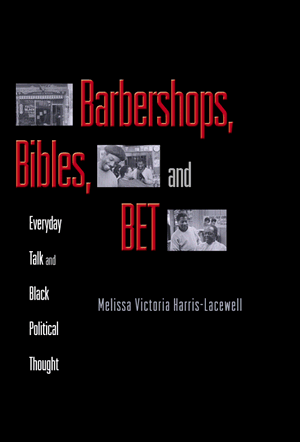
And this speaks to another problem with Walton’s Watch This. It is fundamentally a book evaluating these televangelists. It is not a book about why everyday people – men and women all over the country and world – find their teachings compelling, so compelling that they buy their books, watch their television shows, attend their conferences, and get glad when they succeed. For more on the everyday viewer, one would need to turn to Melissa Victoria Harris-Lacewell’s fantastic Barbershops, Bibles, and BET: Everyday Talk and Black Political Thought. If Walton had spent more time with everyday viewers and consumers, he may have found different resources than financial ones being accumulated through the material aesthetics of these televangelists.
If you know Professor Walton, then you would know these are the kinds of debates he tackles and loves. He’s the kind of professor who wants to struggle with the highest of intellectual thought and the depth of everyday culture. He endeavors to be a public intellectual whose ideas can be intelligible to those who walk within the ivory tower, kneel within their sanctuaries, and stomp along the gridiron (if you can’t tell, I’m already pining for football season!) Professor Walton, enjoy the East coast. The West will certainly miss your presence, but will continue to read your blog entries, watch your television interviews, and wait for that next great book.
I was browsing around the TBN website when I came across a Christian documentary on Robert E. Lee and Stonewall Jackson. Called Warriors of Honor, the film speaks "plainly about the Christian faith of Jackson and Lee," says pastor, author, and homeschooling kingpin Steve Wilkins. "It is a beautiful and accurate account of two great Southern leaders and of a war that forever changed our country." (See the Southern Poverty Law Center for more on Wilkins.) The site for the film proclaims: "Both [Lee and Jackson] were masterful generals, brilliant strategists and, above all, faithful Christians. The faith of these 'Warriors of Honor' governed their lives on and off the battlefield, and their legacies continue even today. 'God's will ought to be our aim, and I am contented that His designs should be accomplished and not my own.' - General Robert E. Lee."
It seems that Newsweek's on a roll this week for Mormon coverage. In a previous post today, Art highlighted the article on Short Creek and its law enforcement legacy. Another article, "America's Next Top Mormon," trumpeted the prominence of Mormons on television. (They are everywhere! American Idol! Dancing With the Stars!) The author, Sally Atkinson, sees a surge of Mormon contestants on reality television as signal of LDS's growing (pop) cultural dominance. While I am not convinced by her thesis, I am intrigued by her reaction to Mormons invading our precious reality T.V. programs. Does this (gulp) mean Americans want wholesome, religious competitors on shows like Rock of Love or Big Brother? The wholesomeness (no rated "R" movies!) is part of where Atkinson thinks the appeal lies. Atkinson writes:
Wholesome, likable Mormon competitors are now so plentiful that some viewers have taken to playing Spot the Mormon. Former "Idol" contestant Carmen Rasmusen, herself a Mormon, says one of this season's early episodes set off her Mormon radar when she heard White tell the judges she'd never seen an R-rated movie. "My husband and I just looked at each other and said, 'She's totally Mormon.' I mean, who else would say something like that?" With all the conniving, back-stabbing and sexuality on reality TV, it may seem like a strange place for Mormons to congregate. That cultural disconnect is obviously part of the attraction for viewers and casting directors alike. Take the strange spectacle last month of a beautiful young Mormon woman— the "Idaho virgin," as she came to be known—sucking the toes of the eligible bachelor on MTV's racy "That's Amore." Or the contestant on this year's "America's Next Top Model" who said maybe her elimination was for the best, as she would have been uncomfortable doing a nude shoot. But for Mormon contestants themselves the motivation is more complex, whether it's testing the limits of their religion, showing America that Mormons aren't the insular community they're often perceived to be, or the one that crosses all denominations: the hunger for fame.
In reality TV terms, the Church of Jesus Christ of Latter-day Saints is in a sweet spot demographically: still small enough that members get excited to see one of their own in the spotlight, but large enough that when they watch together and vote they can affect results and ratings. Mormons reserve Monday nights for Family Home Evening, and when Marie Osmond competed on the family-friendly "Dancing With the Stars" last year, she benefited from having the voting fall on a Monday each week. In fact, all three Mormon contestants made it to the final four that season.
While "Idol"'s voting night is Tuesday, some Mormons around the country still get together for viewing parties and pour in the votes after each show. "Idol"'s producers won't disclose voting numbers, but Rasmusen says producer Ken Warwick once stopped her before a results show and told her she usually did pretty well in the East Coast voting but that her "numbers just soared" when the mountain states kicked in. "I was so happy to hear that people were voting like crazy and supporting me," she says. "Utah does a great job rallying around its people." Lauren Faber, an eighth-grader in Provo, votes for Archuleta as many times as she can each week for at least 20 minutes, "no matter what—even when he messed up that once." That will undoubtedly be music to Archuleta's ears, although last week Osmond spoke out in the church-owned Deseret News, saying that White and Archuleta should be judged based on their talent, not their religion. "I mean, you don't hear other people saying, 'One of the finalists is a Catholic' or 'One of them is a Presbyterian' or 'One of them is Jewish'."
But Mormons don't do well only on shows where the audience votes. "There must be something about the Mormon community that makes these people so self-confident and so open," says Lynne Spillman, a casting director for "Survivor" and "The Amazing Race." She thinks that coming from a large family probably helps in a game like "Survivor," with its complicated group dynamics mirroring sibling rivalries. "They also have these incredible experiences through their missions," she says, "and can relate to being dropped off in the middle of somewhere they've never been and having to make it."
I am curious to what our readers and contributors think about this piece. It strikes me as exoticizing Mormons by pointing out their (gasp) normality (Katie argues "charmed observance" can sometimes function for naughty purposes in this post). Am I hyper-sensitive because of the FLDS media coverage (more on that to come) or my tendency to look for the nefarious because my own research? Or is there something else going on in the need to document the Mormon presence on all these shows? Are Mormons becoming mainstream, at least in pop culture, as Atkinson seems to suggest? I am just not sure, but now, I will be on the lookout for the religious commitment of my favorite reality T.V. show "stars." Perhaps, Rock of Love will add a lovely Mormon to the cast, but for some reason, I doubt it.
BY KATHRYN LOFTON and the Burnt-Over District sisterhood
As a special end-of-the-semester treat, As The World Turns has finally given its viewers the demanded embrace between Noah and Luke. For those worried about super-delegates and electoral tallies, this is a story that gives hope again to the democratization of Christianity. Through Hershey kiss campaigns, online petitions, and wails to Proctor and Gamble, celebrants of on-screen love got the goods. Now the struggle will be that age-old drama: how to keep it hot. Fans of Moonlighting wish them well.
How often do we get a clamor for more, not less? In the world of soap opera sex, requests for sensual expression have always wobbled between romantic desire and daytime discretion. Intimacy during casserole prep is best capped a little pawing, maybe a fade to candlelight close-up.As the decades have droned on (drone indeed, since soap operas function about five years back in fashion, and ten years earlier in social stylistic), more appendages have been exposed, but still: it’s a lot more fantasy talk more than fantasy action.
Over the last month, however, new worlds of dreaming have entered daytime possibility.I speak of the clamor for more love (not less) between Luke Snyder and Noah Mayer, a love match spotlighted in As The World Turns. Since they officially united in September, the couple hasn’t kissed once on-screen, not even after a Christmas declaration of love (which included a climactic cutaway to mistletoe) or a Valentine’s Day ATWT couples round-up (in which everyone saw smooch save Luke and Noah, who hugged it out).Angry viewers began a kissing campaign, demanding more love action from this too-talky tale.The fans have constructed a large letter-writing campaign, posted an online petition, and developed a web site that counts the days, hours, minutes and seconds since last lip lock.
Any talk of homosexuality in this country necessarily turns to thoughts of religion, but in this case, we don’t have to press to any moral abstraction to find talk of God. ATWT makes it easy on us, as this particular opera is owned by one very special soap: Procter & Gamble Productions Inc.CBS executives consult on the series, but the creative direction is set by P&G, makers of (among other cleansing products) Ivory soap.Nearly 129 years ago, Harley Proctor sat in a little Episcopal church in Cincinnati, listening to the Anglican lesson.It was from thee forty-fifth Psalm: “All thy garments smell of myrrh and aloes and cassia out of ivory palaces whereby they have made thee glad.” The Biblically-inspired Ivory suds propagated not only cleanliness, but also holiness: a color and a principle tied up in a new wave of national sale. Through a simultaneous invocation of scientific discourses (ads described Ivory as “99 and 44/100 per cent pure”) and moral imaginaries, Proctor and Gamble brought soap to the people. “Who wants pure soap?” asked one ad, “Pretty nearly everybody.Why do they want it?Because it’s pure.”
From the first ad for Ivory (published in December 1882 in a Christian weekly, The Independent) till today, P&G has meant more than quick clean. It has offered a baptism-by-product, a wash of sacred cleanliness. “Americans are the apostles of personal cleanliness,” explained the Cleanliness Journal, funded in part by P&G, “Ours is primarily a character building, Americanizing enterprise for all people and we continue strong in our belief that cleanliness is akin to godliness.” Today, the godliness suggested is a contested one, tugging between a culture in love with clean (boy kisses are impure kisses) and a culture infatuated with green (ATWT is one of the few soaps continuing to profit in an era of declining daytime ratings). “It’s always hard to please a diverse audience,” explained P&G’s PR rep, “and we have a diverse audience.” Which side will win? Harley’s prim Protestantism or Luke and Noah’s most profitable, if dangerously impious, lust? Fortunately for P&G, there is a precedent: their early ads sold nothing so happily as white male-on-male flesh.Christianity is indeed a confusing sexual arbiter.
I've been flipping through an introductory text in American religious history that might interest some of you: Lynn Bridgers, The American Religious Experience: A Concise History(Rowman and Littlefield, 2006). Rowman and Littlefield have been doing a number of short, introductory texts in American religious history, which we'll feature here from time to time (including one on religion and the Civil War, Both Prayed to the Same God). It could work for some of you who teach American religious history as advanced high school AP courses or lower-division undergraduates. It's short, leaving plenty of room for supplementary readings that students usually like better anyway. The author divides the material up into chapters that follow particular religious traditions.
P.S.: I gave myself a Christmas present of ordering and watching Season 4 of The Wire. So I'll re-recommend Darren's post on The Wire, from last summer, a mini-essay worthy of this riveting series.
I’ve been thinking quite a bit about the ministry of John Hagee since I wrote about him a little in the last chapter of my book on southern pentecostalism. The megachurch pastor, Christian Zionist, pentecostal self-help guru, and best-selling author of end-time camp classics may or may not be a force to be reckoned with. But judging from the attention he’s getting in the press he is a powerful figure of the Chrsitian right. Nearly two years ago Hagee and 400 other conservative religious leaders organized Christians United For Israel (CUFI). That organization sums up one of its goals on its website: “While millions of Evangelical Christians support Israel , there are millions more who do not. It is crucial to educate Christians on the Biblical and moral imperatives of supporting Israel.” Hagee’s harangues against Iran and his call for a preemptive strike against that country have been raising eyebrows in the media for some time now.
Bill Moyers recently featured the Texas preacher on his Journal. Evangelical theologian Ron Sider and M.J. Rosenberg, Director of Policy Analysis for Israel Policy Forum, provided interesting counterpoints. Rapture-ready, Hagee has staked his political and religious fortunes on a militant Israel. Whenever I’ve heard Hagee on NPR, I can almost imagine listeners dropping their tote bags in horror. I thought I heard a collective shriek as Boston’s PBS viewers were treated to the minister’s fury:
Let us shout it from the housetops that a new day has been born in America. The sleeping giant of Christian Zionism has awakened. If a line has to be drawn, draw the line around Christians and Jews. We are united. We are indivisible. And together we can reshape history.
And, worse yet:
JOHN HAGEE, SEPTEMBER 18, 2005: I want to ask Washington a question. Is there a connection between the 9,000 Jewish refugees being forcibly removed from their homes in the Gaza Strip now living in tents and the thousands of Americans who have been expelled from their homes by this tremendous work of nature [Hurricane Katrina]? Is there a connection there? If you've got a better answer, I'd like to hear it.
Mick Huckabee is slated to speak at Hagee’s 18,000-member Cornerstone Church on December 23. What will the former Arkansas Governor and Baptist minister say? Has the flap over his comment on Mormonism chastened him somewhat? The press would certainly have a field day if Huckabee ventured into premillennial eschatology or waxed on the place of Israel in the last days. That would be a rhetorical a-bomb and a public relations nightmare for Huckabee’s handlers. Unlikely, though. Yet this appearance reminded me of the damage that can be done to a campaign by hard-right associations. Think George Bush at Bob Jones U.
Weird -- I've just been writing a short piece for the Wall Street Journal's "Houses of Worship" column on the Gospel Music Channel (more on that article in a future post), which is (according to their publicity materials) the first 24-7 advertiser-supported cable channel devoted to "uplifting and inspiring Christian music." "Rock, Pop, Country, Soul. It's all Gospel," the station's slogan goes. Unlike any radio station I know, the GMC broadcasts artists as diverse as Ricky Skaggs, Jars of Clay, Yolanda Adams, and Kirk Franklin, as well as a variety of gospel rappers that I've never heard of.
The station's founder is Charley Humbard, son of Rex Humbard, who passed away yesterday just as I was in the midst of working on this piece. Rex Humbard pioneered televison evangelism, and eschewed politics as assiduously as electronic evangelists today gravitate towards it. One may contrast the life and work, for example, of the recently deceased James Kennedy (discussed below, scroll down), the theocrat, with Humbard, who said "I hate for politics to get into religion, and religion to get into politics."
As part of the publicity materials for the Gospel Music Channel, I got a wonderful stuffed icon I dubbed Thelonious the Gospel Lamb, complete with choir robe and cross. By pressing on his hoof, the fuzzy creature springs into action and song, with Kirk Franklin's voice shouting "put your hands together, let's have a Holy Ghost Party," as a gospel chorus backs him up and he waves his arms in spirit-filled style. Rex Humbard was painfully square, more Lawrence Welk than Jimmy Swaggart, but Elvis Presley was one of his biggest fans, so he couldn't have been too bad. I hope The King makes an appearance on the GMC as well, even if only during "classic gospel" broadcasts. And Thelonious is righteous!