Tampilkan postingan dengan label popular religion. Tampilkan semua postingan

Rabu, 25 Mei 2011

How Oprah Became a Messiah: Prophet and Profit

Paul Harvey

As Oprah departs, to much media coverage, let us turn once more to our contributor Kathryn Lofton for a summing up of "What is Oprah"?

K. Lofton's book Oprah: Gospel of an Icon, has engendered a lengthy, multi-part, fascinating set of responses from numerous other scholars at Immanent Frame, and on the occasion of Oprah's departure from the network airwaves, Lofton's reflections on her career and meaning in the context of American religious history can be found at CNN Belief Blog, in the Los Angeles Times, in the New York Daily News, and in the Washington Post. Over at Killing the Buddha, Nathan Schneider also provides these links as well as a link to his own interview with Lofton, and gives his own thoughts, here.

Perhaps the easiest place to connect in to all this discussion is at the piece at the CNN Belief Blog, where our valued colleague writes:

As she departs from her ritual slot, there will be a vacuum for some. Yet if history has taught us anything, it is that the void will not be left gaping for long. “The false messiah is as old as the hope for the true Messiah,” wrote Jewish theologian Franz Rosenzweig. “He is the changing form of this changeless hope.”

Oprah represented humanity’s ceaseless interest in spiritual responses to personal problems. We now live in her world: one of first-person confessions, required makeovers, and spiritual consumption.

The measure of her consequence will be not in whether or not she mattered to you, but whether the world you occupy looks more like hers than you know.

Senin, 23 Mei 2011

Women, Vatican II, and the Remaking of American Catholicism


I'm very happy today to post this guest contribution from Julie Ingersoll, well known for her contributions to Religion Dispatches, where lately she's been following the doings of Christian Reconstructionists and Tea Party Patriots (and the connection between the two). Julie is the author of Evangelical Christian Women: War Stories in the Gender Battles, and is currently writing a book on Christian Reconstructionism.

But today's post is about something very different. Below, Julie gives some thoughts on Colleen McDannell's new book The Spirit of Vatican II: A History of Catholic Reform in America. Colleen will be well known to many blog readers here for previous works such as Material Christianity: Religion and Popular Culture in America, and Picturing Faith: Photography and the Great Depression. Colleen's new book is both an academic as well as a very personal reflection on the role of Vatican II in the lives of American Catholics. Also, for some other reflections on the book (and interviews with the author), see here, here, and (from the Salt Lake Tribune paper) here. A bit down the road on the blog, our contributor Kathleen Sprows Cummings will give us her thoughts on the book as well, but for now, thanks to Julie for these reflections.
_______________________________________________________

Women, Vatican II and the remaking of American Catholicism
by Julie Ingersoll

“Where are the people?”

That’s the question historian Colleen McDannell always asks. In her new book, The Spirit of Vatican II: A History of Catholic Reform in America, (Basic Books, 2011) she gives us a distinctly new view of those reforms to America’s largest denomination. Part institutional history, part social history, part family memoir—and in places strikingly funny-- McDannell’s story has a very special person at its center: her mom, Margaret.

Instead of a traditional “church history” that explores the history of doctrine and the conflicts and negotiations among church leaders --all of them male—McDannell traces the impact of Vatican II on the people in the pews. This shift in focus gives us a glimpse into the religious lives of laypeople, especially women.

McDannell begins with the daily life of Catholics under Vatican I with Margaret’s immigrant grandmother who came to the U.S. in the late 1800s. Margaret herself grew up during the rise of the parochial school system intended to keep Catholic children separated from Protestantism. The practice of Catholicism was formal and stiff; ordained men were in charge and laypeople rarely questioned them. The Mass was said on behalf of the people, in Latin, by a priest with his back to the congregation.

Women’s roles were so limited they were even prohibited from participation in the choir that sang during mass. Of course, no women were part of the Vatican Council’s deliberations (toward the end some women were permitted to listen). McDannell writes:

None of the reporters who covered the opening of the Council noted the irony of the crowd of over two thousand men dressed in lace and silk solemnly striding into St. Peter’s on the feast day of the Maternity of the Virgin Mary without being accompanied by a single woman.

Vatican II brought an emphasis on lay leadership; the priest now faces the congregation; the Mass, in the US, is said in English. Women serve as lay leaders and the roles permitted to lay leaders, whether male or female, are greatly expanded. Traditional hymns are now often replaced with contemporary music and church architecture represents these changes materially.

With this shift in authority toward laypeople, Vatican II empowered women and created in them a sense of the significance of their own voices in terms of parish life, religious practice, and even political issues. While remaining conservative, Margaret’s views on issues like the anti war movement and the civil rights movement were tempered by her church life. Catholics came to see themselves, as McDannell describes them, as “deciding people” even on official church positions on issues such as birth control:

“As father Bill was finishing up Mass with a list of announcements, he looked out at his uncomfortable flock. “Well…regarding…and then came a pause and a big smile; “Big Daddy says no!”

Nancy (one of McDannells’ interviewees) never forgot the moment. “The place roared and everyone clapped and laughed,” she reported. Pope John Paul VI had just announced that artificial birth control would remain off limits. “that was the sign of the times,” Nancy observed, that so few at St. Jude’s took the pontiff’s conclusion seriously that day.”

This is a great book on the impact of Vatican II in the daily lives of American Catholics’ as well as changes in the Catholic influence on American culture and politics (there’s so much more than what I can include here).

McDannell also raises important questions about what counts as “religion.” We often privilege the ideas of leaders without even realizing that those make up the religion of only a few. And religious leaders are all too happy for us to consider them the sole authorities on what counts in their traditions. But, in de-centering religion to examine the cultures, practices and material dimensions, McDannell gives a much more complete picture—a picture that includes real life Catholicism.

Rabu, 18 Mei 2011

Witchcraft in Early North America

Paul Harvey

Some of you may be looking for a good classroom resource for teaching about popular religion or witchcraft in early America. If so, this might be the book for you, so I'll reprint the Choice review below of Alison Games, Witchcraft in Early North America, put out as a pretty short classroom-usable volume by Rowman & Littlefield in their "American Controversies" series, edited by excellent historian Douglas Egerton. These volumes come with primary document selections, chronologies, and other pedagogical helps. (I have a volume coming out in late summer or so in the Rowman & Littlefield African American History series, entitled Through the Storm, Through the Night: A History of African American Christianity -- more on that as the pub. date gets closer, but the experience of the close editing of that book, with an eye towards readability for a general non-expert audience, gives me confidence in these other volumes that R & L is putting out).

Anyway, here's more on this volume, and check the book's website here for table of contents and more info. What particularly attracts me here is the clear effort to provide a broader context for popular religious beliefs in the supernatural throughout 17th century America, and including Natives and African peoples as well as British North Americans. In other words, this isn't your father's Buick, the usual Salem-centric story of witchcraft in the colonies.
________________________________________

Games, Alison. Witchcraft in early North America. Rowman & Littlefield, 2010. 216p index afp; ISBN 9781442203570, $36.95. Reviewed in 2011jun CHOICE. Games (history, Georgetown Univ.) makes a vital contribution to the pedagogical resources on early American witchcraft. With its introductory essay and interdependent collection of primary materials, the book demonstrates how accusations of witchcraft mediated colonial encounters between mutually illegible cultures: characterized by flagrant "coercion and cruelty," such conflicts demanded justification and frequently provoked resistance, and therefore lent themselves to prevailing supernatural explanations and persecution. Games's historical introduction broadens the scope of witchcraft study beyond New England to incorporate less familiar outbreaks in New France and New Spain. The author traces as well the conflicting beliefs European, Native, and African peoples brought to these encounters. A modest selection of Salem materials are among the 29 brief primary documents, which include legal documents, reports of first encounters, and possession narratives from across the continent. Games's premise is that the historical record tells the story slant; accordingly, this volume represents a necessary and ethical, albeit brief, attempt to counter the Anglo-centrism that has characterized witchcraft historiography. The author resituates episodes of witchcraft in the context of cultural contact and conflict in which they occurred, incorporating them into larger scholarly trends in the study of early America as a space of contact zones. Summing Up: Recommended. All readers. -- A. T. Hale, University of Puget Sound

Sabtu, 11 Desember 2010

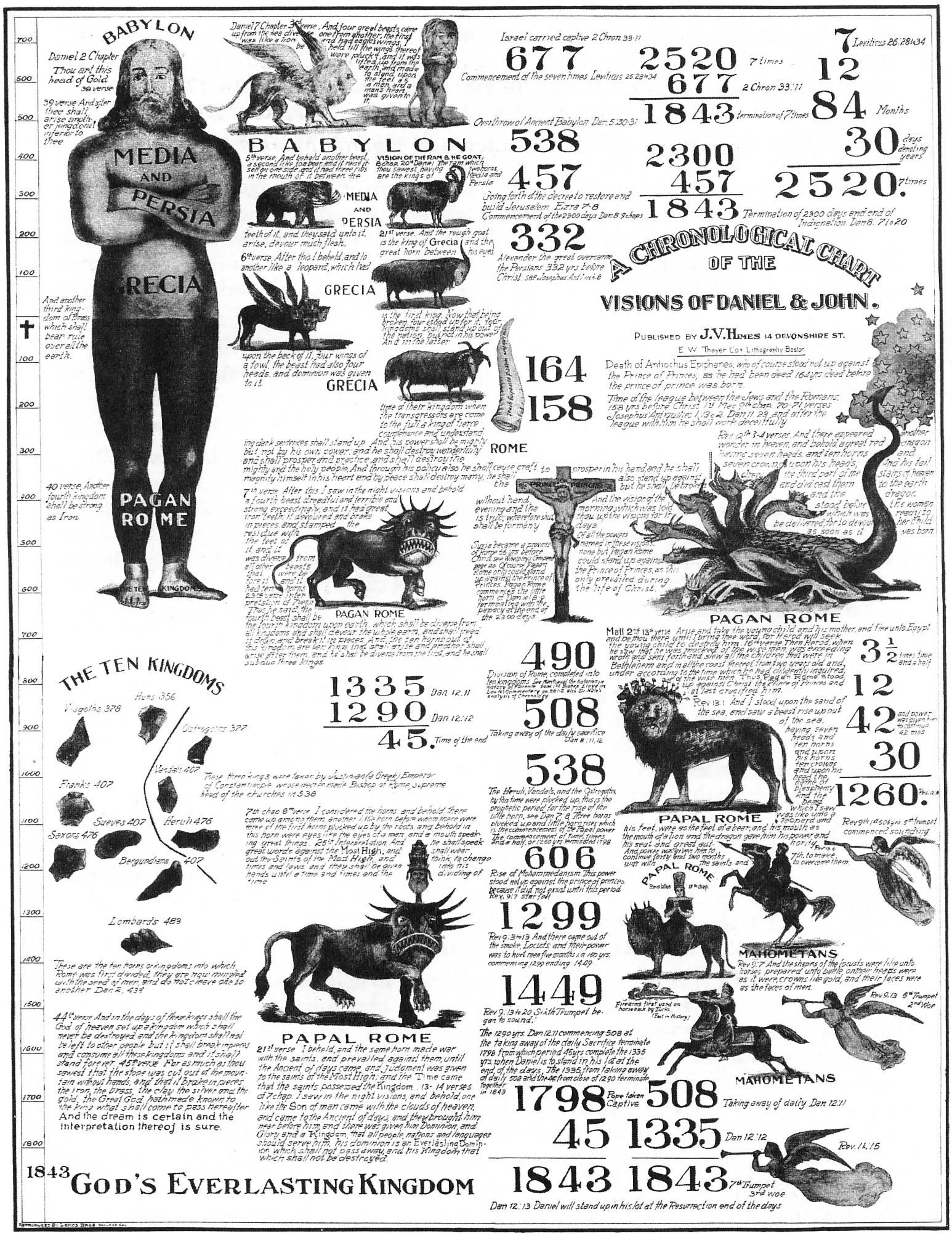
Premillennialists and Their Charts

Randall Stephens

It's hard to narrate the history of millennialism to a general audience without losing the plot in a thicket of obscure Bible verses, dispensational disorientation, and premill fatigue. Sure, there's a rage to explain. But how many paragraphs should a historian of American millennialism devote to "Armageddon," "tribulation," "Gog," "Magog," "Mark of the Beast"? (Paul Boyer navigated this well in his classic When Time Shall Be No More. That's a wonderful guide.)

What better illustration of the Babel of premill confusion than the charts, diagrams, and cartoons premill experts used. The gleeful focus on minutiae, sidetracks, and the like dominates so much premill writing from the 19th and 20th centuries. It must not have been too difficult for a superfan of Star Trek to have turned his/her attention to the second advent in the 1970s or 80s.

So, I paste here some of my favorite confusing charts and illustrations. Try explaining any one of these to a room full of the uninitiated. It would be easier to wax eloquent about the distinguishing characteristics of the Klingons, Romulans, Ferengi, Vulcans, and Cardassians.

From William E. Blackstone's wildly popular Jesus Is Coming (1878). Degree of difficulty: 6 out of 10.


Click to enlarge this iconic Millerite poster from 1843, which deciphers prophetic math from Daniel and Revelation. Would like to see a black light version of it. Degree of difficulty: 9 out of 10.


From Isaac Cummings Wellcome, History of the Second Advent Message and Mission, Doctrine and People (1874). Degree of difficulty: 7 out of 10.


And finally, this one from a copy I picked up back in seminary days, Clarence Larkin, The Dispensational Truth: God's Plan and Purpose in the Ages (1920). This handsome text has some real mind-blowing charts in it. Degree of difficulty: 8 out of 10.


Senin, 08 November 2010

Country Music Minus the Culture Wars

Paul Harvey

My piece reflecting on Ricky Skaggs' new recording Mosaic, and more generally on white southern country music's relationship with politics, is just up at Religion Dispatches. (For those interested, here is Ken Tucker's review of the record, from Fresh Air).

A brief excerpt of my piece is below, and then read the rest here:

On his newest record, Mosaic, Skaggs has taken a step back into themes familiar in the religious history of the South, and away from the culture wars. As the opening epigraph suggests, he hasn’t gone soft on his religious belief, and the apocalyptic message drawn from the book of Elijah on Mosaic suggests that premillennial imagery still exerts a hold.

But the message is fundamentally personal, not political. And that’s a good thing.

. . . {T]he more recent culture wars tie between country, religious fundamentalism, and a Tea Party civil religion is an invented tradition. Historically, it lacks any deep roots in the white Southern tradition of musical expression. . . . Historically, Southern music at its best—the bluesmen, the Carter family, Charlie Poole, and the corpus of the old, weird America—simply could not be tied down to any particular political message or program. This music was about a world beyond one’s control. Its occasional bromides or homilies were not nearly as convincing as its unforgettable portrayals of the darker difficulties of survival in a harsh and uncertain world.

Minggu, 15 Agustus 2010

Black Preaching and African-American History

Randall Stephens

Listen to Sunday's All Things Considered (NPR) for a feature on black preaching from the 18th century to the present. Guy Raz speaks with Martha Simmons about her new edited volume, Preaching with Sacred Fire. The story includes audio clips of 20th-century sermons and some insight on how black preaching through the centuries opens a window onto the African-American experience.

For African-Americans, social movements tend to start in the pulpit. From slavery to civil rights to the election of the first African-American president, preachers have given sermons that moved black Americans to tears and to action. >>>

See also,

Edward Macknight Brawley, ed, The Negro Baptist Pulpit: A Collection of Sermons and Papers . . . (Philadelphia, 1890).

"Reminiscence of a Negro Preacher," Georgia Writer's Project, Library of Congress, November 7, 1939.

"A Holiness Preacher," South Carolina Writer's Project, Library of Congress, January 20, 1939.

Elder Lightfoot Solomon Michaux & Congregation, YouTube, late 1930s(?)

T. D. Jakes, "How to Fight with the Devil," YouTube, 2007.

Martin Luther King, "But if Not," Ebenezer Baptist Church, Atlanta, November, 1967, Internet Archive.

Senin, 17 Agustus 2009

Healing Waters and Streams of Joy

John Turner

Sixty-four weeks on the NYT trade paperback bestseller list and counting (#3 last time I checked). Reason enough to catch up on popular evangelicalism during an end-of-the-summer vacation.

W. Paul Young's The Shack has generated -- by my inexact estimation -- more excitement and sales than any evangelical offering since Rick Warren's The Purpose-Driven Life. It must be fun to have five million copies of one's book in print.


While The Shack certainly affirms Warren's signature "It's not about you" opening, when it comes to the church Young inhabits a very different, anti-institutional stream of American evangelicalism. Young belongs to no church, and much of his first novel rails against the regulations, responsibilities, expectations, and judgments of church-based Christianity.

Last year, several prominent evangelicals, such as Albert Mohler of Southern Baptist Theological Seminary, publicly criticized The Shack's purported heresies: a strong suggestion of universal salvation, a thoroughly equal and relational Trinity, and his depiction of God the Father ("Papa") as female. Those interested in theological discussions can find ample opportunities elsewhere in the blogosphere.

Young's book unfolds in roughly two parts. First, he begins with a tight, compelling narrative about a man emotionally stunted at the hands of an abusive father (Mackenzie "Mack" Allen Philips) who then endures the kidnapping and murder of his beloved young daughter. Theodicy, in a nutshell, the timeless question. Second, Mack travels to the scene of his daughter's murder (a shack with the bloodstains still visible) and meets God, an embodied, loving, and relational Trinity.

As a scholar of evangelicalism, it's hard to simply enjoy popular evangelical fiction (frankly, this is probably difficult for a large chunk of humanity). Moreover, The Shack generates obvious objections. The encounter with God often devolves into overly didactic theological lessons which interrupt almost any sense of narrative. Young's answer to the problem of evil is hardly original -- that God is working through human events for the ultimate good. Mack grows spiritually, and plays a role in the divine economy of redemption, by forgiving both his abusive father and his daughter's killer.

Those objections aside, The Shack is nevertheless hard to set aside. Young's imaginative portrayal of the Trinity is engaging, and his anti-institutional presentation of God appeals to a generation of evangelicals yearning for a more authentic and relational Christianity.

The veneer of machismo that graced the Promise Keeper's movement created a false sense (in my view) that evangelical men were eager and domineering patriarchs (partly put to rest by Brad Wilcox's Soft Patriarchs). Mack's conversations with God lead to divine weeping, tears that are "healing waters and a stream of joy." Regardless of complementarian niceties, evangelicalism is not moving in a patriarchal direction.

Perhaps The Shack's success augurs a shift in the mentality of American evangelicals. The Left Behind series originated in the mid-point of the Clinton presidency, a particularly beleaguered moment for evangelicals. Its apocalyptic narrative eventually ended in triumph. Rick Warren is hardly a triumphant evangelical, though both his massive institution-building and last year's presidential forum suggest a confidence about the role of contemporary evangelicals. Young, ultimately, suggests a far more quiet and subversive role for Christian believers -- agents of reconciliation seeking to heal relationships in a broken world.

Kamis, 18 Juni 2009

Drop Me In the Water


Paul Harvey

Jim Linderman's new work Take Me to the Water: Immersion Baptism in Vintage Music and Photography, looks to be a classic for collectors of Americana, afficionados of photography, and lovers of earlier twentieth century music. It's published by Dust-to-Digital, which also produced what is for me the greatest compilation of American religious music ever, the 6 CD set Goodbye Babylon, and more recently has put out the 2nd volume of Art Rosenblum's Art of Field Recording

Take Me to the Water from Dust-to-Digital on Vimeo.

View a video of the newest work here. The writer Luc Sante is involved in this project as well.

Some blurbs and reviews, to pique your interest:

Featuring photographs Jim Linderman collected over a ten year period with a CD of historic early gospel songs and sermons from prominent collections compiled by Steven Lance Ledbetter. Essays by Jim Linderman, Luc Sante and comprehensive notes by Ledbetter. Dust-To-Digital is an Grammy winning reissue label.

"Instantly become(s) the definitive volume on the subject"-- Joey Lin Anonymous Works May 2009

"One is reminded of the commonality of the human experience...I can put it on any time and immediately feel a sense of renewal and relief"-- Other Music Newsletter May 2009

"Raw, unvarnished emotion...leaps out. Whatever your beliefs, you'd have to be made of ice yourself not to be moved by the spirit coursing through the images and music of Take Me to the Water."-- El Toro Weird at My School June 2009

"Just Wonderful...like you've stumbled upon a forgotten box of family photos hidden in a mildewed corner of the basement"-- Anne Kristoff The Southernist June 2009

"Gorgeous...collected over the years by Jim Linderman, a character who seems the perfect subject for a Harvey Pekar comic. Faith isn't a requisite for finding the power in either the visual or aural representations of this tradition. The transportive properties are immediate and lasting. ...Potent tokens of time and place."-- Derek Taylor Dusted Magazine June 2009


Here's what is on the CD that comes with the volume:

1. Baptize Me (Rev. J. M. Gates) 2. Denomination Blues part 1 (Washington Phillips) 3. John the Baptist (Rev. Moses Mason) 4. Bathe in That Beautiful Pool (Dock Walsh) 5. On My Way to Canaan’s Land (Carter Family) 6. Old Time Baptism part I (Rev. R. M. Massey) 7. Old Time Baptism part II (Rev. R. M. Massey) 8. Go Wash in the Beautiful Stream (Southern Wonders Quartet) 9. I’ll Be Washed (Carolina Tar Heels) 10. Wash You, Make You Clean (Elder J. E. Burch) 11. Baptist Shout (Frank Jenkins of Da Costa Woltz’s Southern Broadcasters) 12. At The River (Tennessee Mountaineers) 13. Wade in de Water (Empire Jubilee Quartet) 14. Baptism at Burning Bush (Rev. Nathan Smith's Burning Bush Sunday School Pupils) 15. Sister Lucy Lee (Bill Boyd and His Cowboy Ramblers) 16. Wade in the Water and Be Baptized (Belmont Silvertone Jubilee Singers) 17. I’m Going Down to Jordan (Ernest Thompson) 18. Go Wash in Jordan Seven Times (Rev. J. C. Burnett) 19. Wade in the Water (Birmingham Jubilee Singers) 20. Goin’ Down to the River of Jordan (J. E. Mainer’s Mountaineers) 21. Baptism by Water, and Baptism by the Holy Ghost (Elder J. E. Burch) 22. Go Wash in the Beautiful Stream (Moses Mason) 23. Wade in the Water (Sunset Four Jubilee Singers) 24. Down To Jordan (Ernest Stoneman's Dixie Mountaineers) 25. Take Me to the Water (Rev. E. D. Campbell)

Jumat, 27 Maret 2009

From Saint Dog to Saint Death

Art Remillard

It was an early 13th century spiritual contest that the Dominican Stephen of Bourbon just couldn't win. While ministering to people of the French countryside, Stephen heard stories about Saint Guinefort. His investigation revealed that the infamous holy person was actually a dog--a greyhound to be precise. According to the legend, Guinefort, who belonged to nobility, saved an infant from a dangerous approaching serpent. The lord and lady, who were absent during the conflict, arrived at the bloody scene and assumed that the dog had killed the child. In response, the lord killed Guinefort, but then discovered that the child was alive. So the negligent parents who left their infant with a dog were also impulsive. That kid's future had therapy written all over it. But the dog was destined for sainthood, in the popular imagination at least.

The shrine to Saint Guinefort was just north of Lyons. In Stephen's time, it was an oft-visited pilgrimage site for women with sick children. Here, mothers petitioned the "holy greyhound" to remove demonic forces from their offspring. For Stephen of Bourbon, however, the only devilish forces were found in the dog. The women were improperly worshiping an idol, he resolved, and any perceived good happening there was an "illusion of the Devil." So the shrine became a location for spiritual competition. And at first blush, Stephen had won. He had the site destroyed and criminalized all future devotions to the greyhound. Still, under the cover of darkness, women continued visiting the site for centuries after. The dog-saint had a tenacious hold on the popular imagination, which no official act or admonition could disrupt.

Of course, these sorts of competitions between clergy and laity still exist. Consider the 2007 documentary Saint Death. The description reads:
In Mexico there is a cult that is rapidly growing--the cult of Saint Death. This female grim reaper, considered a saint by followers but Satanic by the Catholic Church, is worshipped by people whose lives are filled with danger and/or violence-criminals, gang members, transvestites, sick people, drug addicts, and families living in rough neighborhoods. "La Santa Muerte" examines the origins of the cult and takes us on a tour of the altars, jails, and neighborhoods in Mexico where the saint's most devoted followers can be found.

Connections with drugs and violence has prompted Mexican officials to order the destruction of 35 Saint Death statues. Perhaps this was an attempt to cut out the divine lifeline of organized crime. Or perhaps it was a state-sponsored act of idol destruction, motivated by the Catholic Church's opposition to the cult. Either way, I suspect that Saint Death isn't going anywhere. Much like Saint Guinefort, Saint Death represents a creative human response to misfortune and difficulty that will likely retain its significance for quite some time.


Minggu, 12 Oktober 2008

Celebrating the "Cosmic Breed"

Art Remillard
At the dawn of the seventh century, Gregory the Great exhorted missionary monk to "baptize" the pagan customs of the countryside. Destroy the idols, he advised, but leave the temples. This sort of symbolic assimilation has continued to influence Christian religious practices. Believers appropriate potentially objectionable items and refashion them to their own liking. Consider how Latin Americans seem to have baptized Columbus Day. On his Washington Post blog, “Catholic America,” Anthony M. Stevens-Arroyo explains…

Columbus Day is now "contested" - as current terminology would have it. Some
view with joy the anniversary of the navigator's historic landing in part of the
Bahamas. Others see October 12 as a day to mark the beginning of oppression,
enslavement and genocide. Both sides claim Catholic America as their
home….

I rest with the Latin American version of Columbus Day: Día de la Raza. We celebrate not so much the event as its result:-- a "new breed" within the human family. ("Raza" doesn't mean "race" in quite the same way as in English.) Whatever Columbus' intentions or mistakes, Latin America under Spain began to tolerate, legalize and eventually encourage racial intermarriage. Centuries later, the Mexican philosopher, José Vasconcelos, described us as "La Raza Cósmica" (The Cosmic Breed), because we have virtually all of the world's skin colors in our demographic rainbow: white, black, red and yellow.

Racial mixture is what we Latinos and Latinas celebrate on October 12th. As the Puerto Rican patriot Pedro Albizu Campos proclaimed, there is a distinctive Catholic pride in this holiday. Unlike so much of Protestant North America where racial mixing was looked down upon, Catholic Latin America officially recognized the equality of races at the dawn of modern history. I am happy to celebrate Columbus Day by thanking God for my Puerto Rican-Italian nephews and nieces. Let's make October 12 a day for the living, not for the dead.

Senin, 22 September 2008

From Mounds to Megachurches

Paul Harvey


Since I'm in the South today, here's an appropriately southern-themed blog entry, on a new work from the University of Georgia Press, From Mounds to Megachurches. In this short work, centered on Georgia, David Williams take us through the remarkably diverse history of religious practices, institutions, and groups in the Peach State. The book reminds me of Walter Conser's recent work A Coat of Many Colors: Religion and Society Along the Cape Fear River of North Carolina, in the sense of taking the largest themes of southern religious history and following them in a very specific locales over a broad expanse of time. The result is a picture of religion in the region that is at once more diverse and expansive, and at the same time more dependent on place and locale, than we get from stories (including my own work) that feature the evangelical synthesis as the defining principle of southern religious history. Good stuff from good senior scholars deeply immersed in the histories of their own regions. Here's a description from the UGA webpage for the work.


From Mounds to Megachurches: Georgia's Religious Heritage, by David S. Williams

In From Mounds to Megachurches David S. Williams offers a sweeping overview of the role religion has played in Georgia's history, from precolonial days to the modern era.

Williams shows that colonial Georgia was a remarkably diverse place, populated by mainline colonial congregations that included Anglicans, Roman Catholics, German- and Spanish-speaking Jews, Salzburg Lutherans, and Scottish Presbyterians. It wasn't until much later that evangelicalism triumphed and Baptists became the overwhelmingly dominant denomination. Williams uses the stories of such important figures as Tomochichi, John Wesley, Jesse Mercer, Henry McNeal Turner, Lillian Smith, Martin Luther King Jr., and Clarence Jordan to portray larger historical narratives and denominational battles.
Race and religion were intertwined not only in such key movements as abolition and civil rights but also throughout Georgia's history. "In order to fully grasp the religious heritage of Georgia," Williams says, "we must return again and again to racial matters." Recently, Georgians have seen racial, ethnic, and religious diversity grow as Muslim, Buddhist, Hindu, Sikh, Baha'i, and other communities have settled in the state. Williams explores how Georgians have dealt with contemporary issues of tolerance and how, at times, the state has taken center stage in our nation's culture wars.

Firmly rooting religious history in a social, cultural, and political context, Williams presents a representative and balanced account of Georgia's religious heritage. From Mounds to Megachurches sheds new light on what it means to be a Georgian by exploring an issue that remains central to life in the Sunbelt South.

David S. Williams is director of the Honors Program and Meigs Professor of Religion at the University of Georgia, where he has taught since 1989. He is the author of two previous books in religious studies.
October 2008

ISBN 0820331759 cloth • $26.95240 pp. • 6 x 9 in. • 16 b&w photos

"I know no other book that covers such a range of material, with such chronological sweep, in such short compass, for any southern state. Georgia and its citizens will be privileged to have such an accessible survey of their religious heritage available."—John Boles, William P. Hobby Professor of History, Rice University, and author of The Great Revival: Beginnings of the Bible Belt

"David Williams has written a masterful and remarkably concise synthesis of Georgia's religious odyssey. His title is no mere artifice of alliteration, for he does indeed take us from thousand-year old moundbuilders to modern megachurches, and from Moravians to Muslims as well, reminding us of a persistent strain of religious diversity while placing the emergence and evolution of a Protestant evangelical ethos at the center of Georgia's historical experience."—James C. Cobb, author of Away Down South: A History of Southern Identity

Jumat, 05 September 2008

Jesus and Plastic Guitars


Kelly Baker

Since most of America is debating the virtue or vice of McCain's vice-presidental pick, I suggest we delve into the realm of religious popular culture for a change of tune. Digital Praise has created a video game aptly titled Guitar Praise, a Christian version of Guitar Hero (though not associated with the brand). Now, folks who are offended by secular rock music can rock out, in a wholesome way, to songs by Relient K, dc talk, and Caedmons Call among others. One can groove with a plastic guitar and praise at the same time. Digital Praise wants to combine interactive media with effective worship.

This game is not unique considering there have been other Christian video games as well as Christian guilds in secular games, like World of Warcraft. But, it showcases a desire for Christian media that avoids the pitfalls of various non-Christian media, similar to the development of GodTube (see my previous post). What might be unique is that this game could be successful where other Christian games have failed to gain ground. Guitar Hero is a huge success because it fulfills the dreams of all who wanted to be rock stars by allowing one to be a star in your own living room. Guitar Praise will likely build upon this success with more spiritual aspirations, of course. Not surprisingly, Christian bloggers, churches, and ministries are excited about the game for kids. The gaming community, however, is not too thrilled, and various bloggers make easy fun of some of the game's religious aspects. Wired notes, "By tilting your guitars toward heaven you'll be able to send each other "surprises.' Hallejujah." Whether or not the game is scorned, I am betting it will be bought and played by those who want their gaming to match their Christian values.

Rabu, 20 Agustus 2008

Sweating for Jesus


Kelly Baker

Recently Newsweek documented a phenomenon that Sarah Ball entitled, "Working Out With Jesus." Folks can exercise while praising God, so they work on spiritual and material bodies at the same time:

When Dawn Harvey leans back on her elbows, legs outstretched, rapidly pedaling, she's not just toning her abs—she's kicking Satan in the head. And when she and her Camp Springs, Md., aerobics class of 12 women stretch their palms to the sky, pumping them upward in cadence, it's not just for their triceps' benefit—it's a come-hither to their celestial inheritance. "Don't think about the pain—think about how much you love him!" screams instructor Melanie Kelly, over organ-trilling gospel music. "Y'all better praise!" This is gospel aerobics, the answer to your prayers if you're feeling feeble in body or flimsy in soul. It's hymn-singing, shoulder-bobbing, one heck of a workout—and it's happening in a musty church basement near you.

This focus on nurturing the physical as a method to bolster the spiritual is nothing new, and Marie Griffith's Born Again Bodies (2004) aptly tackles the place of the body and fitness in American religious history. Griffith's work traces America's body obsession to its religious origins and uncovers how the corporeal functions as a medium to interpret the soul. For those who haven't read it, get this book. Griffith's cultural history of religion, dieting, and fitness demonstrates the centrality of the bodies to religious people and how they, sometimes painfully, molded themselves to fit a celestial ideal of comportment. Here's my review of Born Again Bodies from the now defunct American Religious Experience website (which has many terrific reviews and now directs folks to our blog):
Americans are body-obsessed, which is increasingly clear from the prominence of billboards, television ads, and magazines proclaiming the benefits of a multitude of diets. In her Born Again Bodies, R. Marie Griffith wants to get to the bottom of this body obsession in American culture and its relationship, if any, to American Christianity. Rather than argue that fitness somehow has spiritual connotations, Griffith explores the connection between body and spirit in religious history to see how this emphasis on fitness might have a religious history. What she uncovers is that religion has been central to the cultural creation of bodies in America. Both Protestantism and New Thought placed an emphasis on dieting and the importance of the flesh for portraying the spiritual. Griffith writes, "devotional dieters," from both New Thought and Protestantism, "deeply care about food intake and physical health because they sense that the able-bodies-those who restrain their bodily desires and seek some degree of health-may more easily establish familiar, loving relationships with the divine powers controlling the world" (5). In other words, the body becomes the mirror for the spirit.

Her work, thus, traces the importance of the body in American Christianity from Puritans to the Oneida Community to Shakers to Christian Scientists to Father Divine and the Peace Mission movement to Elijah Muhammed and Nation of Islam to evangelicals. In each of these groups, both food and sex are central to their religious thought and practice. The body becomes the "text," which can be read to analyze the state of the soul. The importance of restrictions on sex as well as particular body types emerge. Despite their different views on sexuality, Puritans, Oneida, and the Shakers all believed in the importance of bodily discipline, not just as act of moderation, but as evidence of the soul's power to curb "somatic functions" (57). Christian Scientists used the body as a mirror for the soul despite their anti-material approach to the world because illness manifested on the body suggested spiritual problems. For New Thought and many evangelicals, thinness signaled spiritual purity often because the sin of gluttony was avoided. On the other hand, Father Divine and the Peace Mission believed that fat signaled spiritual abundance because these people often lacked food. In the twentieth century, African American evangelicals would emphasis thinness for spiritual as well as physical health. The theologies of these religious groups and movements became evident on the bodies of believers. What Griffith uncovers is clearly something that American religious historians dance around or possibly ignore: the body is battle-worn territory in American Christianity. Religious groups place restrictions and expectations on bodies, and sin and salvation are approached in somatic terms.

Griffith, however, finds something more nefarious in the emphasis on believers' bodies. She argues persuasively that the emphasis on slimness also contains a racial categorization in which American and Protestant ideals of beauty and salvation are wed to thin white bodies. Christian diet writers have ignored the socioeconomic reasons for obesity as well as the racial implications. She writes, "The purity of the ethereal spirit, so celebrated in Christian theology and practice, has persistently been constructed against the filth of the corporeal body, an opposition upon which the categories of race (as well as those of gender) have been assembled" (234). Other bodies bear the weight of "sin" because of the American Protestant dualism between salvation and damnation, the difference between white and black. Fat bodies, then, have become the symbols of filth and sin. With this evidence, the focus of secular American culture on "perfect" bodies has developed from the emphasis on the body as referent for the soul. Fitness culture is not merely quasi-religious devotion, but has religious roots in the Protestant quest for born-again bodies. Griffith's work demonstrates that by focusing on the body in American Christianity, issues of gender and race fit easily into the narrative. Yet the third arm of the "holy trinity" of American studies, class, appears to be missing. Attention to class dynamics of the movement, I think, would have complicated issues of gender and race that Griffith examines. To give Griffith credit, she does mention issues of poverty in relation to the focus on the body as well as the expense of dieting. A focus on class would have brought to the foreground discussion of the relevance of Father Divine's impoverished background for understanding his approach to the body. His movement focused on the sacralization of fat because his followers often lacked food while Christian Scientists, generally middle to upper class, had the luxury of food as well as the luxury of dieting. Class, I think, as well as race and gender is implicated in issues of salvation because slimness comes at a high price. If dieting (thus, the ability to stay slim) requires money, then salvation is bound along class lines as well. To be poor also affected the bodies of believers. For Father Divine, fat had currency for those who go unfed. Slim or stout, bodies, and the salvation they signaled, were impacted by different class backgrounds.

Overall, this book is a delightful addition to American religious historiography because it presents the centrality of the body in American religious life as well as the importance of gendered and racial presentations of the body. The body becomes the ground for interpreting these religious groups and showing how similar their stances were rather than highlighting the already obvious differences. Her mastery of the history also serves as intriguing way to present American religious history to students or to reflect on this history myself. How different would a grand narrative of American religious history appear if corporeality was the starting point? Moreover, studies of the body allow for both the study of the theology of religious groups as well as lived praxis. Born Again Bodies proves to be an insightful study about the impact of the American religious scene on secular culture, the importance of somatic functions for salvation, and the problems that arise when salvation and damnation are wed to certain body types.

Minggu, 06 Juli 2008

Of Summer and Spiritual Staycations

By Phillip Luke Sinitiere

With four young, growing children and a dissertation to finish--in addition to high gas prices as well as other expenses, I'm all about staycations. According to Wikipedia, a staycation is "a period of time in which an individual or family stays at home and relaxes at home or takes day trips from their home to area attractions."

So, inspired by Kelly's recent thoughts about Roadside Religion and summer vacation, Randall's previous reflections on "religious travelouges", and Mike's post on traveling through New Orleans, I wondered what a spiritual staycation might look like in Houston.

With limited funds, half a tank of gas (although my car does have a/c, a nice comfort for sweltering gulf coast summers), and a stack of Mapquest directions, what religious sites could I tour in Houston to get a sense of the city's spiritual offerings? Where might I take a first-time visitor to see some of the landmarks of Houston's religious landscape?


One place I'd go is to the Rothko Chapel. Built in 1971, it is home to religious services, spiritual ceremonies, and showcases art as well as other local events. I'd then travel the short distance into downtown Houston, stopping at the Islamic Da'wah Center, once home to Houston National Bank and co-founded by former Houston Rockets basketball star Hakeem Olajuwon. While in downtown I'd swing by Christ Church Cathedral, an Episcopal congregation founded in 1839 and still very active. The last stops in downtown before heading out to see the spiritual life of suburban Houston would be the Co-Cathedral of the Sacred Heart, recently renovated and (re)dedicated, and consecrated by one of Houston's religious superstars Cardinal Daniel DiNardo, and St. John's Downtown Church, a vibrant justice-oriented (Methodist) congregation led by the tireless service of Rudy and Juanita Rasmus.

Heading out to the suburbs and braving the dense Houston traffic, I'd stop at all 3 locations of Dr. Ralph West's Church Without Walls, billed as "a church that is not restricted by geographical location or sociological background, but limitless in God’s possibilities. It also represents a church where anyone is welcome." I'd then spend some time at the massive Shri Swaminarayan Mandir, Houston's newest Hindu temple, and heading back toward the city stop at Masjid Al-Farooq Islamic Center, where I was once a guest at Friday prayer (or "khutbah").


Other highlights of a summer spiritual staycation would take me to Congregation Brith Shalom, where Hasidic hip-hop, reggae artist Matisyahu once performed, and all 5 locations of Houston's Second Baptist Church (one of the earliest "multi-site" churches). I'd end the staycation with a stop at Lakewood Church, reported to be the nation's largest and fastest growing church and home of rising religious superstar, the "smiling preacher" Joel Osteen--and Marcos Witt, pastor of Lakewood's Hispanic congregation and winner of 4 Latin Grammy awards.


There are of course many other places to visit in Houston, but this would perhaps be a good start.
If you went on a spiritual staycation in your city or town, what what would fill the pages of your "religious travelogue"?

Senin, 26 Mei 2008

Penitente Renaissance

I recently reviewed a rather unusual picture text on the Penitente Brotherhoods of northern New Mexico and Southern Colorado, for a local interest newsletter. It occurred to me the book's subject may be of interest to a wider audience. While this is a work of an enthusiast and caretaker of a tradition, not a scholarly book per se, the subject may interest some readers of this blog, and some of you may want to get this for your school libraries. Hope this is of interest to some --

Ruben E. Archuleta, Manifesting Hope: Penitente Renaissance (Pueblo West, CO: El Jefe, 2007).

Such a labor of love as Ruben E. Archuleta's Manifesting Hope: Penitente Renaissance could only have been accomplished by an insider to a religious tradition famous, and sometimes infamous, for its secretiveness and insularity. Author Ruben Archuleta, formerly the Chief of Police in Pueblo and now an author and santero, writes that “the Hermanos of Southern Colorado and Northern New Mexico are as fine men as anywhere to be found. They are holy, endowed, by an age-old spirituality, especially the spirituality of the orders of begging friars. As Fray Angelico Chavez taught in My Penitente Land, the Brotherhoods live in the lands of sheep and shepherds, living in the rough, dry barren uplands similar to those of Palestine and Extremadura” (27). The abundant and extravagantly produced color photographs in this volume lie as testament both to the rugged and isolated rural conditions in the New Mexico/Colorado highlands that rural and largely Hispanic residents have faced, as well as the remarkable durability of religious practices in these depopulated counties that stand about as far (not geographically, but culturally) from megachurches and pop “praise music” as one could get.

Archuleta’s work on the Penitentes makes a nice accompaniment to scholarly works in this area, notably including Marta Weigle’s Brothers of Light, Brothers of Blood, originally a University of Pennsylvania dissertation in 1971 which still stands as the most thorough and complete documentation of the history and cultures of the La Fraternidad Piadosa de Nuestro Padre Jesus Nazareno (The Pious Fraternity of Our Father Jesus the Nazarene), popularly known as “The Penitentes.” Established, in all likelihood, sometime in the early nineteenth century, the Society is based in northern New Mexico and Southern Colorado in Hispanic communities largely removed from the major arteries of American life. The Penitentes are known for organized yearly processions commemorating Christ’s suffering. In years past, sometimes those commemorations featured acts of penance such as self-flagellation, from which the Penitentes gained a bit of dark renown.

Historically, the Penitentes were hardly viewed so favorably as they appear in books such as this one specifically designed to honor them. From their earlier days in the nineteenth century, Archbishop Jean Baptiste Lamy expressed his displeasure with Hispano practices, mostly by attempting to ban them. Of course, Lamy faced a formidable opponent in Fray Antonio Jose Martinez, who had been a defender of Hispano rights in Mexican territory prior to the North American conquest. Lamy attempted to institute a regime of European Tridentine Catholic practices, which forbade practices not specifically sanctioned by centralized church authorities. Much later, in the twentieth century, the Church finally recognized the Brothers as a legitimate part of church tradition. By that time, it appeared the Penitentes could die out entirely; that did not happen, as this book testifies, but the numerous photographs of older men, eroding walls and roofs on the moradas, and counties facing significant economic and social challenges suggest that the Penitente renaissance remains a work in progress, and the brotherhood a legacy of southwestern Hispano Catholicism whose future is both promising (due, in part, to outsider interest in the santos and other artistic monuments to southwestern Latino devotion) and imperiled (due to an aging population and struggling local branches of the brotherhood).

For years, I have assigned to American religious history students a classic of the field: Robert Orsi’s Madonna of 115th St., a work which studies the practice of penitential Catholicism among (mostly female) Italian Catholics in uptown New York, East Harlem, from the late nineteenth century and down through much of the twentieth century. In the case of the devotions paid to this apparition of the Madonna, women control virtually everything about the practice. Italian-American men, largely anticlerical in sentiment, serve at most as auxiliaries to a set of practices which enshrine female suffering and sacrifice. After discussing this book with students, I often ask them, why are Catholic devotional and penitential practices so largely contained with the worlds of women, while parallel practices in the Latino Catholic world are defined and regulated by men? In asking this question, I am thinking primarily of the Brothers of Light and the Brothers of Blood, the orders which have carried on the practices so colorfully documented in this book. Someday, maybe, a scholar in American religious studies will suggest why the Penitentes, so unusually for American Catholic devotional practice, remain a world of men, with women primarily serving as auxiliaries and helpmeets. In the meantime, this book will provide both information and visual pleasure to its readers.