Tampilkan postingan dengan label guest posts. Tampilkan semua postingan

Jumat, 15 Juli 2011

Rob Bell, Emergence, the Past, and the Future

After news this week of Mark Driscoll's homophobic facebook status, the emergent church again pops into the news cycle. For those of you not in the an emergent hotbed like Knoxville, the term might be unfamiliar. RiAH mentioned the emergent church while pointing to the controversy over Rob Bell's Love Wins back in May, so today's guest post tackles the label "emerging church." Our guest poster, Charlie McCrary, interviewed Bell for his thesis on Bell's evangelical anti-intellectualism. Charlie received his BA in religion from the University of North Dakota in May and begins the MA program in American Religious History at my alma mater Florida State University in the fall. His post reflects on Rob Bell, emergence, and the ambiguity of this very label. Charlie makes an excellent case for why scholars should be paying attention to the emergent church and their appeal as method to understand shifts in American evangelicalism.

Rob Bell, Emergence, the Past, and the Future

Charlie McCrary

The release of Rob Bell’s latest book, Love Wins, and the accompanying evangelical controversy thrust Bell into the broader American consciousness. CNN ran multiple stories about him, and Good Morning America hurried to book him. However, most media outlets, made suddenly aware of Bell, struggled to contextualize him. Most Christian media chose either to condemn or celebrate the book, and thus the “secular” media reported primarily on the theological brouhaha. Measured attempts to understand and analyze Bell and his context were almost completely absent.

Most categorizations of Bell associate him with the “emerging church” (or, sometimes used synonymously, the “postmodern church.”) This term is potentially useful, but it lacks a consistently helpful definition. This is due in part to the fact that many who use the term do so in order to stigmatize certain theological positions and not to analyze evenhandedly. In addition, many figures to whom the label is often applied tend to resist the label. The emerging church movement—or, “conversation,” as many would have it—is necessarily amorphous, as most within it recoil at “dogmatic” epistemological certainties and tend toward apophatic (de)constructions of theology. Also, a main feature of the movement is “cultural relevance,” and thus emerging folks tend to reinvent themselves fluidly.

Granted, it can be difficult to come up with some useful analysis for a group so diverse it includes Bell, Peter Rollins, Mark Driscoll, Brian McLaren, and Scot McKnight. That being said, I think there are two foundational points we should be able to use as our bases for inquiry about the emerging church. First, the word “emerging” itself implies a sort of protest, naturally prompting the question, “emerging from what?” The emerging movement should be seen as a self-conscious reform movement. Most emerging leaders’ books take the form of a response, a correction or expansion of the ideas with which his/her target audience is familiar. This leads to the second point: the emerging church is an evangelical movement. While the term “evangelicalism” is not easily defined and carries a variety of connotations, enough literature and use has been devoted to it that we at least have a sense of what it means. Emerging churches, by and large, function in typically evangelical ways, from the styles of worship music and preaching to the pastors’ book deals with Zondervan. The structure of an emerging church service or the layout of the sanctuary is usually much closer to an average Southern Baptist gathering than a liturgy- and doxology-infused Presbyterian service or a Catholic mass.

Furthermore, the form of Christianity from which emerging folks seek to emerge is usually some version of conservative evangelicalism. Emerging leaders have taken issue with prudish views of sex, a lack of care for the poor, the arrogance of systematic theology, the non-tenability of biblical literalism and young-earth creationism, and more. Given the above description, one might be tempted to characterize the emerging church as simply liberal Protestantism (and some critics have done this.) However, this characterization elevates the theological above all else and ignores the style, the aesthetic, the language, and all the other elements of the evangelical habitus, most of which remain alive and well in emerging churches. In this somewhat paradoxical way, the movement exists as a sort of protest against certain aspects of evangelicalism yet staged by individuals and communities who seek to do so within a steadfastly evangelical context. This is why emergence tends to be popular among college students and in cities with significant young-adult populations; students from evangelical backgrounds go to college and inevitably read Derrida or take a course on biblical literature/history or biology and experience cognitive dissonance. Rather than the two older options, covering one’s ears and claiming that “the world” is out to destroy one’s faith or abandoning religious belief (or at least evangelicalism) altogether, the emerging church represents for many a middle path, so to speak.

So why should scholars care about the emerging church? There are many reasons, but I think the significance of the movement can be summed up with temporal tropes: when we think of the emerging church, we are thinking of a group (or groups) of evangelicals who seek to emerge from the past and shape a new reality for themselves in the present. In turn, this will shape the future of American evangelicalism.

Last summer, I had the opportunity to conduct a mini-interview with Rob Bell via email. In his response to one of the questions he wrote, “People are desperate for narrative — a big story, something large enough to live for. That’s the question right now for millions — is there a story? One we can trust? I say yes. The other stories have failed, which, of course, creates all sorts of new opportunities.” The task for scholars is to identify and analyze what those “other stories” are, why they have failed Bell and his audience, and what “new opportunities” will be seized and what they mean for the future of American evangelicalism.

Minggu, 29 Mei 2011

2nd Biennial Conference on Religion and Am. Culture -- Calling all Guest Bloggers

Paul Harvey

By now, I assume those attending the 2nd Biennial Conference on Religion and American Culture this coming Thurs. - Saturday in Indianapolis have made their plans, but just in case some more information posted below. The conference features an all-star lineup and is going to be good times for sure.

Kelly Baker and I will post thoughts here on the conference after it's over, or even during it depending on how much the J. W. Marriott in Indy charges for its internet connection (i.e., if it's not free, then it's not for me).

But, this post is really to invite anyone else who is going to be there, and has any thoughts on any of the sessions, to send those along to me (pharvey AT uccs DOT edu) and I'll put them up as a guest post. I'm especially interested in the latter session of the conference, including the finale on "The Future of American Religion," because thanks to American Airlines I have to leave Sat. afternoon and miss the last couple of sessions. So, consider this an open invitation to send along your thoughts. And that goes for those unknown to me presently as well as our contributors who are conference participants, as well as other contributors not on the program but attending (yeah I'm looking at you Janine, Heath, and perhaps some others).

Here's the schedule. See some of you there, and looking forward to making the acquaintance of a few others. Party on!

Senin, 23 Mei 2011

Women, Vatican II, and the Remaking of American Catholicism


I'm very happy today to post this guest contribution from Julie Ingersoll, well known for her contributions to Religion Dispatches, where lately she's been following the doings of Christian Reconstructionists and Tea Party Patriots (and the connection between the two). Julie is the author of Evangelical Christian Women: War Stories in the Gender Battles, and is currently writing a book on Christian Reconstructionism.

But today's post is about something very different. Below, Julie gives some thoughts on Colleen McDannell's new book The Spirit of Vatican II: A History of Catholic Reform in America. Colleen will be well known to many blog readers here for previous works such as Material Christianity: Religion and Popular Culture in America, and Picturing Faith: Photography and the Great Depression. Colleen's new book is both an academic as well as a very personal reflection on the role of Vatican II in the lives of American Catholics. Also, for some other reflections on the book (and interviews with the author), see here, here, and (from the Salt Lake Tribune paper) here. A bit down the road on the blog, our contributor Kathleen Sprows Cummings will give us her thoughts on the book as well, but for now, thanks to Julie for these reflections.
_______________________________________________________

Women, Vatican II and the remaking of American Catholicism
by Julie Ingersoll

“Where are the people?”

That’s the question historian Colleen McDannell always asks. In her new book, The Spirit of Vatican II: A History of Catholic Reform in America, (Basic Books, 2011) she gives us a distinctly new view of those reforms to America’s largest denomination. Part institutional history, part social history, part family memoir—and in places strikingly funny-- McDannell’s story has a very special person at its center: her mom, Margaret.

Instead of a traditional “church history” that explores the history of doctrine and the conflicts and negotiations among church leaders --all of them male—McDannell traces the impact of Vatican II on the people in the pews. This shift in focus gives us a glimpse into the religious lives of laypeople, especially women.

McDannell begins with the daily life of Catholics under Vatican I with Margaret’s immigrant grandmother who came to the U.S. in the late 1800s. Margaret herself grew up during the rise of the parochial school system intended to keep Catholic children separated from Protestantism. The practice of Catholicism was formal and stiff; ordained men were in charge and laypeople rarely questioned them. The Mass was said on behalf of the people, in Latin, by a priest with his back to the congregation.

Women’s roles were so limited they were even prohibited from participation in the choir that sang during mass. Of course, no women were part of the Vatican Council’s deliberations (toward the end some women were permitted to listen). McDannell writes:

None of the reporters who covered the opening of the Council noted the irony of the crowd of over two thousand men dressed in lace and silk solemnly striding into St. Peter’s on the feast day of the Maternity of the Virgin Mary without being accompanied by a single woman.

Vatican II brought an emphasis on lay leadership; the priest now faces the congregation; the Mass, in the US, is said in English. Women serve as lay leaders and the roles permitted to lay leaders, whether male or female, are greatly expanded. Traditional hymns are now often replaced with contemporary music and church architecture represents these changes materially.

With this shift in authority toward laypeople, Vatican II empowered women and created in them a sense of the significance of their own voices in terms of parish life, religious practice, and even political issues. While remaining conservative, Margaret’s views on issues like the anti war movement and the civil rights movement were tempered by her church life. Catholics came to see themselves, as McDannell describes them, as “deciding people” even on official church positions on issues such as birth control:

“As father Bill was finishing up Mass with a list of announcements, he looked out at his uncomfortable flock. “Well…regarding…and then came a pause and a big smile; “Big Daddy says no!”

Nancy (one of McDannells’ interviewees) never forgot the moment. “The place roared and everyone clapped and laughed,” she reported. Pope John Paul VI had just announced that artificial birth control would remain off limits. “that was the sign of the times,” Nancy observed, that so few at St. Jude’s took the pontiff’s conclusion seriously that day.”

This is a great book on the impact of Vatican II in the daily lives of American Catholics’ as well as changes in the Catholic influence on American culture and politics (there’s so much more than what I can include here).

McDannell also raises important questions about what counts as “religion.” We often privilege the ideas of leaders without even realizing that those make up the religion of only a few. And religious leaders are all too happy for us to consider them the sole authorities on what counts in their traditions. But, in de-centering religion to examine the cultures, practices and material dimensions, McDannell gives a much more complete picture—a picture that includes real life Catholicism.

Rabu, 23 Maret 2011

Guest Post: Single Pastors and Unpaid Helpmeets

Today's guest post comes Charity Carney, a religious historian at Stephen F. Austin State University. She received her doctorate from University of Alabama in 2009, and her book, Ministers and Masters: Methodism, Manhood, and Honor in the Old South (Louisiana State University Press), will arrive on book shelves in October. This book provides a much-needed look at the place of masculinity in Christianity, particularly among ministers. Her post today engages the "problem" of single pastors and the roles of minister's wives in the contemporary period. Please welcome, Charity!

Single Pastors and Unpaid Helpmeets: The Problem of Marriage and Evangelical Leadership

By Charity Carney

In yesterday’s NY Times article, “Unmarried Pastor, Seeking a Job, Sees Bias,” journalist Erik Eckholm examines the lives of single pastors (particularly those belonging to more conservative evangelical denominations) and the obstacles they face in finding employment. Most churches want to have “family men” (the subtext here is not gay and not interested in getting into the panties of the females in the flock). While the article is interesting, what it posits is not new. It mirrors a debate that has received little attention but has plagued evangelical religious figures since the Christmas Conference or Cane Ridge. Should pastors be single or married? Today, that question has some addendums: single or married? man or woman? straight or gay? But for conservative churches, the social narrative arc has remained surprisingly the same even as church policies have changed. First, a bit of the article [emphases added]:

Like all too many Americans, Mark Almlie was laid off in the spring of 2009 when his workplace downsized. He has been searching for an appropriate position ever since, replying to more than 500 job postings without success.

But Mr. Almlie, despite a sterling education and years of experience, has faced an obstacle that does not exist in most professions: He is a single pastor, in a field where those doing the hiring overwhelmingly prefer married people and, especially, married men with children.

Mr. Almlie, 37, has been shocked, he says, at what he calls unfair discrimination, based mainly on irrational fears: that a single pastor cannot counsel a mostly married flock, that he might sow turmoil by flirting with a church member, or that he might be gay. If the job search is hard for single men, it is doubly so for single women who train for the ministry, in part because many evangelical denominations explicitly require a man to lead the congregation.

Mr. Almlie, an ordained evangelical minister who lives in Petaluma, Calif., has also had to contend with the argument, which he disputes with scriptural citations of his own, that the Bible calls for married leaders. “Prejudice against single pastors abounds,” Mr. Almlie wrote in articles he posted on a popular Christian blog site in January and February, setting off a wide-ranging debate online on a topic that many said has been largely ignored.

Some evangelical churches, in particular, openly exclude single candidates; a recent posting for a pastor by a church on Long Island said it was seeking “a family man whose family will be involved in the ministry life of the church.” Other churches convey the message through code words, like “seeking a Biblical man” (translation: a husband and a provider).

“I’ll get an e-mail saying ‘wonderful résumé,’ ” Mr. Almlie said in an interview. “Once I say I’m single, never married, I never hear back.”

…

Mr. Steen later married and for family reasons moved to Long Island, ultimately leaving the ministry. He now markets accounting services to churches.

Some religion experts suggested a less charitable reason for the marriage requirement: the expectation that a pastor’s wife will provide unpaid labor, perhaps leading the choir or teaching Sunday school.

“Sometimes, parishioners have an unspoken preference for a happily married male with a wife who does not work outside the home,” Cynthia Woolever, research director at U.S. Congregations, wrote in a 2009 article. “She also volunteers at the church while raising ‘wholesome and polite children.’ ”

Mr. Almlie notes that during the first 1,500 years of Christianity, “singleness, not marriage, was lauded as next to godliness.” Martin Luther, in his break with Rome, preached against mandatory celibacy and got married himself.

As he searches for a job, Mr. Almlie is also looking for a life partner. He has tried Christian dating services and even eHarmony, but nothing has clicked. He says that he understands the desire to have a model family, but that he faces too many myths and fears.

“Ultimately, I do begrudge not being hired,” he said.

Noble of Almlie, but some early evangelical minister might have begrudged churches, just for very different reasons. In the early 19th c. bachelorhood was viewed as the norm for Baptist and Methodist preachers, even though communities worried that single ministers would engage in inappropriate relations with young or even married women. Their single status also led to an image of "effeminacy" (subtext here may not be gay, but definitely not "manly" enough). Despite these social concerns, church leaders impressed upon ministers (especially circuit riders) the need to be single and celibate because the work was hard, there was little pay on which to subsist, and a wife and child may distract them from God’s work. The Virginia Conference in 1809 was termed the "Old Bachelor Conference" because there were so few married men in it. The denominational narrative has obviously shifted, but the social fears of congregants (who largely determine the direction of churches nowadays) remain the same and evangelical churches have bowed to cultural prescriptions once again. [See Heyrman, Southern Cross, of course, regarding young ministers’ image in southern society especially]

I also take interest in the role of women in this story—not simply the female pastors who are fighting their way into ministerial positions but the wives of the men who seem to be having more luck getting those jobs. The role of “helpmeet” has held a precious place in evangelical culture and women have played an important role in evangelical religion in America [Ann Douglas, The Feminization of American Culture, still holds here]. In some of my own research, I have run across very early debates over the role of Methodist ministers’ wives (most of these sources are dated late-antebellum as more ministers married—including the infamous debates surrounding James O. Andrew’s marriage and the pursuant denominational break in 1844). One of my favorite examples is an account of a minister’s wife’s experience that appeared in 1859 in the Southern Methodist Itinerant. Several women in one church practically persecuted their pastor’s spouse for neglecting her duties, not attending all church meetings, and attending to things that did not contribute to her husband’s ministry. Some of the “leading ladies” in the community went to the woman and told her that she needed to either teach Sunday School or join the Missionary Society if she wanted her husband’s church to prosper. The wife’s response is classic: if the church would like to pay her, she would be happy to serve but since they hired her husband and not her, they had no special claims to her time and energy. She said: “That the minister’s wife is expected to keep her house and clothe her children upon the lowest range of income, that will not allow her competent help” is work enough without having to “spend half of her time in gossiping among the idle or well-to-do ladies of the congregation—take part in their sewing circles, and attend all their various meetings for good or doubtful purposes.” This response is certainly not typical, but it does demonstrate the pressures placed on minister’s helpmeets from very early on.

What may have contributed to the persistence of this gendered vision of the holy household is actually the very commercial imagery of husband and wife preaching teams that invade our televisions on networks like TBN and advertise on billboards alongside the smiling insurance agents. In my current town of Nacogdoches (East Texas), a Baptist church hired a young pastor and the billboard denotes his position as “Head Pastor” and his spouse as “Wife,” an official title for an official (and officially unpaid) church role. For nationally recognized couples like Joel and Victoria Osteen, Creflo and Taffi Dollar, the Hagee clan, Kenneth and Gloria Copeland, the patriarchal dynamic is retained even if the wife has a larger role in the ministry. Single women like Joyce Meyers and Paula White (the “messed up Mississippi girl”) who have carved out a space still speak in sexed terms about faith and living one’s religion. Thus the debate continues (married/single, man/woman, straight/well, straight) with mainline evangelicalism—a page taken out of the past and pasted in the Times.

Rabu, 09 Februari 2011

Guest Post: Social Media in the American Religious History Classroom

Today's guest post comes from John L. Crow, a graduate student at my alma mater, Florida State University, in American Religious History. John's interests lie in theosophical movements, but this post engages the question of how to use social media effectively in our classrooms.--Kelly

Social Media Tools for the Classroom

John L. Crow


We have all read the news about the ever expanding presence of Facebook and other social networking sites. Terms such as “Classroom 2.0” and “Social Learning Network” have been batted around within the larger discussion of how these tools can assist in the classroom. Yet, for religious historians, many of these tools are less than helpful. However, one relatively unknown tool actually could be of use to classrooms and add an interactive way to look at historical periods. Dipity.com is a social networking and group collaboration website that allows users to interactively create timelines. These timelines can be consist of any event at any time period. Each timeline entry contains a title, description, plus a place for an image and a URL. Signing up for the website is free and the timelines can be created and collaborated by any number of people. As an example of what can be shown, I have taken the static table from Appendix I of Mary Beth Norton’s In The Devil’s Snare, the cases heard by the court of Oyer and Terminer in 1692, and rendered it as an interactive timeline here.


One can zoom in and out of the timeline and begin to see the gaps in activity, the clustering in trials, accusations and executions. The timeline makes the intermittent nature of the trials more apparent than a table.


The interactive and open nature of the platform allows anyone to transport time based data to a dynamic, interactive chronology. Classes could share in the creating of timelines, cooperating in populating continuities that collectively illustrate time periods under study. The particulars of events or the overlapping and interrelated aspects of history become visually and animatedly apparent. The best part is that an instructor can create a blank timelines, have students sign up for free accounts and then they can create the timeline entries as parts of assignments and as study aids.


Social networking is a presence in classrooms, regardless if we like it or not. The persistence of laptops and smart phones allows instant access to Facebook and other sites. Dipity.com, though, allows for a more constructive use of social networking, one that engages the students and enhances the possibilities of their comprehension of the complex and dynamic nature of American religious history.

Sabtu, 02 Oktober 2010

"Pre-History" of Protestant Debates About Abortion

This guest post comes from my colleague and fellow University of Tennessee American religious historian, Mark Hulsether. Mark's work focuses upon the intersection of religion, culture and politics post-1945 in the U.S., and his most recent book, Religion, Culture, and Politics in the Twentieth-Century United States considers the new religious right, religious aspects of ethnic and sexual diversity, and the impact of media on popular religion. Hopefully, we will see more from Mark in the future.

A Comment on the “Pre-History” of Protestant Debates About Abortion Before Roe V. Wade

Mark Hulsether

Reading the thread below about Dan Williams’ new book, God’s Own Party, I was interested in the discussion about abortion—that is, about rethinking how much the issue of abortion was important for traditions of politicized evangelicals prior to the mid-1970s. When I wrote on this issue years ago, I drew on Robert Booth Fowler’s book, A New Engagement, which was based largely on a content analysis of Christianity Today (CT) from 1966 to 1976. Abortion doesn’t stand out there all that much—although it is in the mix—and in Fowler’s brief section about it, most of the citations are from 1973 forward.

But I’ve done little primary research on this and I look forward to being instructed by Williams.

The reason I am writing is to mention a possible similar dynamic—if we hypothesize that evangelicals presupposed opposition to abortion before the 1970s and simply didn’t talk about it too much until after 1973—on the leftward side of the coin constituted by Protestant right on one side, in dialog with Protestant left-liberals on the other.

In my book on Christianity and Crisis magazine (C&C), I have a section about its evolving views on abortion, along with its exceedingly bitter debate about Roe V. Wade and successor policies. If you like vivid and intense conflict in your reading material, this section has it, for example one scholar who said that his colleague’s work was like “giving dum-dum bullets to the Mafia.”

Anyway, C&C (which I’m using as a rough-and-ready barometer of left-liberal debates, somewhat like Fowler used CT) said little about abortion before 1973, although there was a dust-up in 1967.

What the debate after Roe V. Wade did was in large part to bring to the surface fault lines and submerged disagreements that had been there for some time, although evolving in complicated ways by the 1970s.

The pattern at C&C about LGBT rights has interesting family resemblances, too.

So I’m saying that it might be useful to learn from the patterns and to think about trends on both “sides of the coin” in explicit or implicit dialog with each other.


Jumat, 17 September 2010

Suffer the Little Children

Chris Cantwell

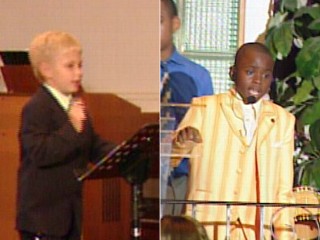
This guest post comes to us from Chris Cantwell, a graduate student studying 19th- and 20th -century religious history with Derek Chang and Nick Salvatore at Cornell University. He was also just named the Assistant Director of the Dr. William M. Scholl Center for American History and Culture at the Newberry Library in Chicago. His work focuses on the relationship between people’s devotional practices and political engagements. His dissertation, “The Bible Class Teacher: Piety and Politics in the Age of Fundamentalism” examines the history of the Adult Bible Class Movement through a microhistory of an unknown, relatively unimportant, but amazingly well-documented Bible class teacher and his Bible class on Chicago’s West Side. Here he looks into the fascinating world of the American child preacher and asks some provocative questions about the practice and meaning of this phenomenon.

You see them and you initially laugh. The grainy footage and shaky camera work suggest what you’re watching may very well be an entry for America’s Funniest Home Videos, so of course it’s not serious. But then the clip plays on. And on. You’re now laughing with a little less fervor as bewilderment slowly pushes humor to the side. You even have a serious look on your face. As the clip passes the two or three minute mark, you suddenly realize that while the YouTube user who posted the clip may have meant it as a joke, the individuals who originally produced the video did not. This is for real. You’re no longer laughing, but focusing; watching the diminutive figure pace and pound and shout with rage far beyond his—and it usually is his—age. But the kicker is not even the video’s main character. It’s his audience. By the time you’ve come to the conclusion that this six-year-old child is, indeed, preaching, you’re confronted with the cheering, clapping, supportive adults who surround the child and encourage not only his message but also his wild performance. It’s like a grade school play, but with fire and brimstone. And no one’s acting.

Child preachers are often the wacky sideshows of American religious history, confined to the fringes of American religious life. They purportedly stand outside the devotional lives of most “ordinary” believers. Indeed, the history of childhood has been around for some time now and has shown that the Sunday school movement, the Y’s, the Boy Scouts and, of course, Horace Bushnell did not exactly clamor to have children practice homiletics. Rather, as the brunt of the scholarship suggests, the motives behind the founding of these organizations were to shelter children from the vices and traumas of the adult world of work, prolong their innocence, and thereby delay their maturation. “This is exactly what the Young People’s Society of Christian Endeavor seeks to do for everyone of its members,” wrote the Reverend Francis Clark in 1902, the founder of that ubiquitous organization of American Protestant childhoods. “It sets them about doing things and thus tides them over the critical period of adolescence, the years of storm and stress and doubt.”

Absent from this narrative of American Protestant youth, however, are not just child preachers but children generally. Children as agents with their own ambitions, anxieties and religious imaginations are often as scarce in the history of American religion as child preachers are in American history. Of course, this lacuna is largely the result of a dearth of sources. Children often did not scribble down, much less understand, their own religious worldviews. Even if they did, such artifacts typically ended up on the family refrigerator and never made it to the archives. But sometimes kids do leave traces. In a 2007 Church History article (favorably mentioned on this blog), E. Brooks Holifield found in a number of antebellum children’s diaries that kids paid surprisingly close attention to their ministers, reflected on their teachings and, in some instances, emulated ministers. In my own research on a number of Sunday school workers at the turn of the twentieth century who were lifelong church members but never rose above laymen, I’ve been impressed by how many of them had aspirations to take to the pulpit in their youth, some as young as six. According to their recollections in later years—admittedly a less reliable source—most willingly and eagerly mounted the stage in the late nineteenth century to give sermon-like addresses before Baptist, Presbyterians, and Methodist congregations. But what has really surprised me in charting the childhoods of these women and men is just how many opportunities local churches provided for children to preach. Sabbath school anniversaries, holiday celebrations, decision days, rallies, monthly Sunday school concerts, quarterly temperance lessons, and especially Children’s Days all demanded spiritual performances from children in ways that mimicked adult worships practices. As much as we’ve interpreted Protestant ideologies of childhood to inflate the innocence of children to Precious Moments-like proportions, there was also a strand of local church culture and evangelical parenting practices that expected, or at least promoted, a kind of spiritual precocity in children.

I’m curious if the religious lives of children have similarly haunted the research of other readers. In a recent query on H-AmRel from BlogMeister Randall Stephens on the denominational acceptance of child preachers, listserv members offered a lengthy list of diverse figures from Bob Jones to C. L. Franklin who both literally and figuratively cut their teeth behind the pulpit. The lived religion of childhood certainly wasn’t something I was expecting to focus on when I began my dissertation, but it has become a central component to many of the arguments I try to formulate. Perhaps by better situating children and their interpretive imaginations in our studies we can deepen our understanding of generational change and stability in America’s religious communities. Taking children and their spiritual aspirations seriously may also help contextualize child preachers and the bemused contempt they perhaps unjustly receive. For when longtime Sunday school worker Asa Bullard worried as early as 1876 that the plethora of church events that forced kids to speak or recite Bible verses threatened to “make an exhibition of the children,” one has to wonder just how much the difference between child preachers and other Protestant children was one of degree rather than kind. Just ask any Protestant who, as a youngster, earnestly, but ultimately unwillingly, performed in church musicals throughout much of their childhood. That, however, would require a very different kind of blog post.

Rabu, 15 September 2010

The Fellowship of Christian Statesmen: From New Contributor Blake Renfro!

Today's post comes from another new contributor (a banner week for us along those lines): Blake Renfro, a graduate student working with Gaines Foster at Louisiana State University. Welcome, Blake!

The Fellowship of Christian Statesmen

A short distance from our nation’s capital there is a modest old row house. A cohort of senators and congressmen live in the house while working in the city. They write their modest rent checks to a decidedly inconspicuous entity known as the “C Street Center.” A recent article in The New Yorker by Peter Boyer, entitled “Frat House for Jesus: The entity behind C Street,” examines the powerful evangelical group that owns the house. (Click here for an older Washington Post article on the same house).

“There’s this whole Washington phenomenon, related to access to power and the aphrodisiac of power,” says one of Boyer’s sources. This observation seems fair. Political culture is defined by ambition and status, but its concomitant religious culture proves more elusive. Ostensibly, individuals like Billy Graham and his successor Rick Warren address the nation’s moral conscious, while acting as personal counsel to the Washington political elite. Boyer’s article reveals a religious entity that seemingly defies this assumption. The C Street row house is one such facet of Washington’s religious culture that both caters to power and eschews it at the same time. The house is an ideal part-time residence for legislators, but it is also an “accountability group,” of politicians who “have pledged to hold one another to a life lived by the principles of Jesus.” The ministry that owns the house is partly funded by an organization known as “The Fellowship.”

The Fellowship was created in the 1950s. According to Boyer, it has become one of the most important evangelical organizations in Washington. Those of us familiar with religion in American life, know that religious groups of every type have lobbyists and activists on Capitol Hill. Born during the height of postwar ecumenism, The Fellowship sponsored the National Prayer Breakfast under the Eisenhower Administration, and it continues to this day. Of course, the main question is: Why haven’t we heard more about this organization? The answer is fairly simple. Doug Coe, the organization’s director for forty years, makes a concerted effort to keep the ministry out of the press. With a fairly modest budget of fifteen-million dollars, Coe and his small staff contribute to a variety of causes in Washington and throughout the world. Yet, the majority of their work “is interpersonal ministry to the powerful.” The Fellowship has established numerous small prayer groups throughout the city, which bring together politicians and bureaucratic officials. Unlike the preaching of more public evangelicals, Coe’s brand of Christianity is less concerned with salvation. The Fellowship focuses on shaping the morality of power and influence. Washington’s political culture might seem immoral, but Doug Coe believes he can persuade the powerful to live a life of humility and good character. He has won accolades from Ronald Reagan, Al Gore, Hillary Clinton, and many others.

Critics charge that The Fellowship is a secretive organization which hinders democratic ideals. In a recent interview on Fresh Air, the writer Jeff Sharlet suggests the organization has supported Ugandan legislation which would make homosexuality punishable by death. Sharlet ignores the rather broad reach of Doug Coe’s ministry, arguing that The Fellowship is merely a fringe movement that “recasts theology in the language of empire.” There might be some truth to this observation. But, The Fellowship has earned the respect of nearly every powerful politician in Washington. This phenomenon encourages us to reconsider the intersection of political and religious culture. Sometimes powerful leaders find solace from unlikely companions.

The C Street row house, despite its flaws, illustrates how democratically elected leaders seek resolution in their political differences. Boyer movingly recounts how, in the spring of 2000, Congressman Bart Stupak’s son committed suicide after a high-school graduation party. Laying their differences aside, his housemates from C Street comforted their friend. Tom Coburn, who accompanied Stupak to view his son’s body, concluded that, “There was no decision to be made. I mean, we had to get to Bart and just be there to support him. We had a contingent of ninety members of Congress come to the funeral. And what they got to see was something they hadn’t seen in a long time: Here’s three Republicans and two Democrats lovin’ a brother through a problem.”

Rabu, 01 September 2010

Beck Plays Prophet -- Guest Re-Post from Andrew Murphy

Today's guest post, or re-post rather from a piece originally appearing at Religion Dispatches, comes from Andrew Murphy, author of Prodigal Nation: Moral Decline and Divine Punishment from New England to 9/11, which we reviewed earlier here on the blog. Andrew's former guest post for us, "When is a Jeremiah not a Jeremiah," may be found here.

Andrew's post today, his take on politics, the prophetic tradition, King, and the Beck rally, comes to us today courtesy of the author. It originally appeared as "Beck Plays Prophet -- Politics Pervades," at today's Religion Dispatches.

There are any number of ways to interpret the events on the National Mall last Saturday — the dueling rallies, the competition over the legacy of Martin Luther King’s “dream,” the intertwining of piety, politics, and patriotism — and many of these have already been blogged and commented on ad infinitum.

And so first, to the obvious: Glenn Beck is no Martin Luther King. Beck’s movement is not King’s movement. This rally was not that rally. We know that. And the incongruity of it all — white middle-class Christians being comforted about their essential goodness on the very grounds where King had called a nation to account for its grievous moral failings — has been noisily pointed out by Rev. Al Sharpton’s counter-rally, by bloggers and pundits on the left, and by many surviving members of the civil rights movements.

What Beck does share with King, however, is that each sought to play prophet to a nation gone astray. That one of them became a national icon, a martyr for the cause of civil rights, and the other hosts a cable television show and has referred to himself as a “rodeo clown” — not to mention that one preached racial justice and reconciliation, while the other denounced the nation’s first African-American president as a “racist…with deep-seated hatred for whites and white culture” — shouldn’t diminish the significance of this observation. Nor should the fact that the diagnoses of the nation’s ills offered by each of these prophets, the sorts of solutions they proffered, and the vision of the future that emerged from each rally could hardly be more different. The two rallies were attempts to bring a prophetic voice to America, and each one was framed by a jeremiad — a prophetic critique of the degenerate present in light of an enduring national mission. The jeremiad as a form of political rhetoric has a long history in the American tradition, and so it is worth taking another look at these two Jeremiahs on the Mall.

Promise of liberty, legacy of injustice

King rose at the Lincoln Memorial in August 1963 to call the nation to account, to insist on the redemption of an American founding promise. The “dream” that he so eloquently voiced that day was actually built on a much more mundane image — that of a bounced check. King reported that he and his fellow marchers “have come to our nation's capital to cash a check,” written by the nation’s founders, “a promissory note to which every American was to fall heir.” Unfortunately, he continued, “America has defaulted on this promissory note insofar as her citizens of color are concerned….America has given the Negro people a bad check, a check which has come back marked "insufficient funds.”

The American past and present, in King’s view, was defined largely by the unwillingness of the nation to honor the check written at the founding. And so the inheritance from the past was a dual one: a founding promise of liberty and equality in theory, and a legacy of slavery and segregation in practice. The change sought by King and the civil rights movement was motivated by a desire to overcome, or to redeem, the latter by finally realizing the potential of the former. This pointed contrast of present with past — of founding covenant with degenerate practice — is central to the power of King’s prophetic political critique.

Contrast all of this with the tenor of the contemporary conservative movement. Central to the traditionalist conservatism espoused by Glenn Beck and Sarah Palin, the two featured speakers at Saturday’s “Restoring Honor” rally — is the idea that the values and practices that dominated the nation’s life during previous eras — traditional families, (Christian) religion in the public sphere, celebration of the military, the equation of white America with “real” America — must be those that lead it into the future. This is the “honor” that needs to be restored, and despite the minor brouhaha caused by Beck’s admission earlier this month that he didn’t think gay marriage was a particular threat to the nation (or Palin’s constant attempt to claim the mantle of feminism), the insistently backward-looking nature of the 2010 rally betrayed a rather different valorization of the past than King’s lament over the squandering of founding promise.

Where King’s dream called for deep and radical transformation — the dismantling of Jim Crow, the passage of meaningful civil rights and voting rights legislation, real equality of economic opportunity, such as had never before been witnessed in the nation’s history — on Saturday Sarah Palin set herself foursquare against any such questioning of the nation’s current practices:

I must assume that you too know that we must not fundamentally transform America as some would want. We must restore America and restore her honor!

So rather than transformation, we need restoration.

Apolitical? Not by a long shot

Beck said before the rally that he saw his role as “to wake America up onto the backsliding of principles and values most importantly of God.” He spoke on Saturday of a nation that has “wandered in the darkness too long,” and called on his listeners to rededicate themselves to faith and country, steering clear of commenting on specific pieces of legislation. Indeed, one of the more interesting claims made by Beck and his fellow organizers was that the rally was not “political.” Even the New York Times’s Ross Douthat claimed that “[Beck] had promised that the rally…would be an explicitly apolitical event. And so it came to pass…” But Douthat goes on to identify what was really at the heart of Saturday’s gathering: “a long festival of affirmation for middle-class, white Christians.” What he seems to mean is that the rally’s speakers did not explicitly endorse a particular legislative agenda. But anyone who thinks that such a “festival of affirmation for middle-class, white Christians,” given the nation’s current religious and political landscape, is “apolitical” needs — to say the least — a more robust and nuanced definition of politics.

Both of these would-be Jeremiahs — King and Beck — sought to call the nation to something, something deeply American as they understood that term. The different registers in which they spoke, the different approaches they took to the past, and the different issues on which they chose to focus their criticisms, though, betray fundamentally different understandings of prophecy and its relation to political critique. Beck’s critique evoked tradition, Christian faith, and the goodness of America, suggesting that his listeners “concentrate on the good things in America, the things we have accomplished and the things we can do tomorrow.” By contrast, King sought to transform the very foundations of an American society shot through with racial prejudice, to bring the past to bear on the present as a form of critique, to transcend past and present practices, to draw on the nation’s founding to envision a new future of racial harmony.

Of course one might object that unlike King, who confronted a governmentally-sanctioned system of American apartheid, we in the twenty-first century face no such organized evil and thus the nation needs no fundamental transformations in the way it clearly did in 1963. But this seems to me precisely the point in distinguishing Beck’s from King’s attempts at prophecy. The kind of celebration of tradition that lies at the heart of the Christian Right’s interpretation of American history and its interpretation of American politics rules out, almost by definition, the kind of searching national self-critique that King insisted on.

With a gaze set boldly backwards

In my most recent book I explore the history of the American jeremiad — the political preaching of such Jeremiahs — as a form of political rhetoric since the earliest days of colonial settlements. I examine the different ways in which traditionalists and progressives have sought to indict American society and mobilize political coalitions throughout American history, and the religious and political figures who have sought to play prophet to the nation since colonial times. King’s speech in 1963, not surprisingly, was one of the great moments of the progressive tradition in American political rhetoric, and it has achieved the sort of iconic status that so often blunts later generations’ appreciation of King’s edgy calls for reform, and his invocation of the “sweltering summer of the Negro’s legitimate discontent.” Traditionalists, on the other hand, have long used the eclipse of institutional Christianity in the nation’s public life as a stalking horse for political movements — most recently, the Christian Right — and the Beck-Palin event fits squarely into the larger dynamic of a reaction against 1960s style progressivism.

And here, it seems, lies the fundamental difference between the two rallies: King called the nation forward into the fuller realization of its founding principles; while Beck and Palin directed the nation’s gaze backward. In Palin’s America, like Beck’s, the future would look much like the past, with an aggressive public Christianity and a federal government weakened in its ability to safeguard the rights of religious or other minorities. King, of course, talked of the past as well, but although his dream was “deeply rooted in the American dream” and (in some way, he insisted) consistent with the nation’s founding principles, realizing that dream would require deep and lasting change. The dream would not become reality until the nation paid the check that it had bounced repeatedly over the course of its history.

When it comes down to it, of course, King’s speech would have remained just words — stirring words, perhaps, but just words — without a successful political movement that braved all sorts of dangers in pursuit of their understanding of American ideals and the meaning of the nation’s founding promises. What will become of Beck, remains to be seen. But the rodeo clown who bills his program as “the fusion of entertainment and enlightenment” has certainly ensured that he will not fade from the limelight anytime soon

Kamis, 26 Agustus 2010

Five Years and an Oil Spill Later

[Emily Clark is a Ph.D. Student in the Department of Religion at Florida State University. She is also the new managing editor of the Journal of Southern Religion. You can expect great things from Emily in the not-too-distant future!]
Five Years and an Oil Spill Later
Emily Clark

This upcoming Sunday marks the 5 year anniversary of Hurricane Katrina’s landfall on the American gulf coast. The aftermath of the storm–the outrage, the rising death toll, the fundraising, the widespread donations of time and money to rebuild, and the levee investigations–largely languished in the national media as time passed. Interest would perk up again when Brad Pitt finished another house, and with the recent interest in the HBO show Tremé, the public eye will incline towards the Crescent City that Care Forgot in the approaching days.

In addition to its Tremé style jazz, New Orleans is also famous for its historical haunting and ghost stories. A former New Orleans resident–the folk artist, musician, and street preacher Sister Gertrude Morgan who died in 1980–remains today in the city she evangelized in a ghostly form. According to sociologist Avery Gordon, “to write stories concerning exclusions and invisibilities is to write ghost stories,” and the scholar’s investigation of these social ghosts leads “to that dense site where history and subjectivity make social life.” As the floodwaters receded from the Lower Ninth Ward (her former neighborhood), they resurrected a Sister Gertrude Morgan specter. Created and propagated largely by current Preservation Hall owner and creative director Benjamin Jaffe, the spectral Gertrude Morgan exists in a specific cultural context: post-Katrina New Orleans. Jaffe’s initial uncertainty about staying in his hometown and the city’s subsequent rebuilding efforts, particularly his artistic contribution to the city’s cultural revival, swirl about his spectral evangelist. For him, she became a symbol for the enduring love, acceptance, and creativity he reveres about his beloved city. She is an icon for authentic New Orleans culture in the post-Katrina world–a symbol for the city she viewed as sinful and most in need of her didactic message (click here for more on Morgan and Katrina).

In 2009, the Journal of Southern Religion released two issues of its typically annual periodical. One of these installments was a special issue entitled “After the Storm,” an exposé on religion in the American South in light of and responding to Katrina. Including articles, poetry, and the visual arts, this particular edition of JSR demonstrated, in the words of guest co-editor Tracy Fessenden, that “New Orleans isn’t going away.” The editors of the JSR encourage you to revisit or explore for the first time this special issue. Five years after the storm and one oil disaster later, religion in the gulf continues to raise difficult questions about power, identity, and social forces. Not only that, the South furthermore remains key to our constantly-developing and ever-nuancing picture of American religion.

Senin, 19 Juli 2010

Strangers and Pilgrims, Travellers and Sojourners

Editor's Note: A previous reference and post on the Pilgrims provoked a flurry of emails from scholars and others quite passionate on the subject. So, again, mea culpa; more importantly, to atone for my sin of an unnecessarily flippant tone, I'm posting below author Jeremy Bangs's explanation of his recent very extensive work Strangers and Pilgrims, based on thirty years of research in the original sources, including many years researching in the original Dutch sources in Leiden.

A note along the same lines: I made reference earlier to Nick Bunker's new book as well as a review of it in
The New Republic. Jim Cullen appreciatively reviews this work, Make Haste from Babylon, over at HNN this week.
_____________________________________________

Strangers and Pilgrims
by Jeremy Bangs

Strangers and Pilgrims, Travellers and Sojourners – Leiden and the Foundations of Plymouth Plantation (Plymouth, Massachusetts: General Society of Mayflower Descendants, 2009). 894 pp. + xxxii; 134 ills. and maps. $55.

Of my eleven scholarly books and many articles, six concern the Pilgrims and Plymouth Colony. Four are document publications - the 17th-century town records of Scituate, Massachusetts (3 vols.), and Indian Deeds: Land Transactions in Plymouth Colony, 1620-1691. The Scituate records are more extensive than those of any other New England town outside Boston. They provide information that allows a reconsideration of the generalizations found in the detail studies of other towns from ca. 1970. In fact, most of those generalizations do not hold up to comparison with more extensive and explanatory documentation. Similarly, the information in the Scituate records contradicts the generalizations in David Hackett Fisher's famous work from the 1980s. The introductions to the Scituate records (totalling ca. 225 pp.) explain the implications for historiography.

I started that project merely as something to do, since I was living in Scituate at the time As the transcription progressed, I realized that the contents differed from what had become common knowledge - for example, it turns out that Scituate was the major town of Plymouth Colony after 1650, being sixty percent larger in population and economy than its nearest rival, the town of Plymouth. No one has paid attention to this in writing a history of the colony, or of New England. Scituate was an actively growing commercial center with interesting religious controversies as well, all overlooked in histories of New England. Similarly the introduction to Indian Deeds, again, ca. 225 pp, explains the significance of the documents that follow for the historiography of Indian relations with the colonists - The fifth book is a biography of Edward Winslow, third gov. of Plymouth Colony. Contradicting the assumption that Plymouth was of no wide importance beyond its own insignificant borders, this revises the history of Plymouth colony's early finances then continues with Winslow's role in the Cromwellian government. He returned to London in 1646 and rose in the committee structure of the government. Eventually he was appointed jointly by the Dutch States General and by Cromwell to be a member (acting as chairman) of an international committee whose task was to resolve commercial disputes remaining between The Netherlands and England after the first Anglo-Dutch war. His career puts Plymouth Colony in the middle of the now fashionable Atlantic history

As for Strangers and Pilgrims: Rejecting centuries of stereotyping both pro and con, Strangers and Pilgrims portrays the emergence of the Pilgrims as a coherent religious and social group whose goals and experimental choices when reacting to past and current events and circumstances made Plymouth Colony unique. Rather than providing neat, static definitions of who they were and then proceeding to conclude that their lives and their colony evaporated into insignificant myth, the book gives attention to the various shifting contexts – religious, political, social, industrial, and domestic - that called these people to responsive action. It is the culmination of thirty years' archival research in America, England, and The Netherlands.

The first chapter reviews the hopes that animated English Puritans when James I ascended the throne - hopes whose disappointment inspired Pilgrim leaders, William Brewster, Richard Clyfton, John Robinson, and John Smyth. They concluded that no true church could exist within the traditional hierarchies, parish structures, and rules retained from Roman Catholicism. Withdrawal from the Church of England led to persecution, while they and their congregations thought they saw God’s anger at England’s failure to achieve further reformation revealed in signs of divine wrath – the tsunami that devastated southwest England in January, 1607, followed by crop failure and famine throughout the country in the summer, the return of the plague in the fall, and a portentous comet towards the end of the year. Christians who had separated into a covenanted community seeking to lead a godly life felt the need to flee. Holland offered religious refuge.

Other English Separatists had found safety in Amsterdam a decade earlier, but sexual scandal among them threatened to associate the newcomers with their disrepute, a danger that increased when Rev. John Smyth re-baptized himself and some followers, calling up images of revolutionary Anabaptism with its end-time social chaos. Rev. John Robinson led the group now known as the Pilgrims to the university town of Leiden, famous for its cloth industry relying on refugee laborers. That city, however, had become the focal point of controversy that would split the Dutch Reformed Church and culminate in a military coup that put an end to the toleration for which Holland had become famous.

Familiarizing themselves with the town, the Pilgrims came into contact not only with the university and with Dutch Reformed and Mennonite churches, but also with English soldiers garrisoned throughout Leiden (such as Myles Standish) and with the thousands of French-speaking refugees who made up around 15% of the town’s population. Some people already in Leiden joined the Pilgrim church, while more new members came over from East Anglia, Kent, and London; the diversity of origins required communal attempts to build unity of purpose. This effort contrasts with any simplistic characterization of the structures of their colony in New England as representing a conscious or unconscious re-creation of regional folk customs and habits recalled from ye olde England.

Although the Pilgrims’ arrival in Leiden coincided with the beginning of the Twelve Years’ Truce in the Dutch revolt against Spanish Hapsburg domination, the peace was unstable. England was providing nearly half the soldiers in the Dutch army; King James exploited this dependence to demand ever greater influence in Dutch religious and political affairs. The Pilgrims found themselves under increasing pressure from England, whose ambassador successfully called for the suppression of the Pilgrims’ publishing project when he discovered offenses to the king’s majesty in Pilgrim calls for reform. King James demanded that Pilgrim William Brewster be arrested; an English bishop even made a clandestine visit to Leiden apparently to try to discover Brewster’s hiding place. The Pilgrims felt the pressure to seek a safer haven before Holland was once again engulfed in war

John Robinson participated in the university theological faculty's debates between double-predestination Calvinists (the Gomarists or Contra-Remonstrants) and their less rigid opponents (the Arminians or Remonstrants). The major focus of the controversy in Leiden was the appointment of Conrad Vorstius to be professor of theology. His opponents accused him of Socinianism and used that charge to convince King James I to retreat from religious toleration to a demand for Calvinist conformity in the Dutch church. Under his political pressure, Prince Maurits carried out a military coup, deposing the toleration-minded Remonstrants in government. The Synod of Dort then proceeded to condemn anyone with a broader theological view than that of the Contra-Remonstrants. The book's examination of documented political intrigue gives a new interpretation to the entire period in Holland. Although agreeing theologically with the decisions of the Synod of Dort, Robinson and the Pilgrims rejected calls to require everyone in Plymouth Colony to subscribe to the Heidelberg Catechism and the Belgic Confession, thus taking a position that had been among those for which the Remonstrants were condemned at Dort. In the Pilgrims' view, only the Bible and Apostles' Creed (which they thought had been composed by the Apostles) could be obligatory - everything else was inevitably imperfect because all things human are imperfect. Their colony became relatively tolerant because of this literalist understanding of the story of the Fall in Genesis.

With the Mayflower Compact, the Pilgrims established independent democratic government in their colony. Introducing the Dutch custom of civil marriage registration, the Pilgrims provided equitable laws for all colonists, whether or not members of the Pilgrim church. With their constitution of 1636, they conceived a representative government that gave no role to the clergy. Recognizing the Indians as equal creatures, the Pilgrims attempted to provide fair treatment for all in their courts; and they acquired land exclusively by sale or trade from the Indians who were understood to be the proper owners. Through their familiarity with the Dutch Union of Utrecht (1579), the Pilgrims helped form the United Colonies of New England (1643) on that model - a model that in turn served to inform the confederation structure of American independence in the late 18th century. Without any emphasis on presentism or triumphalism the book shows how the Pilgrims affected the societies in which they lived and were in turn affected by them.