Tampilkan postingan dengan label religion in colonial America. Tampilkan semua postingan

Sabtu, 04 Juni 2011

Faith of the Founders (My Review of John Fea in the Christian Century)

Paul Harvey

I was very happy that the Christian Century asked me to review John Fea's Was America Founded as a Christian Nation: A Historical Introduction -- and even more glad they gave me relatively ample space (over 1200 words anyway, better than the average review) to develop some thoughts on John's book. The review is here. Here is an excerpt, and then continue at the jump:

Faith of the founders

Was America founded as a Christian nation? No, is John Fea's answer to the question posed in his title. But the answer is yes if we consider how Americans (especially from 1789 to 1865) understood themselves as a Christian nation. And then again, maybe it's just a bad question, Fea concludes, because it arises not from a rich understanding of the past but from present-day polemics. Only when we remove it from that context can we begin to make sense of it.

Continue <<<

Rabu, 18 Mei 2011

Witchcraft in Early North America

Paul Harvey

Some of you may be looking for a good classroom resource for teaching about popular religion or witchcraft in early America. If so, this might be the book for you, so I'll reprint the Choice review below of Alison Games, Witchcraft in Early North America, put out as a pretty short classroom-usable volume by Rowman & Littlefield in their "American Controversies" series, edited by excellent historian Douglas Egerton. These volumes come with primary document selections, chronologies, and other pedagogical helps. (I have a volume coming out in late summer or so in the Rowman & Littlefield African American History series, entitled Through the Storm, Through the Night: A History of African American Christianity -- more on that as the pub. date gets closer, but the experience of the close editing of that book, with an eye towards readability for a general non-expert audience, gives me confidence in these other volumes that R & L is putting out).

Anyway, here's more on this volume, and check the book's website here for table of contents and more info. What particularly attracts me here is the clear effort to provide a broader context for popular religious beliefs in the supernatural throughout 17th century America, and including Natives and African peoples as well as British North Americans. In other words, this isn't your father's Buick, the usual Salem-centric story of witchcraft in the colonies.
________________________________________

Games, Alison. Witchcraft in early North America. Rowman & Littlefield, 2010. 216p index afp; ISBN 9781442203570, $36.95. Reviewed in 2011jun CHOICE. Games (history, Georgetown Univ.) makes a vital contribution to the pedagogical resources on early American witchcraft. With its introductory essay and interdependent collection of primary materials, the book demonstrates how accusations of witchcraft mediated colonial encounters between mutually illegible cultures: characterized by flagrant "coercion and cruelty," such conflicts demanded justification and frequently provoked resistance, and therefore lent themselves to prevailing supernatural explanations and persecution. Games's historical introduction broadens the scope of witchcraft study beyond New England to incorporate less familiar outbreaks in New France and New Spain. The author traces as well the conflicting beliefs European, Native, and African peoples brought to these encounters. A modest selection of Salem materials are among the 29 brief primary documents, which include legal documents, reports of first encounters, and possession narratives from across the continent. Games's premise is that the historical record tells the story slant; accordingly, this volume represents a necessary and ethical, albeit brief, attempt to counter the Anglo-centrism that has characterized witchcraft historiography. The author resituates episodes of witchcraft in the context of cultural contact and conflict in which they occurred, incorporating them into larger scholarly trends in the study of early America as a space of contact zones. Summing Up: Recommended. All readers. -- A. T. Hale, University of Puget Sound

Minggu, 08 Mei 2011

After the Historical Revolutions: Or, When the Tree Falls in the Historical Paradigm Forest, Does Anyone Listen?

Paul Harvey

A review of (and an announcement of) some challenging new works in earlier American History, and the history of the American West, got me to thinking about the changing of the historical paradigm guard -- or whether those guards get changed at all by scholarly revolutions. These are questions which affect the course of American religious history, but bear with me for a short detour before discussing that further.

These thoughts first came from reading Charles Mann’s review of Daniel K. Richhter’s new book Before the Revolution: America’s Ancient Past (Harvard Press) in Saturday’s Wall Street Journal (yes, Virginia, I do read the Wall Street Journal! But I'm not sure if the link will let in non-subscribers; if it doesn't and you want to read, I'm happy to send it to you).

I know nothing about this book other than this review, but I am a big fan of Richter’s earlier work Facing East from Indian Country: A Native History of Early America, a favorite of mine to use in class for its wonderful illustrations of how changing one’s angle of vision creates an entirely different historical sense of a period. Richter also engages in some deft analyses of early American documents of religious history from the European-Native encounter, including John Eliot’s bizarre but fascinating Indian Dialogues, of course the Jesuit Relations, Indian conversion narratives, and various ceremonial encounters at treaty negotiations.

In his review of Richter’s new book, Mann writes:

“Every few decades, historians develop a new way of looking at the past. I am not talking about ‘revisionism’ but unifying conceptual schemes, the sort of mental framework that Frderick Jackson Turner created in his argument for the importance of the frontier to our history or that Bernard Bailyn established in his studies of the American Revolution’s ideological orgins. Historians debated Turner for a long time and continue to debate Mr. Bailyn. I wouldn’t be surprised if they were arguing with Mr. Richter a decade from today.”

When I become King of the World I will permanently ban the word "revisionism" and its variant "historical revisionism" (as I have already banned the words "bias" and "politically correct" in my classrooms, since they have become barriers to thought and discussion), since they have been rendered meaningless for precisely the reason Mann explains there.

But the revolution in understanding is not just in the early America of Richter. My longtime friend Anne Hyde, Professor of History at my sister institution Colorado College, is about to publish her magnum opus for the West of the first half of the nineteenth century, Empires, Nations, Families: A History of the North American West, 1800-1860, part of University of Nebraska’s outstanding series History of the American West series. If this this means anything to you, as it will to some of you, the immediate predecessor to Anne’s book is Colin Calloway’s monumental work One Vast Winter Count: The Native American West Before Lewis and Clark.

(As a brief aside, when Anne and I were in graduate school, she always made it to the library at 8:00 a.m. sharp, while I was lucky to drag myself, half hungover and ears still ringing from some too-loud jazz concert the night before, by 10:00 or 11:00 at best, which explains a lot about the great scholarly discipline it took for Anne to finish this huge work, while I was busy watching the Mavs beat the Lakers).

Anne’s work may suggests a paradigm for understanding the history of the West in that era, in a way such as Richter and Colin Calloway have done for earlier American history. Her work also features chapters fully integrating the Mormon West into the larger picture, and too much else of interest besides to even begin to summarize here.

All of this is exciting as an historian. But all of it also makes me wonder how, whether, and when any of this affects public consciousness of earlier American history. Lately we’ve been talking about Barton et al., and of course the bookshelves at your Barnes & Noble are full of everything Founding Father related. I understand that, but considering the impact of the works above – great on historians, perhaps little on anyone else – makes me wonder about similar questions for religious history.

The older paradigm of American religious history will be familiar to many blog readers here, and most are familiar with its more recent challengers, summarized in works such as Tweed’s edited volume Retelling U.S. Religious History. I once saw Elizabeth Fox-Genovese, God rest her soul, blast away at that book at a Young Scholars in American Religion conference, with most of the authors in that book in attendance; it quickly became clear she was itching for a fight with a group that had no interest in fighting with her on the alleged evils of “postmodernist” history, since that debate was long since old and tired at that point; at the end of it, Diana Butler Bass got up and urged her to give up swinging at phantoms since none of us were in the ring with her. Sitting in the back row with Diana, I gave her a big high-five for trying to extricate us all from such an unproductive conversation.

Much of the newer paradigm seems to come from removing religious history from the specific story of the American nation-state, and using categories that engage religious experience at its own level rather than as some proxy for political parties or current day culture wars. We've blogged here extensively about some recent classics that move American religious history/studies well down this path -- by Leigh Schmidt, Robert Orsi, Kathryn Lofton, and numerous others.

Again, however, for religious history as for the studies of earlier American history mentioned above, one wonders whether and how this affects any sort of public consciousness or discussion, and whether it’s the job of religious historians to evangelize for these perspectives that challenge or disrupt how we perceive the American religious past (and present). Or maybe scholars should just do their work, let popularizers who are good at popularizing disseminate this stuff to the general public (like happens in science all the time -- neuroscientists do their thing, and then someone like Oliver Sacks explains a little bit of it to us), and trust that over a generation or two it will find its way into the more general understandings. That's a comforting and easy role to take, but it leaves not much excuse for complaining about why some pseudo-historians advise presidential candidates while the rest of us get to advise freshmen how to raise their grade from a D to a C.

As usual, I have no answers, only questions. You're welcome.

[Sutton -- sorry about your Lakers. Not].

Sabtu, 07 Mei 2011

Not into History

Randall Stephens

We've been having a lively discussion on this blog, thanks to Paul's post, and there have been other discussion raging in the blogosphere about David Barton and the uses and abuses of history. The selective use of anecdotes, prooftexts, and the decontextualized way of doing history are closely connected. And, thanks to David Barton and his recent headline grabbing, we have a case in point.

Suppose an amateur Bible scholar said "I know everything there is to know about the Old Testament books of Genesis and I and II Chronicles." Then imagine you asked him/her about what he/she knew about Bronze and Iron Age religion and society, or the development of monotheism in the ancient Near East, or the Epic of Gilgamesh, or the original languages, or the extensive secondary literature written by thousands upon thousands of scholars who know way more about the subject. Then suppose he/she replies "no" on every count. Now, how is it again that this person really knows something important about Genesis and I and II Chronicles? This is a Theron Ware situation if there ever was one. Ignorance of context sometimes gives people remarkable confidence!

Barton does not recognized the idea that the past is like a foreign country. Instead Barton tends to flatten out time and space and make it almost seem as if the Founders are our contemporaries, motivated by the same concerns that motivate us now. Yet people in the past--whether we're talking about leaders of Bronze Age tribes or bewigged 18th century nabobs who tinkered on their mansions, read Montaigne in their spare time, or enjoyed arm-chair speculation about nature and providence--are not the same as us. This seems like a kindergarten point, but it's apparently lost on David Barton. (See his famous and repeated misuse of the word "seminary," in which he makes no effort to explain how that word meant something markedly different in the 18th century.)

At the Way of Improvement Leads Home John Fea makes an excellent, related point about context and Barton's ignoring an avalanche of inconvenient information:

I challenge you to go to Wallbuilders website and find much of anything about the fact that the many of the most important founding fathers rejected orthodox Christian doctrines such as the Trinity and the resurrection of Jesus. Good luck finding any sustained discussion about Thomas Jefferson and James Madison's successful attempt to separate church and state in colonial Virginia or the fact that their efforts were supported by evangelical Baptists with a theology similar to Barton's. These facts of history do not help Barton promote his ideological agenda, so why bother with them?

Right on.

Nearly any trained historian worth his or her salt who takes a close look at Barton and his hyper-politicized work will see glaring gaps in what he writes and talks about. He dresses his founders in 21st-century garb. He's not interested in knowing much about the history of colonial America or the US in the early republic. Why? Because he's using history to craft a very specific, anti-statist, Christian nationalist, evangelical-victimization argument in the present. (Remember the many unconfirmed quotations Barton used in the 1990s? He did so because, first and foremost, he was trying to make a political point.)

In history circles this is what we call "bad history."

Rabu, 27 April 2011

Rituals of Violence, War, and Death Among the Wendat/Huron and the Dakotas: Two New Studies

Paul Harvey

War, violence, and rituals of death have been central to American history, nowhere more so than among Native Americans. Here, just wanted to alert you to a couple of new works that advance new understandings of religious rituals surrounding war, violence, and death.

First, last week Historiann called my attention to a new book which I have yet to see but looks hugely promising, especially as a classroom-usable text. I'll quote from her here:

Erik Seeman’s The Huron-Wendat Feast of the Dead: Indian-European Encounters in Early North America (Johns Hopkins University Press, 2011). From the book jacket:

“Two thousand Wendat (Huron) Indians stood on the edge of an enormous burial pit… they held in their arms the bones of roughly seven hundred deceased friends and family members. The Wendats had lovingly scraped and cleaned the bones of the corpses that had decomposed on the scaffolds. They awaited only the signal from the master of the ritual to place the bones in the pit. This was the great Feast of the Dead.”

Witnesses to these Wendat burial rituals were European colonists, French Jesuit missionaries in particular. Rather than being horrified by these unfamiliar native practices, Europeans recognized the parallels between them and their own understanding of death and human remains. Both groups believed that deceased souls traveled to the afterlife; both believed that elaborate mortuary rituals ensured the safe transit of the soul to the supernatural realm; and both believed in the power of human bones.

Appreciating each other’s funerary practices allowed the Wendats and French colonists to find common ground where there seemingly would be none. Erik R. Seeman analyzes these encounters, using the Feast of the Dead as a metaphor for broader Indian-European relations in North America. His compelling narrative gives undergraduate students of early America and the Atlantic World a revealing glimpse into this fascinating — and surprising — meeting of cultures.

Anyone who has poked around at all in The Jesuit Relations will recognize descriptions of the feasts of the dead in these documents to be some of the most immediately compelling and gripping (if, as always with the Jesuits, problematic) primary sources for 17th-century Native American religious practices. Weighing in a a svelte 176 pages, this book looks like an effort to use these kinds of sources in a way that opens them up and makes discussion of cross-cultural religious encounters in early America accessible for classroom discussion.

And here's a powerful new article of interest to many of you, by our friend and colleague Jennifer Graber, whose first book The Furnace of Affliction has received attention at our blog before.

The article, based on some outstanding research in the American Board of Commissioners for Foreign Missions papers at the Minnesota Historical Society, is "Mighty Upheaval on the Minnesota Frontier: Violence, War, and Death in Dakota and Missionary Christianity," Church History 80 (March 2011): 76-108.

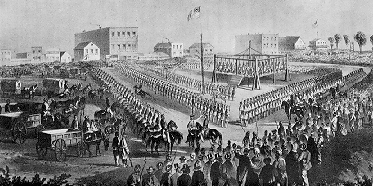
The piece begins by asking "If . . . war is the norm rather than the aberration in American national life, how are we to understand the transformations experienced in 1862 by missionaries and Dakotas as part of a larger American story . . . [and how do we] understand how violence worked to reshape the participants' religious lives?" Graber considers the effects both on missionaries from the ABCFM and the Dakotas of the Dakota War in Minnesota in the late summer of 1862, a horrific outbreak of violence which resulted in the deaths of several hundred settlers and later the mass public execution of over 300 Indians, particularly focused on non-Christian Indians and "medicine men" who were thought to be the ringleaders of the revolt. Graber makes effective use of concepts of Christianity and violence drawn from Emma Anderson's Betrayal of Faith, Jill Lepore's The Name of War, and Harry Stout's "Religion, War, and the Meaning of America" (from Religion and American Culture, Summer 2009, 275-89).

In one section, Graber considers the religious responses of Dakotas to this signal event in their history, including the "conversion" of many of those awaiting execution. She provides a complex portrayal difficult to summarize here but well worth the read. Alongside this, Graber considers also the effect that the trauma of war had on the missionaries, and concludes that "these men underwent their own transformation. Their encounter with violence and devastation, punishment and incarceration caused them to mitigate and complicate the revivalist Calvinism they brought to the frontier. Their vision of missions made up of churches and schools became something else altogether, one of reservations and prisons that God used to make Indian converts."

Despite its short length, this sobering piece had me reflecting in ways which inspired some previous blogging about Emma Anderson's Betrayal of Faith. Highly recommended reading, especially after our last continuous decade of religion, violence, war, and death.

Senin, 25 April 2011

A Cheerful and Comfortable Study of Colonial Material Religion

Paul Harvey

Since yesterday I mentioned Lauren Winner's essay in the Sunday Times book review, which reflected on Rob Bell and American conceptions of hell (and heaven), seems like a good time to showcase this review of her new book A Cheerful and Comfortable Faith, recently published by Yale -- the review is from Choice.

Winner, Lauren F. A cheerful and comfortable faith: Anglican religious practice in the elite households of eighteenth-century Virginia. Yale, 2010. 272p bibl index afp ISBN 0-300-12469-4, $45.00; ISBN 9780300124699, $45.00. Reviewed in 2011may CHOICE.

This study by Winner (Duke Divinity School) of the domestic religious life of elite families in Colonial Virginia both builds upon and modifies earlier work, including Dell Upton's Holy Things and Profane (1986). As Upton did, Winner focuses primarily on material objects as evidence; however, she deals not with public, male-dominated church buildings but rather with articles found in and around the home: needlework, baptismal bowls, prayer books, articles related to food preparation and consumption, and garments and rings worn in times of mourning. Winner's argues that although their roles were circumscribed, Anglican women nevertheless carved out a sphere in which they subtly contested the authority over religious matters claimed by clergy and male relatives and that their religious life, though not as dramatic as that of their Puritan counterparts, was an authentic appropriation of Anglican tradition in a Colonial setting. Winner's work is thoroughly and imaginatively researched, informed but not overwhelmed by theory, adequately illustrated, and accessibly written. This book is an important contribution to Anglican, elite, Colonial, material, and gendered dimensions of American religious life. Summing Up: Highly recommended. Upper-level undergraduates through researchers/faculty.
-- P. W. Williams, Miami University

Jumat, 08 April 2011

Whose Story is American Religious History?

By Heath Carter

I'm here in Grand Rapids, Michigan, where I'm attending the American Society of Church History's spring meeting, organized around the theme of "Christianity and Migrations." There are any number of interesting panels and I hope to post another update before all is said and done, but for now a brief report on Rachel Wheeler's stimulating plenary address this morning entitled, "Whose Story is American Religious History? The Parallel Lives of Daniel Boone and Joshua, the Mohican." Wheeler is an associate professor of religious studies at IUPUI whose work has come up often on this blog [those interested in reading up on her first book, To Live Upon Hope, might check out fellow blogger Lin Fisher's conversation with her back in 2009].

Her talk today engaged big questions about how we should narrate the story of European-Indian encounter in the Americas, which has ramifications of course for how we tell the story of American religious history. She argued that the life of Joshua, an Indian convert to Moravianism, highlights the difficulties with both triumphalist and revisionist accounts of conflict on the frontier. The problems with triumphalism, a view summed up in Horatio Greenough's mid-nineteenth century sculpture, The Rescue, need not be elaborated here. There is a reason why the statue, an image of which Wheeler incorporated into her talk, was removed from the steps of the U.S. capitol building in the late-1950s.
But Wheeler persuasively showed that Joshua's story also complicates the revisionist narrative, which lacks the categories to see his conversion as anything other than collusion with the oppressor; and lacks, moreover, the flexibility to allow for Moravian missionaries who - unlike some of their Protestant counterparts in the late-18th century - were not virulently anti-Indian but were in fact open to some of the ways that Indian converts made Christianity their own.

In elaborating the fascinating comparison between Boone and Joshua, Wheeler followed themes of migration, war, and conversion. All of these will be central to her next book, a biography of Joshua which will put him belatedly on more religious historians' radar (I confess that before Wheeler's talk I had not heard of him). If her second book makes the same kind of splash as her first, it may be that we'll all soon be required to take what she called the "Joshua test" - do our accounts of American religious history shed light upon the experience of this Mohican-Moravian martyr, or will we continue to relegate those like him to the margins? For the profession's sake, let's root for passing grades for all.

Kamis, 31 Maret 2011

John Fea on the TV

Randall Stephens

RiAH friend and contributor John Fea was recently featured on C-Span's Book TV. Fea appears on a March 18 panel on The Founding Fathers and Religion. He speaks about his new book Was America Founded As a Christian Nation?: A Historical Introduction (Westminster John Knox, 2011). Check the video out here. (Sorry, can't embed it.) Here's the summary:

Authors talked about their books on the American Revolution and role played by religion in the founding of the United States. They also responded to questions from members of the audience. Tatiana van Riemsdijk moderated. The participating authors were: Barbara Clark Smith, author of The Freedoms We Lost: Consent and Resistance in Revolutionary America; John Fea, author of Was America Founded As a Christian Nation?; and John Ragosta, author of Wellspring of Liberty: How Virginia's Religious Dissenters Helped Win the American Revolution and Secured Religious Liberty. "Founding Fathers and Religion" was a panel at the Virginia Festival of the Book in Charlottesville, Virginia, held in the City Council Chambers on Friday, March 18, 2011.

Jumat, 18 Februari 2011

Creolization and Kreolization

Emily Clark

Academic talk of Native American-European cultural hybridity and cultural conflict immediately take my mind to the Caribbean world and major port cities like New Orleans or Santo Domingo. When authors write about “creolization,” I think of cultural intersections between French, Spanish, Native American, and African traditions in the American South. I don’t immediately think of Alaska. However, a new book I recently reviewed for Itinerario: International Journal on the History of European Expansion and Global Interaction has widened the geographic spread I associate with creolization, or rather kreolization.

In the 1980s and 1990s, theorizing of the Atlantic World by historians such as Bernard Bailyn and later David Armitage placed the colonial Americas within a more nuanced, engaging, and dynamic framework. The Pacific World and its impact on the colonial Americas has yet to be as thoroughly explored as the Atlantic, but works such as historian Gwenn A. Miller’s Kodiak Kreol: Communities of Empire in Early Russian America demonstrate the importance of expanding the view of colonial American encounters. With the first permanent Russian settlement in Alaska in 1784, the Russian empire continued its eastward movement setting up its own business-oriented, colonial enterprise in the “new world.”

Together, the missionary work of the Russian Orthodox Church and the education imparted by the fur-trading Russian-American Company offered government and trade officials a method to “civilize” the Alutiiq population and thus extend Russia’s imperial border. Miller’s micro-history of interactions between indigenous Alaskans, Russian fur traders, and missionaries on Kodiak Island elucidates how “a distinct Kreol colonial society” developed that “was neither wholly Russian nor wholly Alutiiq. In a world of mutual dependence, intimate encounters between Russian fur traders and Alutiiq women led to a new Kreol generation of colonial subjects to be defined, controlled, and integrated into the imperial Russian enterprise. In their attempts to convert, Christianize, and “civilize” the Alutiiq people, the Russian missionaries demonstrate how interactions between Native Americans and their colonizers were fraught with complications on Alaska’s Kodiak Island. The British praying towns, the French Canadian seaways, and the American southwest were not alone. Though the situation in Alaska was less physically violent, it wasn’t necessary less culturally complex.

For a long-time, the gaze of American historians was that of the covered-wagon pioneers - westward. Miller is certainly not the first or only scholar to change the frame of reference. In her contribution to Thomas Tweed’s 1997 Retelling US Religious History, Laurie Maffly-Kipp elucidates how a narrative based in the Pacific Rim further illuminates typical historical account. Daniel Richter’s often cited Facing East From Indian Country: A Native History of Early America encourages historians to think about their narratives from the shoes – or moccasins – of “the other.” Miller’s book offers a colonial narrative far from the cities of Boston, New York, or Charleston that is both similar and different from the stereotypical westward European expansion model. For those of us interested in syncretism, cultural mixing, hybridity, colonial intersections, creolization, or whatever you want to call it, Kodiak Kreol provides another vantage point from which to theorize.