By way of introduction, John L. Crow is a graduate student in American religious history at Florida State University, and he is now an official contributor to our blog. His interests lie in New Thought, Theosophy, western esotericism, and Buddhism in the west, and of course, he attends the happening alma mater (
the Florida State Seminoles)
of the assistant editor and some of our contributors. Please welcome his thoughts on Theosophy and Courtney Bender's The New Metaphysicals
!--Kelly
I was recently reading the newest edition of
Quest, the journal of the Theosophical Society in America. In it, Robert Ellwood, muses about the future of the society in an essay entitled, “
Theosophy after the Baby Boomers.” In the essay he notes that the membership of the society has decreased from a high of 8,520 in 1927 to the current 3,546. These few members struggle to maintain the financial weight of the society’s properties and infrastructure. Ellwood posits that at some point if the organization can no longer continue in its existing form it may shift to an educational foundation using diverse media to deliver its lessons. He also points to the way the internet will be central to this future.
While Ellwood is clearly excited about the possibilities, there are many scholars who are

faced with the conundrum of how to study religion when its institutional forms are quickly diminishing as its seemingly non-institutional forms are on the rise. This and Ellwood’s essay made me think of Courtney Bender’s recent sociological study on metaphysical religion in Cambridge, Massachusetts,
The New Metaphysicals (Chicago, 2010). Bender points out that those who claim to be “spiritual but not religious” are no less involved with various institutions, but instead create what she calls a “symbiotic and connected relationship” with various religious and non-religious organizations. Constructing alternative social and organizational structures, these Metaphysicals use cooperative institutions to further their practices and community building. One of the institutions in Cambridge that Bender cites is the Boston chapter of the Theosophical Society.
Yet, Bender’s study is limited to a very particular place. As one of my colleagues asked, “How do we apply Bender’s study outside the heritage of William James?” I have been thinking about this and a perfect site to attempt this application is just a twenty-minute commuter train ride outside of Boston, in Salem, Massachusetts. Most are aware of Salem’s long history, especially its infamous trials in the 1690s. Today, in connection with this witchcraft legacy, Salem is one of the largest sites of metaphysical religion. It might be called the Northeastern Mecca of Wicca and neopaganism. We can certainly build on Bender’s insights, applying them to Salem, but we would have to be attentive to significant differences. Still, in noting these differences, we open up an opportunity to use her ideas throughout America.
First, we must understand, like Bender, that “Metaphysicals” is a wide-encompassing label for people who challenge existing boundaries between secular and religious. This flexibility allows us to see how what would previously be seen as a secular institution or means of communication could be incorporated in a larger spiritual network. Next we have to be aware of the diversity of individuals in that network. Bender focused specifically on white middle-class Metaphysicals. In Salem we would see a different set of Metaphysicals. People involved with Wicca and neopaganism are often in the working classes or are in the lower strata of the middle class, and more diverse racially. Still there are traditionally religious organizations in these networks. So while there is no
Swedenborgian Church, nor a
Theosophical Society, to meet at in Salem, other organizations fill in the gaps, both national and local. One of the most important is the Unitarian Church. Bender does not address Unitarianism to a great extent. One might guess that this is because the
Unitarian Universalist headquarters are on Beacon Hill, near Boston Common, not near Cambridge. However, all over the nation Unitarian Churches host chapters of the
Covenant of Unitarian Universalist Pagans (CUUPS). We should include existing metaphysical institutions such as
Unity Churches and other New Thought groups. In areas where the density of Metaphysicals interested in group formation is dense enough, they often form local institutions, renting commercial spaces or meeting in individual’s homes. Salem has numerous examples of these kinds of groups. Being aware of these kinds of institutions allow us to include the various and wide-ranging religious traditions that form the symbiotic relationships of which Bender speaks.
In addition to these religious institutions, there are commercial ones. This is where the boundaries really become porous. As mentioned above, Salem hosts numerous metaphysical bookstores. Bender mentions Seven Stars Bookshop in Cambridge and how it, along with other places like grocery stores, yoga studios, and health fairs, creates a network of commercial institutions that supply Metaphysicals with the goods and services they consume in the practice of their spirituality. In addition to these types of commercial enterprises, Salem offers us the opportunity to delve one level deeper to see the institutions that supply these independent companies. Salem is home to the

national headquarters of
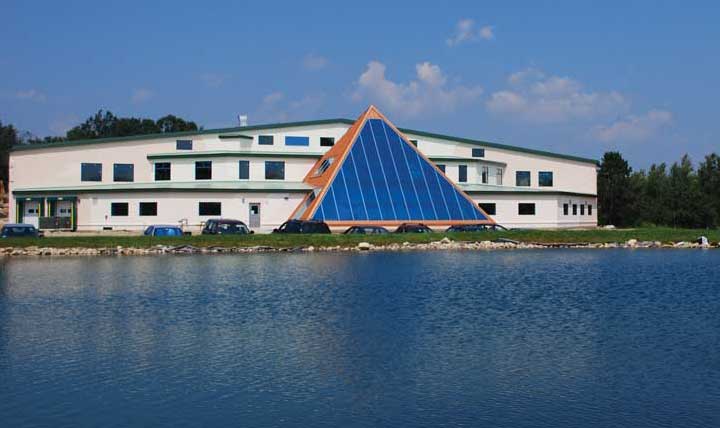
Azure Green, one of the largest distributors of spiritual and occult products in the world. Housed in a building that includes a multi-story glass pyramid, Azure Green supplies the majority of the material sold by independent metaphysical bookshops. Combined with
New Leaf Distributing, the nation’s largest metaphysical book and media distributor located just outside of Atlanta, these two companies homogenize the goods each store has to offer the metaphysical community. Thus, while the inside of
the Bodhi Tree in Los Angeles may differ from
Magus Books in Minneapolis, the majority of the books and goods sold in each are identical. Nevertheless, these stores also supply meeting spaces for discussion groups, tarot card readings, or ritual practice. Thus, while they are a commercial enterprise, they routinely house individual and group spiritual practices. Even non-metaphysical bookstores often house discussion groups for Metaphysicals. The now struggling
Border’s Bookstores are host to a variety of Metaphysicals who use their stores and their coffee shops as meeting spaces.
A final example worth mentioning is the internet. While not of central focus to Bender’s study, the internet is probably the most important place that Metaphysicals use to build and coordinate their communities. Here certain websites become significant “institutions” for information exchange, community discussion, and meeting coordination. While some are organized by tradition, such as
WitchVox, which allows pagans worldwide to meet and exchange messages and files, others are organized by geographic location, such as
Meetup, which is used for people to create affinity groups and then meet in the non-virtual world. On this website one can find local yoga, astrology, or alternative health groups.
The differences between various metaphysical traditions are collapsing just as quickly as are the distinctions between religious and secular institutions that many religion scholars study. The boundaries between New Age practice, neopaganism, and yoga, for instance, are quite porous, as are the designations between what is and what is not religious. The “spiritual but not religious,” as Bender correctly notes, still depend on various institutions to maintain their practices and communities, but they do so in unusual ways. Ellwood is correct when he writes that people “active in religious or other larger meaning-giving organizations, are happier and healthier than solitaries or those who know only casual and informal relationships.” Yet how these solidarities manifest will continue to evolve and change in unexpected ways. As our field continues to grapple with these changes, it will be interesting to see how our methods attempt to capture these networks and communities. Ellwood ends his essay about the future of the Theosophical Society noting that it is “exciting to have the privilege of living in such times of change and challenge.” I think the same can be said for our field too!
 Paul Harvey