Tampilkan postingan dengan label rock music. Tampilkan semua postingan

Rabu, 22 Juni 2011

Rock around the Pew

Randall Stephens

For those of you who work at the intersection of southern history, religion, and music, the H-Southern Music email list just might be for you. I recently posted a question to list members and got some great feedback.

I asked about the work I'm doing for a chapter/article on the interconnections of early rock music and revivalistic religion/hot protestantism/pentecostalism . . . etc. (I wrote a little about this in the last chapter of my book The Fire Spreads, but I'll be exploring this in much greater detail now.) I asked list members about sources--primary or secondary . . . interviews, archives, what have you--that they could suggest. Here are a few of the items that I have found useful mixed in with those that I only learned about through the suggestions of list members (in no particular order). Anything else to add?

Walt Trott and Bill Carlisle, Sister Sunshine: The Martha Carson Story (1st Books Library, 2000)

Macel Ely II, Ain't No Grave: The Life and Legacy of Brother Claude Ely (Dust to Digital, 2010)

Lynn Abbott, I've Got Two Wings (Casequarter, 2009)

Rodney Crowell, Chinaberry Sidewalks (Knopf 2011)

Russ Cheatam, Bad Boy of Gospel Music: The Calvin Newton Story (University Press of Mississippi 2003)

Joe Moscheo, The Gospel Side of Elvis (Center Street, 2007)

Vestal Goodman with Ken Abraham, Vestal!: "Lord, I Wouldn't Take Nothin' for My Journey Now" (WaterBrook Press, 1999)

Bob Terrell, The Life and Times of J.D. Sumner: The World's Lowest Bass Singer (Daywind, 2009)

David Stowe, No Sympathy for the Devil: Christian Pop Music and the Transformation of American Evangelicalism (UNC Press, 2011)

Gayle Wald, Shout, Sister, Shout!: The Untold Story of Rock-and-Roll Trailblazer Sister Rosetta Tharpe (Beacon, 2007)

Jamie Buckingham, O Happy Day: The Happy Goodman Story (Word Press, 1973)

Jerma Jackson, “Sister Rosetta Tharpe and the Evolution of Gospel Music,” Religion in the American South: Protestants and Others in History and Culture, eds. Beth Barton Schweiger and Donald G. Mathews (Chapel Hill: University of North Carolina Press, 2004)

Paul Oliver, Songsters and Saints: Vocal Traditions on Race Records (Cambridge: Cambridge University Press, 1984)

Stephen R. Tucker, “Pentecostalism and Popular Culture in the South: A Study of Four Musicians,” Journal of Popular Culture 16 (Winter 1982)

Jimmy Wayne Jones, Jr., “Modern American Pentecostalism: The Significance of Race, Class, and Culture in Charismatic Growth, 1900-2000” (Ph.D. diss., University of Arkansas, 2002)

Johnny Cash, Man in Black (Grand Rapids: Zondervan, 1975)

Tammy Wynette with Joan Dew, Stand by Your Man (New York: Simon and Schuster, 1979)

Charles Sawyer, The Arrival of B. B. King (Garden City, N.Y.: Doubleday and Company, Inc., 1980)

Myra Lewis with Murray Silver, Great Balls of Fire: The Uncensored Story of Jerry Lee Lewis (New York: William Murrow and Company, Inc., 1982)

Charles White, The Life and Times of Little Richard: The Quasar of Rock (New York: De Capo Press, 1994)

Vince Staten, The Real Elvis: Good Old Boy (Dayton, Oh.: Media Ventures, 1978)

Van K. Brock, “Assemblies of God: Elvis and Pentecostalism,” Bulletin of the Center for the Study of Southern Culture and Religion 3 (June 1979)

James R. Goff, Jr., Close Harmony: A History of Southern Gospel (Chapel Hill: University of North Carolina Press, 2002)

Peter Guralnick, Last Train to Memphis: The Rise of Elvis Presley (Boston: Little, Brown and Company, 1994)

Nick Tosches, Hellfire: The Jerry Lee Lewis Story (New York: Grove Press, 1998. I'm using this one for my fall 2011 course on the history of rock)

Ann Rowe Seaman, Swaggart: The Unauthorized Biography of an American Evangelist (New York: Continuum, 1999)

Jimmy Swaggart, To Cross a River (Plainfield, NJ: Logos International, 1977)

Senin, 06 Juni 2011

Foxed Paper and the Slight Smell of Mold: Reading, Browsing Actual Print Periodicals

Randall Stephens

Last week I visited the Midwestern Baptist Theological Seminary Library in Gladstone, Mo, just north of Kansas City. The staff was terrific and a bonus was an enormous collection of discarded books for sale--$1 or 50 cents/ea. I picked up Tim LaHaye's Battle for the Mind, and, oddly enough, a copy of Gordon Wood's Empire of Liberty.

Ideally, I hoped to browse through some denominational magazines and periodicals from the 1950s and 1960s for my next project on Christianity and rock/anti-rock. I was pleasantly surprised. The library had loads of Baptist and SBC serials dating back to the early years of the Cold War. Some of the titles I browsed through: Baptist Quarterly Review; Home Life; Baptist Training Union Magazine; The Student (A Baptist-style Jesus People-ish magazine, which Sam Hill actually wrote in). In addition to all that there were extensive runs of Christianity Today and Christian Century, along with quite a few other gems.

The Southern Baptist Periodical Index was a real help. But blast the indexers for not cataloging what I wish they had! (Page after page after page on "Missions.") I have seldom used the Index to Religious Periodical Literature (Chicago : American Theological Library Association.) But it's a tremendous resource for work on post-war American religion. And it gives a pretty good indication of the more popular magazines and journals that circulated at the time. See below the first page of the edition for 1971, listing a range of publications. (Click to enlarge.)


So, here are a few questions for all the RiAH research nerds and archive troglodytes out there: What do you suppose were the largest circulating and/or most influential denominational periodicals of the 1950s and 1960s? Which ones are the best for getting a sense of what men, women, and children in the pews were thinking? Why?

Minggu, 24 April 2011

New York Rock Star Jesus Christ Opens Gates to Heaven

Paul Harvey

Today's NY Times features a cornucopia of religion for your Easter
Sunday. To start, our new contributor David Stowe's "Jesus Christ, Rock Star," looks at why religion was once part of popular music, how the divide between "rock" and "Christian" music happened, and why that divide may be in the process of lessening (plus just for fun a link accompanying the article takes you to Barry McGuire's Eve of Destruction, a song that opens Todd Gitlin's capacious survey The Sixties: Years of Hope, Days of Rage):

Despite being a rare bright spot in an industry facing difficulties, music with explicit religious content has been largely segregated from non-religious pop music, both in terms of radio stations and audiences — so much so that it even has a name, contemporary Christian music.

This wasn’t always the case. For much of pop music history, religious themes had an uncontroversial place at the top of the charts, a presence most clearly felt in the late ’60s and early ’70s. But over the next decades, the politicization of faith, relying in part on the surge of youth into the country’s churches, turned religious themes into a forbidden zone for secular musicians.

Then you can hop over to John Leland (great name!), "The Evangelical Squad," which looks at evangelical entrepreneurs in some unlikely places in the NYC area, including the East Village. A brief excerpt, with a nod to Tony Carnes's Journey through NYC Religions which we blogged about here before:

But the church and its expansion into the East Village highlight a concerted groundswell of middle-class, professional evangelicals in Manhattan, an area many churches once shunned as an epicenter of sin. It is the place, many now believe, to reach the people who influence the world.

Though much attention has been paid to New York’s boom in immigrant churches, in recent decades the number of English-speaking evangelical churches south of Harlem has grown tenfold, to more than 100, said Tony Carnes, a researcher and founder of the online journal A Journey Through NYC Religions, who has studied New York churches since the 1970s. Without fanfare, the newcomers have created networks to pay for new churches and to form church-planting incubators, treating the city as a mission field.

"Because the institutions are new, Mr Carnes added, the city has become “like a Silicon Valley of church-planting. “You can come here, try new ideas, fail and start again,” he said. “It’s a hot area where failure isn’t a disgrace.”

Finally, our good friend Lauren Winner appears in the Book Review section, reflecting on all the recent brouhaha over Rob Bell's Love Wins. She writes of the long-lived yin-and-yang of exclusivity versus universalism in evangelical thought, including in the nineteenth century with Elizabeth Stuart Phelps's The Gates Ajar.

Lauren concludes:

So, too, Rob Bell is articulating the concerns of a generation of Christians schooled in toleration, whose neighbors and coworkers and siblings are Muslim or Buddhist or agnostic, a generation whose pluralist social commitments are at odds with theological commitments to limited salvation. Bell speaks for those Christians who take the Bible seriously but can’t imagine their secular friends aren’t going to heaven, too. He speaks for that woman in the pew who can’t bear the thought of spending eternity apart from her atheist brother. The tweeting gatekeepers of conservative evangelicalism may also share these concerns, but for them, the solution is to convert the unbelieving neighbor.

Sabtu, 23 April 2011

Lady Godga's Judas, Just in Time for Easter

What better than a little Lady Gaga for Easter? Welcome below our first contribution from new contributor David Stowe, whose new book No Sympathy for the Devil has received quite a bit of blogging attention here. Here, David analyzes Lady Gaga's new single and its place in the history of Christian pop and religious-themed musicals such as Jesus Christ Superstar.

Lady Gaga's Judas
by David Stowe

At this time forty years ago Jesus Christ Superstar the double album was near the top of the charts, with the musical slated to open on Broadway in the fall. Godspell was about to open off-Broadway, and Marvin Gaye's spiritually-infused What's Going On was being shipped to record stores.

Now we have Lady Gaga, whose just released single, "Judas," already has some eight million hits. It includes lines likes these

When he comes to me, I am ready
I'll wash his feet with my hair if he needs
Forgive him when his tongue lies through his brain
Even after three times, he betrays me

I'll bring him down, bring him down, down
A king with no crown, king with no crown

[Chorus]
I'm just a Holy fool, oh baby he's so cruel
But I'm still in love with Judas, baby
I'm just a Holy fool, oh baby he's so cruel
But I'm still in love with Judas, baby

And also:

In the most Biblical sense,
I am beyond repentance
Fame hooker, prostitute wench, vomits her mind
But in the cultural sense
I just speak in future tense
Judas kiss me if offensed,
Or wear ear condom next time

New York magazine has published a detailed Biblical exegesis of the lyrics:

Lady Gaga's "Judas" is more than a pop anthem to loving the wrong guy: It's also the perfect excuse to examine infamous Catholic schoolgirl Lady Gaga's religiosity and the way she appropriates, inverts, and reworks Biblical allusions and images. Here's a serious, line-by-line analysis of the liturgical references in Judas from Luke 7:38 to John 13:27." They don't call her "Godga" for nothing ...

“I’ll wash his feet with my hair if he needs”
A reference to Luke 7:38, in which Mary of Bethany anoints Jesus’ feet with her tears and dries them with her hair. In John 11:2 (and 12:3), she anoints Jesus’ feet with perfume and then wipes them with her hair. In some Christian traditions, Mary of Bethany and Mary Magdalene are the same person; in other traditions, they are distinct persons. Either way, though, Gaga's take is slightly off: Hair is for wiping or drying feet, not for washing....

Tim Rice meets Madonna. As Mary Magdalene sung so controversially 40 years ago:

I don't know how to love him
What to do, how to move him....
He's a man
He's just a man
And I've had so many
Men before
In very many ways
He's just one more.

Minggu, 10 April 2011

Coming Out in the Jesus Movement

Paul Harvey

Recently we've blogged about David Stowe's new book No Sympathy for the Devil: Christian Rock Music and the Transformation of American Evangelicalism, a history of the rise of Christian rock and pop that will interest many of you. David has a a new piece up (well, a couple of weeks old, sorry it took me a while to get to it) that tells us more about his subjects. On the UNC Press blog he has posted "Coming Out of the Jesus Movement: A Conversation with Marsha Stevens-Pino," about one particularly controversial musician he covers in the book. A brief taste:

Larry Norman, whom I wrote about last month, could aptly be called the Bad Boy of Christian Rock, Marsha Stevens might be deemed the Problem Child—even “evangelical Christianity’s worst nightmare.” Yet it would be hard to find a figure who better reflects the continuities and contradictions of the Jesus Movement. Stevens cut her born-again teeth at age sixteen on the beaches of Orange County just when Calvary Chapel was attracting hordes of young people (and more than a few reporters). Like thousands of teenagers from across Southern California she was baptized in the Pacific at Corona del Mar.

Marsha, her sister Wendy, and their significant others formed Children of the Day, a classic Jesus music group that played gentle, folksy songs of faith. One of her songs, “For Those Tears I Died,” became a movement classic. Children of the Day created perhaps the first albums of what’s come to be called praise music, those easy-to-sing, sometimes-maligned anthems that have crowded traditional hymns out of a majority of American evangelical churches, mega- or otherwise.

Over the course of the Seventies, Marsha went from an icon of the Jesus Movement to a pariah. The constant demands of touring and recording took a toll on the Stevens’s marriage. Then she announced she was in love – with a woman. Divorce carried enough stigma in evangelical circles, but leaving one’s husband to take up with another woman—a different order of scandal altogether.

Continue reading here < < < <

Senin, 28 Februari 2011

Musical Monday: Larry Norman and Repurposing the Gospel Aura

Paul Harvey

A couple of musical posts to liven up your Monday. First, blog friend David Stowe, author of the very-soon-to-forthcome No Sympathy for the Devil: Christian Pop Music and the Transformation of American Evangelicalism (which we blogged about a few weeks ago), has a guest post at the UNC Press blog based on a conversation in 2007 with Christian rock pioneer Larry Norman, shortly before he (Norman, that is) passed. The stories, full of musical celebrities, are fun. And he continues:

Were all these stories credible? Who knows. He told me he’d chatted in an airport lounge with a woman in a beautiful jacket who claimed that her husband was Bob Dylan. AndraĂ© Crouch, who happened to be there with Norman, confirmed the woman’s story. Norman confirmed something that my ears had told me: that Dylan’s Grammy-winning single “Gotta Serve Somebody” was closely modeled on Norman’s song “Righteous Rocker,” released several years earlier.

This is a fun read, highly recommended.

As is Douglas Harrison, Repurposing the Gospel Aura, in today's Religion Dispatches, which takes the use of a gospel choir as a backdrop to Eminem's much-commented-upon Chrysler/Detroit commercial as a way of reflecting on how and why this music invites audiences "to imagine themselves as part of a colorblind fellowship of humanity bound together by the soulful sound of a black gospel choir." Harrison reflects on what is gained, and what is lost/missing, in that process. Black gospel is a "universal language of inspiration and transcendence that cuts across race, class, and history," but in the process, "the very real racial tension surrounding the struggle for equality of opportunity in America isn’t so much resolved or reconciled or even recognized. It is simply ignored in these digestible little pageants of musical and psychosocial harmony."

Thinking of this post at Religion Dispatches, it's a good time to congratulate our blog contributor Gerardo Marti, who has just finished his book manuscript, for Oxford, on a very similar theme: Worship Across the Racial Divide: Notions of Race and Religious Practice in Multiracial Churches, coming out with Oxford next year. Gerardo talks about how African American music comes to stand for authenticity in the churches he studies. And he talks about much else besides -- maybe we can entice him to do a little post here in celebration of mailing off the manuscript, telling us about his work a bit more? Let's hear it, ya'll.

Rabu, 16 Februari 2011

More on Arcade Fire and the Suburban Soul (and Self-Promotion)

Paul Harvey

Monday I posted briefly about the Grammys, including surprise winner for Best Album, Arcade Fire. In (as Luke Harlow would say) the best self-promotional RiAH tradition, I draw your attention to Religion Dispatches today, where I develop those thoughts on Arcade Fire at greater length, with a piece about their current record The Suburbs and previous efforts Funeral and Neon Bible. A little excerpt below, and then you can follow the link from there:

Has there been a major pop group more concerned with exploring personal anxieties, aspirations, and narratives through music defined so fundamentally by religious themes? The turmoil and paranoia of the last decade—wars, attacks, economic crashes, myriad color-coded fears—run through Arcade Fire’s three full-length records: Funeral, Neon Bible, and The Suburbs. The newest effort induces a tour of previous decades, when suburbia seemed (but only seemed) to offer placidity and refuge from the wilderness downtown.

Senin, 14 Februari 2011

Esperanza Spalding, Arcade Fire, and Why There is a God


Paul Harvey

I do not pretend to understand the moral universe; the arc is a long one, my eye reaches but little ways; I cannot calculate the curve and complete the figure by the experience of sight; I can divine it by conscience. And from what I see I am sure it bends towards justice. Theodore Parker.

He must have been watching the Grammys last night.

Every time I fall into despair about that "bends towards justice" line, something happens to keep hope alive, and put God back on my mental map again. The last couple of weeks have been such a time -- Egypt, the Packers, Glenn Beck's ratings falling off a cliff -- and ending with an actual victory for musical truth and justice last night at the Grammys: the recognition of Esperanza Spalding for "Best New Artist" (keeping in mind that she's already 26 and has a whole stack of recordings already, she's only "new" since popular music only wakes up and recognizes jazz once every 10-20 years), and Arcade Fire for best record for The Suburbs. Spalding gave a nice lesson in grace (listen and learn, Kanye) in complimenting her competition, notably Justin Bieber, whose angry fans were tweeting in furiously and defacing Spalding's Wikipedia page from their teenage wastelands. Oh well, they'll grow up.

Aside from her own records, I wanted to draw your attention to one new collaboration of Spalding's, with the great veteran saxophonist Joe Lovano: Bird Songs, just out from Blue Note Records, featuring Lovano, Spalding on bass, and an all-star lineup reinterpreting Charlie Parker's tunes. Not surprisingly (to me), Lovano finds a spiritual core to classics such as "Yardbird Suite":

"Yardbird Suite" appears on the album in two distinct versions. First as "Birdyard," a piece that Lovano put together to feature the aulochrome. "I took a phrase from 'Yardbird Suite' and turned it into a kind of whirling dervish of sorts through five different keys and improvised on the aulochrome over that. It would have been incredible to hear Charlie Parker play that instrument and develop ideas within the possibilities of this horn."

The version of "Yardbird Suite" that closes the album is the perfect summation of the spirit of adventure with which Lovano approached this project. "It came to me one day, I heard that melody as a hymn, as a spiritual, and I started to play it just by myself unaccompanied saxophone. And then I heard all these parts, added an interlude, and went into a 6/8 kind of a dance, and it turned out to be a really different exploration on that piece of music."

As for Arcade Fire, has there been a major pop group more concerned with exploring religious themes through their music? Most obviously, at times perhaps laying it on a little too thickly, this came in their last CD Neon Bible, but The Suburbs is full, too, of anxious contemplation of uncovering meaning in dispiriting environments. A thoughtful review, which compares the CD to Springsteen's The River (and also likes it more than the heavier-handed Neon Bible, a conclusion with which I beg to differ as I believe the former is a bit more ambitious and interesting musically), is here. An older interview with Arcade Fire's leader Win Butler, including a discussion of some of his formative religious influences, is here.

Esperanza shows us hope, even in the suburbs.

Jumat, 04 Februari 2011

No Sympathy for the Devil

Paul Harvey

Those of you who know Randall know that one of his hobbies is collecting quotations from evangelicals hysterically opposing the newfound demon of rock-n-roll music in the 1950s and 1960s (maybe Randall will post a few of those here for us), part of his research on the reaction of evangelical to rock in its early days. Going a bit further: I once saw Julian Bond give a great talk about civil rights and popular culture, starting with one of those overwrought quotations, which sounded like a typical screed against rock coming from some straightlaced white evangelical ca. 1957 -- but as it turned out came from Martin Luther King, who could preach the anti-rock message with the best of them.

Obviously a lot has changed in the relationship of evangelicals to popular musical culture since then. And I expect to see that explained thoroughly in this forthcoming text, that I think a lot of you are going to be interested in this one when it comes out (pub. date is listed as April 2011): David Stowe, No Sympathy for the Devil: Christian Pop Music and the Transformation of American Evangelicalism.

Stowe, who teaches English and religious studies at Michigan State, previously authored a book about big band jazz in the New Deal Era (Swing Changes), and more recently (and relevantly for this blog) the really fine study How Sweet the Sound: Music in the Spiritual Lives of Americans (Harvard Press, 2004), an exploration covering topics from hymns to hip-hop, and from Jewish cantors to Native American chanters.

I look forward to digging into this one soon; information from the book's website is pasted in below.

In this cultural history of evangelical Christianity and popular music, David Stowe demonstrates how mainstream rock of the 1960s and 1970s has influenced conservative evangelical Christianity through the development of Christian pop music. For an earlier generation, the idea of combining conservative Christianity with rock--and its connotations of nonreligious, if not antireligious, attitudes--may have seemed impossible. Today, however, Christian rock and pop comprises the music of worship for millions of Christians in the United States, with recordings outselling classical, jazz, and New Age music combined.

Shining a light on many of the artists and businesspeople key to the development of Christian rock, Stowe shows how evangelicals adapted rock and pop in ways that have significantly affected their religion's identity and practices. The chart-topping, spiritually inflected music created a space in popular culture for talk of Jesus, God, and Christianity, thus lessening for baby boomers and their children the stigma associated with religion while helping to fill churches and create new modes of worship. Stowe argues that, in the four decades since the Rolling Stones first unleashed their hit song, "Sympathy for the Devil," the increasing acceptance of Christian pop music by evangelicals ultimately has reinforced a variety of conservative cultural, economic, theological, and political messages.

Jumat, 21 Januari 2011

Going Straight to Hell on a Crazy Train

By Michael J. Altman

Combining Paul's post of a Sarah Palin version of a classic song and Kelly's post about zombies, I bring you the best parody of Ozzy Osbourne ever. This comes courtesy of Westboro Baptist Church, the church that loves Jesus but probably hates you:


That's right, WBC is protesting Ozzy Osborne--a few decades late, if you ask me--making it official: "God hates Ozzy Osborne!"

Senin, 04 Oktober 2010

Bob Dylan, Sacred Folkster

Paul Harvey

The historian Sean Wilentz's biography/analysis of Bob Dylan has been getting a lot of attention, including a very annoying and somewhat dyspeptic review in the New York Times. Much better informed and more interesting is Scott Poole's essay on the book. The author, most recently, of Satan in America: The Devil We Know (wish someone would make a PBS series out of that one!), Poole discusses the sacred roles of bards and musicians such as Dylan, including the following passage:

In Wilentz’s view, Dylan became a sacred intersection for the varying paths of populist Americana, a hierophant of the folk spirit that has included everything and everyone from Walt Whitman’s liturgy of American democracy to Jack Kerouac’s “sounds of matching boxcars” to Aaron Copland’s hymns in praise of the common man and the democratic landscape. Dylan found the real America, before that term had been abused by right-wing ideologues seeking to become puppet-masters to angry mobs.

Jumat, 24 September 2010

White Rockers in Search of Soul Salvation

Paul Harvey


This piece of mine comes from today's Religion Dispatches -- I'm posting a snip below and you can follow the link from there.


Fifty-eight-year old rock veteran John Mellencamp recorded his latest record live, in three different sacred spaces — a legendary studio (Sun Studios in Memphis), a hotel room in San Antonio (where blues legend Robert Johnson cut some epochal sides in 1936), and, most significant for this article, the First African Baptist Church in Savannah, Georgia.


The first two are hallowed ground of American musical recording history. The third is the oldest black Baptist congregation in the country; so far as I know, it has no history of being used as a backdrop for popular recordings. All three, though, have deep mythical meanings for white Americans in search of authenticity. . . .


Selasa, 24 Agustus 2010

From the Record Bin: Your Gonna Love Your New Life

Randall Stephens

So here's a find a got from an Emporia, Kansas, thrift shop back in 1995. I've held on to this record, called John 15:13, by the Christian Sons, for ages now. It's perfect pitch early 1970s, evangelical awesomeness. (If I remember right, the Christian Sons were an Assemblies of God, soft rock group from Colorado that didn't want to push it into full-throttle Jesus People freakiness.)

Back when I picked the album up and dusted it off it further confirmed what I thought about a certain strain of evangelical pop music from the 70s and 80s. It seems that many evangelicals were seriously into the Carpenters, John Denver, Bread, Captain and Tennille, and a few other icons of the shag carpet and pleather years. The Nazarene church I attended in Olathe, Kansas, featured gospel quartets and more college-friendly stuff, what passed as "young people's music," I guess. The Christians Sons fit into the latter category. They were really small time when compared to contemporary Christian soft rock icons like Honeytree, 2nd Chapter of Acts, or the Archers. But still, they had their charms.

Hear song here.

The song, "Your Gonna Love Your New Life," written by one Phil Johnson, is a greeting to a new convert. "Let me be the first to shake your hand," croon the Christian Sons, "and tell you that this life is really grand." Stilted, yes. Weird, you betcha. Fascinating, without a doubt.

People will hear a song like this today as nothing more than Christian kitsch. Like something piled on to that mountain of Jesus junk that Colleen McDannell scaled in her amazing Material Christianity. But I have to remind myself that music like this really did speak to believers of a certain frame of mind in a certain era. It was exciting, new, and cheery. It thrilled the youngsters in churches who were stoked to see and hear drums in church. Born-again Christians could have fun, and, sorta, rock out, too.

Senin, 12 Juli 2010

The Oslo Soul Children and the Cowboy Twins

Today's guest post comes to us from our Senior Norwegian correspondent

Hilde Løvdal,

who posted here last year on "The Adventures of a Norwegian in Colorado Springs." Today she sends her exploration of the influence of contemporary Christian music in her homeland.

People often ask me why I am so fascinated by American evangelicalism. To me, it’s perfectly logical. I grew up in a culture saturated with American evangelical culture. So, to me, it’s a matter of studying a culture that is strangely familiar while totally different at the same time. American Christian music, in particular, has influenced the ways Norwegian Christians try to balance being faithful to their beliefs and being up to date culturally.

My hometown Kragerø is a small town in the Norwegian Bible Belt (yes, there is one!) and was for a long time the home of SkjærgĂĄrds Music and Mission Festival, the Norwegian equivalent to the Cornerstone Festival. (“SkjærgĂĄrds” refers to the landscape you see in the promo trailer.)
The festival was held for the 30th time last week and had about 6000 visitors. In total, about a 250,000 people have been to the festival - and that’s a lot of people for a nation of 4.8 million people where maybe 5-10% of them attend church on a regular basis.

The festival has had a mix of local and international acts, but American artists have more often than not been the main attractions. As such, Skjærgårds has been a vital force in introducing American Christian rock and gospel music to a Norwegian audience. Larry Norman, Petra, Jars of Clay, Margareth Becker, Newsboys, Rebecca StJames, Jesse Dixon, Koinonia, Al Green, and Five Blind Boys are no strangers to veteran festival attendees.

From the first Skjærgårds festival. Photo: Vårt Land/Skjærgårds arkiv

SkjærgĂĄrds grew out of a group of young Norwegian Christians inspired by American Christian rock and contemporary gospel music, which again was introduced to the Norwegian audience in the wake of the Jesus movement in the 1970s (yes, it was here too!). Andrea Crouch, in particular, was a major inspiration to Christian musicians throughout Norway. Thanks to Crouch et al, gospel choirs may have been the most important arena that churches have had to reach Norwegian teenagers and young adults. I don’t think I’m exaggerating when I estimate that thousands of Norwegians know Crouch’s Soon and Very Soon by heart.

Since 1988, Oslo Gospel Choir has been the most important ambassador of Norwegian contemporary gospel music. OGC has not just had success within the Christian market, but also managed to reach across to the secular market. Oslo Gospel Choir was the bestselling act in Norway in the 1990s - in any category. Other successful gospel choirs include Norwegian Gospel Voices Voice of Joy and Safari. Lately, Oslo Soul Children has been a driving force in the urban gospel. Since it started in 2005, the OSC concept has spread to more than 70 choirs across Norway (there’s even one in Japan!) and there’s now also Oslo Soul Teens. (PS - those of you interested in trans-Atlantic gospel music can see OSC live on tour in the States this fall.)

Contemporary gospel music has not fared well in all Christian circles. SkjærgĂĄrds caused quite a stir when it started in 1981. The pioneers behind SkjærgĂĄrds grew up in a culture where strict moral codes distinguished believers from non-believers. It was a bold move to bring drums on stage in a culture where drums were considered the devil’s instrument and dancing was a major social taboo (“It’s not the dancing itself we’re against, but whatever it might lead to”). Yet, those skeptical towards the new rhythms and new ways of doing Christian music have also relied heavily on American gospel music, albeit in the Southern gospel tradition.

Southern gospel has been hugely popular in low church groups in and outside the state church. Pentecostals and fundamentalists may have disagreed over the theological matters, but they’ve shared a love for the harmonies and message they find in Southern gospel music. Churches and religious meetings are abounding with groups such as Fjordingane and Rett kurs. The folks over at Southern Gospel Scandinavia estimate that Southern gospel has been part of the Norwegian evangelical culture for at least 90 years. Lately, the Gaither’s Homecoming concept has attracted thousands of primarily baby boomers to their concerts, and there’s even a Norwegian/Swedish version of it – Minns du sĂĄngen.

I could go on and on about the profound impact American religious culture has had on Norway’s Bible Belt culture. I could for instance write about Cowboytvillingene (the Cowboy Twins), a legendary 1990s duo that spread the Good News through Southern gospel music and their own TV-show. Or about how my grandmother and Johnny Cash’s mother had very similar hymnals. Or about the connections between Christian hipster musicians in Norway and the States. Or about how Christian hipsters mourned the loss of Larry Norman and organized tribute concerts in his honor. Or about how pastors look to Bill Hybels and Rick Warren for inspiration. Or how most of the books in Christian bookstores are Norwegian translations of American evangelical literature. No wonder, then, that reading books by the likes of Andrew Beaujon, Colleen McDannell, Eileen Luhr, and Heather Hendershot is a glimpse into a culture that is strikingly familiar to my own background.

Kamis, 10 Juni 2010

Rock and Roll Sermon; or, the Raw and the Cooked

Paul Harvey

One summer evening in 1992, I spent an evening hanging out at the Corner Grocery (I think it was called) in Oxford, Mississippi. I can’t remember what got me there, and there were just a few people present, sucking down beverages to fend off the stifling heat, but during the evening a solo guitarist set up and began playing. At first I paid just intermittent attention, but as the evening progressed I found myself hypnotized by his solo version of hard-driving, rhythmically intense blues of a kind I had never heard before (later, his son joined him on drums, and someone else played bass, not always in tune but full of enthusiasm –“TUNE THE BASS!” another patron kept yelling at the stage, reminding me of when I saw the great jazz singer Betty Carter start pounding on the piano of her accompanist in an angry show of what tempo she was wanting in the middle of a particular number). By the end of the evening, I was exhilarated. Another younger fellow from Poland happened to be sitting nearby, and I asked him what I thought. “The raw and the cooked," he said. He preferred the “cooked,” blues with more melody and studied technique, but as long as I was in Mississippi I figured it was a good time to eat the raw, blues tartare.

The guitarist was from the Clarksdale area, not too far away, and he introduced himself as R. L. Burnside. The name meant nothing to me then; little did I know that during these late years of his life he was about to go from being a local working man on a meteoric rise to cult figure status among younger blues-seeking hipsters, thanks in part to the efforts of Arhoolie Records and Fat Possum Records (the latter being the producer also of The Mountain by the Heartless Bastards, my current favorite rock-n-roll sermon about unfulfilled desire and our deep need for others to prop us up sometimes; thanks to the power of their lead singer's voice, they manage to make the cooked seem raw).

Some years after hearing him in Oxford, I walked by the House of Blues on Decatur Street in New Orleans, and saw that he was the headliner act that night. The show was already sold out – fine with me, I thought, for in 1992 I paid no cover and got a whole evening of music from him, just at the cost of a beer (or two, or five, or whatever it was).For once in my life, I didn't arrive at the party after all the cool people had left.

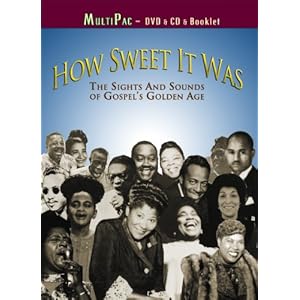
The Polish guy’s response has never left me, for some reason, and I often think of it when assessing my responses to musical CDs that come my way. And I was thinking of it again after blogging recently about the just-released CD and DVD set How Sweet It Was: The Sights and Sounds of Gospel's Golden Age. This CD compilation represents the best of “cooked” post-war gospel – with the astoundingly beautiful, sophisticated quartet harmonies, and subtle musical transformations throughout the songs. This is the cooked -- raw gospel processed through the voices of skilled performers with consummate technique, who produce great art in the process.

If Anthony Heilbut’s collection is the cooked, Fire in My Bones is the raw. From the website for this 3-CD collection:

The majority of this music has never been reissued on CD, or in any other form (most tracks were originally released on regional independent labels). Most post-WWII compilations of African-American gospel music naturally concentrate on the astounding quartet and solo vocalist sounds made during the music's Golden Age. Fire In My Bones attempts to address and collect more neglected sounds from that era (and on to the present day). Dozens of traditions are represented. Some go back hundreds of years while others seem to have been arrived at as soon as the tape began to roll. Field recordings and studio tracks are all mashed together, with solo performances next to congregational recordings, hellfire sermons next to afterlife laments. Leon Pinson, Elder & Sister Brinson & the Brinson Brothers, Grant & Ella, Straight Street Holiness Group, Theotis Taylor, Brother & Sister W B Grate -- these artists will now be just a little less obscure.

A few of the cuts here have been anthologized frequently, including Madam Ira Mae Littlejohn’s “Go Devil Go,” from 1947. But most of the cuts feature individual singers who put down very few tracks on record; in some cases, they made just one recording.

On the first disc, for example, is “Better Get Ready,” by the Elder Roma Wilson and family, from 1948. You have to love liner notes like this: “This recording of four interweaving harp players with Wilson’s vocals on top was made as a ‘test’ by a record shop owner in Detroit. It was then released as a Gotham label 78 without the awareness of Roma or his three young sons (who all backed up their father on harmonica on the record). Mike Seeger called it the ‘single most important selection by multi-harp players in existence.’”

The second cut, “rock and Roll Sermon,” features a hard-rocking Elder Beck from 1956 castigating rock and roll music with a musical fury that would put most rock and roll to shame. Another strange selection, "The Very Last Mile," by John Boswell and the True Sounding Boswellettes, features a "flanged-out" guitar that sounds like it should have been on the soundtrack for Pulp Fiction. Other cuts features fife-and drum corps, some women in a senior home singing some old standards, and lined-out congregational singing. All of the music dates from the post-World War II era, meaning it's much clearer and easier to hear (with much less fuzz and static to fight through) than the compilations of music from the 1920s-1930s such as the all-time classic anthology Goodbye Babylon.

The Village Voice has an excellent review of the compilation here; a brief taste:

As Fire in my Bones came together, the original intent—to thoroughly document and classify the fervent religious music lurking beyond the resplendent harmonies of the vocal quartets that typify gospel's Golden Age (which historically falls between the end of World War II and the rise of "rock 'n' roll")—was completely overwhelmed. Not only was there a lot of great music from that era, but it continued right on through the '60s and '70s and into the present age—the box goes as late as 2007. The set gives in abundance, beyond classification. The keening, traditional-blues slide guitar of Willie Mae Williams's "When the Sun Goes Down" stands alongside the nimble country shuffle of Reverend Lonnie Farris's "Peace in the Valley." Reverend Louis Overstreet's "Working on the Building" slowly turns into congregational ecstasy, while the reverberated stomp of the Abraham Brothers' "Spirit of the Lord" could pass for a garage-rock revival number without setting off any atheist alarms. And then there's "Rock 'n' Roll Sermon," which is too delicious to simply give away here.

So, by all means, eat the delicious haute cuisine offered for you in gospel compilations such as How Sweet It Was. But on some Tuesday night when your senses need some awakening, put on Fire in my Bones. It's the closest gospel equivalent to the evening with R. L. Burnside that I've found.

Addendum: Other short, fun reviews of the compilation are here, here, and here. An excerpt from the first one, which hits it exactly right:

Every unjustly maligned genre deserves a three-disc savior, and for modern gospel music—often considered the exclusive terrain of bright-eyed church choirs wrapped in matching robes, swaying on risers—the redeemer is Fire In My Bones, a collection of scrappy, distorted, burning good news.

Minggu, 30 Mei 2010

How Sweet It Was: Sights and Sounds of Gospel's Golden Age


Paul Harvey

NPR this morning featured a new CD/DVD collection put together by the outstanding gospel music scholar and producer Anthony Heilbut: How Sweet It Was: The Sights and Sounds of Gospel Golden's Age. A brief description from amazon:

A best of the best compilation covering a span of over 40 years. Compiled by Gospel music expert Anthony Heilbut, this exciting multi-facted package offers great film of Gospel icons as well as many all-time classic music tracks. The 26 track CD covers the period of the 1940s through the 1960s and features many all time greats such as: Mahalia Jackson, Rosetta Tharpe, Marion Williams, Swan Silvertones, Clara Ward, Five Blind Boys of Mississippi, Soul Stirrers, Dixie Hummingbirds and much more including 9 previusly unissued performances. The DVD, also 26 tracks, features a comparable all-star lineup (filmed in the early 1960s) including: James Cleveland, Alex Bradford, Rosetta Tharpe, Marion Williams, Soul Stirrers, Sensational Nightingales and many more. A 32-page booklet includes biographical notes, a Gospel music history overview (both written by Anthony Heilbut) and many rare period photos.

The first of three reviews (presently) from amazon gives a thorough description of the contents of the set. HEre's the first paragraph:

In perhaps his most diverse gospel compilation to date, producer and gospel scholar Anthony Heilbut presents a satisfying panorama of the Golden Age of Gospel with this CD/DVD/Booklet package including some of the most passionate music America ever produced. Though the window of what is considered Black gospel's "Golden Age" is small, an all-too-brief fifteen years, the various soloists, groups and quartets peopling its story are large in number and broad in style. How Sweet It Was has the best-loved gospel Divas: Clara Ward, Marion Williams, Mahalia Jackson, Dorothy Love Coates, Rosetta Tharpe; the quartets, from the polished jubilee inspirations of Ira Tucker and the Dixie Hummingbirds to the hard, unapologetic squalling of Archie Brownlee and the Five Blind Boys of Mississippi. Female quartet is also here in great form with excellent recordings by three of the idiom's greatest: the Famous Davis Sisters, Dorothy Love Coates & the Original Gospel Harmonettes, and Albertina Walker & the Caravans. In addition, the CD features noteworthy recordings by more obscure vocalists like Professor J. Earl Hines, Lois Russell and The Famous Blue Jay Singers. Though all of the recordings included are worthy of place in any gospel collection worth its name, there are of course several standouts unavailable or hard-to-find elsewhere that make obtaining one's own copy of How Sweet It Was not simply desirable but genuinely requisite.

The NPR story online features a video recording of the incomparable Sister Rosetta Tharpe's "Up Above My Head," as a sampler of what's on the DVD, not to mention a sampler of the next fifty years of guitar playing in popular music.

Selasa, 30 Juni 2009

Just 'Cause You Feel It, Doesn't Mean It's There

Days of Hope, Religion of Fear:
Reflections on Jason Bivins's Religion of Fear: The Politics of Horror in Conservative Evangelicalism

by Paul Harvey

Just 'Cause You Feel It, Doesn't Mean It's There -- "There There," Radiohead

Reading Jason Bivins’s
Religion of Fear made me think, not so much of Hell Houses or planes flying aborted fetus pictures over Notre Dame, but of Arcade Fire’s Intervention:

I can taste the fear
Gonna lift me up and take me out of here

And it made me think of Don Delillo’s White Noise, which played so expertly and wittily on social paranoia as a broader product of secular horror – as seen in the “airborne toxic event” that drives the plot of the novel.

Perhaps I’m thinking of that today while hanging in hippy-trippy Crestone, Colorado, right at the base of the Sangre de Christos, surrounded by a plethora of religious communities; and sitting at the Shambala CafĂ©, overhearing the musings of some of the locals, who are (unwittingly) serving as a counterpoint but also counterpart to the subjects of Bivins’s work, and who seem cumulatively like a DeLillo character come to life.

It should be called the Department of Offense, not the Department of Defense, man. Dude,

Obama’s just doing their bidding, man. They'll get someone else to run the Ponzi now.

Paranoia's seductions strike deep in the heartland, and even a fur piece down the road from the heartland. Arcade Fire captures their voice as well:

Don't wanna give 'em my name and address,
Don't wanna see what happens next,
Don't wanna live in my father's house no more. . . . .

Don't wanna fight in a holy war,
Don't want the salesmen knocking at my door,
I don't wanna live in America no more.
'Cause the tide is high,
and it's rising still,
And I don't wanna see it at my windowsill.

Indeed in reading Jason’s work I was wondering if DeLillo was going to come up. And he does in one of the quotation epigraphs for the last chapter, where a character in DeLillo’s Mao II says: “So we turn to the news, which provides an unremitting mood of catastrophe. This is where wefind emotional experience not available elsewhere.”

But evangelical audiences did have that emotional experience available elsewhere, which is exactly what this book is about.

Starting with Jack Chick tracts in the 1960s, and moving on through evangelical critiques of popular music, hell houses, the entire oeuvre of the Left Behind novels, and a variety of other evangelical popular productions, Bivins traces how and why the audience for these productions could taste the fear, and why it lifted them up and took them out of here, from the 1960s to the present. Throughout, the emphasis is on the erotics of fear, and how the cultural products of evangelical fear dovetailed with the horror genre in ways that simultaneously provided titillation, fright, anger, and reassurance. This is religious studies that cultural historians need to engage.

Jason’s textured work provides one of the richest exploration of evangelical popular culture since the 1960s that I’ve ever read. He manages to avoid the demons of this genre: on the one hand, the left-wing journalism school that sees theocracy anywhere and everywhere; and on the other hand the penchant for celebrating products of popular culture on their own terms, without seriously considering any normative statements about the meanings of these cultural products.

Here is how he puts it at the end of chapter 2, setting up the series of topical chapters to come:

The frights are not propagandistic, but they are politically coded. While they may not be designed to generate political ideologies or programs directly, they are created out of sociopolitical concern and they underwrite antiliberal politics . . . none of these creations [Chick’s cartoons, anti-rock/rap censorship, Hell Houses, and Left Behind novels] takes a “mustard seed approach,” waiting patiently for faith to blossom. They are proudly direct and confrontational, seeking to alarm in God’s name . . . Through blood, shock, death, and destruction, the religion of fear ushers into being a world whose very terrors announce its redemption.

Consistently throughout, we find Bivins’s subjects (conservative evangelical audiences who consume these products) “drinking deeply of the forbidden in order to deny it,” with the “compulsions, desires, and fascinations that these representations seek to displace” inevitably returning “in vicarious experiences and representations which promise the erasure of these desires even as they deliver a surrogate thrill . . . Desire is thus, even when expressed in a litany of repudiations, a central part of the religion of fear.”

This is the case with his tracing of the history of evangelical anti-rock/rap/metal tracts:
these demons are never fully driven out but, like an endlessly glitched compact disc, return to infinitely reassert their place of prominence in this discourse.” The repressed returns again and again to the same stuck place in the CD, and the audience can’t stop watching/listening, not unlike the one place in the Arcade Fire song quoted above that I just had to keep replaying while driving home from school.

But here’s my favorite quote that sums up the theme of the work. Commenting on the Left Behind novels (and I didn’t know how many of these novels there were – enough to form a genre by itself), a fifteen-year old fan is quoted as saying, “The best thing about the Left Behind books is the way the non-Christians get their guts pulled out by God.” Sometimes it takes a fifteen-year old to raise a thesis.

Fear has its erotics, and it has its politics, the subject of the final chapter:

The religion of fear’s exemplars are public creations, representations meant for the entire sinning world . . . Slowly, since the 1960s, the seeming outlandishness of its many claims have been reframed. The discourse now normalizes and naturalizes ideas that are antithetical to the kind of pluralism on which democracies thrive. Or as put in a previous paragraph: Nowhere in the religion of fear do we see suasion and reason, only ramparts manned and fingers pointed.

Where does the religion of fear go from here? (Feel free to respond to that question, Jason!). The prevailing tension between hope and fear seems especially urgent now, as gun stores sell out, the usual pundits and radio show hosts prattle on, Glen Beck sells his own unctuous evangelical paranoia – but also while the political rhetoric of hope had strong currency in the 08 political marketplace in America, and the 09 political marketplace in Tehran. I’m just asking.

In the meantime, I hope you’ll engage this book. It is not easy reading; it avoids simple philosophizing or sloganeering; and it requires (or at least required from me) frequent bouts of re-reading denser sentences that balance competing ideas and theoretical reflections delicately posed on a teeter-totter. Ultimately, despite its somewhat pessimistic conclusion, the book is a resounding affirmation of democratic pluralism against the erotic seductions of the culture of fear, as are the protagonist's unconcious realizations in "Intervention":

Been working for the church
While your life falls apart
Singing hallelujah with the fear in your heart
Every spark of friendship and love
Will die without a home.

Selasa, 14 April 2009

Goodness, Gracious, Great Balls of Fire and Brimstone

Randall Stephens

Jerry Lee Lewis to Sam Phillips on the perils of rock and roll, Sun Records Studio, Memphis Tennessee, 1957

Jerry Lee Lewis: H-E-L-L . . . that’s right. It says “MAKE MERRY with the JOY OF GOD, only.” But when it comes to worldly music, rock and roll, anythin’ like that, you’re in the world, and you haven’t come from out of the world, and you’re still a sinner. And you’re a sinner. You’re a sinner unless you be saved and born again, and be made as a little child, and walk before God, and be holy. And brother, I mean you got to be so pure, and no sin shall enter there. No SIN! Cause it says “no sin.” It don’t say just a little bit. It says “no sin shall enter there.” Brother, not one little bit. You got to walk and TALK with God to go to heaven. . . .

Sam Phillips: Now Look, Jerry . . .

Lewis: Mr. Phillips, I don’t care . . . it ain’t what you believe, It’s what’s written in the BIBLE! . . . .

Phillips: Nah, gosh, it’s not what you believe it’s how do you interpret the Bible?

I’ll stop right there. It’s just so much more fun to hear this on youtube. A transcription can’t capture the accents and folk wisdom entailed, ya hear? I don’t even think Mark Twain could render the conversation justly. Hat tip to Joe Lucas (Historically Speaking) for making me aware of this fly-on-the-wall treasure. (How many other famous pop icons discussed hermeneutics with their producers?!?)

Hearing the above, I thought about work I’ve done, albeit very little, on rock, pop music and holiness-pentecostalism. At the suggestion of Bland Whitley while in grad school, I read an essay on famous pentecostal musicians (Stephen R. “Pentecostalism and Popular Culture in the South: A Study of Four Musicians,” Journal of Popular Culture 16 [Winter 1982]: 68-80.) Few have looked at pentecostal rock and rollers and country singers as Tucker did all those years ago. The evidence from interviews with performers, autobiographies, and secondary work is pretty stunning.

Elvis Presley, like “The Killer,” attended an Assemblies of God church. Johnny Cash spent some harrowing Sundays in a fired-up Church of God. Tammy Wynette did, too. There are other links between black pentecostalism and B.B. King and Little Richard. The latter’s autobiography will blow your hair back. All that to say that the connection between sanctified religion, gospel quartets, shouting preachers, and rock is not a mere coincidence.

Here’s are a couple questions I’m interested in, and this speaks to the above audio clip: If, as the Louvin Brothers reminded the faithful in 1960, “Satan is real, working in spirit . . .” then how does one square the devil’s music with holy living? That dilemma worried Jerry Lee, and, to a lesser extent, Elvis. How much of the vibrancy and ecstasy of early rock was a result of a religious tension? Maybe much more than most realize.

I said a little bit about this in the last chapter of my book. It’s worth quoting David Wilkerson (of Cross and Switchblade fame) who wrote about Lucifer’s rock trickery in a 1959 issue of an Assemblies of God magazine. For every Youth for Christ rally “Satan is now staging a rock and roll rally!” he said. Even worse, “Satan has used rock and roll to imitate the work of God at Pentecost! In these last days Satan has come down to baptize with an unholy ghost and unholy fire!” Rock shows looked like upside-down pentecostal revivals: “the shaking, the prostration” of the saints “are imitated by this unholy baptism—as far even to speaking in vile tongues!”

I learned that lesson in a BIG way as a young teen when my youth group watched the late-80s Christian documentary Hell's Bells: The Dangers of Rock 'n' Roll.