Tampilkan postingan dengan label religious statistics. Tampilkan semua postingan

Minggu, 06 Maret 2011

Bowling Alone With God while Catching Hell With Rob Bell

Paul Harvey

In the Wilson Quarterly, my scholarly co-conspirator (and occasional guest contributor here) Kevin Schultz reviews the new book by the eminent sociologist Robert Putnam and American Grace: How Religion Divides and Unites Us (we have mentioned the book briefly here before, and Robert Wright reviews it in theNew York Times here, while plenty of the book's other findings, reflections on them, and links to other discussions of the work are posted over at the Social Capital Blog). The findings are not especially surprising, for religious history scholars anyway, but Schultz commends the vast data sets surveyed in the book. In short:

Putnam and Campbell’s thesis, supported by numerous surveys, including two they conducted themselves, is that since 1950 the American religious landscape has become simultaneously more polarized and more tolerant. While 72 percent of Americans today think “America is divided along religious lines,” a “whopping 89 percent” (including 83 percent of evangelical Protestants) nevertheless believe that heaven is not reserved solely for those who share their faith, a finding that suggests tolerance absent just a generation ago.

It's amusing that this review coincides with the latest internet flare-up of religious polemics: Rob Bell, pastor of Mars Hill Bible Church, publishing a new book Love Wins which, so I gather, questions the existence of eternal hell. For that sin, he's being cast down into hell by some powerhouse evangelical theologians and gatekeepers (not that they could have read the book yet -- the condemnation came based on some a publisher's press release promo for the book). Eric Reitan summarizes the story over at Religion Dispatches, where he terms the reception to Bell's book "excommunication by tweet":

This short description launched a frenzy ofreactions within the evangelical community. Justin Taylor, vice president of editorial at Crossway,quickly posted a fierce condemnation—based solely on advance material. “It is unspeakably sad,” writes Taylor, “when those called to be ministers of the Word distort the gospel and deceive the people of God with false doctrine.” He concludes that Bell “is moving farther and farther away from anything resembling biblical Christianity.” Taylor’s post spurred a furor of tweeting and blogging, including a curtly dismissive tweet from Bethlehem Baptist Church’s John Piper: “Farewell, Rob Bell."

It reminds me of reading through countless denominational controversy polemics from the 19th century, esp. ones pitting the Methodists and the Baptists firing away at each other on Calvinism, infant baptism, and other controverted issues. Ultimately, that sound and fury signified little but the explosion of an antebellum evangelical empire. And internecine theological food-fights are fun to watch, and fun to study, in part because they suggest how much religion matters personally. And how much it doesn't matter in other ways. As Schultz puts it in his review, paraphrasing a part of Putnam and Campbell's book:

A Missouri Synod Lutheran pastor, confronted with data showing that more than four-fifths of his denomination don’t believe that one’s faith is the only avenue to heaven, remarked that he and his fellow pastors had “failed.” But while most clergy side with that pastor, most parishioners are quite happily tolerant. This is the American grace of the book’s title.

And I might mention that some Appalachian religious folk, the "No-Hellers of Central Appalachia," beat Rob Bell to the punch a long time ago (a brief summary of their tenets may be found here). There's nothing like hearing Universalism preached with an Appalachian inflection. The downside of their theology: no "Hell Houses" on Halloween. And that leaves us with the question: What would Jason Bivins do/study?

Kamis, 28 Januari 2010

Why is the South So Religious?

Randall Stephens

The editors of the Science & Religion Today blog asked me to answer that question. One could come at that from any number of angles. So, here's my stab at it . . .

Flannery O’Connor wrote about the Christ-haunted South. The buckle of the Bible Belt. The heart of the heart of God’s country. She could not throw her pen in the air in Dixie without it landing on some wild, fascinating tale of Jesus maniacs, tortured believers, crippled visionaries, or teeth-gnashing atheists: “Whenever I’m asked why Southern writers particularly have a penchant for writing about freaks, I say it is because we are still able to recognize one.” It also helped that her town of Milledgeville, Georgia, was home to the state insane asylum and a smattering of hot-Protestant sectarians.

O’Connor wrote beautifully about something that was so obvious as to be nearly mundane: The South is the most religious region in the United Sates. The Southern Baptist Convention, the nation’s largest denomination, claims roughly 16 million adherents. The Pew Forum on Religion & Public Life reports that “more than eight in ten people in Mississippi (82 percent) say religion is very important in their lives, making the Magnolia State the most religious according to this measure.” Fewer than four in ten of those polled in Vermont, harvesting their organic crops or brewing their organic-certified beer, claimed religion was important in their lives. read on >>>

Rabu, 29 Juli 2009

Big Love's Reality Show

Paul Harvey

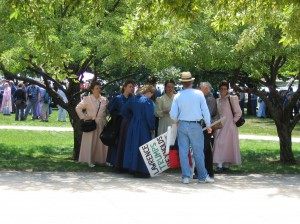
Here's something you don't see everyday: an FLDS (Fundamentalist Church of Jesus Christ of Latter-Day Saints) protest rally in Salt Lake City, reported on here, with photographs, by our friends at Juvenile Instructor, with background details on the controversy reported on in the local paper here, and further background and commentary here. As for the level of police state tension at today's protest gathering, suffice to say Chicago '68 it was not!

And since we're just a few days past Pioneer Day, here's the Pew Forum's report "A Portrait of Mormons in the U.S.," full of interesting data.

Selasa, 17 Maret 2009

Seeing Unlike a State

Paul Harvey

Just a bit more on the ARIS survey, and various responses to it, which we've blogged about it here twice already in the last few days. Deep in the lower depths of this semester it's been hard to investigate this much on my own, so thanks for those that we've linked to here for giving us useful commentary to interpret and contextualize the numbers. Here's one more, that discusses the free market of religious surveying (since the federal government does not collect statistics -- hence the result that these religion surveys involve seeing unlike a state), and how the surveyors often find what one might expect they would find: Nathan Schneider, "Seeing What They Wanna See," from Religion Dispatches, along with his more informal entry on his blog, here. Nathan has a suggestion that speaks to my own heart: that religion scholars create an NCAA-bracketology-like betting pool to bet on what numbers will go up or down as these various surveys get reported:

If you’re used to following religion news, there’s this occasional ritual that happens when one of the major polls gets released. The newspapers find the most sensational story they can in the numbers, then they pretend to freak out on the front page for a day, and then everybody happily forgets about the whole thing (except a poor handful of social scientists who actually have to rely on the numbers in their research). Come to think of it, we religion folks should start a pool and gamble on what comes out each time.

Minggu, 15 Maret 2009

Obama's Five Pastors and ARIS's Surveys

Paul Harvey

Laurie Goodstein, "Without a Pastor of His Own, Obama Turns to Five," discusses what happened when Obama, unlike our own Jon Pahl, was no longer jammin' with Jeremiah Wright. My favorite passage:

None of these pastors are affiliated with the religious right, though several are quite conservative theologically. One of them, the Rev. Joel C. Hunter, the pastor of a conservative megachurch in Florida, was branded a turncoat by some leaders of the Christian right when he began to speak out on the need to stop global warming.

Heavens, wouldn't want to be talking about that there global warming thing.

On another note: Gary Laderman takes aim at the ARIS study (reported on here a couple of days ago), in "Sacred and PRofane: ARIS Survey Gets Religion, Misses Boat." Then, Mark Silk responds to him here. The exchange shows both the limitations as well as the utility of religious adherence surveys.

Senin, 09 Maret 2009

American Religious Identification Survey

Paul Harvey

The ongoing ARIS (American Religious Identification Survey) project has just released its latest numbers -- a brief summary story and graphics are here. There are some obvious limitations about surveys such as these, but generally they provide some interesting data for discussion. The biggest news on this one: the rise of the "nones," i.e. no religion -- up to 15%, from a starting point of 8% in the original 1990 survey, and now almost equal with Baptists and just a little under Catholics as the top group in the survey -- more on them here. Generally, almost all denominations have lost ground, according to the survey; the relative decline of non-Catholic Christian groups is graphed here, while the growth of respondents answering "no religion" is graphed here. Other researchers are attempting to tabulate the growth of Islam, which they feel is undercounted in these surveys. Overall, the friendly atheists are happy! Perhaps Obama's deliberate inclusion in his addresses of "those with no faith" and like phrases will appear more frequently in political discourse.

Selasa, 15 Juli 2008

"It's Just the Way It Is":Of Spiritual Salad Bars, Spiritual Bazaars, Spiritual Shopping, and Spiritual Seeking

By Phillip Luke Sinitiere

As many readers are no doubt already aware, the Pew Forum on Religion and Public Life recently released the second report of its U.S. Religious Landscape Survey. Part one dealt with religious affiliation, and part two covers beliefs, practices, social, and political views.

Part of the second report's summary reads as follows:

A major survey by the Pew Research Center's Forum on Religion & Public Life finds that most Americans have a non-dogmatic approach to faith. A majority of those who are affiliated with a religion, for instance, do not believe their religion is the only way to salvation. And almost the same number believes that there is more than one true way to interpret the teachings of their religion. This openness to a range of religious viewpoints is in line with the great diversity of religious affiliation, belief and practice that exists in the United States, as documented in a survey of more than 35,000 Americans that comprehensively examines the country’s religious landscape.


This is not to suggest that Americans do not take religion seriously. The U.S. Religious Landscape Survey also shows that more than half of Americans rank the importance of religion very highly in their lives, attend religious services regularly and pray daily. Furthermore, a plurality of adults who are affiliated with a religion want their religion to preserve its traditional beliefs and practices rather than either adjust to new circumstances or adopt modern beliefs and practices. Moreover, significant minorities across nearly all religious traditions see a conflict between being a devout person and living in a modern society.

The Landscape Survey confirms the close link between Americans' religious affiliation, beliefs and practices, on the one hand, and their social and political attitudes, on the other. Indeed, the survey demonstrates that the social and political fault lines in American society run through, as well as alongside, religious traditions. The relationship between politics and religion in the United States is particularly strong with respect to political ideology and views on social issues such as abortion and homosexuality, with the more religiously committed adherents across several religious traditions expressing more conservative political views. On other issues included in the survey, such as environmental protection, foreign affairs, and the proper size and role of government, differences based on religion tend to be smaller.

One of my hometown newspapers, the Houston Chronicle, ran a story on the Pew Report, observing, "Texas appears to be more religious than the nation as a whole, according to the survey, with 47 percent of Texans saying they attend church once a week, compared to 39 percent of Americans. Moreover, 77 percent of Texans say they have an absolutely certain belief in God, compared to 71 percent of people nationwide."

As the saying goes, everything is bigger in Texas.

On a more serious note, the point of this post is to highlight the early impressions, observations, and interpretations of the data. I find it interesting that in response to both reports commentators and analysts find evidence of and for a religious economy. (See Kelly Baker's previous post on the report, as well as thoughts offered by Luke Harlow and Randall Stephens.)


Writing about the first report, Susan Jacoby calls the U.S. a spiritual bazaar, while Chester Gillis prefers to write about seekers and shoppers, as does Martin Marty.

Kelly Baker's blogpost cited above quotes the Jacoby and Gillis analyses so I won't post those here. However, Marty's thoughts, originally part of a Sightings piece, correspond nicely to those offered by Jacoby and Gillis.

According to Marty:

Shopping and switching accelerate long term trends. Centuries ago, evangelists in staid New England lured established Congregationalists into becoming ecstatic Baptists; advertising, luring, and changing has long gone on since. Here is Emerging Trends, June, 1980: "LESS THAN HALF REMAIN IN SAME DENOMINATION. Princeton, N.J. Fewer than half of U.S. adults [43 percent] say they have always been a member of their present religion, or denomination, as determined by a recent Gallup survey.

Is that good or bad? It's certainly inevitable. Mobility, the tangle of mass university experience, inter-marriage, advertising, competition, perhaps a dose of pick-and-choose egocentrism, "fulfilling…boutique church-going desires" (Wall Street Journal, March 1), valid or superficial judgments on the religious affiliation one is leaving, and profound spiritual searches all go into the "switching" and "changing" mix. Together they assure that those who cover American religious life will not run out of puzzling and exciting subject matter, as they switch subjects and change attitudes themselves.

Most, I presume, will agree that a religious economy exists in America, or at least consider using the marketplace metaphor to help explain the dynamics of religion in the U.S. It is not the only interpretive grid of course, and there are other meaningful metaphors to use. Nevertheless, as I read responses to and interpretations of the report it struck me that many used economic terms and ideas to explain religious affiliation and non-affiliation. Religious economy, or at least some configuration of the marketplace approach, apparently has staying power.


I end with the observation of Rice sociologist Michael Lindsay about the second report, quoted in the Houston Chronicle article: "Religion in American is like a spiritual salad bar. Americans pick and choose their beliefs and religious practices in a custom-designed faith system. I don't have a judgment call on whether it's good or bad. It's just the way it is."


[More religion humor found here.]

Senin, 03 Maret 2008

Buffet of the Spirit and Redneck Judaism


PAUL HARVEY

Following our blog's discussion of the recent Pew survey, here's a funny and engaging personal reflection on one man's conversion to Judaism. A nice passage which fits with memories of my younger years:

In the Protestantism of my childhood, the Bible, especially the New Testament, was meant to be read, but reverentially. The words were cast in stone; they didn’t resonate with the earthy energy that I find in Torah.

Dana Jennings, author of this piece, also recently published Sing Me Back Home: Love, Death, and Country Music, where he chases some dragons of his own past in a manner akin to Gram Parsons in the next blog entry below.

Minggu, 02 Maret 2008

God's Row and America's Religious Landscape


“God’s Row” and America’s Religious Landscape
by Darren Grem


Since we’ve lately been on the topic of the nation’s contemporary religious landscape, I thought I’d broadcast an interesting article from Sunday’s NY Times. According to James Angelos, storefront churches and temples have been popping up with increasing regularity along a two-mile stretch of White Plains Road in the Bronx, changing the borough’s religious environment and possibly affecting its economic well-being. We’ve discussed religious organizations as economic entities before, but this story relates another perspective. Detractors think this area of the borough needs more than spiritual rejuvenation, arguing that the churches and temples along “God’s Row” take up real estate that could better serve the community if zoned for business. Religious leaders disagree, arguing that the economic problems in the area predated the “revival” along White Plains Road.

Regardless, the row over God’s Row hints at some of the broader social and economic ramifications – whether direct or indirect – caused by the various religious restructurings currently occurring across America. Read all about it here.

Jumat, 29 Februari 2008

"On Faith" Roundtable: The Pew Survey on U.S. Religion


BY KELLY BAKER

Luke already pointed us to the new Pew survey on U.S. religion, and the Washington's Post "On Faith" had a roundtable on the very topic with some heavy hitters including Martin Marty, Susan Jacoby, Chester Gillis, Susan Brooks Thistlethwaite, Anthony M. Stevens-Arroyo, and many others. Each weighed in on the survey and gave their interpretation of the American religious landscape with quite different conclusions. Here are some excerpts.

Martin Marty, "In Sickness and In Health"
Is it a mark of the health or sickness of American religion that so many Americans have switched their religious affiliation in adult life or dropped out? The answer is "yes."

Before elaborating, let me say that both findings point to something that is almost inevitable in today's world, and that virtually all religious leaders are aware of the trends.

Now to separate the two issues:

Is the fact that so many have switched their affiliation a mark of health or sickness. Let's look at the natural causes: there are millions and millions of "interfaith" marriages, and in many cases the switching occurred out of love on the part of one spouse for the other, and religion comes along as part of the package deal. Or interfaith marriage may have created tension and worked destructive effects on the marriage and the religious commitments of both. So when either or both "switches," the marriage may prosper, as might the religious faith of both.

There are, of course, many other reasons for switching. It can be a sign of sickness if religion is nothing more than a lightly-purchased commodity, one not backed by faith-commitment so much as by convenience, fad, or fashion and an unwillingness to deal with the demands of a faith.. It can be a sign of dilettantism, of attraction to fads, and that cannot be a good sign of health.


Susan Jacoby, "The American Spiritual Bazaar: Something for Everyone"
The relative ease with which Americans cast off one spiritual identity for another is an old phenomenon; the Pew findings show only that there has been an expansion and acceleration of a longtime, perhaps inevitable, trend in a pluralistic society. Our secular Constitution provided the underpining for the fluid American religious landscape.Try as they might--and religious denominations certainly did in the past--the legal foundation of American society upheld the right of citizens to choose their own religion. Your priest, rabbi, or parents might be furious if you stepped outside the fold, but American society as a whole didn't care.

...

America has always been a nation that offered extraordinary possibilities for reinvention[sic]; religious reinvention is one of those possibilities. From the standpoint of denominations being abandoned, this is certainly a weakness. The Catholic Church could count on no help from American society when people started abandoning it because of its stands on birth control, divorce, and a celibate male priesthood. Most rabbis still refuse to participate in ecumenical marriage ceremonies because they know that every intermarriage weakens traditional Judaism. Paradoxically, the ease with which Americans change religious identities may account for the excessive respect with which religion in general is regarded in this country.

In general, the Pew findings strongly support the idea advanced by Alan Wolfe, director of the Boisi Center for Religion and Public Life at Boston University, that American religion can be characterized as "broad but shallow." We have a minority of devout right-wing fundamentalists who have exercised political influence out of proportion to their numbers, and a minority of secularists who exercise less political influence than their numbers merit. In between there is a broad America that believes in God and respects religion in general but is not strongly committed to exclusionary religious principles or to a closer relationship between religion and government. There are also huge numbers of Americans who describe themselves as "spiritual but not religious"--a phrase I take to mean that they are hedging their bets by believing in some sort of divine providence but are not interested in undertaking the obligations that adhere to traditional religion. These are not people who want to get up for temple on Saturday or church on Sunday morning, but they like to watch television shows about angels and teenagers who talk to God.

Chester Gillis, "We Are Seekers and Shoppers"
Americans are seekers and shoppers. When it pertains to religion, they are no different. You may hear someone say, “I was baptized Catholic, married a Lutheran and became one, divorced, and now am unaffiliated.” This describes a growing number of Americans. The Pew Forum survey tells the story of religious identity in America. We are a mobile society not only in where we live, work, and travel our travel; we are also religiously mobile.

No doubt there are numerous reasons for such mobility, including exogamous marriage, longer lives and geographic, social, and economic factors. America’s freedom of ideas, speech, and religion underscores how different it is from many nations where a single religion dominates or where changing affiliation is simply not done, frowned upon, or even forbidden

For me, the most dramatic statistic reported in the survey is the category of “unaffiliated,” which has the highest self-identification (31%) among 18 to 29 year olds. This result mirrors studies of young Catholics (described as millennials born in 1979 or later) who demonstrate a low rate of identifying with institutional Catholicism. Recent statistics also indicate that one third of Americans who identify themselves as Catholics, approximately 23 million people, do not belong to parishes and thus likely do not have regular contact with the church.

Susan Brooks Thistlethwaite, "The U.S. is Post-Denominational"
It is clear from this Pew study that the old denominational affiliations no longer apply. The religious landscape in the U.S. is best described these days as “post-denominational.” Post-denominational means that it is far less important whether you are Methodist or Baptist, or even Catholic, than where you fall along the continuum of fundamentalist to evangelical to progressive (liberal) to secular or unaligned. While some faiths or denominations generally are more evangelical or more liberal, each tradition has a wide spectrum within it. If you are a liberal Christian in a conservative Protestant denomination, you may have more in common with a Reformed Jew than with the Christians in your own denomination.

The shift in religious affiliation, or away from religious affiliation, has the most correlation, in my view, with that range of religious cultural assumptions than with any specific doctrine. And when people move from one affiliation to another, they are choosing a better cultural fit.

Anthony M. Stevens-Arroyo, "What's Missing From the Unsurprising Pew Study"
There are two reasons none of this is new: 1) religious identity with institutions changes when people migrate; and 2) personal religious preferences change when people of different faiths intermarry. To dispatch the last point first: the percentage of people married to a person of another church in the Pew Study is 40% and that is the same as the percentage who have switched religion. Protestants, like Baptists and Methodists, switch from congregation to congregation with amazing ease. The more intermarriage among people of different denominations, the more one or both leave the original congregation. Moreover the so called “non-denominational” churches serve the purpose of reconciling the religious differences between two Protestants by providing a vanilla brand with which both can feel comfortable.

All of this is common sense and has been researched before Pew came along. What it might mean is a thornier issue. Accommodating contemporary patterns of choice is considered by some a sign of religious weakness, but as proof of religious vitality by others. Like the argument about whether the glass is half-full or half-empty, solving the puzzle is more a statement about the observer’s preconceptions than an evaluation of fact.

In the PARAL Study we found that the religion of the mother is more likely to dominate in a family where only one faith is chosen for the children. This is Jewish law, of course, but it also demonstrates that practice of religion while a child falls within the realm of the woman. Professor Ana María Díaz-Stevens of Union Seminary in New York calls it “the matriarchal core.” Unlike the Pew study results which lumped together all people, the PARAL Study found that among Latinos the Catholic religion of the mother is more likely to be the children’s religion in two out of three households.

The role of migration is also a major factor in religious switching. The Pew Study pointed out that Catholicism rests today on the new members added by immigration. What was left unstudied was the larger theme explored in the PARAL Study about how Latino immigrants have changed U.S. Catholicism. In fact, the supposed “defection” of Latinos and Latinas is really more about “disaffection” for new parishes and lackluster liturgies. We found that as upper mobile Latinos and Latinas move to the suburbs, there is a tendency to perceive the suburban parish as not as welcoming as the typical mission or barrio congregation where Latinos predominated. Social distance is the result.

Senin, 25 Februari 2008

Pew Survey on U.S. Religion


Recent Pew Survey on US Religion: Something Old, Something New?
By Luke Harlow

According to this article in the New York Times, the American religious landscape is uncertain as ever. The Pew Forum on Religion and Public Life has just released the U.S. Religious Landscape Survey and it includes some interesting statistics. Among them:

The U.S. Religious Landscape Survey estimates the United States is 78 percent Christian and about to lose its status as a majority Protestant nation, at 51 percent and slipping.

More than one-quarter of American adults have left the faith of their childhood for another religion or no religion at all, the survey found. Factoring in moves from one stream or denomination of Protestantism to another, the number rises to 44 percent.

One in four adults ages 18 to 29 claim no affiliation with a religious institution."

And there's also this data:

"On the Protestant side, changes in affiliation are swelling the ranks of nondenominational churches, while Baptist and Methodist traditions are showing net losses.

Many Americans have vague denominational ties at best. People who call themselves ''just a Protestant,'' in fact, account for nearly 10 percent of all Protestants.

Although evangelical churches strive to win new Christian believers from the ''unchurched,'' the survey found most converts to evangelical churches were raised Protestant.

Hindus claimed the highest retention of childhood members, at 84 percent. The group with the worst retention is one of the fastest growing -- Jehovah's Witnesses. Only 37 percent of those raised in the sect known for door-to-door proselytizing said they remain members.

Among other findings involving smaller religious groups, more than half of American Buddhists surveyed were white, and most Buddhists were converts.

More people in the survey pool identified themselves as Buddhist than Muslim, although both populations were small -- less than 1 percent of the total population. By contrast, Jews accounted for 1.7 percent of the overall population.

Much of this data seems to confirm what the scholarship on American religion has suggested for some time: the declining significance of of the denomination, believing Americans' lack of deeply held ties to traditions and institutions, and the tenuous nature of any sorts of claims that the United States is a "Christian nation," are classic themes in the literature.

From another perspective, however, I wonder if we have scholarly answers for all the questions this data raises. In what sense, for example, are religious non-affiliates--a group that seems to be growing, especially among younger Americans--religious? (Of course, that might just be begging a question about how we most effectively assess religiosity.) Put another way, do these statistics force us to reassess our views on American religious life?