Tampilkan postingan dengan label theory. Tampilkan semua postingan

Kamis, 07 Juli 2011

Hannah Adams' Intellectual Grandchildren; Or, Maybe It Was All Liberal Protestantism, After All?

By Michael J. Altman

Robert: I feel that an earlier generation of scholars of religion was willing to consider these questions. The answers may not always have been satisfying–but I think of William James here, or even the early theorists of crowd behavior. There were scholars interested in talking about how we think about these sorts of human events, but I don’t see it anymore.

Richard: James is the perfect example of it–

Robert: But in the end he’s too individualistic for me!

Richard: Very Protestant, maybe?

Robert: Yes. [Laughs]


Maybe it's just me, but it feels like it's a strange time in the field of religious studies. I've been hiding in my dissertation cave for the past few months so maybe that's part of it. Yet, every time I poke my head out I keep noticing things. Little things. Reports of unease in the rooms of that conference in Indianapolis here, a dialogue about "presence" and "abundant events" that seems to run out of vocabulary before it can get off the ground there. To me, these moments signal the slow death of liberal Protestant religious studies and the grasping about for whatever will come next.

Paul already mentioned James Turner's Religion Enters the Academy but I want to come at the book from a different angle.  Paul is right, William James is the hero of the book in the final chapter. But the first two chapters narrate the rise of the comparative and academic study of religion in America among liberal (mostly Unitarian) Protestants. In the first chapter, Turner brings Hannah Adams and Joseph Priestly to the fore as the early comparativists before 1820. Chapter two follows the growth of Unitarian and Transcendentalist interest in world religion from 1820 to 1875. This includes Thomas Wentworth Higginson's The Sympathy of Religions (1871), Lydia Marie Child's Progress of Religious Ideas through Successive Ages (1855), and James Freeman Clarke's  Ten Great Religions (1871). Meanwhile, Harvard, Yale, and Princeton offered comparative religion as part of their ministerial training in the latter quarter of the century. The University of Chicago opened its doors in 1892 and quickly added a department of comparative religion. Then, a year later and in the same town, the World Parliament of Religions attempted to unite "all religion against all irreligion" with the help of many liberal Protestants. The long and the short of it--the history of religious studies is the history of liberal Protestantism.

It's not that early scholars of comparative religion happened to be liberal Protestants. Rather, Turner shows that comparative religion, and later religious studies, was a particularly liberal Protestant project. As he puts it, "Comparative religion during its first academic decades in the United States was thus a historically minded, text-based study, oriented toward articulated religious or ethical propositions. And the discipline's driving motive, stated or unstated, was t understand how non-European religions stacked up against Christianity" (65-66). It was a project by Protestants, for Protestants, using Protestant categories.

Enter our hero, William James. James shifted the categories in The Varieties of Religious Experience. Gone were texts. Gone were institutions. Gone were beliefs, creeds, and doctrines. James went after experience. James also threw out the hierarchy of "world religions" and placed religious experience on a level playing field, drawing on contemporary accounts of religious experience. James got rid of the Protestant categories, and took little interest in comparing Christianity to other religions. Turner ends the book noting that, in the end, William James won. Maybe. James is still taught in "Theory of Religion" courses. I even read Varieties in a graduate seminar a few years back. We don't read James Freeman Clark anymore.

But Robert Orsi's laugh takes all the wind out of Jamesian sails. Even William James is too Protestant--too individual. Religion for James was "the feelings, acts, and experiences of individual men in their solitude, so far as they apprehend themselves to stand in relation to whatever they may consider divine." I imagine Cotton Mather in his private solitude meditating on the grace of God not a procession in Italian Harlem.

As I read work on Asian religions, mostly Hinduism, the argument against the term religion--and by extension religious studies--seems rather easy. It's a Western term that doesn't fit well with the realities of Indian culture. Fine. We can have the debate if you want. But what if it isn't an East / West problem? What if the unease of religious historians not knowing their Bible or not wanting to admit to it, the back and forth of Bushman and Orsi trying to find a way to account for "abundant events," and the liberal Protestant history of religious studies are all linked? What if religious studies doesn't fit well with the realities of American culture? Maybe the unease in Indy and the search for adequate language to describe religious experience are really the unease of our liberal Protestant history and the search for a way out of it.

The field has been trying to shed its history for a long time now. As a religious studies major in college I took the "Theory of Religion" course. We read Durkheim, Freud,Weber and other European thinkers important to the field. Other than James we didn't read any Americans until we go to the late twentieth century--Eliade, J.Z. Smith, Russell McCutcheon. We ignored the American history of the field and its liberal Protestant baggage--poor James Freeman Clark.

William James won. But is that enough?

Minggu, 06 Maret 2011

Bowling Alone With God while Catching Hell With Rob Bell

Paul Harvey

In the Wilson Quarterly, my scholarly co-conspirator (and occasional guest contributor here) Kevin Schultz reviews the new book by the eminent sociologist Robert Putnam and American Grace: How Religion Divides and Unites Us (we have mentioned the book briefly here before, and Robert Wright reviews it in theNew York Times here, while plenty of the book's other findings, reflections on them, and links to other discussions of the work are posted over at the Social Capital Blog). The findings are not especially surprising, for religious history scholars anyway, but Schultz commends the vast data sets surveyed in the book. In short:

Putnam and Campbell’s thesis, supported by numerous surveys, including two they conducted themselves, is that since 1950 the American religious landscape has become simultaneously more polarized and more tolerant. While 72 percent of Americans today think “America is divided along religious lines,” a “whopping 89 percent” (including 83 percent of evangelical Protestants) nevertheless believe that heaven is not reserved solely for those who share their faith, a finding that suggests tolerance absent just a generation ago.

It's amusing that this review coincides with the latest internet flare-up of religious polemics: Rob Bell, pastor of Mars Hill Bible Church, publishing a new book Love Wins which, so I gather, questions the existence of eternal hell. For that sin, he's being cast down into hell by some powerhouse evangelical theologians and gatekeepers (not that they could have read the book yet -- the condemnation came based on some a publisher's press release promo for the book). Eric Reitan summarizes the story over at Religion Dispatches, where he terms the reception to Bell's book "excommunication by tweet":

This short description launched a frenzy ofreactions within the evangelical community. Justin Taylor, vice president of editorial at Crossway,quickly posted a fierce condemnation—based solely on advance material. “It is unspeakably sad,” writes Taylor, “when those called to be ministers of the Word distort the gospel and deceive the people of God with false doctrine.” He concludes that Bell “is moving farther and farther away from anything resembling biblical Christianity.” Taylor’s post spurred a furor of tweeting and blogging, including a curtly dismissive tweet from Bethlehem Baptist Church’s John Piper: “Farewell, Rob Bell."

It reminds me of reading through countless denominational controversy polemics from the 19th century, esp. ones pitting the Methodists and the Baptists firing away at each other on Calvinism, infant baptism, and other controverted issues. Ultimately, that sound and fury signified little but the explosion of an antebellum evangelical empire. And internecine theological food-fights are fun to watch, and fun to study, in part because they suggest how much religion matters personally. And how much it doesn't matter in other ways. As Schultz puts it in his review, paraphrasing a part of Putnam and Campbell's book:

A Missouri Synod Lutheran pastor, confronted with data showing that more than four-fifths of his denomination don’t believe that one’s faith is the only avenue to heaven, remarked that he and his fellow pastors had “failed.” But while most clergy side with that pastor, most parishioners are quite happily tolerant. This is the American grace of the book’s title.

And I might mention that some Appalachian religious folk, the "No-Hellers of Central Appalachia," beat Rob Bell to the punch a long time ago (a brief summary of their tenets may be found here). There's nothing like hearing Universalism preached with an Appalachian inflection. The downside of their theology: no "Hell Houses" on Halloween. And that leaves us with the question: What would Jason Bivins do/study?

Rabu, 23 Februari 2011

What the Foucault (Do We Know)?: FSU's Grad Symposium Redux


Kelly J. Baker

As I am still recovering from a whirlwind weekend at Florida State University's Tenth Annual Graduate Symposium, I wanted to note how much I enjoyed my time this weekend and what a boon this conference is to religious studies graduate students. What you all should know from the outset is that I am not a neutral observer. I love this conference, and Mike Pasquier and I even organized it long, long ago. (Hat tip to our own contributor Emily Clark was the organizational guru this year).

Now, I did not attend every panel nor did I attempt to, so I encourage readers and participants who attended other panels to send their reflections along. What I was able to do was to talk to graduate students of alma mater and other institutions about their own work and mine as well. The paper presenters swung for the fences, and I enjoyed their energy, evidence, and historiographical strategies. Grads in American religious history presented on papers ranging from Emily Post to Christian manhood to the Holy Land Experience to body studies to Burning Man to border saints to the problems of "lived religion" to beards and shaving. The brilliance of this symposium is that it allows a welcoming and encouraging environment for grads to present their work with feedback from the likes of John Corrigan, Amy Koehlinger, Amanda Porterfield, Kathryn Lofton, and Sylvester Johnson to name only the Americanists. (Any graduate student in religious studies writ large should plan to go next year.)

The keynote with the best title ever was "What the Foucault Do We Do Now?" with Matthew Day, Sylvester Johnson, Matthew Kapstein and Katie Lofton interrogated the place of power in the study of religion, the institution of the academy, and the genealogy of religious studies. The panel paired scholars of ranging interests from methods and theory to Buddhism to American religious history and posed the question of how power (read Foucault) functions both for our subjects of study but also for our positions as scholars. For the interest of RIAH readers, Day, Johnson and Lofton proved to engage exactly what is at stake in religious studies from very different positions. Johnson prodded the strange bifurcation between the academy and the "real" world, and he argued compellingly that just because the origins of religious studies are bound to colonial endeavor does not mean we (religious studies scholars) should burden ourselves solely with origins. Instead, our knowledge and expertise applies to the "real" world because the academy, despite various attempts, is still bound to our contemporary moments. We are experts, we have power, and we should use it.

Lofton employed IBM advertisements to discuss the merger of power and subjectivity. She suggested that these particular ads did not uplift individuals but rather created a powerless collective at the whim of power grids, bad traffic, and other mundane problems of contemporary life. Each of us faces the similar hum drum, and the ads questioned our agency even in how companies market products not to me or you, but some amorphous us. From ads to religion, Lofton noted that perhaps religion is best understood as repository in which things, ideas, and brands collect. My sense was that religion was archive, hodge podge, even bricolage in this analogy. To understand religion is to understand the pile-up.

In my assessment, Day's contribution offered the opposite of Lofton--religion as empty. Day was troubled by the category of religion, the discipline of religious studies. Building upon Bruce Lincoln and Russell McCutcheon, Day argued that religious studies scholars don't problematize religion, so that as a category religion is valueless because of its infinitude. He asked can it be art or sports? Moreover, he wants religious studies scholars to question the reliance upon "experience" as a measure of religion. What does it mean? Or more importantly, what is at stake when we gesture to experience? Day's critique suggested a need for a critical edge about what is religion and what we study when we assert religion as our subject matter. Moreover, does the gesture to experience limit our subject matter?

During Q&A, I asked Lofton and Day to compare their stances about religion as repository or as empty. What is at stake in empty or full? Their answers are theirs, but I couldn't help but wonder what my own assessment of this was. Part of me wants to claim the middle path of "can't it be both?", but that is terribly unsatisfying. The power of religion as a category is what is at stake in their assertions, and I wonder how often religious studies scholars interrogate what exactly religion is in our own work. Is it empty or full? Is it value-free or value-filled? Do we craft our own categories of religion as experience, belief, practice, etc? Do we use the categories of those we study? In my own work, I confront the strange yet different assumptions about "good religion"(read helpful and therapeutic) versus "bad religion" (read harmful or malicious) because I work on the "bad." The commentary usually moves something like "bad religion" is not religion at all. What is religion becomes, then, essential to how to approach the Klan, the hate movement, or even my newer fascination with apocalypticism. How I make the case that this is actually religious becomes significant. I point to the pile-up: theology, ritual, practice, and belief that all show the Protestant nature of the Klan. Yet, I could also point to the emptiness (malleability) of Protestant as a label, of religion as a construct, yet I don't. I could though. Empty or full?

Graduate students, if these kinds of questions are interesting to you, plan on attending next year's symposium at FSU. If they aren't, plan on attending or presenting anyway because you can't beat the encouraging environment, the weather, or the chance to ask, "What the Foucault do we do now?"


Selasa, 07 Desember 2010

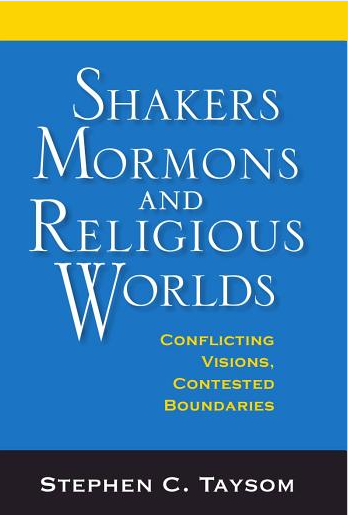
Shakers, Mormons, and Religious Worlds

Christopher Jones

Last week I received in the mail a copy of Stephen Taysom's Shakers, Mormons, and Religious Worlds: Conflicting Visions, Contested Boundaries, recently released from Indiana University Press as part of their Religion in North America series. As I noted in a post a little over a month ago at the Juvenile Instructor, it is the first book on Mormonism to be published as part of that series.

Steve is a good friend and a thoughtful scholar, and I'm anxious to read through the book (just as soon as I finish grading final exams). I've read the dissertation that served as a starting point for the book manuscript, and while my own proclivities generally don't lean toward theory-heavy analyses, I found Steve's research insightful. He takes the comparison between the Shakers and Mormons further than anyone else has to date, revealing that even beyond their communitarian lifestyles and alternative marital practices and sexual arrangements, the two can be compared in fascinating ways. Looking at the rules that governed daily life in each community, their respective dietary codes, and their comparative modes of religious experience, Taysom adds much to our understanding of new religious movements in 19th century America (and provides some great fodder for lectures).

Over at the Juvenile Instructor blog, Matt Bowman has interviewed Steve about the book. Matt posted Part I this morning, and Part II should be following later this week. Part I describes where the idea for the book came from, the process of finding a publisher and revising the dissertation into a book manuscript, and Steve's reflections on the current place and trajectory of Mormon studies in the academic world.

If you or the religious studies geek in your life is looking for a last minute Christmas gift, consider stuffing her stocking with Shakers, Mormons, and Religious Worlds.

Minggu, 07 November 2010

"Things Do Things"

Emily Clark

Those of us who were in Atlanta for the AAR have had nearly a week to recover from our self-inflected wounds of staying up late and social networking over lagers and ales. We have also had a little under a week to digest the wide-ranging, quality panels and papers we had the opportunity to hear. One Saturday afternoon panel that continues to stick out for me was the Author Meets Critics panel for Thomas Tweed’s Crossing and Dwelling: A Theory of Religion. Though the book came out in 2006 and in 2009 the Journal of the American Academy of Religion published a review symposium, including a response from Tweed, this 2010 session in Atlanta drew quite a crowd. Based on his years in the field of religious studies and American religious history, Tweed defines religion as “confluences of organic-cultural flows that intensify joy and confront suffering by drawing upon human and suprahuman forces to make homes and cross boundaries.”

Unfortunately Ivan Strenski (of University of California, Riverside) was unable to attend, but the three other respondents/“critics” led off an engaging discussion that ranged from scholarly moral obligation to the agency of “things.” Chip Callahan (University of Missouri) reflected on Tweed’s book in light of his current research on the religious lives and worlds of New England whalers. Callahan found Tweed’s work helpful because his use of dynamic water metaphors allows us to focus on the everyday lives of our actual subjects. Marie Marquardt (Agnes Scott College)’s reflections on Oscar, a Mexican migrant “outsider” living in the US who she met during her fieldwork, demonstrate how a theory or definition that is itself “on the move” resonates well with subjects who are on the move. Also recognizing Tweed’s dynamic definition, Grant Wacker (Duke University) spoke about the “positionality of the observer” and the “motility of data,” along with amusing anecdotes from his years of working with/near Tweed in North Carolina.

During his response and the Q&A session following, Tweed reflected on his past projects and his forthcoming book on the National Shrine of the Immaculate Conception. He spoke of the moral obligations we as scholars have to our subjects, living or dead. Both ethnographic work and archival work exists in a world of “moral entanglement.” Tweed also drew our attention to the significance of artifacts – for “buildings perform roles” and “statues have agency.” “Things do things.” Scholars of material culture have long called for the importance of stuff, but material culture can easily be overlooked by discussions of power and authority. Tweed’s short but poignant phrase “things do things” got me thinking about destroyed things. I’ve blogged before about Hurricane Katrina and Avery Gordon’s notions of haunting, as the absence of pre-Katrina buildings lends a ghostly presence to the Crescent City. Not only are dwellings important, the Q&A also prompted Tweed and the respondents to reflect on those who are excluded from home. In addition to looking at how/why some people are unwelcome from particular dwellings, destroyed dwellings and our subjects’ response to their destruction and absence is significant. Do they rebuild? Do they move? Do they forget? Or how do they remember? Non-things do things too.