Tampilkan postingan dengan label religion and public policy. Tampilkan semua postingan

Kamis, 05 Mei 2011

Glory Hallelujah: While Barton Marches On, Historians Live to Fight Another Day

Paul Harvey

By popular demand, I feel compelled to post this link to today's New York Times piece about the political influence of self-styled historian David Barton, and to this link to Barton 's appearance on the Jon Stewart show (and for a critique of it, see here). He puts on his best public face for Stewart, but sheds it when throwing out the red meat about the Terrible Oppression Visited on American Christians for his WallBuilders' radio audience and other friendly venues, as discussed here and here among many other places. Perhaps most to the point here, his relentlessly entrepreneurial streak has elevated him from fringe to center, and given him an impressive political power base as the house historian for any number of potential presidential candidates. To which I can only say: that is so not awesome!

Forthcoming soon will be my co-blogmeister Randall Stephens' book The Anointed: Evangelical Truth in a Secular Age (co-authored with Karl Giberson), in which a series of evangelical experts in "history" (Barton), "science" (Ken Ham) and other fields, who collectively constitute one of those mathematically possible alternative universes that the string theorists are always theorizing and talking about, are analyzed and set within context.

But in truth, Barton's ideological entrepreneurialism, and the pointless debates on trivialities that he has provoked (did Washington say so help me God -- who the hell cares, and who knows, maybe Jesus actually said "blessed are the cheesemakers'" as Monty Python speculated, is my answer), has just kind of worn me out, and I'd much rather call attention to real historians working on matters of scholarly/intellectual interest who also have a public voice and cache, and who engage the deepest and most transcendent issues with scholarly substance.

To that end, here's a story about historian and Harvard President Drew Gilpin Faust's Jefferson Lecture, about war and its fascinations from Homer to Bin Laden.

Ms. Faust traced what she called "the seductiveness of war" to its location on the "boundary of the human, the inhuman, and the superhuman," and the possibility it offers of transcending "the gray everyday" of life. "Stories of war are infused with the aura of the consequential," she said in her talk, "Telling War Stories: Reflections of a Civil War Historian."They're also as difficult to tell as they are compelling. She described how writers and soldiers throughout history have tried to describe the experience of war, only to find it slipping away from them. "There remains a fundamental untellability and unintelligibility about war," she said, which only makes it more powerful as a subject.

For American History readers, Faust will be best known most recently for her work This Republic of Suffering: Death and the American Civil War, discussed on our blog and reviewed here. Historian David Blight provides a fuller context for and a wonderful appreciation of Faust's scholarly career here.

Partly my attention to Faust's work came from the immediate political context of the jingoism of the Bin Laden celebrations set alongside the massive death and destruction of the last ten years -- a seemingly inevitable, if unsettling, part of how war stories unfold.

But more of it came from thinking of selecting works for next year's Civil War/Reconstruction class, as we enter the 150th anniversary. Over at Civil War Memory, Kevin Levin reflects on Faust's address, expresses his ambivalent feelings about war re-enactments, and quotes from part of Faust's address:

And yet. Two months from now, we will again witness a reenactment of the Battle of Bull Run. Tens of thousands of participants and spectators are expected, for the enthusiasm to refight the Civil War has only grown in the fifty years since the centennial observances. Most of the costumed soldiers and camp followers will have read extensively about the war; they will wear garments accurate to the last button and stitch; they will use period weapons and canteens and knapsacks, for authenticity is the watchword of the thriving reenactor culture. They will in these myriad details get history just right. But what will they understand of war? Will this reenactment do any more to acknowledge the war’s purposes and politics and their continuing significance than did the reenactments of fifty years ago? Will its celebratory mood and mode acknowledge what Frederick Douglass declared he would never forget: “the difference between those who fought for liberty and those who fought for slavery”? Will the reenactors tell only an old “battle piece” of courage and glory and how sweet and proper it is to die? Will we in this historic sesquicentennial — to be observed at a time when Americans are involved in real conflicts in three sites across the globe— forget what a heavy responsibility rests on those whoseek to tell the stories of war?
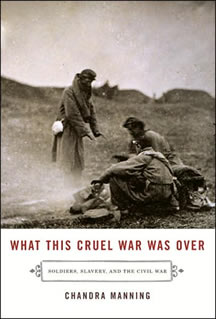
The last time I did this course, I paired Faust's Republic of Suffering with another powerful book, Chandra Manning's What This Cruel War Was Over: Soldiers, Slavery, and the Civil War Kevin Levin usefully reviews it here; a useful contrast is his take on Gary Gallagher's The Union War, posted here); taking the two works together (Manning and Gallagher, I mean) gives one a good rundown on recent debates on how Americans of the time gave meaning to the war.

The result of the pairing of Faust and Manning -- one about the impossibility of a "good death" during the war, and the other about the larger socio-political meanings people gave to the sacrifices on both sides, was some of the most powerfully engaged student discussions I had ever seen, because the works compelled a profound consideration of the question Edward J. Blum raised in his review of Faust: was there ultimately a transcendent meaning in all this death? Was there life that emerged from the death-haunted republic of suffering? Was war a force that gave Civil-War era people meaning, and if so, how does that affect our perceptions of contemporary wars?

Eric Foner raises many of these same questions in his review of Gary Gallagher's new book The Union War in last Sunday's New York Times Book Review. In some contrast to Manning and a number of other contemporary historians, who see a significant shift in soldiers' attitudes through the course of the war, Gallagher argues that emancipation "always 'took a back seat' to the paramount goal of saving the Union. Most Northerners, he says, remained indifferent to the plight of the slaves. They embraced emancipation only when they concluded it had become necessary to win the war. They fought because they regarded the United States as a unique experiment in democracy that guaranteed political liberty and economic opportunity in a world overrun by tyranny." In effect, this was a war about the nation-state, with emancipation a somewhat accidental by-product. Gallagher and Manning both rely on an extensive body of research (including in the regimental newspapers, not often used by other historians) which brings in first-hand evidence from the soldiers (and their homefront supporters). Weighing that evidence, and trying to determine what represents the views of "many" or "most" soldiers, becomes one of the central points of contention here. I'm no expert on any of this, but the discussion raised has been terrific.

Foner challenges Gallagher's view by asking, essentially, what was this cruel war over? He concludes:

Before the war, slavery powerfully affected the concept of self-government. Large numbers of Americans identified democratic citizenship as a privilege of whites alone — a position embraced by the Supreme Court in the Dred Scott decision of 1857. Which is why the transformation wrought by the Civil War was so remarkable. As George William Curtis, the editor of Harper’s Weekly, observed in 1865, the war transformed a government “for white men” into one “for mankind.” That was something worth fighting for.


The "something" that was worth fighting for became the crux of the student discussions in my class (and countless other Civil War classes around the country, of course), and provided some moments of intellectual transcendence (and fierce debate). Barton et al aside, there's hope yet for the public presentation of serious history, including those which which centrally involve religious themes of meaning, purpose, violence, and the sacred.

Sabtu, 20 Maret 2010

First Annual Conference on Public Intellectuals, 23-24 April 2010, Harvard University

Randall Stephens

Next month I'll be taking part in an interesting new conference on public intellectuals. (I've been working on public anti-intellectuals of late, so this should be fun.) The organizers Larry Friedman (Harvard) and Damon Freeman (UPenn) hope to draw interested parties to the conference. All sessions are open to the public.

Here's the summary:

In 1993, literary critic Edward Said defined the ideal intellectual as someone who stood outside circles of power while advancing knowledge and freedom for the wider public in "speaking truth to power." This first annual Conference on Public Intellectuals seeks to deepen and broaden Said's critique by providing an opportunity to scholars who are writing on public intellectuals.

The conference will take place over a period of two days, Friday and Saturday, 23-24 April 2010 at Harvard University. It is free and open to the public. The conference venue is in Room 1305 of William James Hall, 33 Kirkland Street on Harvard's campus. Sixteen papers are spread over four sessions: Public Intellectuals as Cultural Icons; Religion, Science, and Tolerance; and Race, Gender, and Protest, Parts One and Two. The conference also features two plenary sessions on Career Reflections. The conference is also working in conjunction with "The Future of American Intellectual History" symposium taking place Friday afternoon, 23 April in the Lower Level Conference Room at Harvard's Busch Hall.

See the full program here.

See this recent post on a conference exploring a related theme: CFP: “Intellectuals and Their Publics”: Third Annual U.S. Intellectual History Conference Sponsored by USIH and the Center for the Humanities, The Graduate Center, CUNY, New York City

Minggu, 14 Februari 2010

Texas Toast: Christianity and History in the Lone Star State, Part DCLXVIII


Paul Harvey

Today's New York Times magazine features another roundup of the Texas schoolbook controversy: Russell Shorto, "How Christian Were the Founders."

Since we have blogged a bit before about this, and it's been covered much more extensively and thoughtfully by (among many others) John Fea's twenty-five (and counting) posts, I don't have that much useful to add except mainly to call your attention to this very nice piece by Shorto. The public hearings over these standards were a circus defying parody. As John Fea put it, "This is what happens when non-historians try to mess with state history standards."

Just two points to mention a bit further. First, Shorto follows the remarkable career of Cynthia Dunbar, who manages to be a law professor for Liberty University in Lynchburg while residing in Richmond, Texas, and who serves on the Texas board of education which has overseen the textbook standards even while likening sending children to public schools to “throwing them into the enemy’s flames, even as the children of Israel threw their children to Moloch.” Shorto writes:

In 2008, Cynthia Dunbar published a book called “One Nation Under God,” in which she stated more openly than most of her colleagues have done the argument that the founding of America was an overtly Christian undertaking and laid out what she and others hope to achieve in public schools. “The underlying authority for our constitutional form of government stems directly from biblical precedents,” she writes. “Hence, the only accurate method of ascertaining the intent of the Founding Fathers at the time of our government’s inception comes from a biblical worldview.”

Dunbar is leading the charge of those who insist on connecting the Declaration of Independence and the Constitution, then somehow declaring the Declaration to be based on Christian principles, and then from there arguing that those principles became law in the Constitution. Jon Rowe explains and dissects this business further here.

[[Update: Here's Cynthia Dunbar's statement about Obama, just before the 2008 election: "State Board of Education member Cynthia Dunbar isn't backing down from her claim that Democratic presidential candidate Barack Obama is plotting with terrorists to attack the U.S. . . . In a column posted on the Christian Worldview Network Web site, Dunbar wrote that a terrorist attack on America during the first six months of an Obama administration 'will be a planned effort by those with whom Obama truly sympathizes to take down the America that is threat to tyranny.' She also suggests Obama would seek to expand his power by declaring martial law throughout the country."]]

Secondly, and more importantly as far as I'm concerned, Shorto covers the strategy of the Houston dentist Don McLeroy and other board members who are seeking "transformational change outside of the public gaze," meaning that the real war will be conducted in private with textbook publishers who have to take these general standards and condense them down into textbook bite-sized chunks.

Their model is based on their previous assault on the state educational science standards -- failing to get in their intelligent design theories, they managed to get textbooks to incorporate language about the "strengths and weaknesses" of evolution as a possible "inroads to creationism." In their view, there has been a secularist conspiracy among experts to suppress "truth" in both science and history. Evidently, biology and history professors are united in an alliance to lead schoolchildren down the path of destruction, while the Texas activists seek "an uncovering of truths that have been suppressed." (My blog co-editor Randall Stephens' forthcoming book The Annointed: America's Evangelical Experts discusses the history of this idea, and the creation of an entirely separate evangelical intellectual universe, with great skill).

The conspiracy theory emanating from the evangelical right, and from state legislative proponents of "intellectual diversity," always seems odd to me, for it has been academic historians of the last generation -- evangelical, non-evangelical, Jewish, atheist, and of all other stripes -- who have led the way in creating a vibrant religious history scholarship in all fields, American history and many others besides. The recent American Historical Association poll demonstrated this best; religion led all other categories in terms of historians' fields of interests. Sociologists are busy at this too -- see the article "Sociologists Get Religion," for a rundown on the discussion about the "strong program" of religion as a social force that folks in that field are busy discussing presently.

I had further occasion to think about this recently while contrasting a statement by a regent of the University of Colorado demanding that more conservatives get hired, with a whole host of job applications that I was reading for a position in my History department at the University of Colorado, in European and/or African History. It was exciting to read over explanations of the newest work in fields of which I know relatively little, including quite an explosion of scholarship on religious interactions of Christians/Jews/Muslims in the medieval, Mediterranean, and Iberian worlds. The fact that we can only hire one candidate from this harvest of talent will be painful for sure; but the sheer intellectual firepower these (mostly) younger scholars are bringing to bear on important historical questions left me feeling pretty good about our field. History is just a damn interesting subject, and it's painful to watch (as in Texas) when it's turned into a boring slugfest over number of mentions of our favorite people/groups/religious traditions/whatever. Yawn. No wonder students don't know much about history -- there's no place for the discipline and aesthetics of historical thought.

[An aside: I feel similarly about my second love, biology, which I majored in for part of college and would have pursued had history not called me away. As I've blogged about before, reading On the Origin of the Species is like listening to the Bach cello pieces, supremely simple and complex at the same time].

Did it ever occur to me for one second to "investigate and report on" the (as Colorado radio commentator Mike Rosen, of 850 AM Denver, once expressed about me, his token America-hating left-wing professor, in a bizarre hour-long rant) "ideological inclinations" of these candidates, or to find out who they voted for in the last election and make my hiring decisions accordingly? Please.

What is best and most interesting about this work in history, sociology, religious studies, and other fields is, of course, completely lost in all these ahistorical "Christian nation" debates. The questions are posed wrongly to begin with, and thus the answers come down in ideological sound bites. That's why the complex motivations of people, founding fathers and everyone else, are reduced to categorical ideological slots that must be chosen:

McLeroy remains unbowed and talked cheerfully to me about how, confronted with a statement supporting the validity of evolution that was signed by 800 scientists, he had proudly been able to “stand up to the experts.”

The idea behind standing up to experts is that the scientific establishment has been withholding information from the public that would show flaws in the theory of evolution and that it is guilty of what McLeroy called an “intentional neglect of other scientific possibilities.”

Similarly, the Christian bloc’s notion this year to bring Christianity into the coverage of American history is not, from their perspective, revisionism but rather an uncovering of truths that have been suppressed. “I don’t know that what we’re doing is redefining the role of religion in America,” says Gail Lowe, who became chairwoman of the board after McLeroy was ousted and who is one of the seven conservative Christians. “Many of us recognize that Judeo-Christian principles were the basis of our country and that many of our founding documents had a basis in Scripture. As we try to promote a better understanding of the Constitution, federalism, the separation of the branches of government, the basic rights guaranteed in the Bill of Rights, I think it will become evident to students that the founders had a religious motivation.”

Perhaps most importantly, the very public discussion of the textbook standards ultimately pales in comparison to the more private campaign to be conducted in forthcoming months and years. Sharing a meal with textbook representatives at the local Tex-Mex establishment probably will have more to do with shaping history than with whatever happened at these public forums. Shorto explains:

It’s possible a wave of religion amendments will come in the next meeting, in March, when American government will still be among the subjects under review. But the change of tone could signal a shift in strategy. “It could be that they feel they’ve already got enough code words sprinkled throughout the guidelines,” Kathy Miller says. The laws of Nature and Nature’s God. Moses and the Bible “informing” the American founding. “The Glory of God and advancement of the Christian Faith” as America’s original purpose. “We’ve seen in the past how one word here or there in the curriculum standards gets seized upon by the far-right members at adoption time,” Miller says. “In the science debate, the words ‘intelligent design’ did not appear, but they used ‘strengths and weaknesses’ as an excuse to pitch a battle. The phrase became a wedge to try to weaken the theory of evolution, to suggest that scientists had serious problems with it. We’ve seen the board use these tiny fragments to wage war on publishers.”

This squares with what Tom Barber, the textbook executive, told me: that in the next stage in the Texas process, general guidelines are chiseled into fact-size chunks in crisp columns of print via backroom cajoling. “The process of reviewing the guidelines in Texas is very open, but what happens behind the scenes after that is quite different,” Barber says. “McLeroy is kind of the spokesman for the social conservatives, and publishers will work with him throughout. The publishers just want to make sure they get their books listed.”

I'm reminded here of the narrative that Edward Larson tells in Summer for the Gods, about the Scopes Trial, and his skillful explanation of the tension played out in Tennessee that summer between democratic/localist ideals of public education and the sometimes conflicting role of a national culture of expert-defined knowledge in shaping educational standards. From this article, it seems that the Christian Nationists on the Texas board have learned their lesson well. The controlling narrative that developed about Scopes was devastating to Christian conservatives, hence their strategic drive to control the narrative now, with the public hearings being something a sideshow for the more important and subtly strategic interventions to come.

Senin, 08 Februari 2010

Things I Wish Were True

by Matt Sutton

1) I found the following over the weekend on the internet (so it must be true): In the 1930s Huey Long impregnated Aimee Semple McPherson and the fetus was preserved cryogenically for thirty-some years until it was implanted in a surrogate. The result was Sarah Palin. Too bad I missed this scoop when I was working on my book.

2) That Focus on the Family was irrelevant. Instead they pulled off what has to be the most sophisticated anti-abortion ad ever—by not making it about abortion. I was amazed when I actually saw the Tebow Superbowl ad. That Focus successfully got the talking heads and bloggers discussing and debating a ministy’s right to run an anti-abortion ad for months before the ad aired got the abortion issue back into the nation consciousness. Then, to actually see the ad and realize that it wasn’t even about abortion… Focus deserves a lot of credit for playing me and a whole lot of other people for suckers. You can see the ad here.

3) That the Denver Broncos were still coached by Mike Shanahan and quarter-backed by Jay Cutler. Oh yeah, and that they won the Superbowl.

Rabu, 11 November 2009

The LDS Church, Gay Rights, and Religious Freedom in Utah

Our newest contributor to the blog, Christopher Jones, needs no introduction. He has posted here before, and posts regularly at the excellent blog Juvenile Instructor. Chris is a Ph.D. student at William and Mary, where he plans to work on earlier American religious history, and down the road a bit he plans to post on John Wigger's new biography of Francis Asbury. But his first post today as our newest regular contributor concerns some big news coming out of Utah yesterday. Welcome to Chris!
____________________________________

Late last night, I received word from friends in Utah that an official representing the Church of Jesus Christ of Latter-day Saints read a prepared statement before the Salt Lake City Council declaring the church’s support of two measures aimed at protecting the housing and employment rights of the gay and lesbian community. Utah newspapers quickly picked up the story, and shortly after the statement was read, the City Council voted unanimously in favor of the ordinances. By this morning, national news outlets and political websites were reporting on this rather surprising development, especially given the heavily publicized involvement of the LDS Church in California’s Proposition 8 battle over the legality of gay marriage last year and the church’s recent history of not lobbying government officials in the form of public statements released from church headquarters.

While this certainly marks a momentous shift in LDS discourse on gay rights, those hoping that last night’s episode represents a small step toward the LDS Church recognizing the validity of gay marriages will be disappointed. The official statement was clear on this point:

The Church supports these ordinances because they are fair and reasonable and do not do violence to the institution of marriage. They are also entirely consistent with the Church’s prior position on these matters. The Church remains unequivocally committed to defending the bedrock foundation of marriage between a man and a woman.

As reported in the Salt Lake Tribune, there is already some rhetorical backlash coming from Utah’s more conservative state legislators, which is notable not in and of itself, but rather because it points to the fact that with the LDS Church’s support, the push for nondiscriminatory laws could soon pass at the state level:

House Speaker David Clark, R-Santa Clara, said the press has been more active in talking about a possible legislative repeal than lawmakers themselves. But he said it would be "interesting" to watch how the church's statement moves public opinion.

"History has proven that the side of the issue [church officials] take has public-opinion sway," Clark said. "Public-opinion sway has a sway on legislators."

But while much of the media is focusing on this episode as a significant occurrence in the ongoing saga within Mormon (and Utah) circles over marriage rights (which it certainly is), the recent developments in Salt Lake City speak to larger issues, too. Perhaps most significantly, the ordinances passed last evening included a clause specifically protecting religious organizations. The inclusion of such clauses follows the precedent pioneered by the bill passed through New Hampshire’s legislature in June. It apparently is working to undercut one of the main talking points of advocates of traditional marriage---that the legalization of same-sex marriage (or, in the case of Utah, the enactment of housing and employment rights for the LGBTQ community) threatens religious freedom.

It will be interesting to see whether other cities and states follow suit and include similar clauses to protect religious freedoms as efforts spread to recognize the rights and marriages of same-sex couples. For students and scholars of American religion, this is particularly true, as the role of religion in public discourse and society continues to manifest its consistent presence and considerable influence.