Minggu, 16 November 2008

Sutton Named Top Young Historian

By Randall Stephens

And young, and top, and historian he is. At 33, Matt's been recognized by the History News Network for his excellent writing, research, and classroom prowess. A typical student review of a Sutton course: "He's amazing. I absolutely loved his class. He made a subject that I care very little about into something so interesting. I was always excited to got to his class." He's published articles, written a stellar book, and racked up awards at an astonishing rate. Just take a look at the long list of favorable reviews of Aimee Semple McPherson and the Resurrection of Christian America!

Matt's amusing anecdote is a humbling reminder to me of the times I've worn underpants on the outside of my trousers, come to school wearing two ties, or run over students (by accident) with my Honda CRV. Still trying to get that college sweatshirt out of the grill.

Sabtu, 15 November 2008

Markets and Morality Conference Report

"Did you ever wake up to find/A day that broke up your mind . . . It's just that demon life/has got you in its sway." Yes, from "Sway," my favorite Stones song. And yes, pretty much a description of my last week, between health problems, scrambled trips, and general chaos, so excuse the lack of blog entries.

In the meantime, thanks to
Kate Carte Engel for this report from the Markets and Morality Conference recently held at the Library Company of Philadelphia, which
I blogged about in September. It sounds like it was a blessedly rational event; just reading about it calmed me down. In the near future I hope to host a blog "interview" with Prof. Engel on her new book Religion and Profit: Moravians in Early America. Until then, here's her first of what I hope will be other guest posts.
_____________________________________


MARKETS AND MORALITY CONFERENCE
by KATHERINE CARTE ENGEL

Religion and the economy has been a recurrent subject for this blog, so perhaps readers will be interested to hear a report of a recent conference held in Philadelphia. Market and Morality: Intersections of Economy, Ethics, and Religion in Early North America, the seventh annual conference of the Library Company of Philadelphia’s Program in Early American Economy and Society offered participants both lively discussion and interesting papers on a timeless subject.
The PEAES Program, steered by the University of Delaware’s Cathy Matson, fosters scholarship on diverse aspects of the early American economy and the wider culture that surrounded it. It has become a focal point for new and methodologically innovative work on early America, and its attention to the study of religion in the early American economy points to the vitality of that field.

As one commentator noted, Max Weber and Perry Miller were present as the elephants in the room, but panelists tried to work beyond (and sometimes with) them to build new paradigms of the study of religion in the economy. No single theory emerged as victor. but speakers covered topics as diverse as seventeenth-century Quaker merchants (Kristen Block), Puritan economic thought (Mark Valeri), and the controversies over early nineteenth-century turnpikes in New England (Jason Opal). Multiple historiographical approaches were brought to bear on the subject. Jose Torre offered a grand intellectual narrative that swept from Plato to the early republic. Holly Snyder used synagogue records and merchant ledgers to examine how Jews infused their economic lives with spiritual content. Opal delved into the town records of early national New England. Quite obviously, the diversity of approaches to this subject underlies the difficulty of coming to one, satisfactory theory to explain it.

Perhaps a better metric for understanding religion in the early American economy is the range of recurring themes in the conference’s discussion, topics marking the issues that Americans did battle with in their efforts to make spiritual sense of their economic lives: the shifting definition of providence, the nature of free will, and the meaning of sacrifice. These are theological questions but they were practical ones too for the people studied here. At the same time, in this effort to blend two very different subjects, political economy, the nature of the body politic, and the realities of transatlantic trade in the age of sail played an equally important role. In the concluding discussion, reminders to bring God back into the conversation alternated with those calls to remember political realities under which people lived.

The University of Connecticut’s Christopher Clark concluded the day with a discussion he described as a “wealth of notions.” He noted the marked drift over the last twenty-five years away from viewing markets as hostile forces. He pointed out that this beneficent view of the economy--perhaps a relic of the boom years that he dated as from 1983 to about last week--underlay most of the papers, which looked for accommodations between religious actors and economic situations, rather than core conflict between religion and economy. Yet wide-ranging discussion that followed highlighted how difficult it can be for historians to keep both of these subjects in mind at once. In short, no answers were to be had, but the breadth of scholars represented points to a fruitful discussion to come. The papers for the conference are available on the conference website.

Rabu, 12 November 2008

Tourist-Pilgrim-Professor

BY MICHAEL PASQUIER

Recently, my family and I took a day trip to Walden Pond and the town of Concord, Massachusetts. I snapped a few photographs of the autumnal landscape and the New England townscape and sent them to some friends and relatives. I received this email response from one of my cousins who happens to be a high school English teacher.

"I went to the woods because I wished to live deliberately, to front only the essential facts of life, and see if I could not learn what it had to teach, and not, when I came to die, discover that I had not lived."

No commentary. No personal reflection. Just the words of Henry David Thoreau. I should also mention that I telephoned an aunt of mine that same morning (she, too, a high school English teacher) to tell her of my impending trip, and she literally cried; she wanted to be there so badly. “Oh, you have to tell me all about it,” she insisted. “You have to take pictures! You have to remember to visit Nathaniel and Ralph and the rest of them for me!”

And so we entered the frenzied clutter of cars and pedestrians and cyclists that is Concord’s Main Street on a perfect weekend in October, plopped the two-year-old in the stroller, and started for Sleepy Hollow Cemetery. It seemed that all signs pointed to our destination—Authors Ridge. After maneuvering toddler and stroller over cracks and roots and rocks and cobble, we reached the summit and paused in front of the modest stone markers placed over the remains of great writers made into myths. Several people had already paid their respects by leaving various mementos of their journey to what Louisa May Alcott once pseudonymously called “this modern Mecca” (she used her nickname Tribulation Periwinkle).

Little did Alcott know—or perhaps she knew quite well—that she would be visited by similar sorts of pilgrim-tourists who flocked to Concord in the 1860s and who, in the words of Alcott, “roost upon Concordian fences, chirp on Concordian doorsteps, and hop over Concordian fields and hills, scratching vigorously, as if hoping to unearth a new specimen from what is popularly believed to be the hot-bed of genius.” I wonder how much today’s roosting, chirping, hopping, scratching, and hoping resemble that of the nineteenth century. I wonder how much the myth has changed since the The Scarlet Letter (1850) became THE book to study for the English AP test. I wonder when high school English teachers started crying over the Transcendentalists. And I wonder why I felt so happy to be there.
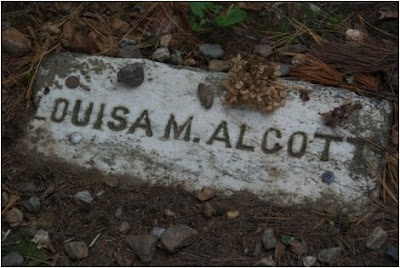
So to all you college professors who teach courses on religion in America—the next time you’re covering the Transcendentalists, don’t just spend the hour situating this or that author within the larger movement of romanticism or placing this or that idea within the larger tradition of liberal Protestantism. Instead, remember your audience. Hell, remember yourself. Reflect upon how this ridiculously quotable, glaringly tiny group of American thinkers became so pervasive in American culture and so interesting or boring but nonetheless known to you and your students. Heaven knows they’ve never heard of old John Winthrop, who, by the way, you can also visit next time you’re in the Boston area at the King’s Chapel Burying Ground.

And to all you folks who plan to visit the site of Thoreau’s shed and remains, watch out for the high school cross country teams at Walden Pond and skateboarders at Sleepy Hollow Cemetery. They’re courteous, but many.

For a few recent books on Transcendentalism and other related matters, see Philip Gura’s American Transcendentalism: A History (Hill and Wang 2008); John Matteson’s Eden’s Outcasts: The Story of Louisa May Alcott and Her Father (W.W. Norton 2007); Dean Grodzins’ American Heretic: Theodore Parker and Transcendentalism (Univ. of North Carolina 2007); Sterling Delano’s Brook Farm: The Dark Side of Utopia (Belknap/Harvard 2004); and David Robinson’s Natural Life: Thoreau’s Worldly Transcendentalism (Cornell 2004). For a 2002 NPR report on Thoreau’s Walden, go to this link.

Selasa, 11 November 2008

Robert Orsi Forum in Historically Speaking

By Randall J. Stephens

The latest issue of Historically Speaking includes a forum on “Abundant History,” which features a lead piece by Robert Orsi and responses from Thomas Kselman, Jane Shaw, Brad S. Gregory, and Constance M. Furey. The forum was made possible by a grant from the John Templeton Foundation. I have posted Orsi’s lead essay and Shaw’s response here.

It’s a provocative subject. Some of you may know that Orsi has been looking at the limits of critical historical method and its epistemological underpinnings. The essays in the forum examine the religious experiences that lay outside “the conceptual range of modernist epistemology and historiography.”

After discussing Marian apparitions, Orsi poses several critical questions:

What words or categories of interpretation are there for phenomena such as these? How do we talk about what happened, first at Lourdes (and at other sites where the transcendent breaks into time and comes face to face with humans in the circumstances of their everyday lives), and then afterward, as the result of what happened at Lourdes, there and at all the other Lourdes? How do we account for the excess?

A few related items: Johns Hopkins University Press will begin publishing HS in January 2009. It's been a pleasure to work with them. That means that HS will now be available on Project Muse. It's good news for us because to date we've had a limited web presence. I’ve moved up from associate editor to editor. And, lastly, I’ve started doing some caricatures. Call that an experiment, failed or successful. William James, which accompanies Shaw’s piece, is one of the first.

Senin, 10 November 2008

A Time to Renewal

Oki Niksokowa ( All my Relatives )


We have just concluded a very destructive period in our history and while a very many of you think that the changes coming will be good and will benefit you history says otherwise.

The election of Barak Obama is certainly one filled with hope and positive motion but the corrupted actions done by those who think win at all costs is appropriate - you cannot create good from bad. Good and Evil do not mix and what was done to the candidates of both parties in an effort to win was driven by a selfish egoistic manic attempt to ascribe the power of positive action to someone other that yourself. The people who did this have given control of their lives to someone else, when you do that there is nothing left of you............

Native American Prophesy Pt. 1


Energy does not flow like that and those of you who are capable of looking deeper than the surface of your mirror know that what I say is true. You have only embedded in your future the path of destruction which has been foretold by many of those same people that you show respect for by being members of this Spiritalk List!


Native American Prophesy Pt. 2


I have learned over the years that one man cannot impact many with the power to change themselves because those people only want to hear what is wrong with someone else - not themselves. Therefor no positive change can happen in your life until you see the need for it and by your very nature you will deny. Cumulative positive change can only come if you all realize and admit your shortcomings and decide to do something about them as a group!

Native American Prophesy Pt. 3


There will be those of you who will say that the reason for this email is that I am ngry because my candidate did not win. I say this to you - while I did vacillate back and forth over who to vote for in the end I could not come to a good conclusion. This was supported by Spirit who told me I am not a party to this government and while I may be forced to pay taxes and the obey the laws, I only do so because I do not have the external support necessary to say NO!

Native American Prophesy Pt. 4


I do not feel I am a part of this undemocratic mayhem that you call your government and in the end I chose not to vote at all! That was my protest..... Not noticed by anyone, except those entities that are most important to me - the Spirits that guide me and my tongue!

Native American Prophesy Pt. 5


However there is still prophesy to deal with and the same prophesy is coming from enough varied sources that there definitely is validity to it and one needs to pay attention.

A Hopi Message to the People

The change that is needed will not come from Obama -

It must come from you....It must come from your bother, sister mother father all working for the survival of the tribe.

I am working on sending more of what I just sent because this is not an easy concept to understand when you have been trained to be a puppet!

My life is almost over, and one could say why do you care so much? I care because I have touched the next 7 generations. I want them to be here to feel that touch in a positive way!

No Obama cannot bring about the change you need! Only you can do this! Peace and healing in brotherhood and sisterhood do we walk!


Waatowa Pistoto,
Two Feathers - Kainaiwa - Blackfoot Nation

Minggu, 09 November 2008

Sugrue's Sweet Land of LIberty: Review and Interview


Paul Harvey

Just a bit more on Thomas Sugrue's Sweet Land of Liberty. Alan Wolfe reviews it in today's New York Times; he finds the history moving but the advocacy unconvincing, concluding:

Imagine how much more might have changed if the Northern civil rights movement had borrowed more of the moral appeal to conscience that inspired civil rights in the South.

Prior to the book's publication, Sugrue was interviewed about his work here. As if in direct response to Wolfe's review, he explains his focus on the structural and the institutional:

Q: So you’re exploring the idea that racial inequality is about institutions and not only personal attitudes?

A: That’s one of the major themes that run through my book. Since the mid-20th Century, Northerners and Americans in general have framed the question of civil rights as a moral question or a psychological question — a question about individual motivations and individual intentions. But the story of the North is a story of the ways in which racial separation and racial privilege are created and replicated through institutions. Ultimately it’s a story of the ways in which the taking for granted of how we organized our workplaces, how we organized where we live, became the foundation for deeper and more pernicious forms of racial inequality.

By explaining away racial inequality as a problem in the hearts and minds of white Americans, we also dodge having to grapple with the larger issues about the ways in which racial inequality is the result of exploitation--the result of asymmetrical power relationships. That fundamentally, as civil rights activists have highlighted, is a political problem which requires pushing the political system to demand a different allocation of power and resources.

Yale Divinity School Job Announcement

YALE DIVINITY SCHOOL seeks to make a tenure track appointment in the field of American religious history, to begin July 1, 2009. In an ecumenical environment Yale Divinity School prepares students for ordained ministry in diverse Christian churches and for a wide range of professional involvements, including higher education, law, medicine, management, and public service. A Ph.D. or its equivalent, strong potential as a teacher will be required. The successful candidate should have expertise in American religious history of the nineteenth and/or twentieth centuries.

A letter of application with curriculum vitae and a list of three references should be submitted by December 15, 2008 to Dean Harold W. Attridge, Yale Divinity School, 409 Prospect Street, New Haven, CT 06511-2167.

Yale University is an Affirmative Action/Equal Opportunity employer. Yale values diversity in its faculty, staff, and students and especially encourages applications from women and underrepresented minorities.