Sabtu, 06 November 2010

Big Church

Randall Stephens

Big, bigger, biggest. Americans dig superlatives. I didn't know that as a kid when the Stephens clan attended the enormous College Church of the Nazarene in Olathe, Kansas. It was and still is one of the defining features of my home town. It looks a little like a massive brick wigwam, or an enormous brick-covered circus tent, or bricked mother ship, with docking stations, resting on the prairie. (When the main sanctuary was built around 1980 I don't think "megachurch" had yet entered the neologism lexicon.)

As a youngster, maybe I assumed that most other people, too, attended churches with 2,000-plus members. Our church had stadium seating and a passion play that brought acres of Jerusalem--hills, shrubbery, buildings, a tomb, the Last Supper tablescape--into our sanctuary. I did visit some Missouri Wesleyan and Nazarene churches out in the sticks that didn't have orchestras, so I suppose I did soon realize that not everyone was blessed with a sprawling church complex.

You could get lost in the basement halls of our church. (I still remember all the smells of that basement when we had to scurry down there in the late 1970s during a tornado. Odors of Play Doh mingling with mold, perfume, and Old Spice.)

I wonder what future generations of historians will have to say about the megachurch. (Surely, sociologists and suburban anthropologists have plenty to say about it now. So did Andrew Sullivan in his Conscience of a Conservative.) What does the megachurch tell us about religion in America in the last 20 years or so? What does the disdain that most critics have for them tell us? If we took a snapshot of American evangelicalism in the 1880s or the 1950s and compared that with the megachurch context of today, what contrasts would come into focus? (Matt Sutton found some roots of the phenomenon in Sister Aimee and Angelus Temple.)

An excerpt of an AJC piece on the ever-present megachurch:

Shelia M. Poole, "Megachurches: Supersizing Faith," Atlanta Journal-Constitution, November 6, 2010.

Rock climbing walls, kids' spaces that resemble small Disneylands, bookstores, state-of-the-art sound systems. It's church -- supersized. In metro Atlanta and elsewhere, the number of megachurches, which have long been defined as having a weekly attendance of 2,000 or more, are still drawing huge numbers of worshippers and receiving millions of dollars in the collection plate. "Megachurches have really succeeded because they service all needs of the community, the spiritual and the social," said Lerone A. Martin, an assistant professor of American religious history at Eden Theological Seminary in St. Louis. . . .

These religious behemoths have received greater attention of late after a flurry of well-publicized litigation against one of the most mega of megachurches, the 25,000-member New Birth Missionary Baptist Church in Lithonia. New Birth is named as a defendant in five lawsuits, four of which allege that its prominent pastor, Bishop Eddie L. Long, coerced four young men into having sex.
>>>

Jumat, 05 November 2010

Heidelberg Center for American Studies Spring Academy

Paul Harvey

I've been asked by Hilde, our Senior Norwegian Correspondent, to forward along information on this unique opportunity for finishing graduate students, to present their work with fellow American and European colleagues in Heidelberg. Hilde writes: "I attended the Spring Academy last year, and it was a wonderful experience! It's a great mix of students from Europe and the USA, covers many disciplines, and has a supportive and safe atmosphere to present your material." Hilde, any chance the Oslo Soul Children will be a warm-up act at the conference?

More information below:
__________________________________________________
HCA Spring Academy:

American History, Culture & Politics

Gruppenbild WebHCA Spring Academy on American History, Culture & Politics is an annual, one-week interdisciplinary conference for Ph.D. candidates working in different fields of American studies.

Every year twenty outstanding Ph.D. students from European and American universities come to Heidelberg to present their dissertation projects. All presentations are thematically arranged into ten panels. Participants are requested to prepare a twenty-minute presentation of their research projects which is followed by a forty-minute discussion session. Four experts are invited for afternoon workshops that elaborate on topics discussed during the conference.

Uni1Possible topics for discussion are American literature and culture, U.S. history, domestic and foreign policy, as well as the economy and aspects of jurisprudence. Race, class, and gender are frequently employed analytical categories. This diversity of disciplines and approaches enables students from different academic backgrounds to become part of a unique international intellectual network which has been successfully established and broadened by the HCA in the last six years.

God's Almost Chosen Peoples

Paul Harvey

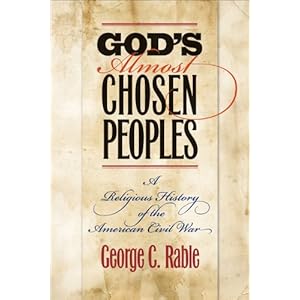
Some of you blog readers are probably hanging at the Southern Historical Association meeting today and through the weekend in Charlotte; sorry I'm not there with you, afraid that the AAR maxed out my personal travel/alcohol budget. In the meantime, though, hope you'll drop by the University of North Carolina Press booth and check out George Rable's very promising looking new book, God's Almost Chosen Peoples: A Religious History of the American Civil War. Skip Stout and others have given the lengthy work a hearty endorsement on the book jacket, and I hope to get to it over Christmas break when 600 pp. books seem a little less daunting. Information on the book below, from the UNC Press website.

God's Almost Chosen Peoples

A Religious History of the American Civil War

By George C. Rable


Throughout the Civil War, soldiers and civilians on both sides of the conflict saw the hand of God in the terrible events of the day, but the standard narratives of the period pay scant attention to religion. Now, in God's Almost Chosen Peoples, Lincoln Prize-winning historian George C. Rable offers a groundbreaking account of how Americans of all political and religious persuasions used faith to interpret the course of the war.

Examining a wide range of published and unpublished documents--including sermons, official statements from various churches, denominational papers and periodicals, and letters, diaries, and newspaper articles--Rable illuminates the broad role of religion during the Civil War, giving attention to often-neglected groups such as Mormons, Catholics, blacks, and people from the Trans-Mississippi region. The book underscores religion's presence in the everyday lives of Americans north and south struggling to understand the meaning of the conflict, from the tragedy of individual death to victory and defeat in battle and even the ultimate outcome of the war. Rable shows that themes of providence, sin, and judgment pervaded both public and private writings about the conflict. Perhaps most important, this volume--the only comprehensive religious history of the war--highlights the resilience of religious faith in the face of political and military storms the likes of which Americans had never before endured.

Kamis, 04 November 2010

What to Do With God in America

Paul Harvey

While we're in catch-up blogging mode, I meant to link to this piece earlier, "What to Do with God in America," over at A Lively Experiment, David McConeghy's blog. McConeghy summarizes and provides links to various of the summaries/reviews/academic critiques of the PBS series, and then proposes an elaborate classroom exercise over a period of week in which students would examine the narrative of the film on their own, and get involved in making a proposed film of their own.

With all the discussion about PBS’ God in America series, it occurred to me that it might be possible to use the series as the basis for a course that privileges deconstruction of the (maligned) narrative that PBS built and therefore employ remixes as a way for students to create counter-narratives that explicitly engage the primary source. Perhaps the documentary would provide a shortcut allowing us to manage both content and technical mastery.

We had some discussion here earlier about the pros/cons of blogging, especially for younger scholars and graduate students. This kind of post certainly fits in the "pro" category, as it provides the kind of reflection on teaching and innovative proposal on classroom work that should be impressive to any search committee.

Religion in the American West Seminar

Paul Harvey

Sorry for being an absentee blogger as of late, hope to catch up this weekend with posts about the AAR. To start with, though, Tisa Wenger has provided an excellent summary/analysis of the Religion in the American West seminar panel; click here for it. The discussion there concerned the following presentations:

1. Travis Ross, “California Imagined: The Pacific Expositor and the Religious Imagination”
2. Jonathan Olson, “Not Merely Asiatic but Pagan: Religion, Chinese Exclusion, and the American West”
3. Barry Alan Joyce, “Creating an Axis Mundi in the American Southwest: Religion, Science, and the Sacred at Chaco Culture National Historic Park”
4. Brett Hendrickson, “Mexican-American Religious Healing and the American Spiritual Marketplace”

More post-AAR reflections will be coming up soon.

Rabu, 03 November 2010

Florida State University Graduate Symposium


Coming off the 2010 Annual American Academy of Religion meeting, I thought it was especially relevant to blog about the Florida State University Graduate Symposium hosted each year by FSU's religion graduate students. The call for papers has been up on h-net for about a month now, but I particularly wanted to draw the attention of my fellow Americanists.

The Florida State University Department of Religion is pleased to announce its 10th Annual Graduate Student Symposium to be held February 18-20, 2011 in Tallahassee, Florida. This year’s symposium will be centered on the theme “Discourses of Ritual and Power.”

Dr. Matthew Kapstein, of the University of Chicago and Directeur d'études of the Ecole Pratique des Hautes Etudes, Paris, will deliver this year’s keynote address. His lecture is tentatively titled “Spiritual Exercises in Indian Buddhist Philosophy: The Thought of Pierre Hadot in a Comparative Perspective.” Also, we are pleased to once again host Dr. Kathryn Lofton of Yale University as a guest respondent.

Presentations should be approximately 15 to 20 minutes in length and will receive faculty responses. Those proposing papers in the sub-field of American Religious History can look forward to Dr. Lofton, Dr. John Corrigan, Dr. Amanda Porterfield, and Dr. Amy Koehlinger offering thoughtful responses. In addition, every year respondents select the best graduate paper to receive the Leo F. Sandon Award, an endowed award named for the Religion Department's former chair.

Every year, this conference is a big success. There is no registration fee, and food and drink is provided throughout the weekend.

Proposals including an abstract of approximately 300 words, a list of key terms, and a one-page CV should be submitted by December 1, 2010 for review. Final papers must be submitted by January 15, 2011. Please send proposals to fsureligionsymposium@gmail.com

Selasa, 02 November 2010

Religion and the Liberal Public Realm

Randall Stephens

Over at the NYT's Opinionator blog Stanley Fish weighs in on "Religion and the Liberal State Once Again." An excerpt:

The question is what does the liberal state do with those religious believers [fundamentalists and the range of exclusivists]— the popular answer in the comments is “tell them to go back where they came from” — and my contention, and the only one I make (in agreement with John Milbank), is that the liberal state is incapable of doing anything with them except regard them, as many of the posters do, as fanatical, medieval, crazy, dictatorial and downright dangerous. As I point out, liberalism’s inability to regard strong religious claims — claims that spill out into public life — as anything but a mistake and a transgression is not something liberalism can correct or get beyond; it is the inevitable (and blameless) reflection of what liberalism is and must be if it is to sustain its particular, not to say peculiar, brand of universalism, a universalism that operates by reducing persons to formal entities, all of which are, in the essential political respect, exactly the same. (It’s universalism writ small.)

Fighting words, in some quarters. It will be interesting to read the blazing comments on the NYT and elsewhere. Mostly elsewhere.