Sabtu, 09 Oktober 2010

What Does the Vision Quest Mean to Me?

Oki Niksokowa,

When I was asked to give my interpretation of what a Vision Quest meant to me I was floored. What could I write that has not already been written and by more talented authors than myself? I would love to be original in what I write but today how original can one be? So I don't know what to say but I do have some unique and from what I have read around the earth as yet unsaid ideas about what a vision quest is.

To most a Vision Quest means long preparation, getting in the 'Zone', becoming one with Creator and prepare for a long journey into the mountains with nothing but a blanket and a pipe! Becoming prepared to go without food and water for up to four days or more depending upon the traditions of your people. You begin to realize that you and your people have strayed so far afield that you have no more traditions to follow! Then the panic begins: What have we lost, where have my people even gone, who can I depend upon for instructions, support, guidance and strength? We look high and low in the library, on the internet even in the faces that we pass on the street. "Oh great Creator what has happened to us, I am frightened and I do not believe I will be able to go on this Quest that you have clearly put in my mind to accomplish before I pass on to the waiting Sand Hills beyond the beyond!" "What will become of me? How will I be perceived and who will do the perceiving?" Then it is that we realize that we have no one qualified to perceive us in a teaching way. There is no one there to provide that much needed guidance that true Human Beings need to become beyond themselves. Why do I feel so alone and useless? What can I pass on to life that comes after me? Are we as a species truly lost and waiting for the annihilation to begin?

Then I hear my father "Two Feathers" come through to me in my spirit and say all problems can be solved – there is no question without an answer. It is up to you my son to hear and believe the answer no matter how discordant it may sound. You know many things and yet you know nothing and that is why you allow me and your grandfather Fools Crow to come and guide you. At 64 you know you are too unhealthy to go out into the mountains and sit alone! You will surely die from such an experience and yet you need to connect to the High Spirits now for guidance in the things you are yet unsure of. Time to change, Two Feathers and become a man once more. Time to realize that there are many ways to solve a problem and a Vision Quest is no different. Realize too that in the instructions we give you will remove the barriers of the Holy Mountains and distance. They are where you are. You can take the stresses of no food and water into your spirit and manufacture them at will with your mind. Remember all these practices are a way for you to separate yourself from this society you have been subjected to so that you can truly SEE reality. You can train yourself to reach a state of separation at will so that you will hear voices in other tongues, and the cries of the helpless in other lands, and the voice of the Eagle as he becomes one with you! You will hear the questions and the answers at the same time; you will know the coming of the future, and the pain in the hearts of those that seem to have no pain or disharmony. You will also know the solution to those cries of anguish that the people feel for the Earth and the grandfather Sun and the continued fear injected into them by a society that is as afraid as your brothers and sisters. You can be that place of guidance, solace, understanding and love – all you need to do is do it!

No, you do not necessarily need to Vision to find the answers to your life. You just need to "Show Up, and be Present" If you can prepare physically and mentally to go out on that Mountain and if you have the proper support mechanisms in place to assure your safety, then do so, but do not let obstacles get in your way. Always remember you have a WAY………………..


TO WALK THE RED ROAD

Long road winding

began in the stars

spilled to the mountain tops

carried in the snow

to the streams

to the rivers

to the ocean

it covers Canada

Alaska

America

Mexico

to Guatemala

and keeps winding

around the indigenous


The Red Road

is a circle

of People standing

hand in hand

People in this world

People between

People in the Spirit world

Star People

Animal People

Stone People

River People

Tree People

The Sacred Hoop


To walk the Red Road

is to know sacrifice

suffering

It is to understand Humility

It is the ability

to stand naked before God

in all things

for your wrong doings

for your lack of strength

for your discompasionate way

for your arrogance

because to walk the Red Road

you always know

you can do better.

And you know

when you do good things

it is through Creator

and you are grateful.


To walk the Red Road

is to know

you stand on equal ground

with all living things

It is to know that

because you were born human

gives you superiority over nothing.

It is to know that

every creation carries a spirit

and the river knows more than you do

the mountains know more than you do

The stone people know more than you do

the trees know more than you do

The wind is wiser than you are

animal people carry wisdom

And

You can learn from every one of them

because they have something

you don't

They are void of evil thoughts.

They wish vengeance on no one

they seek Justice.


To Walk the Red Road

you have God given rights

you have the right to pray

you have the right to dance

you have the right to think

you have the right to protect

you have the right to know Mother

you have the right to dream

you have the right to vision

you have the right to teach

you have the right to learn

you have a right to grieve

you have a right to happiness

you have the right

to fix the wrongs

you have the right to truth

you have a right to the Spirit World.


To Walk the Red Road

is to know your Ancestors

to call to them for assistance

It is to know that there is good medicine

and there is bad medicine

It is to know that Evil exists

but is cowardly as it is often in disguise.

It is to know there are evil spirits

who are in constant watch

for a way

to gain strength

for themselves

at the expense

of you.


To Walk the Red Road

you have less fear at being wrong

because you know

that life is a journey

a continuous circle

a sacred hoop

mistakes will be made

and

mistakes can be corrected

if you will

be humble

for if you cannot be humble

you will never know

when you have made a mistake.

If you walk the Red Road

you know that every sorrow

leads to a better understanding

every horror cannot be explained

but can offer growth.


To Walk the Red Road

is to look for beauty

in all things.


To Walk the Red Road

is to know

you will one day

cross to the Spirit World

and you will be

not afraid


Copyright Bloodpoet/2001


May your Walk on the Red Road

be one of courage

for it takes a strong person

to learn and grow in The Creator

A person of Bravery

will seek Justice for all living things

with a steady ~ compassionate hand


May you never be afraid

to speak your truth

and may you

'sing your death song

like a Warrior going home'

as you

'are recognized in the Spirit World'


Hau

Jumat, 08 Oktober 2010

Mormonism and Historical Thought at the CFH

Randall Stephens

I just attended a wonderful session at the 2010 Conference on Faith and History here at George Fox University, south of Portland, OR. This year's program contains a wide range of panels and plenary sessions. See it here. A number of younger scholars are taking part, asking questions about the intersection of faith and history and looking into how religious groups have grappled with the past.

The morning's session, titled "Things True or Useful: Mormon Ways of Writing History," dealt with the contested meaning of history, the sacred, and scholarship within the Mormon world. The papers included:

“History Thrown Into Divinity: Faith, History, and the Founding Events of
Mormonism” Matthew Bowman, Georgetown University

“Finding Connections between Faith and History: A Journey of Discovery” Rachel Cope, Brigham Young University

"‘The Sacred and the Profane’: Shipps, Eliade, and Mormon History” Ryan Tobler, University of Chicago

Susanna Morrill, Lewis and Clark College, drew the three together in her concluding remarks.

I found it striking that evangelicals share many of the burdens of self understanding and historical thinking (or unthinking) with Mormons. The panelists pointed to a statement, well known among Mormon scholars, made by a church official: “Some things that are true are not very useful.” History--critical, influenced by enlightenment rationalism--might "not be very useful." Matthew Bowman explained some of the nuances of that infamous remark. It first hit me as a somewhat typical, anti-intellectual statement. . . the sort you would hear among fundamentalist with reference to human origins science (thinking Kurt Wise here.)

The panelists also dealt with the somewhat tortured relationships believers and the church have had with the field of history. Questions about bracketing exercised the audience in the Q&A. (I wondered if historians and religious studies scholars have different senses of "empathy.") I always find these conversations helpful. They mark out the boundaries of history and role faith communities play in working out their collective memory.

I look forward to seeing the future work of each of these early-career scholars.

Now, if I can just find time to make it to Powell's Books. I can get there quickly enough. Budget Rental gave me a free upgrade to a new Mustang. Makes my own car seem like a mo-ped.

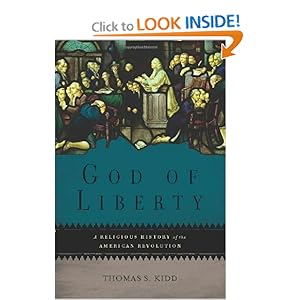
God of Liberty: BookTV

To follow up on Paul Harvey's earlier post about Thomas Kidd's God of Liberty: A Religious History of the American Revolution, this weekend BookTV is airing a lecture Kidd delivered recently at Indiana Wesleyan University. (Incidentally, as Paul also posted, Indiana Wesleyan is hosting a conference organized by religion scholar Rusty Hawkins, Divided by Faith: A Decade Retrospective, next week.)

Find additional information and show times of Kidd's lecture here.

God in America: Pre-Premiere Reviews and NPR Forum Network

Paul Harvey

A couple of nice reviews of the PBS series God in America to be shown next week, Oct. 11 - 13: this one, from Variety, and this one, from the Boston Phoenix. I'll have more to say on the show both here and at Religion Dispatches, by early next week.

In the meantime, here's a press release from WGBH (where the show originated) on a series of lectures and other events associated with the show:

October 5th, 2010

Press Contact:
Stacy Buchanan617.300.2458

Boston, MA – The PBS|NPR Forum Network has recently added a new series of curated
talks around the upcoming PBS broadcast God In America.

Examine the complex interactions between religion and democracy though the
God In America series, which contains over 100 lectures and talks by the world's biggest
religious experts, scholars, philosophers, and journalists, and features some of the
largest religious debates in the United States.

Journalists and scholars explore the changing landscape of American faith. Other
talks to discover include: Rutgers University political science professor W. Carey
McWilliams discusses the future of Catholicism in America. Stephen Goldsmith, former
special advisor for President Bush, talks about the role of religion in American cities, and
history's greatest minds wrestle with reconciling science and religion.

These are just a few of the many talks that can be found in the God In America
series, all free and respected resources to help the American population better
understand the history, diversity, and freedom behind religion in the United States. You
can join the conversation at: http://forum-network.org/series/god-america-series. The
Forum Network lecture series God In America has been created as a compliment to the
upcoming PBS broadcast, God In America.

God In America, a presentation of AMERICAN EXPERIENCE and FRONTLINE,
will explore the historical role of religion in the public life of the United States. The six-
hour series, which interweaves documentary footage, historical dramatization and
interviews with religious historians, will air over three consecutive nights on PBS
beginning Monday, October 11th. Please check with your local PBS station for times.

Kamis, 07 Oktober 2010

Governing Across the Divide

by Blake Barton Renfro

Sam Lloyd, Dean of Washington National Cathedral, has worked tirelessly during his tenure to make the Cathedral a voice of reason in a city of power. Lloyd is particularly concerned with exploring the intersection of faith and public life. In the fall of 2007, the Cathedral began a lecture series called “The Sunday Forum,” which convenes each week before the 11:00AM service. Writers, academics, journalists, politicians, and other public figures are invited to discuss topics that engage religion and civic life. Even in the midst of dramatic budget cuts, the Cathedral continues to sponsor a number of special programs which deal with American politics and religion. It would be easy to suggest that we live in overwhelmingly divisive times, where religious communities are in constant disagreement with the political establishment. However, those of us familiar with American history know that there has never been an era of religious and political utopia. The Cathedral’s public events are one venue devoted to intelligent conversation about the role of religion in American life.

Tuesday evening (5 October) the Cathedral sponsored a program entitled “Governing Across the Divide.” Sponsored by the Ignatius family, the event featured President Obama’s chief advisor David Axelrod and Joshua Bolton, chief of staff to former President George W. Bush. Moderated by Bob Schieffer, Bolton and Axelrod discussed, in Sam Lloyd’s words, “how civility and cooperation might return to the discourse.” Political insiders say that Washington is currently experiencing one of the worst periods of gridlock. Schieffer recalled how a recent guest on Face the Nation requested a separate waiting room, simply because he didn’t want to sit in the same room with a political opponent. This is just one example of the decidedly childish behavior among some political elites.

While time constraints limited a more in-depth discussion, both Axelrod and Bolton concluded that the media fuels political incivility. Both men expressed deep discontent over the media’s obsessive frenzy over attracting viewers. Joshua Bolton argued that political differences are wildly exaggerated by differing media outlets. “Governing Across the Divide” certainly didn’t provide any practical solutions to our political climate. Still, it confirmed my suspicion that some citizens are seeking a more intelligent answer to our political dialogue. The program is available on-demand.

Rabu, 06 Oktober 2010

Glenn Beck, Methodism, and "Black Founders"

by Christopher Jones

Glenn Beck initially drew my interest because of his Mormonism—I sensed in Beck’s conspiratorial approach to politics something reminiscent of an earlier generation of Mormon public figures. The pervading fear of socialist subversion, combined with the particularly Mormon interpretations and understandings of human agency, the methods and aims of satanic opposition, and the divinely-inspired nature of America’s Founding documents, were reminders both that the influence of Cleon Skousen and Ezra Taft Benson’s religio-political views still loomed large among a certain segment of the Mormon population and that in them lay a narrative that had the power to appeal to not only conservative Mormons but other embittered Americans as well, suspicious of the government and intent on rescuing the nation from secularism and immorality (and make no mistake,
perceived secularism and immorality are as central to Beck’s movement as is some vague libertarian notion of fiscal responsibility). These topics have been discussed, analyzed, and reanalyzed at least a hundred times over by now (though some commentators rehash them anew and claim such discoveries for their own, all while butchering the identities of key people and ideas in Mormon history), and to be honest, I’ve grown weary of thinking about Beck, his Mormonism, and his agenda in general. In fact, I’d sworn off posting anything more on Beck here or at the Juvenile Instructor.

But one of Beck’s more recent forays into early American history has forced me to reconsider. It touched a nerve not because of Beck’s subtle invocation of Mormon themes, but rather because they addressed the subject of my current research—early American Methodism. Sandwiched in between Beck’s recent assertion that race relations in America were (with the exception of some unidentified “racists”) fairly harmonious before the years immediately preceding the Civil War and that provisions for Revolutionary War soldiers and veterans operated on a sort of colorblind basis is an intriguing discussion of what Beck oddly refers to as “the first real megachurch … a white and black megachurch.” The "megachurch" in question (which goes unidentified) is St. George's Methodist Episcopal Church in Philadelphia and the central figure is Richard Allen, eventual founder of the AME Church.

“Richard Allen,” Beck explains, “was a preacher at a white church—a megachurch. … And Richard Allen, this megapreacher, he tried to segregate.” Beck’s go-to guy for all matter historical, David Barton, chimes in, noting that “In the 1790s [Allen] proposed having a black denomination. And both whites and blacks said, ‘we don’t want that. We want the integrated stuff. We don’t want separate denominations.’ There was finally an overt act of racism in one church that kind of gave him the impetus to go ahead and start a black denomination. But for years, neither blacks nor whites wanted a separate denomination ‘cause they worshipped together in those churches, in Philadelphia and elsewhere.”

Rather than focusing on each of the several problematic points raised (the insightful scholarship of Albert Raboteau, Dee Andrews, and Richard Newman is recommended for those interested), I’d like to ruminate on the meanings and implications of two particular points.

First, I was struck by Beck and Barton omitting entirely any mention of Methodism. Richard Allen is simply “a black preacher” and St. George’s is simply a generic “megachurch.” Considering that Methodist theology and worship were so central to Allen’s identity as a Christian (and as a black man), and that his "black denomination" remained within Methodist Episcopal tradition, this seems as especially odd omission. This not only simplifies and distorts the history of St. George’s (and Methodism more generally) by ignoring the complex dynamics of early American religion, but also serves as a useful means of locating this supposed bastion of interracial harmony within the tradition so many of Beck’s listeners and viewers claim as there own today—conservative evangelical Christianity. This rhetorical maneuver, then, allows these conservatives to co-opt the legacy of interracial evangelicalism in early America (in much the same way that Beck has co-opted the legacy of Martin Luther King, Jr. and the Civil Rights Movement of the twentieth century).

Second, this conversation between Beck and Barton took place during a recurring segment of Beck’s show called “Founder’s Friday.” This particular episode was devoted to “Black Heroes in American History,” and was part of Beck’s stated effort to “spend more time learning about our black founders, and restoring this part of history” (a worthwhile effort, no doubt—at least theoretically). I was immediately reminded of Richard Newman’s biography of Richard Allen, Freedom’s Prophet, in which Newman sought to place Allen squarely within the tradition of America’s Founding Fathers. Echoing others, Newman reinforced the notion that Allen was a black founder, but moved beyond previous assessment by declaring that Allen was deserving of such a title not only because he founded black institutions but also because he “was essentially the forerunner of modern civil rights activists” and because “his belief in nonviolent but confrontational reform offered lessons for virtually every black leader who followed in his wake” (p. 4). As Alan Taylor summarized in his review of the book, “Allen was a Founder for all Americans. He emphasized a prophetic vision of America as a multi-racial democracy of equal rights and equal opportunity. His egalitarian vision was far more daring than anything considered by the more famous white Founders.”

In Beck’s vision of “black founders,” however, Richard Allen in cast as a foil to the interracial harmony he earlier enjoyed as a “mega-preacher” to “2,000 whites” by promoting “segregation.” Tellingly, then, what Beck sees as antithetical to his imagined ideal of American society, Newman see as admirable and daring. The implication of Beck’s narrative—that this “black preacher” and the black church he pioneered, are mere distractions to the real story of this Christian nation—serves as an interesting contrast to those who “seek a sense of authenticity” in black institutions and raises important questions about the place of the black church in the conservative white mind today.

Surveying Religious Knowledge: The Founding Fathers, and the Pew Poll

Paul Harvey

For anyone interested, an announcement from History News Network:

Join Thomas Kidd, author of
God of Liberty: A Religious History of the American Revolution for a live Q&A on HNN's Ning Network at 3 p.m. Eastern on Wednesday, October 13.

Kidd's take on the poll of Americans' religious knowledge, which Chris Jones blogged about here a few days ago, may be found at "
The Founding Fathers Would be Shocked at Our Religious Ignorance." He makes the point that the relatively high degree of religious knowledge evinced by skeptics, noted by the recent pollsters, is not new.

Over at Immanent Frame, a variety of other scholars offer their views on, and take a number of shots, at, the Pew Poll:
Surveying Religious Knowledge. In her contribution, Kathryn Lofton asks, if a person is polled about rock and roll history and is unable to identify Big Mama Thornton, does this make them ignorant of rock and roll history? She continues:

For now, I can only observe that a survey which pits religious groups against one another in a Quiz Bowl, and which imagines that praying Protestants ought to know the authority of Martin Luther, tell me very little about religious knowledge, and tell me even less about what the humanities do to serve such a surveyed public. It may be that we live in a budgetary time that begs for base descriptions of our basic (un)knowing. I would only warn that the minute we believe the answers we offer begin with multiple choice questions is the same minute when we cede our complexity to that formation of ignorance.